

KP-002 · Crop-Specific Guides
Transforming Wheat Production through the Paedar Qudratti Nizam Kashatqari (PQNK)
Conventional wheat farming is locked into a cycle of high input costs and stagnant yields around 30 maunds per acre. This paper lays out the PQNK cost and revenue model for wheat, comparing it head-to-head against the conventional system and projecting the foreign exchange impact of national-scale adoption.
Read or listen to the full paper ↓Abstract
Conventional wheat farming is trapped in a cycle of high costs and diminishing returns: repeated tillage, synthetic fertilizer (DAP and Urea), weedicides, and frequent flood irrigation push operational costs per acre while yields plateau around 30 maunds per acre, a ceiling that has not kept pace with rising input prices. The result is chemical burden on the soil, long-term fertility loss, and a commodity-market price that keeps farmer incomes low and vulnerable to shocks outside their control.
PQNK applies its regenerative lens to wheat as a precise, knowledge-based system rather than a substitution of one input for another. Zero-tillage direct seeding replaces three to four tillage passes; precision seeding replaces the dense 60 kg per acre conventional rate, starting at 8 kg per acre in the first crop and falling below 5 kg per acre on a mature farm; and soil biology is left to provide nitrogen and solubilize phosphorus and other nutrients from the soil's own mineral reserves, eliminating the need for DAP and Urea altogether. Residue mulch suppresses weeds without chemical weedicides and cuts irrigation from four or five flood irrigations down to a maximum of two furrow irrigations.
The paper walks through a full per-acre cost and revenue comparison. Conventional production costs roughly PKR 39,000 per acre against a PQNK cost of about PKR 5,000, an 87% reduction. At a conservative PQNK yield of 45 maunds per acre sold into a premium organic market (PKR 7,500/maund versus PKR 3,500/maund for conventional grain), net profit rises from PKR 66,000 to PKR 332,500 per acre, an increase of more than 400%.
Scaling this to national policy, the paper models converting 20% of Pakistan's roughly 9 million hectares of wheat area to PQNK. At a PQNK yield of 4.0 tonnes per hectare and assuming 80% of that production is exported at a conservative $650 per tonne for 'Organic Plus' wheat, the resulting foreign exchange earnings approach US $3.75 billion, a figure the paper argues could rival or surpass forex earnings from established commodity export sectors. A 50% adoption scenario is also sketched, covering farmer prosperity, water savings, soil regeneration, and food security.
The paper closes with a four-pillar national proposal: knowledge transfer through master trainers and showcase farms, market linkage and a 'PQNK Organic Plus' export brand, policy support for the transition (including access to PQNK machinery), and a dedicated research and production-management entity to hit export targets.
Revision R1 (27 September 2026): the wheat seed-rate and spacing figures have been updated to those locked in the PQNK book (Chapter 29): 5 rows on the 42-inch bed at 8-inch seed-to-seed spacing, about 62,000 hills per acre with 2 seeds per hill (about 124,000 seeds), 8 kg per acre for the first crop, reduced toward under 5 kg per acre on a mature, precisely planted farm, with 4.24 kg per acre consumed in the NARC/PNARD trial (2021-22), within that mature range. The PDF opens with a revision note to the same effect; the original text follows unchanged.
Full Paper
If you use “Listen”, the text of the page may be sent to your browser or operating system’s speech provider, such as Apple, Google or Microsoft, depending on the voice your device uses. Pedaver does not process, transmit or store any audio.
Knowledge Paper KP-002 - Revision R1, 27 September 2026 (NARC figure updated 28 September 2026)
The wheat seed-rate and spacing figures in this paper have been superseded by the figures locked in the PQNK book, Chapter 29 (SIPP and Precision Planting).
Wheat is sown in 5 rows on the 42-inch bed at 8-inch seed-to-seed spacing: about 62,000 hills per acre, with 2 seeds per hill (about 124,000 seeds per acre). The recommended seed rate is 8 kg per acre for the first crop, reduced season by season toward the calculated rate of under 5 kg per acre on a mature, precisely planted farm. The NARC/PNARD trial (2021-22) consumed 4.24 kg per acre at about 80 percent planter precision, within that mature range. Seed size runs from about 10,000 seeds per kg in long, cool grain-filling regions to about 28,000 seeds per kg in Punjab, so always calibrate with the actual seed lot.
Where this paper gives a precision seed rate of 10 kg per acre (including in its seed-rate and cost tables), use the figures above; the lower first-crop and mature rates only reduce the seed cost shown.
The original paper follows unchanged.
Knowledge Paper: Transforming Wheat Production through the Paedar Qudratti Nizam Kashatqari (PQNK)
Title: The PQNK Pathway to Doubling Farmers' Income and Dominating the Organic Wheat Export Market
1. Preamble: The PQNK Lens
The Paedar Qudratti Nizam Kashatqari (PQNK) is not merely a set of agricultural practices; it is a paradigm shift. It is a philosophy that views the farm as a self-regenerating, pristine ecosystem. The PQNK lens moves us away from the extractive and input-intensive model of agriculture, which has depleted soils, depleted water tables, and depleted farmer prosperity. Instead, PQNK works in harmony with nature's intelligence, fostering soil biology to unlock unparalleled productivity, sustainability, and profitability. This paper applies the PQNK lens to wheat production, revealing a pathway to national prosperity.
2. The Problem: The Unsustainable Conventional Wheat Cycle
Conventional wheat farming is trapped in a cycle of high costs and diminishing returns.
• High Input Costs: Farmers are burdened by the costs of repeated tillage, synthetic fertilizers (DAP, Urea), weedicides, and frequent irrigation.
• Stagnant Yields: The average yield often plateaus around 30 maunds per acre, unable to compensate for rising input costs.
• Soil Degradation: Chemical fertilizers and tillage destroy soil organic matter and beneficial microbial life, leading to long-term fertility loss.
• Low Profit Margins: The combination of high costs and a commodity-market price keeps farmer incomes low and vulnerable.
3. The PQNK Solution: A Symphony of Regenerative Practices
PQNK for wheat is a precise, knowledge-based system that dramatically reduces external inputs while boosting yield and quality.
4. The Economic Transformation: A Comparative Analysis (Per Acre)
Let us translate these practices into a clear financial picture for one acre of wheat. Assumptions:
• Conventional Yield: 30 Maunds/Acre
• PQNK Yield: 45 Maunds/Acre
• Conventional Wheat Price: PKR 3,500 /maund (Approx. Govt. Support Price)
• PQNK Wheat Price: PKR 7,500 /maund (Conservative Intl. Organic Price)
Cost of Production (Per Acre Estimate)
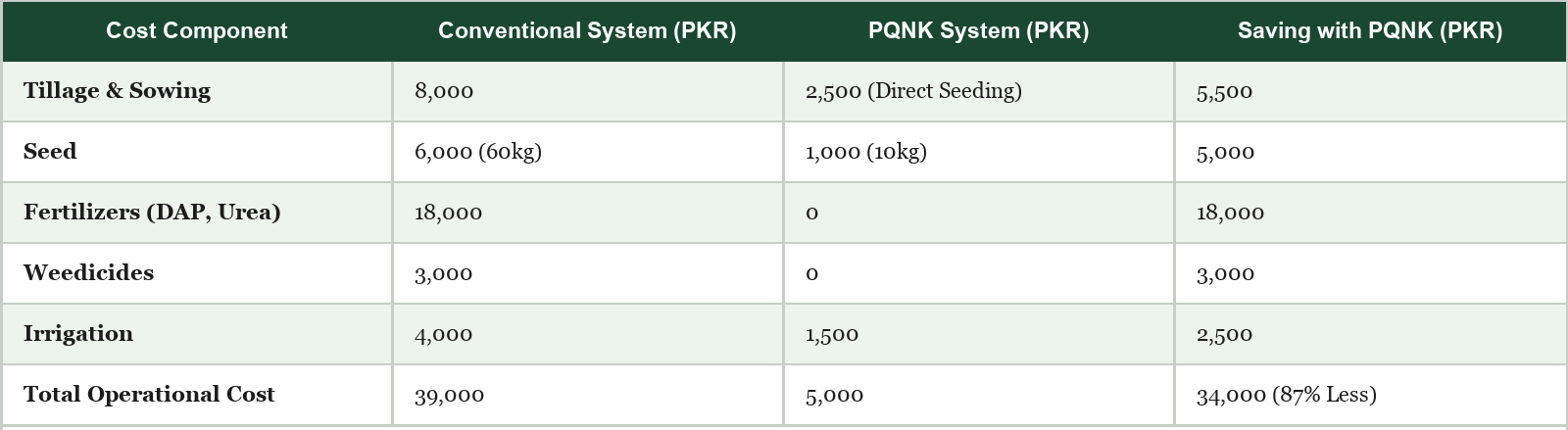
| Cost Component | Conventional System (PKR) | PQNK System (PKR) | Saving with PQNK (PKR) |
|---|---|---|---|
| Tillage & Sowing | 8,000 | 2,500 (Direct Seeding) | 5,500 |
| Seed | 6,000 (60kg) | 1,000 (10kg) | 5,000 |
| Fertilizers (DAP, Urea) | 18,000 | 0 | 18,000 |
| Weedicides | 3,000 | 0 | 3,000 |
| Irrigation | 4,000 | 1,500 | 2,500 |
| Total Operational Cost | 39,000 | 5,000 | 34,000 (87% Less) |
Revenue & Profit (Per Acre)
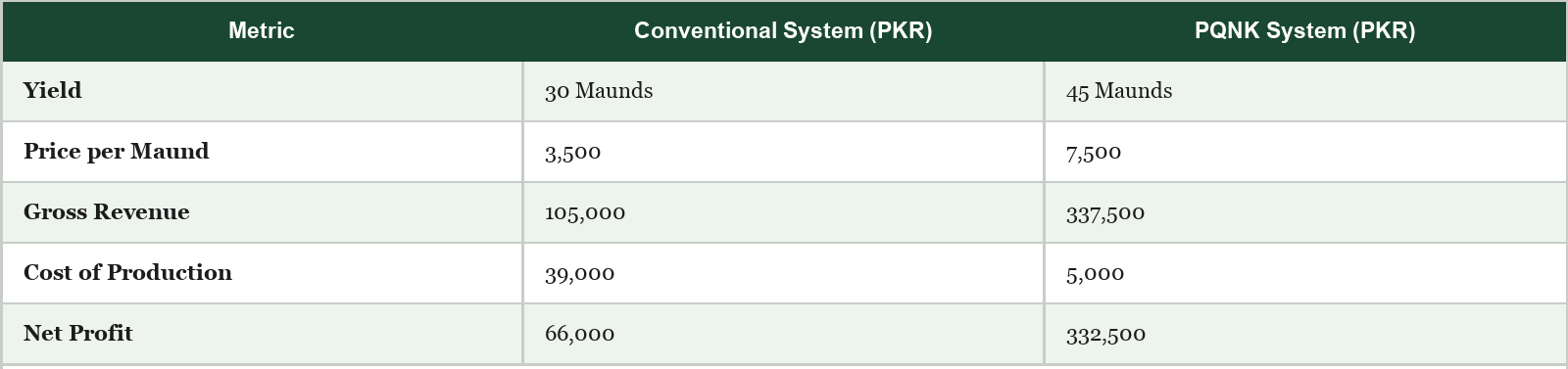
| Metric | Conventional System (PKR) | PQNK System (PKR) |
|---|---|---|
| Yield | 30 Maunds | 45 Maunds |
| Price per Maund | 3,500 | 7,500 |
| Gross Revenue | 105,000 | 337,500 |
| Cost of Production | 39,000 | 5,000 |
| Net Profit | 66,000 | 332,500 |
Comparison between Conventional and PQNK
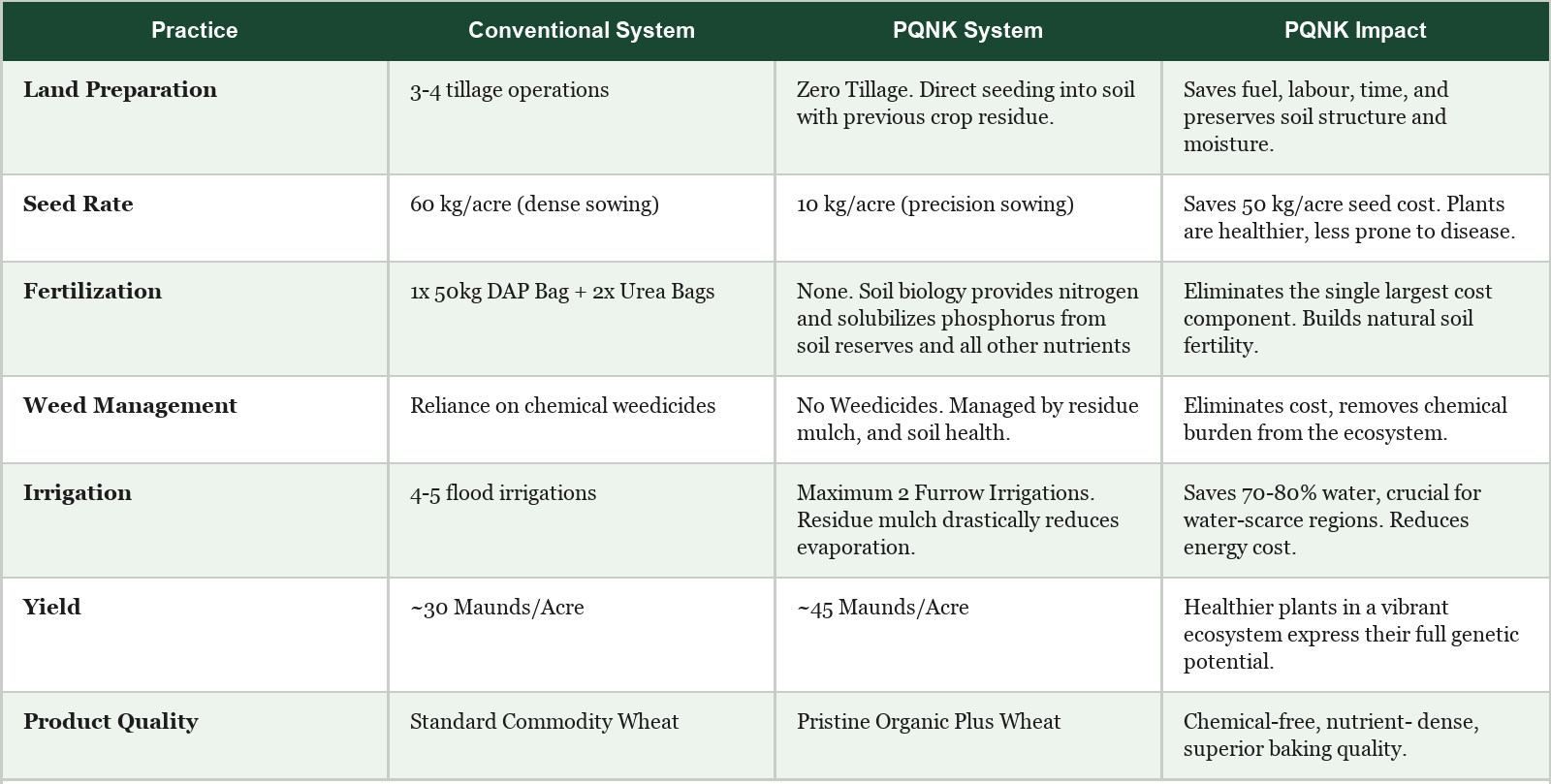
| Practice | Conventional System | PQNK System | PQNK Impact |
|---|---|---|---|
| Land Preparation | 3-4 tillage operations | Zero Tillage. Direct seeding into soil with previous crop residue. | Saves fuel, labour, time, and preserves soil structure and moisture. |
| Seed Rate | 60 kg/acre (dense sowing) | 10 kg/acre (precision sowing) | Saves 50 kg/acre seed cost. Plants are healthier, less prone to disease. |
| Fertilization | 1x 50kg DAP Bag + 2x Urea Bags | None. Soil biology provides nitrogen and solubilizes phosphorus from soil reserves and all other nutrients | Eliminates the single largest cost component. Builds natural soil fertility. |
| Weed Management | Reliance on chemical weedicides | No Weedicides. Managed by residue mulch, and soil health. | Eliminates cost, removes chemical burden from the ecosystem. |
| Irrigation | 4-5 flood irrigations | Maximum 2 Furrow Irrigations. Residue mulch drastically reduces evaporation. | Saves 70-80% water, crucial for water-scarce regions. Reduces energy cost. |
| Yield | ~30 Maunds/Acre | ~45 Maunds/Acre | Healthier plants in a vibrant ecosystem express their full genetic potential. |
| Product Quality | Standard Commodity Wheat | Pristine Organic Plus Wheat | Chemical-free, nutrient- dense, superior baking quality. |
4A. The Foreign Exchange Opportunity: A 20% Conversion Scenario
To understand the immediate opportunity, let us project the impact of a conservative and achievable target: converting 20% of the nation's total wheat area to the PQNK system.
Scenario Assumptions:
Total National Wheat Area: ~ 9.0 million hectares (approx. 22.2 million acres) Area under PQNK (20%): 1.8 million hectares (approx. 4.44 million acres) PQNK Yield: 4.0 Tonnes/Hectare (~ 45 Maunds/Acre) Total PQNK Production: 1.8 million hectares 4.0 T/Ha = 7.2 million tonnes Exportable Surplus: Assuming 80% of PQNK production is exported for premium forex earnings = 5.76 million tonnes
Export Price: A conservative $650/tonne for "Organic Plus" wheat. Foreign Exchange (Forex) Earnings Calculation: Total Forex Earnings = Exportable Surplus × Export Price Total Forex Earnings = 5.76 million tonnes × $650/tonne Total Forex Earnings = US $3.744 Billion This figure of nearly $3.75 Billion is not merely an increase in revenue; it is a strategic infusion of high-value foreign exchange earned from a sector traditionally struggling with low margins. It represents a paradigm where agriculture becomes a leading export sector, not a subsidized burden.
Comparative Impact:
This $3.75 billion from just 20% of the wheat area under PQNK would be earned by selling a premium, value-added product. It could potentially rival or surpass forex earnings from certain commodity sectors that have far higher production and export complexities.
Conclusion of the Scenario:
A 20% adoption of PQNK presents a low-risk, high-reward pathway to generating substantial forex reserves. It builds a powerful case for prioritizing agri-exports as a key pillar of national economic strategy, starting with this readily achievable target. Conclusion: The PQNK system increases net profit per acre from PKR 66,000 to PKR 332,500. This is an increase of over 400%. The farmer's income is not just improved; it is revolutionised.
5. National Scale Impact: The 50% PQNK Adoption Scenario
If 50% of the national wheat area is brought under PQNK production:
1. Farmer Prosperity: Millions of farming families will see their per-acre profit increase by PKR 266,500. This transitions them from subsistence to genuine prosperity.
2. Export Boom: Pakistan becomes a global powerhouse for high-value "Organic Plus" wheat, commanding a premium price in the international market and earning crucial foreign exchange.
3. Environmental Resilience:
• Water Saved: Billions of cubic meters of irrigation water are conserved.
• Soil Revived: Millions of acres of farmland begin to regenerate.
• Chemical Halt: The environment is cleansed of thousands of tonnes of synthetic fertilizers and pesticides.
4. Food Security: With a 50% increase in yield per acre on half the area, total national wheat production would see a significant net increase, enhancing food security.
6. The Proposal: A Call to Action
We propose a national mission, "PQNK Wheat for Prosperity," with the following pillars:
• Pillar I: Massive Knowledge Transfer: Train a cadre of PQNK master trainers and establish showcase training farms in every district.
• Pillar II: Market Linkage & Branding: Create a "PQNK Organic Plus" brand, directly link farmer producer organizations (FPOs) with international buyers, and develop robust supply chains for exports.
• Pillar III: Policy Support: Initially, provide support for the transition, such as access to set of PQNK machines. The system's own economics will make it self-sustaining thereafter.
• Pillar IV: Research & Development: Establish a PQNK production management entity to manage programmed production to achieve export targets.
7. Conclusion
The PQNK system for wheat is a ready-now solution. It is a win for the farmer, a win for the national economy, and a win for the planet. By choosing PQNK, we are not just growing a crop; we are cultivating a future of abundance, resilience, and pristine health. Let us embrace this wisdom and embark on this transformative 'picnic' for our nation.
Glossary:
• PQNK: Paedar Qudratti Nizam Kashatqari - The Regenerative & Sustainable Pristine Organic Farming System.
• Organic Plus: Denotes produce that not only is certified organic but is grown in a way that actively enhances the ecosystem, going beyond standard organic definitions.
• Maund: A traditional unit of mass used in South Asia, equal to 40 kilograms.
Footnote: Any Production Process That Inundates Soil With Water, Disturbs Soil Through Tillage, Or Leaves Soil Bare Without Organic Mulch Cover Does Not Qualify As Natural Ecosystem Science For Production Agriculture.
PQNK, to be pronounced as 'picnic', which stands for Paedar Qudratti Nizam Kashatqari, and means: the regenerative & sustainable Pristine Organic Farming System.
About This Paper
- Crop
- Wheat
- Problem
- High Input / Production Cost · Yield Stagnation / Decline · General Soil Fertility / Land Degradation · Farmer Income Instability / Debt · Over-Irrigation
- Science
- Economics · Soil · Water · Production Architecture
- Evidence
- Economic Model/Projection
- Authority
- Current / Approved PQNK Knowledge
Related PQNK Science
Key Takeaways
- PQNK cuts wheat production costs per acre by roughly 87%, from about PKR 39,000 to PKR 5,000, mainly by eliminating tillage passes, DAP/Urea, and weedicides.
- PQNK yield is modeled at 45 maunds/acre versus 30 maunds/acre conventional, sold at a premium organic price of PKR 7,500/maund versus PKR 3,500/maund.
- Net profit per acre rises from PKR 66,000 to PKR 332,500, an increase of over 400%.
- Converting just 20% of national wheat area to PQNK is projected to generate nearly US $3.75 billion in export forex earnings.
- Irrigation drops from 4-5 flood irrigations to a maximum of 2 furrow irrigations thanks to residue mulch cover.
- The paper proposes a national 'PQNK Wheat for Prosperity' mission built on training, branding, policy support, and R&D.
- Wheat seed rate (revised R1, per the PQNK book): 8 kg/acre in the first crop, under 5 kg/acre on a mature farm, 4.24 kg/acre consumed in the NARC/PNARD trial; 5 rows at 8-inch spacing, about 62,000 hills per acre.
Related Crops
Related Knowledge
same problem
Restoring Prosperity in Citrus and Mango Orchards Through the PQNK Regenerative System
Decades of industrial orchard management have driven a 60% decline in Kinnow nutrition density and widespread orchard abandonment. This paper presents field data from a Toba Tek Singh comparison and the Sujjahabad Mango Research Station showing how PQNK reverses that decline, lifting A-grade fruit yield by up to 80%.
same problem
Restoring Earth's Operating System: The PQNK Framework for Regenerative Agriculture
A comprehensive policy and investment brief that models global agriculture's degenerative trajectory against a PQNK-led alternative, laying out true-cost economics, a five-year implementation roadmap with quarterly KPIs, and specific financial instruments, from transition bonds to farmer cooperative financing, meant to move PQNK from pilot to planetary scale.
same problem
Sugarcane: The Bamboo Principle
Sugarcane is conventionally treated like wheat, sown, harvested, and replanted every few years, but this paper uses bamboo as an analogy for a rhizome-forming perennial that can be harvested repeatedly from a protected living base. It lays out the wide-spacing planting geometry and selective-cut discipline behind PQNK field cases of eight harvest cycles from one planting, with recorded yields of over two thousand maunds per acre, with documented fields reaching 2,800 maunds (about 112 tonnes) (revised R1, per the PQNK book).
same problem
Transforming Pakistan's Sugar Industry Through the PQNK (Pristine Organic Farming) System
Pakistan's sugar sector runs on a decades-old cycle of farmer exploitation, long-haul cane transport, and volatile supply. This paper proposes concentrating high-yield PQNK sugarcane cultivation within a 10-15 km radius of each mill, and models the profit, sugar-recovery, and crushing-season gains that follow.