

KP-027 · Crop-Specific Guides
Sugarcane: The Bamboo Principle
Sugarcane is conventionally treated like wheat, sown, harvested, and replanted every few years, but this paper uses bamboo as an analogy for a rhizome-forming perennial that can be harvested repeatedly from a protected living base. It lays out the wide-spacing planting geometry and selective-cut discipline behind PQNK field cases of eight harvest cycles from one planting, with recorded yields of over two thousand maunds per acre, with documented fields reaching 2,800 maunds (about 112 tonnes) (revised R1, per the PQNK book).
Read or listen to the full paper ↓Abstract
The paper opens with a direct claim: sugarcane is the most misunderstood crop in South Asian agriculture, planted as though it were wheat, an annual sown, grown, harvested, and uprooted in a single season, when it is in fact biologically identical to bamboo. Like bamboo, it is planted once and harvested for decades, forms rhizomes at its base, grows in clumps, and tillers prolifically when given space, light, and undisturbed soil, responding to selective cutting not with decline but with vigour. Field observations across PQNK farms confirm this: when 10-12 mature canes are harvested from a clump, 10-15 new shoots are already emerging from the base with another generation following, so the plantation is never empty and growth and harvest happen simultaneously.
Conventional sugarcane, by contrast, grows shoots from stubble buried 8-10 inches below the surface, structurally weak points far from surface solar energy and microbial richness. Each ratooning cycle produces progressively weaker plants, red rot colonizes the stressed root zones, and by the third or fourth ratoon yields have collapsed enough to force a costly, labour-intensive replanting that resets the clock without addressing the underlying cause: tillage, chemical fertilizer, and flood irrigation have eliminated the microbial community, compacted the subsoil, and salinized the root zone, leaving the plant unable to access the mineral nutrition the soil still contains.
Before any planting, the field must pass through four non-negotiable, one-time conversion steps: a single deep subsoiling to fracture the hardpan and restore root penetration, oxygen, and drainage; one deep irrigation to flush accumulated salts and chemical residues; permanent 42-inch raised beds 8-10 inches high with lateral-irrigation furrows that are never disturbed again; and permanent no-till management with old roots retained and harvest trash returned as mulch rather than burned or removed.
Planting geometry gives each plant room to become a powerhouse: 42-inch beds, 5ft row spacing, 4ft plant spacing, roughly 2,000 plants per acre, established from single-bud setts at about 160kg/acre versus 6,000kg/acre conventionally, a 97% reduction in seed cost. That wide spacing forces roots outward and downward into a massive anchor system, letting sunlight and air reach every leaf and each plant produce 20-40 strong tillers with individual canes reaching 4-5kg. Once established, the core operational discipline is selective harvesting: cutting only mature, fully developed canes while leaving young shoots and medium canes untouched, exactly mirroring bamboo forestry, which spares the plantation the shock of a full harvest, stimulates fresh tiller emergence, and lets the farm sell into the market whenever prices are favourable rather than only at the low-price peak season.
Results reported across PQNK farms are stark: 80-120 tonnes per acre yield against 30-40 tonnes conventionally, 12-14% sucrose against 10-12%, an 80-90% reduction in externally supplied irrigation water, red rot absent across multiple harvests, and a productive lifespan of 8-10-plus years from a single planting. Crucially, quality improves over time rather than declining, a product of soil maturity rather than sugar-boosting chemistry: mulch-maintained moisture at field capacity rather than flood saturation means less water dilution, and continuous plant vigour from intact soil biology means the plant concentrates sugar naturally as it thrives. Over multi-decade production, genetic vigour is refreshed by periodically introducing nursery-raised plants into established clumps without disrupting the soil system, a manageable, infrequent task rather than a structural limitation.
Revision R1 (2 October 2026): the sugarcane figures in this paper have been aligned with the PQNK book, Chapter 37 (Sugarcane, The Bamboo Principle). Bamboo is an analogy for sugarcane's perennial habit, not a claim that the two plants are biologically identical. PQNK field cases have kept productive cane for eight harvest cycles from one planting; there is no fixed lifespan in years, longevity is judged field by field, and not every ratoon will outyield the one before. Recorded PQNK cases report yields of over two thousand maunds per acre, with documented fields reaching 2,800 maunds (about 112 tonnes), and sucrose of 10 to 14 percent where comparable conventional cane was reported at 8 to 10 percent, to be confirmed by mill or laboratory analysis. Seed cane is about 160 kg of single-bud setts per acre; the saving depends on the local conventional rate. Red rot remains a serious disease: healthy soil reduces stress, but no crop is immune. Beds follow the standard PQNK profile (42-inch bed top, 18-inch furrow top, 8-inch furrow bottom, 8-inch depth). On mature beds with 400 mm or more of annual rainfall, rain, dew, humidity and capillary rise carry the crop, and furrow water is supplementary, given only when the soil-ball test shows a need. Replanting the same clone does not refresh its genetics; renewal means introducing healthy planting material with minimal disturbance. The PDF opens with a revision note; the original text follows unchanged.
Full Paper
If you use “Listen”, the text of the page may be sent to your browser or operating system’s speech provider, such as Apple, Google or Microsoft, depending on the voice your device uses. Pedaver does not process, transmit or store any audio.
CHAPTER FORTY-SEVEN
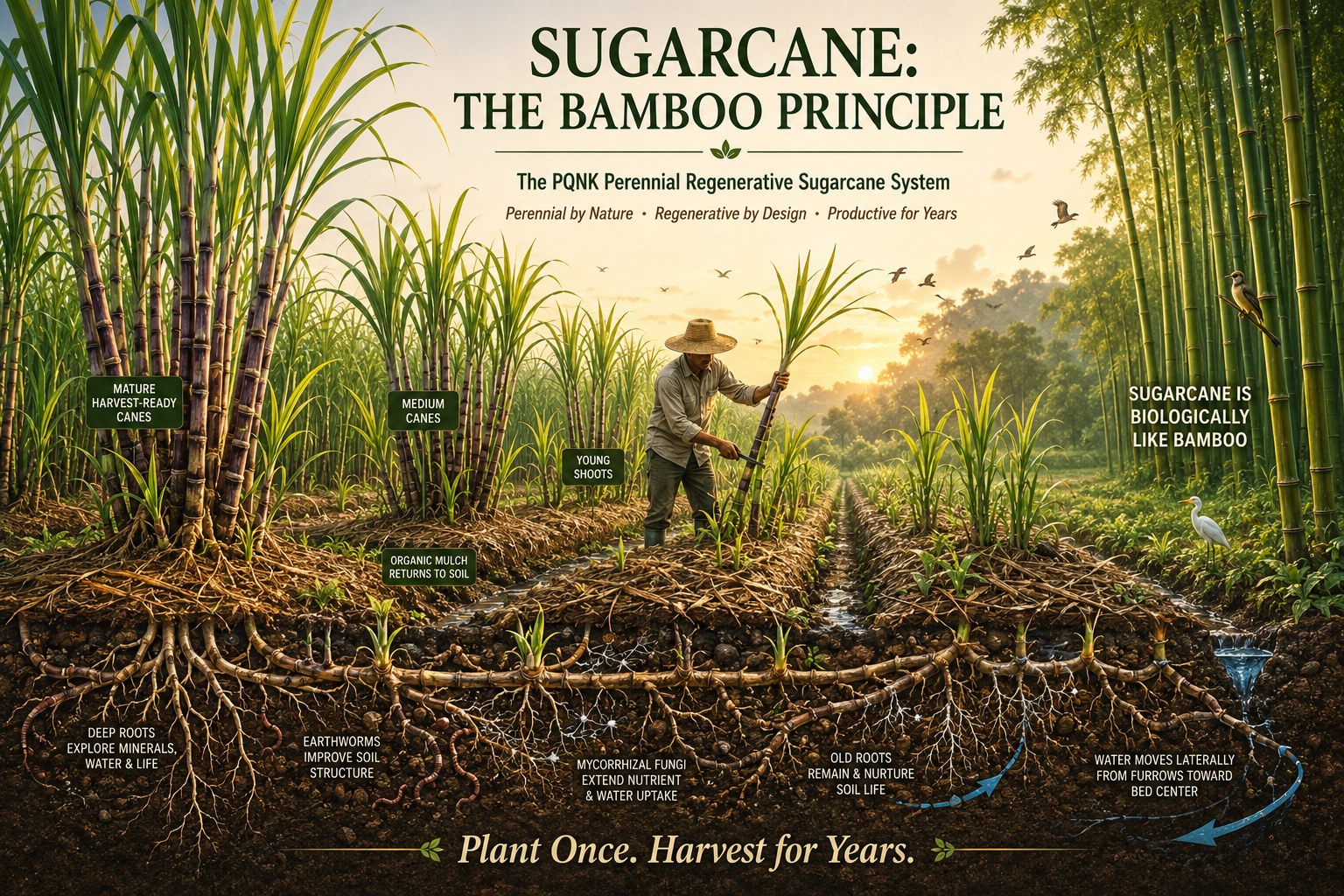
Sugarcane: The Bamboo Principle
Sugarcane is the most misunderstood crop in South Asian agriculture. It is planted as though it were wheat — an annual that must be sown, grown, and harvested in a single season, then uprooted and begun again. This misunderstanding is the root cause of every problem that plagues conventional sugarcane cultivation: the declining yields, the rampant red rot, the replanting costs every three to four years, the mounting fertiliser bills, and the exhausted soils. PQNK corrects this misunderstanding with a single, clarifying insight: sugarcane is not wheat. It is bamboo.
The Bamboo Insight
Bamboo is planted once and harvested for decades. It produces progressively stronger culms over time. It responds to selective cutting not with decline but with vigour — each harvest stimulates the rhizome to generate new shoots. The clump grows denser, the culms grow thicker, and the system becomes more productive the longer it is left undisturbed.
Sugarcane is biologically identical in this respect. It is a perennial grass. It forms rhizomes at its base. It grows in clumps. It tillers prolifically when given space, light, and an undisturbed soil system. Under PQNK, a properly established sugarcane plantation produces continuously for eight to ten years or more, with yields and quality increasing — not declining — with every harvest cycle.
Field observations confirm what biology predicts. When ten to twelve mature canes are harvested from a PQNK clump, ten to fifteen new shoots are already emerging from the base, with another generation following behind them. The plantation is never empty. Growth and harvest happen simultaneously. This is circular production — not a crop rotation, but a continuously yielding perennial system.
What Conventional Farming Gets Wrong
Conventional sugarcane shoots grow from stubble buried eight to ten inches below the soil surface. These are structurally weak points — far from the solar energy and microbial richness of the surface zone. Each ratooning cycle produces weaker plants than the last. Red rot (Colletotrichum falcatum) colonises the stressed root zones. By the third or fourth ratoon, yields have collapsed sufficiently to justify replanting — a costly, labour-intensive process that resets the clock without addressing the underlying cause.
The underlying cause is simple: the soil system is dead. Tillage, chemical fertilisers, and flood irrigation have eliminated the microbial community, compacted the subsoil, and salinised the root zone. The sugarcane cannot access the mineral nutrition the soil contains because the biological machinery that makes those minerals plant-available has been destroyed.
The Four Mandatory Conversion Steps
Sugarcane cannot express its perennial nature in a degraded soil. Before any planting, the field must be converted through the four non-negotiable PQNK steps. There are no shortcuts. Each step serves a specific biological purpose.
1. Hardpan Fracture: A single deep subsoiling operation to restore root penetration, oxygen availability, and water infiltration. Without this, sugarcane roots remain in the shallow compacted layer and productivity collapses. This is done once only — never again.
2. Soil Detoxification Flush: One deep irrigation to flush accumulated salts and chemical residues accumulated from years of conventional practice. This resets the soil chemistry and prepares the root zone for biological rebuilding.
3. Permanent Raised Beds: Beds shaped once — 42 inches wide, 8 to 10 inches high, with furrows for lateral irrigation. Soil is never disturbed again. All movement is confined to furrows. No re-compaction of the growing zone.
4. Permanent No-Till with Root Retention: Old roots remain in the soil after harvest. Harvest residues (trash) are returned as mulch — never burned, never removed. The field becomes a self-feeding, self-maintaining system.
Planting Geometry and Establishment
The planting system is designed to give each sugarcane plant the space to become a powerhouse. Wide spacing that seems wasteful at establishment becomes the source of dramatic long-term yields.
• Bed width: 42 inches
• Row spacing: 5 feet between rows
• Plant spacing: 4 feet between plants within the row
• Population: approximately 2,000 plants per acre
• Seed material: single-bud setts (approximately 160 kg/acre vs. 6,000 kg/acre conventionally — a 97% reduction in seed cost)
• Establishment: nursery-raised transplants placed in the centre of raised beds
The wide spacing forces roots to spread outward and downward, creating a massive anchor root system that prevents lodging and accesses deep mineral reserves. Sunlight reaches every leaf. Air circulates freely. Each plant has the resources to produce 20 to 40 strong tillers, with individual canes often reaching four to five kilograms.
The mother shoot is cut at one to two feet after establishment to stimulate tillering if a single harvest model is preferred. If year-round selective harvesting is planned, the mother shoot is allowed to develop fully.
Selective Harvesting: The Core Rule
The single most important operational principle in PQNK sugarcane is selective harvesting. The conventional instinct — harvest the entire field at once — must be abandoned completely.
Under PQNK, only mature, fully developed canes are cut. Young shoots, medium-sized canes, and newly emerging basal tillers are left untouched. This mirrors bamboo forestry exactly: the mature culms are taken; the clump is never cleared.
This practice produces three compounding benefits. First, the plantation is never put under the shock of a full harvest — the rhizome continuously draws energy from the canopy of retained plants. Second, each selective cut stimulates fresh tiller emergence, increasing density and root mass over time. Third, the farm can sell into the market whenever prices are favourable — not only during the peak harvest season when mill prices are lowest.
Results Observed Across PQNK Farms
Yield: 80 to 120 tonnes per acre (vs. 30 to 40 tonnes conventionally)
Sucrose content: 12 to 14% (vs. 10 to 12% conventionally)
Water savings: 80 to 90% reduction through mulch and lateral irrigation
Seed cost: 97% reduction through single-bud setts
Fertiliser and pesticide cost: eliminated entirely
Red rot: absent across multiple harvests on PQNK plantations
Productive lifespan: 8 to 10+ years from a single planting
Why Quality Improves Over Time
Conventional farming produces quality decline with each ratoon. PQNK produces quality improvement. The reason is soil maturity. With each passing year, the microbial community deepens, the root mass expands, the mineral cycling stabilises, and the plant's access to a full spectrum of plant-available nutrients improves. The result is thicker stalks, longer internodes, and higher juice concentration.
The 12 to 14% sucrose content is not a product of sugar-boosting chemistry. It is a product of less water dilution — mulch-maintained soil moisture at field capacity rather than flood saturation — and of continuous plant vigour from an intact soil biology. The plant is not stressed; it is thriving. Thriving sugarcane concentrates sugar naturally.
The Closed Circle: Nothing is Wasted
After the initial establishment flush, the PQNK sugarcane system requires no external inputs. The only material entering the system is the trash from the harvest itself — leaves, tops, and cut residues — which are immediately returned to the soil surface as mulch. This mulch suppresses weeds, conserves moisture, feeds soil life, and regulates temperature. The cycle repeats indefinitely. The farm becomes self-sustaining and independent of market inputs.
Soil exposed after burning or cleaning loses this cycle. Bare soil in a sugarcane field is not hygiene — it is destruction. The mulch layer is the engine of the entire system. Protecting it is non-negotiable.
Long-Term Genetic Vigour
One question that arises with very long-term perennial production is genetic decline — whether a single planting maintained for 20 to 30 years will lose vigour. The PQNK approach addresses this through periodic introduction of nursery-raised plants into established clumps, refreshing the genetic material without disrupting the established soil system. This is manageable and infrequent — not a structural limitation of the system.
——————————
Applying PQNK without understanding nature’s operating system will not deliver abundance, stability, or nutrient density.
PQNK (pronounced “picnic”)—the regenerative & sustainable Pristine Organic Farming System—is grounded in Natural Ecosystem Science. This science employs perennial biodiversity, protects soil with organic mulch, and avoids practices such as water inundation, tillage disturbance, and leaving soil bare.
It is the process that matters most. PQNK is a pristine production system designed not merely for yield, but for optimal, balanced output—where quality, sustainability, and ecological harmony emerge from a self‑regulated, zero‑external‑input methodology.
Connect & Resources Facebook: www.Facebook.Com/Pedaver YouTube (PQNK): https://www.youtube.com/@pedaverpqnk3167/videos YouTube: http://www.youtube.com/@aasifsharif PDF Knowledge Papers: https://drive.google.com/drive/folders/1iadwV6mdUPyrUIpB3oRfNv6DLiackaUL?usp=sharing Email: pedaver@gmail.com WhatsApp: +92 320 677 6666
About This Paper
- Crop
- Sugarcane
- Problem
- Yield Stagnation / Decline · Fungal / Bacterial Disease · High Input / Production Cost · Price Volatility / Market Glut
- Science
- Soil · Plants · Production Architecture · Economics
- Evidence
- Measured Field Result
- Authority
- Current / Approved PQNK Knowledge
Related PQNK Science
Key Takeaways
- Sugarcane is biologically a perennial, rhizome-forming grass, not an annual; misunderstanding this drives the declining yields, red rot, and replanting costs of conventional cultivation.
- Single-bud setts at roughly 160 kg/acre (revised R1, per the PQNK book): the saving is calculated against the local conventional seed rate, not quoted as a universal percentage.
- Selective harvesting, cutting only mature canes and leaving young shoots and tillers untouched, mirrors bamboo forestry and lets growth and harvest happen simultaneously, year-round.
- Field results (revised R1, per the PQNK book): recorded PQNK cases report yields of over two thousand maunds per acre, with documented fields reaching 2,800 maunds (about 112 tonnes) and sucrose of 10-14% where comparable conventional cane was reported at 8-10%, with productive cane kept for eight harvest cycles from one planting; longevity is judged field by field.
- Higher sucrose comes from less water dilution under mulch-maintained field-capacity moisture and continuous plant vigor, not from any sugar-boosting input.
- Long-lived ratooning needs continued observation (revised R1, per the PQNK book): where replacement is needed, healthy planting material is introduced with the least possible disturbance; replanting the same clone does not refresh its genetics.
Related Crops
Related Knowledge
Companion paper
Sugarcane Cultivation on PQNK: A Perennial, Circular Production System
This companion knowledge paper turns the bamboo-principle reframe into an operating system: selective, year-round harvesting from overlapping generations of cane within the same clump, with rising density treated as a soil-health signal rather than a problem to be thinned.
same problem
PQNK Foundational Document, Topic 4: The Economics of Resilience — A Detailed Cost-Benefit Analysis over a 2-5 Year Horizon
This paper builds a two-pillar economic model, avoided conventional costs plus valued ecosystem services, to show PQNK generating a $300 to $865-plus per acre annual advantage over conventional farming by year four or five, arguing the transition should be understood as an investment in biological capital rather than an expense.
same problem
Potato Planting Depth vs Mulch-Based No-Till Planting: A Production, Economics, and Quality Analysis under the PQNK System
A scientific and economic comparison of conventional 6-inch deep seed burial against PQNK's surface-placement-plus-mulch method, showing that mulch delivers the same tuber-zone temperature control as deep burial while also enabling earlier sowing, denser planting, and a roughly 90% cut in per-acre production cost.
same problem
Open Field Vertical Farming Under PQNK: Stacking Biology Instead of Expanding Land
Translates a field lecture into a structured framework for growing tunnel-style vining crops in open fields without tunnels, greenhouses, or chemical inputs, arguing that vertical canopy management and time-based crop replacement can turn one acre into a resilient, year-round livelihood unit.