

KP-005 · Crop-Specific Guides
Transforming Pakistan's Sugar Industry Through the PQNK (Pristine Organic Farming) System
Pakistan's sugar sector runs on a decades-old cycle of farmer exploitation, long-haul cane transport, and volatile supply. This paper proposes concentrating high-yield PQNK sugarcane cultivation within a 10-15 km radius of each mill, and models the profit, sugar-recovery, and crushing-season gains that follow.
Read or listen to the full paper ↓Abstract
Pakistan's sugar industry has run the same operational model for over four decades: an annual cycle of overproduction that depresses farmer prices, followed by underproduction that leaves mills scrambling for cane. Farmers face delayed payments, under-weighed produce, and disrespectful treatment, discouraging cultivation; mills then pay high costs to truck cane in from hundreds of miles away, degrading quality en route and inflating operating expenses. The end-consumer absorbs the cost through inflated sugar prices. The paper identifies the root failure as mills neglecting their immediate agricultural geography.
PQNK is proposed as a structural fix rather than an efficiency tweak: concentrated, high-yield, organic sugarcane cultivation within a 10-15 km radius of the mill, turning farmers from supplicants into economic partners. A head-to-head comparison shows PQNK cutting soil preparation cost in half, seed requirement from 150 to 5 maunds, and eliminating fertilizer and weedicide spend entirely, while lifting maximum yield from 1,000 to 3,000 maunds per acre and sugar content from 9% to 11-13%. Critically, PQNK also extends the harvesting window from five months (November-March) to eight months (October-May).
The paper's per-acre economic model for a PQNK cane plot — 5,000 plants, 10 canes per plant, 2 kg average cane weight — yields 100,000 kg (2,500 maunds) per acre, generating gross income of roughly PKR 875,000 and net profit near PKR 745,000 after approximately PKR 130,000 in expenditure. For the mill, the benefits compound: an 8-10 month operating season instead of 6, sugar recovery rates up by as much as 40% thanks to fresher, higher-sucrose cane, and dramatically lower costs from eliminating long-distance transport.
At the national and consumer level, the paper argues concentrated PQNK sourcing zones would stabilize sugar prices through consistent supply, protect soil health and water tables by eliminating chemical fertilizer and pesticide use, cut irrigation water use by up to 80%, and stimulate rural economies through a thriving, profitable farming base tied directly to each mill.
The paper closes with a four-part call to action: pilot PQNK adoption within 10-15 km radii of participating mills, mill-led farmer education and facilitation, government policy support and regulatory incentives for mills that adopt regenerative sourcing, and a wider knowledge-dissemination campaign to bring stakeholders — government, mill boards, and farmer associations — to the table.
Full Paper
If you use “Listen”, the text of the page may be sent to your browser or operating system’s speech provider, such as Apple, Google or Microsoft, depending on the voice your device uses. Pedaver does not process, transmit or store any audio.
1. Introduction: A System in Crisis
Pakistan's sugar industry is trapped in a vicious and unsustainable cycle. For over four decades, a monolithic operational model has prevailed, characterized by identical systems, procedures, and a counterproductive mentality. This has resulted in systemic exploitation of farmers, volatile supply chains, and soaring consumer prices. The conventional cycle of overproduction one year, leading to farmer exploitation, followed by underproduction the next, causing mills to scramble for cane, must be broken. This paper presents a paradigm shift: the Paedar Qudratti Nizam Kashtqari (PQNK) system—a regenerative and sustainable pristine organic farming model that promises to benefit every stakeholder, from the farmer to the consumer.
2. The Conventional Model: A Cycle of Exploitation and Inefficiency
The current system is fundamentally flawed. Farmers face delayed payments, under-weighed produce, and disrespectful treatment. This discourages cultivation, leading to supply shortages. Mills then incur high costs to transport cane from hundreds of miles away, which deteriorates quality and increases operational expenses. The entire structure is a lose-lose situation, with the end-consumer bearing the ultimate cost through inflated sugar prices. The core failure is the mills' neglect of their immediate agricultural geography.
3. The PQNK Solution: A Regenerative Paradigm
PQNK, is not merely a new set of techniques; it is a philosophical shift towards working with nature. It transforms farmers from supplicants into partners, focusing on concentrated, high-yield, organic cultivation within a 10-15 km radius of the mill.
4. Comparative Analysis: PQNK vs. Conventional Farming
The data below illustrates the stark contrast between the two systems, demonstrating PQNK's superiority across all metrics:
5. The PQNK Advantage: A Multiplicative Benefit
The PQNK model creates a powerful virtuous cycle:
For the Farmer: Unprecedented Profitability A detailed cost analysis of PQNK reveals transformative economic potential:
Number of Plants: 5,000
Canes per Plant: 10
Total Canes: 50,000
Avg. Weight per Cane: 2 Kg
Yield per Acre: 100,000 Kg (2,500 Maunds)
Income (@ PKR 350/40 Kg): PKR 875,000
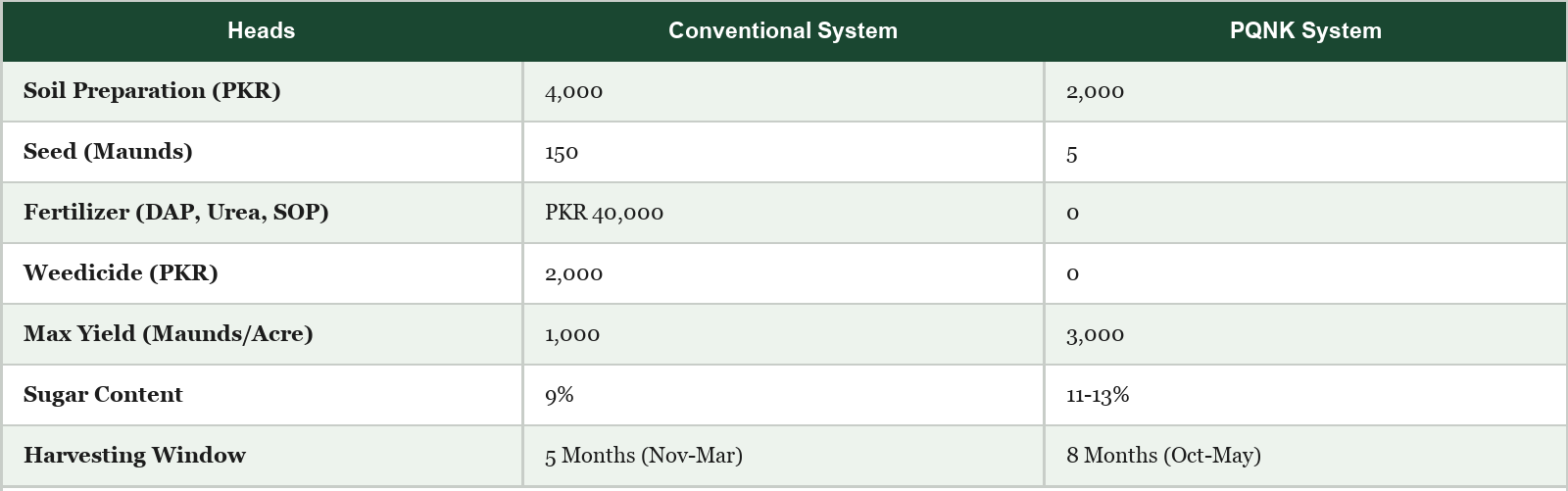
| Heads | Conventional System | PQNK System |
|---|---|---|
| Soil Preparation (PKR) | 4,000 | 2,000 |
| Seed (Maunds) | 150 | 5 |
| Fertilizer (DAP, Urea, SOP) | PKR 40,000 | 0 |
| Weedicide (PKR) | 2,000 | 0 |
| Max Yield (Maunds/Acre) | 1,000 | 3,000 |
| Sugar Content | 9% | 11-13% |
| Harvesting Window | 5 Months (Nov-Mar) | 8 Months (Oct-May) |
Net Profit (after approx. PKR 130,000 expenditure): PKR 745,000 per Acre
This profitability empowers farmers and ensures their willing partnership.
For the Sugar Mill: Operational Excellence
Extended Crushing Season: The harvesting window expands from 5 to 8 months, allowing mills to operate for 8-10 months instead of 6.
Enhanced Sugar Recovery: Fresh, high-sucrose cane (11-13% vs. 9%) yields more juice, increasing recovery rates by up to 40%.
Dramatically Lower Costs: Eliminating long-distance transportation and its associated costs significantly improves the mill's bottom line.
Consistent Supply: A concentrated, motivated farming community within a short radius guarantees a consistent and high-quality raw material supply.
For the Nation and Consumer:
Price Stability: A consistent supply and efficient operations lead to stable sugar prices in the market.
Environmental Sustainability: The elimination of chemical fertilizers and pesticides protects soil health and water tables.
Up to 80% reduction in irrigation water, much higher water use efficiency
Economic Growth: A thriving, profitable agricultural sector stimulates rural economies.
6. The Way Forward: A Call to Action
The PQNK system is the "golden goose" that the industry has overlooked. It is an issue that demands the serious attention of all stakeholders: federal and provincial governments, sugar mill boards, and farmers' associations.
We recommend:
Pilot Programs: Sugar mills should be incentivized to adopt the PQNK model within a concentrated 10-15 km radius.
Farmer Education & Facilitation: Mills must actively motivate and train farmers in PQNK practices, providing them with the necessary support.
Policy Support: The government should create a regulatory framework that encourages and rewards mills for adopting sustainable and regenerative practices like PQNK.
Knowledge Dissemination: This paper should be the first step in a widespread campaign to educate all stakeholders on the tangible benefits of this system.
7. Conclusion
The choice is clear. We can persist with the conventional, exploitative model that bleeds farmers, burdens mills, and punishes consumers. Or, we can embrace the future with the PQNK system—a regenerative, profitable, and sustainable model that secures the future of Pakistan’s sugar industry. The time for talk is over; the time for action is now.
—————————
Footnote: Any Production Process That Inundates Soil With Water, Disturbs Soil Through Tillage, Or Leaves Soil Bare Without Organic Mulch Cover Does Not Qualify As Natural Ecosystem Science For Production Agriculture.
PQNK, to be pronounced as 'picnic', which stands for Paedar Qudratti Nizam Kashatqari, and means: the regenerative & sustainable Pristine Organic Farming System.
www.Facebook.Com/Pedaver
https://www.youtube.com/@pedaverpqnk3167/videos
pedaver@gmail.com
WhatsApp +92 320 677 6666
About This Paper
- Crop
- Sugarcane
- Problem
- High Input / Production Cost · Grain Quality Defects (Chalkiness, Breakage, Shriveling) · Post-Harvest Loss / Spoilage · Farmer Income Instability / Debt · Price Volatility / Market Glut
- Science
- Economics · Production Architecture · Water
- Evidence
- Economic Model/Projection
- Authority
- Current / Approved PQNK Knowledge
Related PQNK Science
Key Takeaways
- PQNK sugarcane lifts maximum yield from 1,000 to 3,000 maunds/acre and sugar content from 9% to 11-13%.
- The harvesting window expands from 5 months (Nov-Mar) to 8 months (Oct-May), letting mills run 8-10 months instead of 6.
- Modeled net profit reaches roughly PKR 745,000 per acre for PQNK cane growers, against about PKR 130,000 in expenditure.
- Concentrating PQNK cultivation within a 10-15 km radius of each mill eliminates the long-haul transport costs and cane-quality loss driving the current crisis.
- Fresher, higher-sucrose cane is projected to raise mill sugar recovery rates by up to 40%.
- The paper calls for mill-led pilot programs, farmer training, and government policy support to seed a national transition.
Related Crops
Related Knowledge
same problem
The Farmers' Crisis Will Not Be Solved by Another Support Price: Why Pakistan's Farmers Must Reduce Cost, Improve Quality and Build Independence Through PQNK
A nationwide farmers' association's press conference voiced real distress over diesel, fertiliser, wheat and sugarcane policy, and the danger that one failed crop leaves a farmer unable to finance the next. This paper argues that distress is real but the standard remedy, another support price or subsidy, cannot be the permanent foundation of farm viability, because it exchanges biological dependence for political dependence. PQNK reframes the question: since a farmer cannot control the market price, government policy, rainfall or the exchange rate, his strongest and most durable defence is progressively lowering his own cost of production by restoring the soil's biological functions, while building resilience to climate shocks and competing through demonstrable produce quality.
same problem
Commercial Advantages of PQNK Production: Why Biological Correctness Outperforms Industrial Efficiency
A supplementary business case arguing PQNK's commercial edge comes not from yield or scale but from structurally low cost of production, quality-driven demand, and continuous harvest cash flow, walking through eleven distinct commercial mechanisms from certification-free trust to appreciating soil as a farm asset.
same problem
Open Field Vertical Farming Under PQNK: Stacking Biology Instead of Expanding Land
Translates a field lecture into a structured framework for growing tunnel-style vining crops in open fields without tunnels, greenhouses, or chemical inputs, arguing that vertical canopy management and time-based crop replacement can turn one acre into a resilient, year-round livelihood unit.
same problem
Sugarcane: The Bamboo Principle
Sugarcane is conventionally treated like wheat, sown, harvested, and replanted every few years, but this paper uses bamboo as an analogy for a rhizome-forming perennial that can be harvested repeatedly from a protected living base. It lays out the wide-spacing planting geometry and selective-cut discipline behind PQNK field cases of eight harvest cycles from one planting, with recorded yields of over two thousand maunds per acre, with documented fields reaching 2,800 maunds (about 112 tonnes) (revised R1, per the PQNK book).