

KP-114 · Crop-Specific Guides
The PQNK Framework for Regenerative Animal Husbandry: Productivity, Profitability, and Planetary Health
Moving past the A1-versus-A2 milk debate, this paper argues that milk and meat quality is determined by the health of the whole production ecosystem rather than a single protein variant, and lays out PQNK's stocking-density and margin case for pasture-based dairy and livestock built on native breeds and diverse forage.
Read or listen to the full paper ↓Abstract
The paper opens by naming the A1-versus-A2 beta-casein debate a valid but distracting science: the real determinant of milk's quality and health impact, it argues, is the health of the entire production ecosystem, not the genetics of a single protein. An unhealthy A2 cow in a stressed industrial setting can still produce inflammatory milk carrying cortisol, imbalanced fats, and chemical residues, while a healthy, grass-fed A1 cow can produce milk that is better tolerated, true quality running from soil to soul rather than from one gene.
Six pillars are set out as PQNK's non-negotiable foundation for animal husbandry: living, microbially rich soil as the absolute priority beneath all forage; diverse forage (Napier, Alfalfa, and others) as the engine that delivers the phytonutrients behind rich milk and animal health; native breeds such as the Gir (disease resistance, rich milk) and Sahiwal (arid-region dairy performance) as the most efficient converters of that forage into nutrient-dense milk, ahead of high-volume exotic breeds bred for output alone; animal welfare as a prerequisite, defined concretely as a minimum of two hours of daily grazing, freedom of movement, and a low-stress environment; respect for milk composition's natural change across the lactation cycle; and closed-loop economics that recycle nutrients internally rather than depending on external purchases.
The paper's economic case reframes ecological farming's productivity from High-Input/High-Output/Low-Margin to Low-Input/Moderate-Output/High-Margin: it cites a stocking density of roughly 15 animals per acre achievable on managed, high-yield PQNK forage against about 3 animals per acre under traditional practice, substantially lower input costs as pasture management replaces purchased feed and preventative health eliminates medicine costs, and resilience to market shocks from input-price volatility that conventional operations remain exposed to.
It closes with a direct call to action split between two audiences: farmers, urged to embrace their role as ecosystem managers and prioritize soil health, animal welfare, and native genetics as the path to lasting prosperity; and consumers, urged to inquire beyond labels, asking how an animal was raised and what it ate, on the argument that consumer demand for genuinely healthy food is what empowers farmers to adopt the practices that rebuild agricultural ecology.
Full Paper
If you use “Listen”, the text of the page may be sent to your browser or operating system’s speech provider, such as Apple, Google or Microsoft, depending on the voice your device uses. Pedaver does not process, transmit or store any audio.
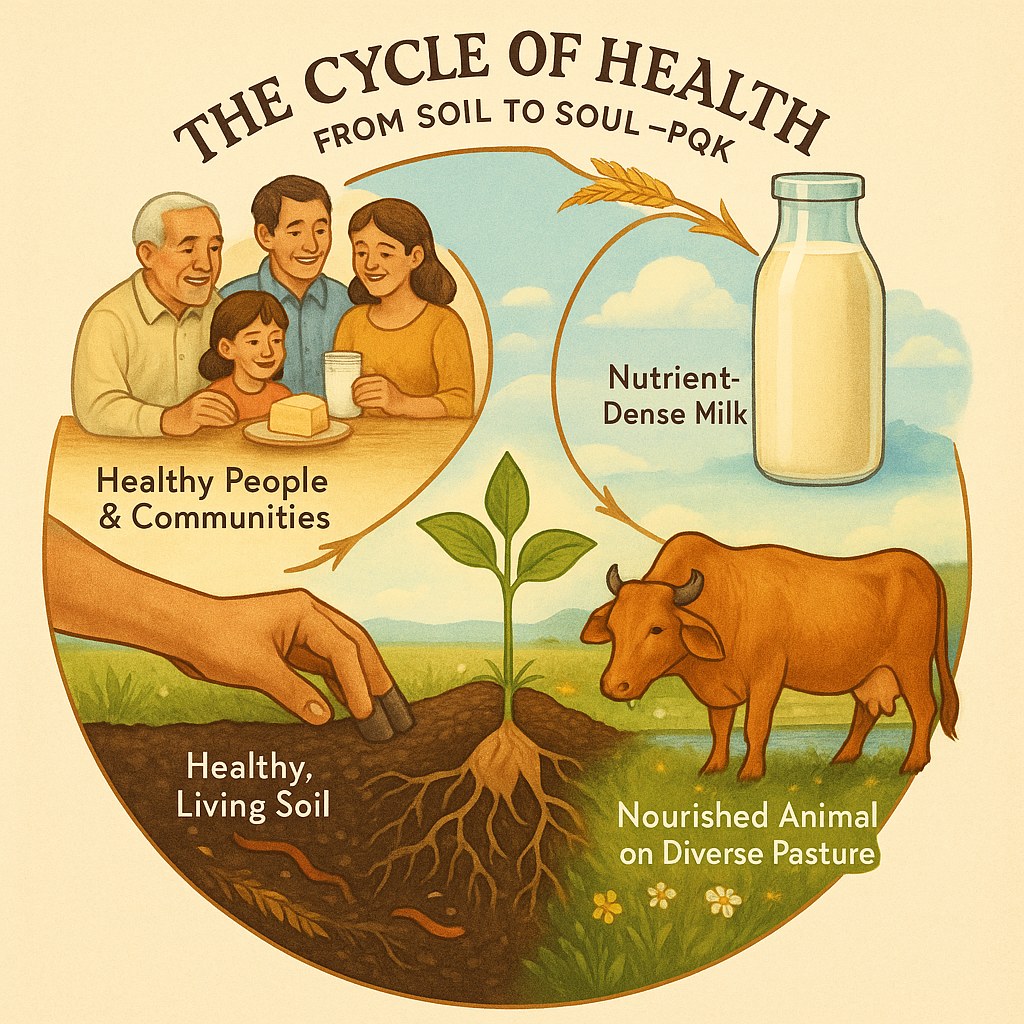
The journey of our food from farm to table is broken. The rise of debates like A1 versus A2 milk is not the problem, but a symptom of a deeper crisis: the collapse of our agricultural ecosystems. This paper moves beyond isolated issues to present a holistic framework for restoring health, wealth, and sustainability to animal husbandry through the principles of PQNK.
I. The Flawed Debate: A Symptom of a Broken System
The science distinguishing A1 and A2 beta-casein proteins is valid, yet focusing on it alone is a distraction. The core determinant of milk's quality and health impact is not genetics alone, but the health of the entire production ecosystem.
An unhealthy A2 cow in a stressed, industrial setting will produce inflammatory milk due to cortisol, imbalanced fats, and chemical residues. A healthy, grass-fed A1 cow can produce milk that is better tolerated. True quality is a function of the entire system—from soil to soul.
II. The Pillars of PQNK: Principles for a New Paradigm
PQNK is built on managing the farm as a living, interconnected system. Its principles are the non-negotiable foundation for producing truly nourishing food:
Soil Health is the Absolute Priority: Living, microbially rich, mineral-dense soil is the only foundation for nutrient-dense forage.
Diverse Forage is the Engine: A variety of grasses, legumes, and herbs (e.g., Napier, Alfalfa) provide the phytonutrients that translate into rich milk and robust animal health.
Native Breeds are the Ideal Conversion Machines: Adapted over millennia, breeds like the Gir (renowned for disease resistance and rich milk) and Sahiwal (a dairy champion for arid regions) are unparalleled in their efficiency at converting diverse forage into nutritionally dense milk, not just high volume.
Animal Welfare is a Prerequisite: Animals must express natural behaviors: grazing (minimum 2+ hours daily), freedom of movement, access to clean water and air, and a low-stress environment.
Embrace Natural Cycles: Milk composition changes throughout lactation to meet the calf's needs. Respecting this cycle is respecting biological integrity.
Closed-Loop Economics: The system is designed for internal reliance, recycling nutrients, and breaking dependence on external purchases.
III. The Economic Reality: The PQNK Advantage
The misconception that ecological farming is less productive is overturned by a true cost analysis. PQNK shifts the economics from High Input, High Output, Low Margin to Low Input, Moderate Output, High Margin.
The PQNK Edge:
Stocking Density: ~15 animals per acre is achievable on managed, high-yield PQNK forage, vs. ~3 animals/acre in traditional practices.
Input Costs: Substantially Lower. Pasture management replaces purchased feed. Preventative health eliminates medicine costs.
Profitability: Highest. Low production costs combined with premium prices for nutritionally dense, ethically produced milk sold directly to consumers ensure superior margins.
Resilience: Immune to market shocks from input price fluctuations.
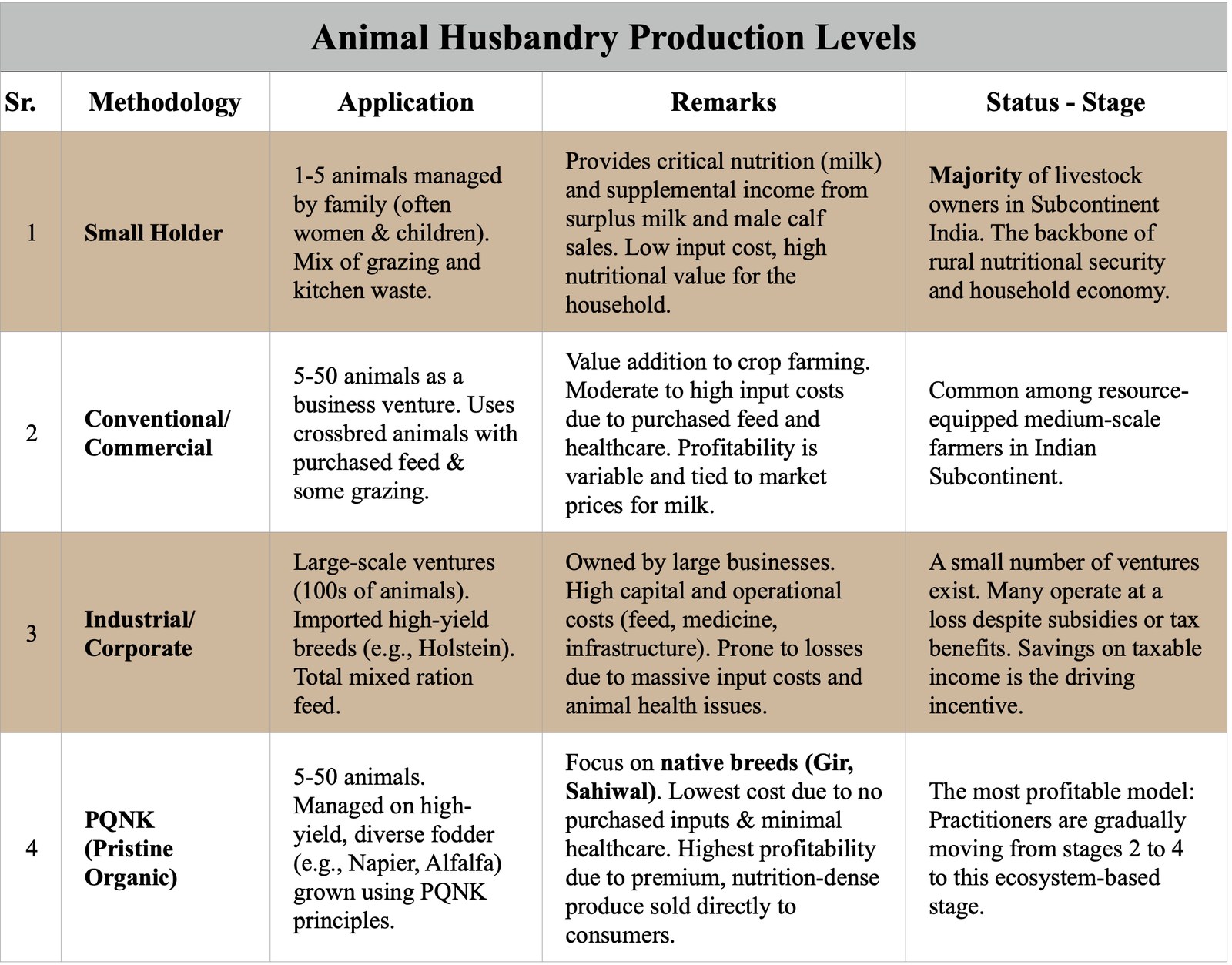
IV. A Classification of Animal Husbandry Systems
| Sr. | Methodology | Application | Remarks | Status - Stage |
|---|---|---|---|---|
| 1 | Small Holder | 1-5 animals managed by family (often women & children). Mix of grazing and kitchen waste. | Provides critical nutrition (milk) and supplemental income from surplus milk and male calf sales. Low input cost, high nutritional value for the household. | Majority of livestock owners in Subcontinent India. The backbone of rural nutritional security and household economy. |
| 2 | Conventional/ Commercial | 5-50 animals as a business venture. Uses crossbred animals with purchased feed & some grazing. | Value addition to crop farming. Moderate to high input costs due to purchased feed and healthcare. Profitability is variable and tied to market prices for milk. | Common among resource-equipped medium-scale farmers in Indian Subcontinent. |
| 3 | Industrial/ Corporate | Large-scale ventures (100s of animals). Imported high-yield breeds (e.g., Holstein). Total mixed ration feed. | Owned by large businesses. High capital and operational costs (feed, medicine, infrastructure). Prone to losses due to massive input costs and animal health issues. | A small number of ventures exist. Many operate at a loss despite subsidies or tax benefits. Savings on taxable income is the driving incentive. |
| 4 | PQNK (Pristine Organic) | 5-50 animals. Managed on high- yield, diverse fodder (e.g., Napier, Alfalfa) grown using PQNK principles. | Focus on native breeds (Gir, Sahiwal). Lowest cost due to no purchased inputs & minimal healthcare. Highest profitability due to premium, nutrition-dense produce sold directly to consumers. | The most profitable model: Practitioners are gradually moving from stages 2 to 4 to this ecosystem-based stage. |
The following table contrasts the prevailing models, illustrating the logical progression towards the PQNK - Natural Ecosystem Science for Production Agriculture:
V. A Call to Collective Action
The path forward requires a collective shift in mindset.
To Farmers: You are the stewards of this transition. Embrace your role as ecosystem managers. Prioritize soil health, animal welfare, and native genetics. Your path to lasting prosperity lies in the value and resilience of the PQNK model.
To Consumers: You hold the power of choice. Inquire beyond labels. Ask: "How was the animal raised?" "What did it eat?" Your demand for truly healthy food empowers farmers to adopt these practices and rebuild our agricultural ecology.
Conclusion:
We stand at a crossroads. We can continue to debate single molecules within a broken system, or we can choose to heal the system itself. The PQNK framework offers a proven, profitable, and regenerative path forward—one that restores the true value of milk and meat by honoring the health of the soil, the animal, the farmer, and the consumer.
In service of the ecosystem,
The PQNK Team
www.Facebook.Com/Pedaver
https://www.youtube.com/@pedaverpqnk3167/videos
pedaver@gmail.com
WhatsApp +92 320 677 6666
About This Paper
- Crop
- Napier Grass · Alfalfa
- Problem
- Animal Health / Welfare / Product Quality · External Input Dependency
- Science
- Nutrition · Biodiversity · Economics · Food Quality
- Evidence
- Economic Model/Projection
- Authority
- Current / Approved PQNK Knowledge
Related PQNK Science
Key Takeaways
- Argues milk and meat quality is a function of the whole production ecosystem, not genetics alone: a stressed A2 cow can produce inflammatory milk while a healthy, grass-fed A1 cow can be well tolerated.
- Names native breeds like Gir (disease resistance, rich milk) and Sahiwal (arid-region dairy performance) as the most efficient converters of diverse forage into nutrient-dense milk, ahead of high-volume exotic breeds.
- Sets a concrete welfare bar: a minimum of two hours of daily grazing, freedom of movement, and a low-stress environment, alongside respecting lactation's natural composition changes across the cycle.
- Cites roughly 15 animals per acre achievable under managed PQNK forage versus about 3 animals per acre under traditional practice.
- Reframes the economics from High-Input/High-Output/Low-Margin to Low-Input/Moderate-Output/High-Margin, with pasture management and preventative health replacing purchased feed and medicine as the dominant cost levers.
- Calls on farmers to prioritize soil health, native genetics, and animal welfare, and on consumers to ask how an animal was raised rather than relying on labels alone.
Related Knowledge
same problem
The Chicken Is Not the Problem, the Production System Is: From Industrial Poultry to PQNK Integrated Poultry Production
A point-by-point PQNK response to a widely circulated critique of industrial poultry, separating the well-supported concerns, accelerated growth genetics, welfare under confinement, antimicrobial resistance, nutrient concentration in manure, from overstated claims about hormones and disease causation. The paper traces the poultry chain back through feed to the soil that grew it, and proposes PQNK Integrated Poultry Production: a near-closed biological loop in which feed crops restore soil, birds are kept under conditions that allow normal behaviour, and manure returns to the land at rates the system can absorb, closing with a specific list of what must actually be measured to compare production systems fairly.
same problem
PQNK Knowledge Paper: The Universal Application of the PQNK Model — From Soil to Supper
Responding to a Nigerian farmer's question about whether PQNK applies outside crop farming, this paper argues that because every link in the food chain, honey, eggs, milk, meat, or fish, ultimately traces back to plant nutrition, restoring plant health under PQNK automatically improves outcomes across poultry, aquaculture, dairy, and apiculture.
same problem
The PQNK Food Chain: From Soil to Soul — The Principle of Bio-potentiation
Introduces bio-potentiation as the inverse of biomagnification: where conventional agriculture concentrates toxins as they move up the food chain, a PQNK-managed living-soil system is argued to amplify nutritional value and potency at each successive trophic level, from soil to plant to animal to human.
same problem
PQNK vs. "Soil Science for Regenerative Agriculture": Critical Analysis for NARC Colleagues
A direct response circulated to Pakistan's National Agricultural Research Centre after a shared knowledge paper on regenerative soil science, crediting its correct ecological principles while arguing it stops at soil ecology and organic-input substitution, whereas PQNK goes further into a complete, input-free, mechanized production system already running on working farms.