

KP-116 · PQNK Philosophy, Framework & Economics
PQNK vs. "Soil Science for Regenerative Agriculture": Critical Analysis for NARC Colleagues
A direct response circulated to Pakistan's National Agricultural Research Centre after a shared knowledge paper on regenerative soil science, crediting its correct ecological principles while arguing it stops at soil ecology and organic-input substitution, whereas PQNK goes further into a complete, input-free, mechanized production system already running on working farms.
Read or listen to the full paper ↓Abstract
The paper opens as a direct reply, addressed to an NARC WhatsApp group, to a knowledge paper titled 'Soil Science for Regenerative Agriculture' shared in that group. It credits the paper for what it gets right, soil as a living system, no-till as essential, organic matter and microbes as vital, chemical fertilizer and tillage as destructive, before arguing it stops short of a complete, actionable, ecosystem-mimicking production system.
Its central critique is specific: the reviewed paper still permits purchased inputs such as EM (effective microorganisms) products, compost, and minerals, which PQNK treats as a persisting dependency rather than a genuine break from input-based farming. Against that, the paper sets out six reasons it considers PQNK further along the same path: a basis in over 400 million years of ecosystem evolution rather than a designed intervention; microbial centricity in every design decision, from raised beds preventing root drowning to mineral liberation through microbial mining; zero external inputs after restoration, using only what is already present on the land; scalability and existing mechanization, framed as already adopted by hundreds of thousands of farmers across South Asia rather than a garden-scale theory; freedom from commercial bias as a self-funded, non-commercial initiative; and whole-ecosystem design covering water management and pest layers, not soil patches alone.
The paper closes by naming PQNK inclusive (works for every topography, crop, and scale), conclusive (based on nature's proven blueprint), actionable (comes with tools and machinery), field-proven (already adopted at scale), unbiased (self-funded, non-commercial), and sustainable (zero external inputs once established), framing the choice for NARC colleagues as one between partial, commercially-influenced solutions and a complete natural system already transforming agriculture in the region.
Full Paper
If you use “Listen”, the text of the page may be sent to your browser or operating system’s speech provider, such as Apple, Google or Microsoft, depending on the voice your device uses. Pedaver does not process, transmit or store any audio.
Subject: Why PQNK is the Inclusive, Conclusive & Unbiased Natural Blueprint for Regenerative Agriculture
Dear Colleagues,
We have reviewed the knowledge paper “Soil Science for Regenerative Agriculture” shared in this group. While it provides a valuable introduction to soil ecology and organic practices, it falls short of presenting a complete, actionable, and ecosystem-mimicking production system.
Below is a clear comparison showing why PQNK (Pristine Organic Farming System) is not just another method—it is the natural blueprint that has fed all life forms for over 400 million years without human intervention, resource depletion, waste, or pollution.
Most importantly: PQNK is not a theory or commercial product. It is a self-funded, non-commercial initiative with no market bias—driven purely by true ecosystem science for production agriculture.
!Where the Paper Agrees with PQNK
• Soil is a living system.
• No-till is essential.
• Organic matter and microbes are vital.
• Chemical fertilizers and tilling are destructive.
⚠ Where the Paper Stops Short – PQNK Goes Further
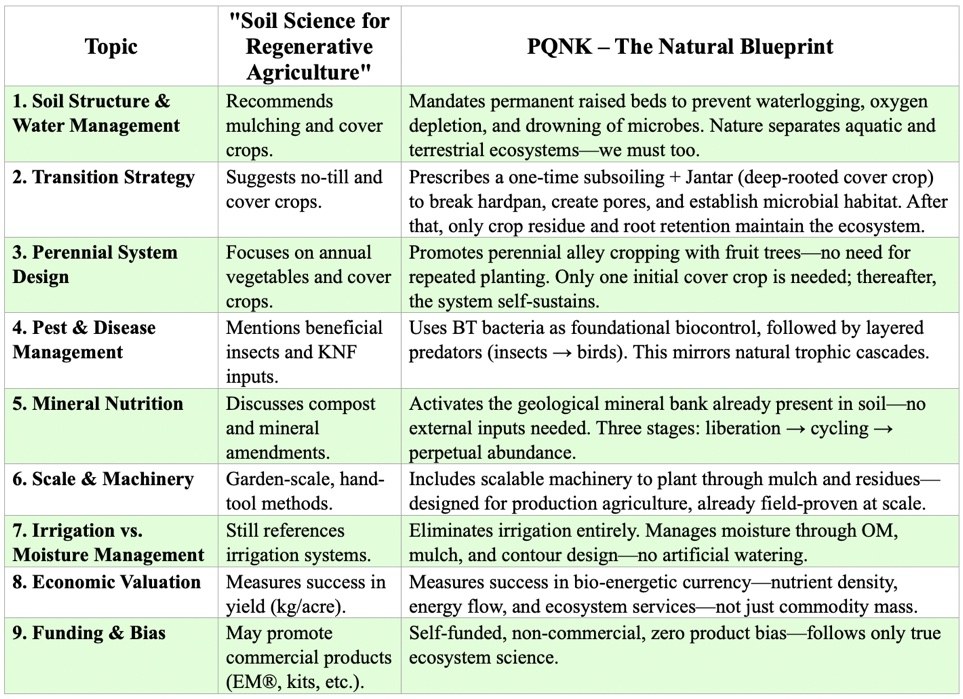
| Topic | "Soil Science for Regenerative Agriculture" | PQNK – The Natural Blueprint |
|---|---|---|
| 1. Soil Structure & Water Management | Recommends mulching and cover crops. | Mandates permanent raised beds to prevent waterlogging, oxygen depletion, and drowning of microbes. Nature separates aquatic and terrestrial ecosystems—we must too. |
| 2. Transition Strategy | Suggests no-till and cover crops. | Prescribes a one-time subsoiling + Jantar (deep-rooted cover crop) to break hardpan, create pores, and establish microbial habitat. After that, only crop residue and root retention maintain the ecosystem. |
| 3. Perennial System Design | Focuses on annual vegetables and cover crops. | Promotes perennial alley cropping with fruit trees—no need for repeated planting. Only one initial cover crop is needed; thereafter, the system self-sustains. |
| 4. Pest & Disease Management | Mentions beneficial insects and KNF inputs. | Uses BT bacteria as foundational biocontrol, followed by layered predators (insects → birds). This mirrors natural trophic cascades. |
| 5. Mineral Nutrition | Discusses compost and mineral amendments. | Activates the geological mineral bank already present in soil—no external inputs needed. Three stages: liberation → cycling → perpetual abundance. |
| 6. Scale & Machinery | Garden-scale, hand-tool methods. | Includes scalable machinery to plant through mulch and residues—designed for production agriculture, already field-proven at scale. |
| 7. Irrigation vs. Moisture Management | Still references irrigation systems. | Eliminates irrigation entirely. Manages moisture through OM, mulch, and contour design—no artificial watering. |
| 8. Economic Valuation | Measures success in yield (kg/acre). | Measures success in bio-energetic currency—nutrient density, energy flow, and ecosystem services—not just commodity mass. |
| 9. Funding & Bias | May promote commercial products (EM®, kits, etc.). | Self-funded, non-commercial, zero product bias—follows only true ecosystem science. |
#Why PQNK is Scientifically Conclusive, Field-Proven & Unbiased
1. Based on 400+ Million Years of Evolution PQNK mimics how natural ecosystems function without human inputs—closed-loop, self-renewing, and abundant.
2. Microbial Centricity Unlike the paper, PQNK places microbes at the center of every decision—from raised beds (to prevent drowning) to mineral liberation (via microbial mining).
3. No External Inputs Ever The paper still allows for purchased inputs (EM®, compost, minerals). PQNK uses only what is already on the land—activating the native mineral bank and microbial community.
4. Scalable & Mechanized – Already in Use PQNK is not a “garden theory.” It is a production-ready system already adopted by hundreds of thousands of farmers across South Asia and beyond, with tools and machinery to manage large-scale, mulch-based farming.
5. No Commercial Bias Unlike many regenerative agriculture methods that promote specific products, PQNK is self-funded and non-commercial. This ensures recommendations are based purely on ecosystem science, not market interests.
6. Complete Ecosystem Design From water management to pest layers, PQNK designs whole ecosystems—not just soil patches.
$Final Message to NARC Colleagues
The knowledge paper is a good introduction, but it does not provide a complete, actionable, and input-free production system. PQNK does—and it’s already working on farms across our region, free from commercial influence.
PQNK is:
• ✅ Inclusive – Works for every topography, crop, and scale.
• ✅ Conclusive – Based on nature’s proven, timeless blueprint.
• ✅ Actionable – Comes with tools, machinery, and clear steps.
• ✅ Field-Proven – Already adopted by hundreds of thousands of farmers in Pakistan, India, and beyond.
• ✅ Unbiased – Self-funded and non-commercial—follows true science, not market trends.
• ✅ Sustainable – Requires zero external inputs once established.
Let’s move beyond partial solutions and commercial influences and adopt the complete natural system that has been perfected over 400 million years—and is already transforming agriculture in our own communities.
Let’s build farms that work like forests.
PQNK The Pristine Organic Nature’s Blueprint for Food Security – Field-Tested, Farmer-Proven & Free from Commercial Bias
Footnote: PQNK (pronounced 'picnic')—the regenerative & sustainable Pristine Organic Farming System—is grounded in Natural Ecosystem Science. This science employs perennial biodiversity, protects soil with organic mulch, and avoids practices like water inundation, tillage disturbance, and leaving soil bare.
About This Paper
- Problem
- External Input Dependency
- Science
- Soil · Biodiversity · Water · Economics
- Evidence
- Philosophical/Framework Argument
- Authority
- Current / Approved PQNK Knowledge
Related PQNK Science
Key Takeaways
- Credits the shared NARC paper for correctly identifying soil as a living system, endorsing no-till, and naming chemical fertilizer and tillage as destructive.
- Its central critique: the paper still permits purchased inputs (EM products, compost, minerals), which PQNK treats as a persisting dependency rather than a genuine break from input-based farming.
- Argues PQNK's basis in over 400 million years of ecosystem evolution and microbial-centric design (raised beds preventing root drowning, mineral liberation via microbial mining) go beyond a soil-ecology introduction to a complete production system.
- Positions self-funded, non-commercial status as a credibility differentiator against regenerative-agriculture material that can still carry commercial input recommendations.
- Claims field adoption by hundreds of thousands of farmers across Pakistan, India, and beyond as evidence PQNK is production-ready rather than a garden-scale theory.
- Frames PQNK's scope as whole-ecosystem design, water management and pest layers included, rather than a soil-only intervention.
Related Knowledge
same problem
Why the World Needs PQNK
A case for large-scale PQNK adoption addressed to five constituencies: farmers, governments, environmentalists, health professionals and poverty-alleviation institutions. Because agriculture sits where soil, water, biodiversity, food, farm economics and human health meet, restoring the farm as a living ecosystem benefits all of them at once.
same problem
Chemical Fertiliser Dependency Through the PQNK Lens
An evidence-qualified review of the article “Chemical Fertilizer Industry”. It keeps the article's warning about soil degradation, nutrient pollution and biological decline, disciplines its headline numbers, and argues that fertiliser dependency is a symptom of a damaged production system (tillage, flooding, bare soil and simplified biology) that PQNK removes by restoring aerated, covered, living soil, reaching zero purchased fertiliser and pesticide at maturity.
same problem
The Global Wheat Crisis Is a Warning: Food Security Cannot Depend on a Production System That Is Failing
The renewed wheat-exporting crisis is usually explained by heat, war, energy costs and disrupted shipping, but this paper argues it exposes a deeper, fourth dependency few are naming: a production model whose own functioning requires stable climate, cheap energy, manufactured fertiliser and uninterrupted supply chains. It argues Pakistan's food security depends less on securing the next shipment of wheat than on rebuilding the biological productive capacity of its own soil.
same problem
Plant Nutrition Is a Living System, Not an Input Prescription: Why PQNK Restores the Nutrient-Cycling Environment Instead of Feeding the Plant Element by Element
Modern agriculture describes plant nutrition element by element: identify what the plant contains, calculate what the crop removes, replace it from a bag. This paper argues that framing mistakes an accounting exercise for a biological one. A plant's mass is built mostly from air and water, its nitrogen comes from the atmosphere through biological fixation, and the net new mineral draw on the geological reserve after recycling is very small; what determines whether a crop can acquire a nutrient is the living biological interface between mineral and root, not the total inventory in the soil. PQNK therefore restores the nutrient-cycling environment rather than writing an ever-longer fertiliser prescription: manage the habitat, and the living system manages plant nutrition.