

KP-203 · PQNK Philosophy, Framework & Economics
The Chicken Is Not the Problem, the Production System Is: From Industrial Poultry to PQNK Integrated Poultry Production
A point-by-point PQNK response to a widely circulated critique of industrial poultry, separating the well-supported concerns, accelerated growth genetics, welfare under confinement, antimicrobial resistance, nutrient concentration in manure, from overstated claims about hormones and disease causation. The paper traces the poultry chain back through feed to the soil that grew it, and proposes PQNK Integrated Poultry Production: a near-closed biological loop in which feed crops restore soil, birds are kept under conditions that allow normal behaviour, and manure returns to the land at rates the system can absorb, closing with a specific list of what must actually be measured to compare production systems fairly.
Read or listen to the full paper ↓Abstract
This paper responds directly to a widely shared article, "Poultry Vs Organic Chicken and Eggs," which raises legitimate concerns about accelerated broiler growth, confinement of laying hens, feed production, antimicrobial use, manure concentration and the environmental footprint of industrial poultry, alongside stronger claims about hormones, arsenic, cancer, early puberty and nutritional superiority that require tighter evidence before being repeated as established fact. PQNK's position is that it does not need the weakest claims to make the strongest argument: industrial poultry has been optimised around rapid output, feed conversion, stocking density and unit cost, and the real question is whether the whole production chain, from soil to feed crop to bird to food to human, is functioning as a healthy system.
Modern broilers reaching slaughter weight in roughly six weeks is real, but it is the product of decades of genetic selection for growth and feed efficiency combined with concentrated nutrition, not routine hormone use, the U.S. FDA states plainly that no steroid hormone implants are approved for growth purposes in poultry, and claims of illegal hormone use in particular places require specific evidence rather than generalisation to all commercial chicken. This correction strengthens rather than weakens the underlying PQNK argument: genetics, feed formulation and management have already changed the bird profoundly, which is reason enough to examine whether the production environment itself remains biologically appropriate. EFSA's 2023 welfare assessments identify fast growth and high stocking density, not hormones, as the genuine welfare concern, and recommend avoiding cages for laying hens and reducing broiler stocking density so birds can walk, forage, dust-bathe and interact normally, the same principle PQNK applies to plants: genetic potential is expressed through the production environment.
A poultry house converts feed into animal biomass, so the environmental and nutritional history of the maize, soybean and other feed ingredients belongs inside the poultry account: feed grown under repeated tillage, heavy irrigation, synthetic fertiliser and fossil energy carries those upstream costs into the bird, while feed grown under a living-soil system with permanent cover and biological nutrient cycling gives poultry a different ecological foundation before the chick is ever placed. GMO status is not the useful dividing line, since the article's own source material acknowledges that the evidence does not support the claim that feeding GM soy or maize makes the resulting meat or eggs unsafe or genetically altered; the more informative questions are how the crop was grown, how much water and energy it required, what pesticide regime accompanied it and whether it strengthened or weakened soil and farmer independence. Routine antimicrobial use in healthy birds is a separate and genuine One Health concern: WHO guidance recommends stopping routine use of medically important antibiotics for growth promotion and disease prevention in healthy food-producing animals, because that use can select resistant bacteria that move between animals, food, people and the environment. PQNK asks the question one stage earlier than better drug stewardship alone: why does a production environment require routine medication to stay productive in the first place, rather than being designed, through genetics, space, hygiene, ventilation, litter, nutrition and biodiversity, to reduce disease pressure directly.
Several other claims in circulation need tighter boundaries. Eggshell colour is primarily a breed characteristic, not a marker of production quality, a white egg from a healthy, well-fed bird is not inferior for its shell colour, and genuine differences in egg nutrient composition between systems are a measurement question, not something either "all eggs are equal" or "organic eggs are automatically superior" can settle by assertion. Manure is a nutrient resource, not inherent waste, but UK government evidence on the River Wye catchment shows that concentrating millions of birds geographically can produce nutrients, especially phosphorus, faster than the surrounding land can safely absorb, converting a resource into pollution through the rate and place of release rather than through anything intrinsic to manure itself. Reported water-use figures, such as 1.2 to 5.7 million litres per poultry house per year, and greenhouse-gas figures are not usable for comparing production systems unless house capacity, climate, flock cycles, processing boundaries and upstream feed-water demand are all defined; PQNK's position is to compare complete systems on stated boundaries, not isolated numbers detached from their denominator. And claims linking commercial chicken to cancer, diabetes, cardiovascular disease or early puberty overstate evidence that a hazard can exist under some exposure into a claim about ordinary consumption, conflating hazard with measured exposure and association with causation; the goal of a PQNK critique is to be strong enough to withstand scientific scrutiny, not merely to sound alarming.
Free-range, slower-growing and organic systems improve animal behaviour and reduce some inputs, but a free-ranging or desi bird can still be fed on grain grown on degraded soil hundreds of kilometres away, so breed and label alone do not describe the whole production system. PQNK Integrated Poultry Production instead treats the farm as a connected biological cycle rather than isolated factories: living soil grows diverse feed crops, on-farm feed supports healthy birds kept under conditions that allow natural behaviour, birds convert that feed into nutritious meat and eggs, and manure returns to the same soil at rates the biological system can process, closing the loop from soil through crop, feed and bird back to soil rather than ending it at a factory gate. The objective is not literal isolation, outside intervention remains appropriate when genuinely needed, but a sustained, near-closed-loop system in which feed production, bird welfare, nutrient return and food quality reinforce one another instead of being optimised separately.
PQNK Integrated Poultry Production is presented as a production-system framework whose performance must be measured under local conditions, not asserted from principle. Priority measurements include feed conversion and growth rate, mortality and welfare indicators, veterinary drug use, meat and egg nutrient composition, water per kilogram of meat and per dozen eggs including feed-production water, energy use, manure nutrient balance, soil biological and physical change, feed-crop yield and irrigation, greenhouse-gas emissions, production cost and farmer return, so that conventional, organic, free-range, desi and PQNK-integrated systems can be compared on the same boundaries rather than by label or headline number. The paper closes on a pattern that recurs across production agriculture: a crop or animal is blamed for resource demand or pollution that is actually a consequence of the production architecture around it, rice for being flooded, manure for being concentrated beyond what land can absorb, chicken for a feed, genetics and housing system built around maximum throughput. PQNK changes the unit of analysis from the commodity to the ecosystem: the goal is not merely "organic chicken" but biologically integrated poultry production, in which healthy soil produces healthy feed, an appropriate environment supports healthy birds, manure returns safely to the biological cycle, and meat and eggs are judged by measured quality rather than colour, label or marketing claim.
Full Paper
If you use “Listen”, the text of the page may be sent to your browser or operating system’s speech provider, such as Apple, Google or Microsoft, depending on the voice your device uses. Pedaver does not process, transmit or store any audio.
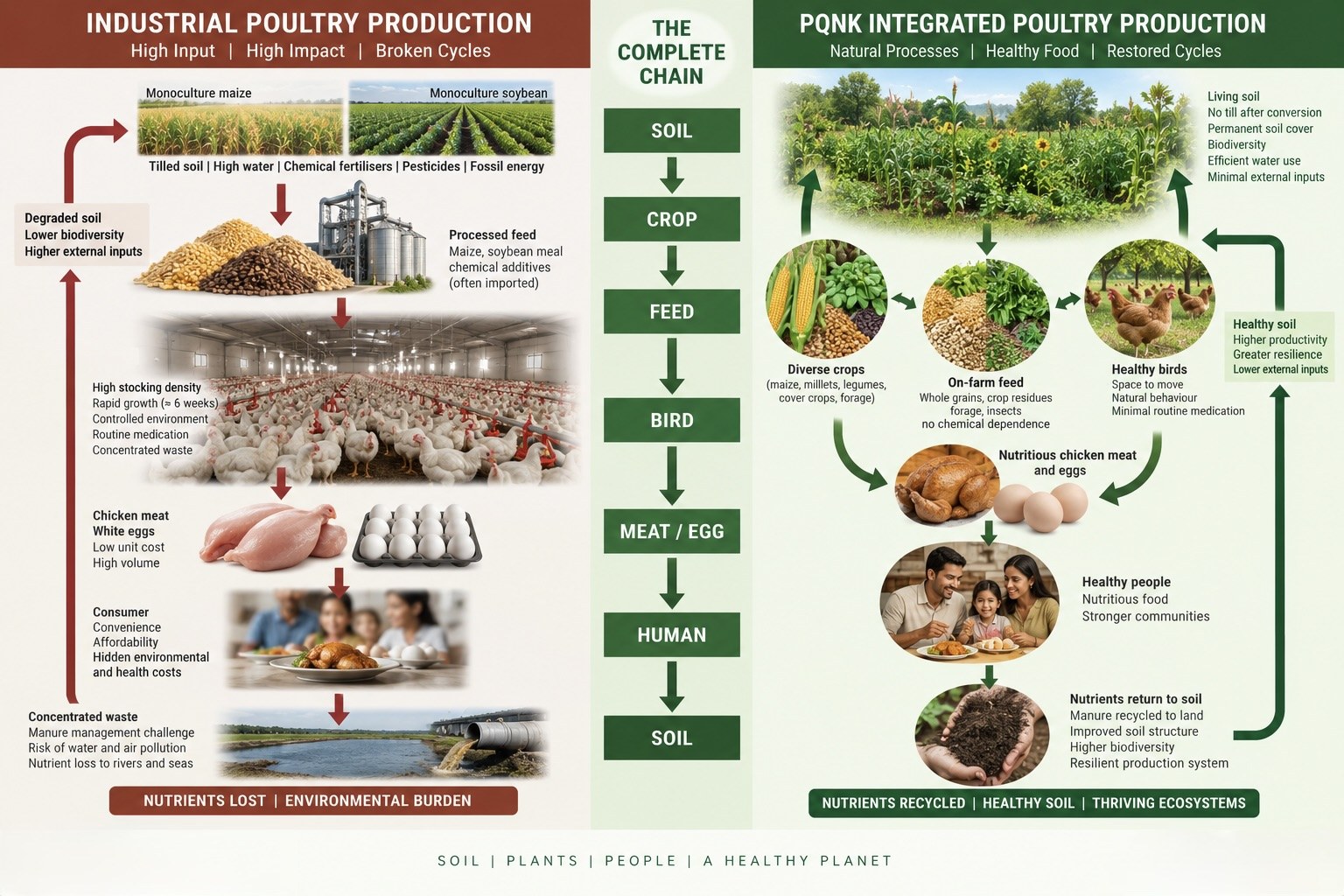
A chicken is biologically downstream of agriculture. To understand the meat or egg, follow the chain back to the soil.
1. The Article Raises the Right Question, but Not Every Claim Is Equal
The OneAlif article “Poultry Vs Organic Chicken and Eggs” raises legitimate concerns about accelerated broiler growth, confinement of laying hens, feed production, antimicrobial use, manure concentration, water pollution and the environmental footprint of industrial poultry. It also makes stronger claims about hormones, arsenic, cancer, early puberty, water use and nutritional superiority that require tighter evidence and more careful boundaries before they should be repeated as established fact.
PQNK does not need the weakest claims in order to make the strongest argument. The central issue is already visible: industrial poultry has been optimized around rapid output, feed conversion, stocking density and unit cost. The biological question is whether the whole production chain, from soil to feed crop to bird to food to human, is functioning as a healthy system.
2. Six-Week Broilers: The Acceleration Is Real
Modern broilers can reach slaughter weight in roughly six weeks. This is primarily the result of decades of genetic selection for rapid growth and feed efficiency, combined with concentrated nutrition and controlled management. The OneAlif article is strongest when it makes this distinction. Rapid growth is real; it does not require a hormone-injection explanation.
European Food Safety Authority assessments identify fast growth and high stocking density as important welfare concerns. Further selection for faster growth can worsen locomotor, comfort and other welfare problems. The relevant PQNK question is therefore not whether growth itself is bad, but whether the biological development of the whole animal remains balanced when one production trait is pushed aggressively.
Evidence note: EFSA, Welfare of broilers on farm (2023).
Maximum output is not the same as optimum biological production.
3. Hormones: Do Not Build the Argument on a Misconception
The widespread belief that the normal six-week broiler is produced by routine hormone injection is not supported as a general explanation. In the United States, for example, the FDA states that no steroid hormone implants are approved for growth purposes in poultry. Claims of illegal drug use in particular places require specific evidence, testing and enforcement records; they should not be generalized to all commercial chicken.
This correction strengthens rather than weakens the PQNK argument. Humans have already changed the bird profoundly through genetics, feed formulation and management. That is sufficient reason to examine whether the production environment is biologically appropriate.
Evidence note: U.S. FDA, Steroid Hormone Implants Used for Growth in Food-Producing Animals.
4. The Feed Question Begins in the Soil
A poultry house does not manufacture chicken from nothing. It converts agricultural feed into animal biomass. The environmental and nutritional history of maize, soybean and other feed ingredients therefore belongs inside the poultry account.
PQNK follows the chain backward:
LIVING SOIL → FEED CROP → FEED → BIRD → MEAT / EGG → HUMAN
If feed crops are produced with repeated tillage, large irrigation demand, synthetic fertiliser, pesticides and fossil energy, those upstream costs do not disappear when the grain enters a feed mill. Conversely, if feed crops are produced under a living-soil system with permanent cover, biological nutrient cycling, Soil Moisture Management and minimal disturbance, poultry begins with a different ecological foundation.
5. GMO Is Not the Most Useful Dividing Line
The OneAlif article itself acknowledges that the scientific consensus does not support the simple claim that feeding GM soy or maize makes chicken meat or eggs genetically modified or inherently unsafe. PQNK should therefore avoid reducing the feed question to “GMO versus non-GMO.”
The more useful questions are how the crop was produced, what happened to the soil, how much water and energy were required, what pesticide regime accompanied production, what nutritional profile the feed achieved, and whether biodiversity and farmer independence were strengthened or weakened. The production system is more informative than a single seed label.
6. Antibiotics: A Genuine One Health Concern
Routine antimicrobial use in healthy food-producing animals is a well-established public-health concern. WHO recommends stopping routine use of medically important antibiotics for growth promotion and disease prevention in healthy animals because antimicrobial use can select resistant bacteria that move between animals, food, people and the environment.
PQNK asks a question one stage earlier: why does a production environment require routine medication to remain productive? Veterinary treatment remains essential when animals are genuinely sick. But a system should be designed to reduce disease pressure through genetics, space, hygiene, ventilation, litter, nutrition, biodiversity and management rather than making routine medication part of the production architecture.
Evidence note: WHO Guidelines on Use of Medically Important Antimicrobials in Food-Producing Animals (2017).
7. Cages and Stocking Density: Allow the Bird to Be a Bird
Broilers and laying hens must be distinguished. Commercial broilers are generally raised in houses, while the battery-cage criticism applies principally to laying hens. Nevertheless, both systems raise the same biological question when space and environment prevent normal behaviour.
A chicken is biologically equipped to walk, scratch, forage, dust-bathe, rest, interact socially and respond to its surroundings. EFSA recommends avoiding cages for laying hens and reducing broiler stocking density so birds can perform important behaviours. PQNK applies the same principle used for plants: genetic potential is expressed through the production environment.
Evidence note: EFSA, Welfare of broilers and laying hens on farm (2023).
8. White Eggs Are Not the Problem
The OneAlif article correctly notes that eggshell colour is primarily a breed characteristic. White is not a synonym for industrial, and brown is not a certificate of biological quality. A white egg from a healthy, well-fed bird in an appropriate environment does not become inferior because of its shell colour.
The shell is packaging. The production history is what matters.
Egg composition can vary with breed, feed, forage access, season and management. Some studies find differences in fatty acids or micronutrients between production systems, but PQNK should not replace “all eggs are the same” with the equally simplistic claim that every desi or organic egg is nutritionally superior. The correct answer is measurement.
9. Manure: A Nutrient Becomes Pollution When the Cycle Is Broken
The River Wye example points to a real systems problem. UK government work identifies livestock manure, especially poultry manure, as a major contributor to surplus phosphorus in the Wye catchment. The issue is not that poultry manure is inherently waste. It is that industrial concentration can produce nutrients faster than the surrounding land and biological system can safely absorb them.
Evidence note: UK Government River Wye Action Plan; River Wye SAC Nutrient Management Plan.
In a functioning biological cycle, manure is a resource. It contains nutrients and organic matter that can support soil organisms and plant growth. When millions of birds are concentrated geographically and manure is repeatedly applied beyond crop and soil need, the same resource can become a pollutant through nutrient loss to water and air.
Nature has nutrient cycles, not waste streams. Pollution begins when the rate and place of release exceed the ecosystem’s capacity to recycle the material.
10. Water and Carbon Numbers Need Boundaries
The article reports 1.2–5.7 million litres of water per poultry house per year. That is not the biological water requirement of one chicken. Without house capacity, climate, flock cycles, drinking water, cooling, cleaning and processing boundaries, the number cannot be used to compare production systems. The deeper water account must also include feed production.
The same discipline applies to greenhouse-gas figures. A number such as kilograms of CO₂-equivalent per tonne is useful only when the system boundary, geography, feed source and production method are defined. PQNK should compare complete systems, not dramatic numbers detached from their denominator.
11. Cancer, Puberty and Diabetes: Do Not Overstate the Evidence
The article is scientifically strongest on antimicrobial resistance and weakest when it moves from possible contaminant exposure to broad claims that conventional chicken causes cancer, diabetes, cardiovascular disease, endocrine disruption or early puberty. These are different questions with different evidence requirements.
Evidence that arsenic exposure can cause disease does not prove that ordinary consumption of commercial chicken produces a harmful arsenic dose. Likewise, evidence that steroid hormones can affect endocrine function does not establish routine hormone exposure from commercial poultry. PQNK should distinguish hazard from measured exposure, association from causation, and illegal practice from normal production.
The objective is not to defend industrial poultry. It is to make the critique strong enough to withstand scientific scrutiny.
12. Organic and Desi Are Improvements, Not the Final System
Free-range, slower-growing and well-managed organic systems can improve animal behaviour and reduce some inputs, but “organic” and “desi” are not complete descriptions of the production system. A free-ranging bird may still consume feed grown on degraded soil hundreds of kilometres away. An organic crop can still be produced through repeated soil disturbance. A desi bird can still be poorly fed or badly managed.
PQNK therefore goes upstream and downstream simultaneously. It asks how the feed is produced, how the bird lives, how manure returns to the land, how water and energy are used, and what nutritional quality reaches the consumer.
13. The PQNK Integrated Poultry Production Model
A PQNK-linked poultry system begins with the natural ecosystem principle that biological production should operate as a connected cycle rather than a collection of isolated factories.
14. Closing the Biological Loop
The goal is not literal isolation from the outside world. Agricultural products remove matter from the farm, and animal health sometimes requires outside intervention. The practical objective is a sustained, near-closed-loop biological system inSYSTEM COMPONENTPQNK DIRECTIONSoilPermanent biological production zone: no repeated tillage, continuous cover, biodiversity and SMM.Feed cropsProduced with progressively lower irrigation, fossil energy and recurring purchased-input dependence.Bird geneticsSelected for productive performance together with robustness, health and appropriate growth.Housing & rangeAdequate space, ventilation, litter, movement, light and opportunity for normal behaviour.Animal healthPrevention through environment and management; veterinary treatment when genuinely required.ManureReturned at biologically appropriate rates as a nutrient resource, not accumulated as a waste stream.Food qualityMeasured through meat and egg composition, safety and nutrient density rather than labels alone. which the major flows reinforce rather than damage one another.
SOIL → CROP → FEED → BIRD → FOOD → HUMANBIRD MANURE → SOIL BIOLOGY → PLANT NUTRITION → FEED CROP
In such a system, poultry becomes a biological partner in the farm rather than the final stage of an industrial feed pipeline. Feed production supports soil restoration. Birds convert appropriate plant and biological resources into food. Manure returns nutrients to the soil at rates the living system can process. External inputs become corrective tools rather than the architecture of production.
15. What Must Be Measured
PQNK Integrated Poultry Production should be treated as a production-system framework whose performance must be measured under local conditions. The research task is not to validate whether natural biological cycles exist. It is to quantify how well the agricultural adaptation performs.
Priority measurements should include feed conversion and growth rate; mortality, gait and welfare indicators; veterinary drug use; meat and egg nutrient composition; water per kilogram of meat and per dozen eggs, including feed-production water; energy use; manure nutrient balance; soil biological and physical change; feed-crop yield and irrigation; greenhouse-gas emissions; production cost; and farmer return.
These measurements would allow conventional, organic, free-range, desi and PQNK-integrated systems to be compared on the same boundaries rather than by labels or isolated headline numbers.
16. The Larger Lesson
The poultry debate repeats a pattern already visible across production agriculture. A crop or animal is blamed for the resource demand, pollution or health concern created by the production architecture around it. Rice is called water-wasting because it is flooded. Livestock manure is called waste when animals are concentrated beyond the nutrient-absorbing capacity of the land. Chicken is blamed for the consequences of a feed, genetics, housing and waste-management system designed around maximum throughput.
PQNK changes the unit of analysis from the commodity to the ecosystem. The chicken is not considered separately from the feed crop, the feed crop separately from the soil, or the food separately from the human who consumes it.
The chicken is not the problem. The egg is not the problem. The production system determines what biological potential is expressed, what resources are consumed, what waste is created and what quality of food reaches the consumer.
The objective should therefore not merely be “organic chicken.” It should be biologically integrated poultry production: a system in which healthy soil produces healthy feed, an appropriate environment supports healthy birds, manure returns safely to the biological cycle, and the final meat or egg is judged by measured quality rather than by colour, label or marketing claim.
Nature is the production system. Human engineering has value only when it helps agriculture operate within its rules.
Sources and Evidence Basis
OneAlifcommunity. “Poultry Vs Organic Chicken and Eggs.” Article supplied for review, 2026.
European Food Safety Authority (EFSA). Welfare of broilers on farm; Welfare of broilers and laying hens on farm, 2023.
World Health Organization. Guidelines on Use of Medically Important Antimicrobials in Food-Producing Animals, 2017; Antimicrobial Resistance: The Food Chain.
U.S. Food and Drug Administration. Steroid Hormone Implants Used for Growth in Food-Producing Animals.
UK Government. River Wye Action Plan; River Wye SAC Nutrient Management Plan evidence base.
PQNK field framework and governing principles: Pedaver / PQNK knowledge system.
About This Paper
- Crop
- Maize (Corn) · Soybean
- Problem
- Animal Health / Welfare / Product Quality · External Input Dependency · Waste Accumulation / Disposal · Contamination / Residue / Food Safety Risk · Macro / Policy-Level Externalities
- Science
- Nutrition · Food Quality · Soil · Biodiversity
- Evidence
- External Scientific Evidence
- Authority
- Current / Approved PQNK Knowledge
Related PQNK Science
Key Takeaways
- Separates well-supported concerns about industrial poultry, growth rate, confinement, antimicrobial use, manure concentration, from overstated claims about hormones and disease causation that need tighter evidence before repetition.
- The six-week broiler is the product of genetic selection and feed efficiency, not routine hormone use; the U.S. FDA confirms no steroid hormone implants are approved for growth purposes in poultry, while EFSA (2023) identifies fast growth and high stocking density as the genuine welfare concern.
- The poultry account starts in the soil: feed crops grown under tillage, heavy irrigation and synthetic inputs carry those upstream costs into the bird, while feed grown under a living-soil system gives poultry a different ecological starting point.
- GMO status is not the useful dividing line for feed; how the crop was grown, and its water, energy, pesticide and soil impact, is more informative than the seed label alone.
- Routine antimicrobial use in healthy birds is a genuine One Health concern per WHO guidance; PQNK asks why a production environment needs routine medication to remain productive, rather than treating better drug stewardship as the whole answer.
- Manure is a nutrient resource, not inherent waste, it becomes pollution when geographic concentration exceeds what surrounding land can safely absorb (the UK's River Wye case), and eggshell colour is a breed trait, not a quality signal.
- Water and greenhouse-gas figures for poultry are only comparable across systems once house capacity, climate, flock cycles and upstream feed-water demand are defined as explicit system boundaries.
- PQNK Integrated Poultry Production closes the biological loop (soil → crop → feed → bird → food → human, and manure back to soil) rather than treating poultry as the end stage of an industrial feed pipeline.
- Performance must be measured, not asserted: feed conversion, welfare indicators, drug use, nutrient composition, water and energy per unit, manure balance, soil change, yield, emissions and farmer return, so systems are compared on the same boundaries rather than by label.
Related Knowledge
same problem
Chemical Fertiliser Dependency Through the PQNK Lens
An evidence-qualified review of the article “Chemical Fertilizer Industry”. It keeps the article's warning about soil degradation, nutrient pollution and biological decline, disciplines its headline numbers, and argues that fertiliser dependency is a symptom of a damaged production system (tillage, flooding, bare soil and simplified biology) that PQNK removes by restoring aerated, covered, living soil, reaching zero purchased fertiliser and pesticide at maturity.
same problem
Why the World Needs PQNK
A case for large-scale PQNK adoption addressed to five constituencies: farmers, governments, environmentalists, health professionals and poverty-alleviation institutions. Because agriculture sits where soil, water, biodiversity, food, farm economics and human health meet, restoring the farm as a living ecosystem benefits all of them at once.
same problem
Wheat Hybrid and Organic Wheat Through the PQNK Lens
A PQNK response to a widely circulated review comparing hybrid and organic wheat, arguing that hybrid describes genetics while organic describes a production standard, so the two are not opposite categories that can be compared directly. Applies PQNK's seed-is-potential, soil-is-the-production-system framework to modern wheat breeding, chemical dependence, organic certification, water management and the health claims made against modern wheat.
same problem
PQNK Knowledge Paper: The Universal Application of the PQNK Model — From Soil to Supper
Responding to a Nigerian farmer's question about whether PQNK applies outside crop farming, this paper argues that because every link in the food chain, honey, eggs, milk, meat, or fish, ultimately traces back to plant nutrition, restoring plant health under PQNK automatically improves outcomes across poultry, aquaculture, dairy, and apiculture.