

KP-178 · Nutrition & Food Quality
The PQNK Food Chain: From Soil to Soul — The Principle of Bio-potentiation
Introduces bio-potentiation as the inverse of biomagnification: where conventional agriculture concentrates toxins as they move up the food chain, a PQNK-managed living-soil system is argued to amplify nutritional value and potency at each successive trophic level, from soil to plant to animal to human.
Read or listen to the full paper ↓External Knowledge — this paper is sourced from outside Pedaver/PQNK. It is presented as supporting evidence, not as PQNK's own approved doctrine.
Abstract
The paper opens by naming the conventional agricultural pattern it inverts: biomagnification of toxins, in which synthetic chemicals concentrate in a roughly geometric progression as they ascend the food chain, reaching peak toxicity at the human level. Against this 'Pyramid of Poison,' it proposes a 'Fountain of Life' model in which nutritional potency amplifies from the soil upward rather than degrading.
It grounds the foundation of this cascade in self-generating, living soil, citing links between soil microbial diversity, particularly mycorrhizal fungi, and increased plant uptake of phosphorus and zinc, and describing on-farm nutrient cycling, mulching with crop residues, retention of roots in soil, as building a complex soil mineral and organic matrix that moves beyond simplistic NPK management. The soil is described as a 'perpetual knowledge bank' that grows its own capital through recycling on-farm biomass rather than importing it.
The first biological transformation is attributed to the plant itself: in resilient, low-stress ecosystems, plants produce a wider array of secondary metabolites, antioxidants, polyphenols, flavonoids, as part of natural defense, with the paper citing the Baranski et al. (2014) meta-analysis showing organic crops can carry significantly higher levels of certain antioxidants as scientific grounding for this step.
The paper's central mechanism, bio-potentiation, is illustrated through the herbivore stage: beta-carotene from diverse PQNK pasture grass is converted in an animal's liver to pre-formed, more bioavailable Vitamin A (retinol), while research by Benbrook et al. (2013) is cited showing biodiverse grazing produces milk and meat with a superior Omega-3 to Omega-6 ratio and beneficial fats such as conjugated linoleic acid (CLA). The animal is described as a 'nutritional refinement unit' whose output, milk, meat, manure, is of a higher order than its input of grass. At the human consumer stage, the paper references research such as the SMILES trial to argue diets from diverse, organic whole-food systems improve health outcomes not merely by removing toxins but by supplying superior, more assimilable nutrition.
A final section treats dew as a specific, measurable key performance indicator of a balanced farm organism: not a direct nutrient itself, but a catalyst supporting phyllosphere microbe activity and pre-dawn hydration, whose consistent presence signals a thriving PQNK microclimate where water, mineral, and energy cycles are in harmony. The paper closes by framing the real choice as not toxic versus non-toxic food, but a degenerative chain of poison versus a regenerative cascade of nutrition.
Full Paper
If you use “Listen”, the text of the page may be sent to your browser or operating system’s speech provider, such as Apple, Google or Microsoft, depending on the voice your device uses. Pedaver does not process, transmit or store any audio.
PQNK (Pristine Organic) Farming System
Audience: Farmers, Processors, Agronomists, Conscious Consumers Objective: To elucidate the transformative journey of nutrition in a regenerative organic system and establish the Paedar Qudratti Nizam Kashatqari (PQNK) as the gold standard for health and sustainability.
Abstract:
Conventional agriculture has illuminated a dangerous principle: Biomagnification of Toxins, where synthetic chemicals concentrate significantly, often in a geometric progression, as they move up the food chain, leading to peak toxicity at the human level. This paper introduces and scientifically validates the opposing principle inherent in the Paedar Qudratti Nizam Kashatqari (PQNK) system: Bio-potentiation of Nutrition. We posit that in a vibrant, living-food web, the value of food does not diminish but is enhanced and transformed at each trophic level, creating a cascade of perpetual abundance for all consumers, including humans.
1. Introduction: The Two Pyramids
The Pyramid of Poison: A depiction of the conventional linear and degenerative model where toxicity increases.
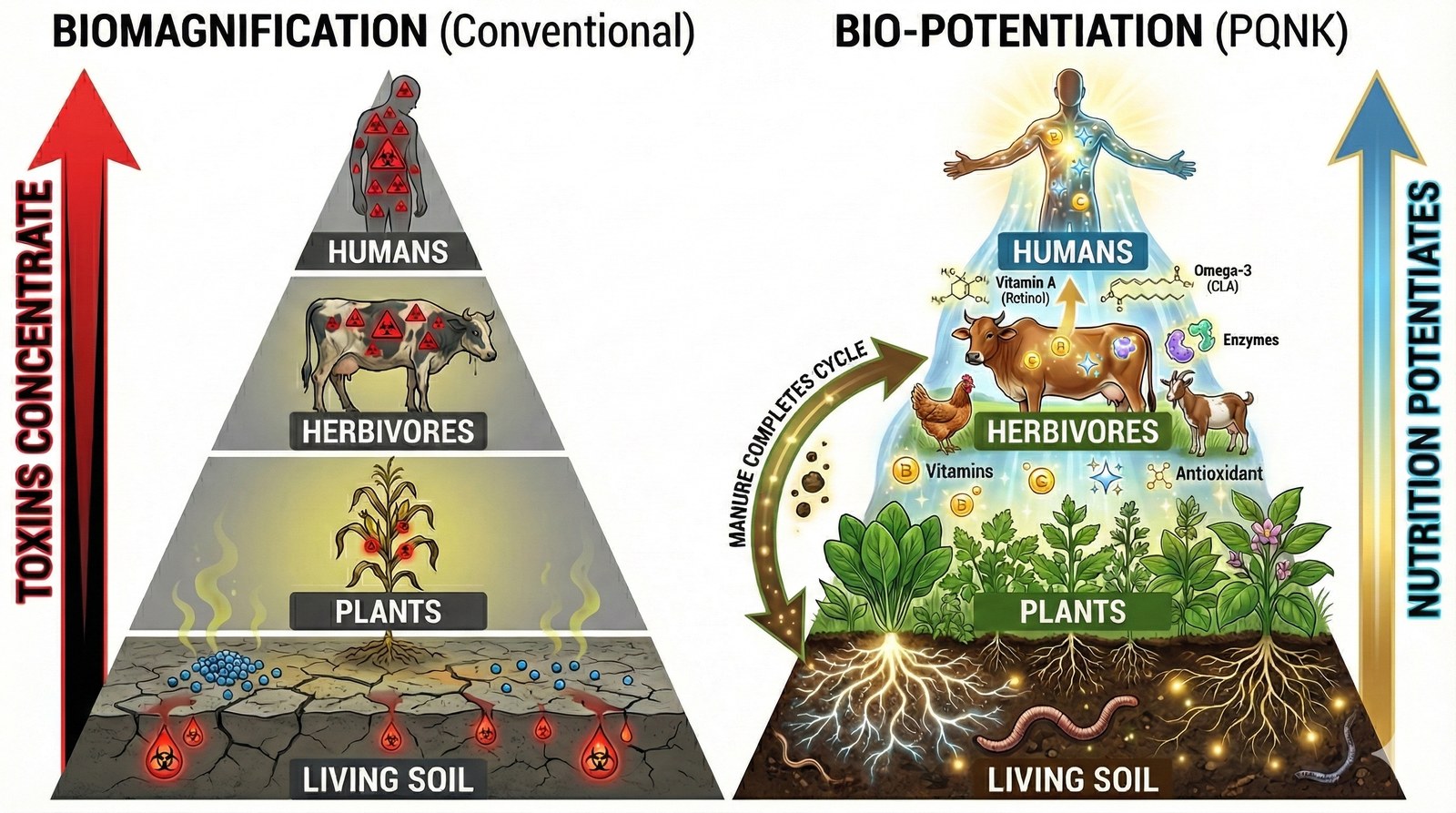
The Fountain of Life: Introducing the PQNK model—a regenerative, circular system where health and nutritional potency amplify from the soil upward.
2. The PQNK Foundation: The Self-Generating, Living Soil
Scientifically Authenticated:
Soil Microbial Diversity: Studies consistently link soil microbiome health to plant nutrient density (e.g., relationships between mycorrhizal fungi and increased phosphorus/zinc uptake).
On-Farm Nutrient Cycling: The system relies on in-situ biomass recycling through practices like mulching with crop residues, retention of roots in soil, and fostering a thriving soil food web. This creates a complex soil mineral and organic matrix, moving beyond simplistic NPK. These elements form the self-generated raw material for all future nutrition.
PQNK Lens: The farm is a self-contained universe of fertility. The soil is not a sink for imported inputs but a "perpetual knowledge bank" that grows its own capital through the intelligent recycling of on-farm biomass.
3. The First Transformation: The Plant as Alchemist
Scientifically Authenticated:
Phytonutrient Synergy: Plants in resilient, low-stress ecosystems (as created by PQNK) produce a wider array of secondary metabolites (antioxidants, polyphenols, flavonoids) as part of their natural defense mechanisms.
Nutrient Density: Research, such as the meta-analysis by Baranski et al. (2014), has shown that organic crops can have significantly higher levels of certain antioxidants.
PQNK Lens: The plant is not a passive vessel. It is an alchemist, transforming soil-based minerals and microbial signals into complex, bioactive compounds—this is the first step of bio-potentiation.
4. The Principle of Bio-potentiation: Ascending the Trophic Levels
This is the core of the paper.
Defining Bio-potentiation: The process by which nutrients are converted into more complex, bioavailable, and potent forms as they move through a healthy, closed-loop food web.
The Herbivore Example (Cow/Goat):
Scientifically Authenticated:
Vitamin Conversion: Beta-carotene from diverse PQNK pasture grass is efficiently converted in the animal's liver to pre-formed Vitamin A (Retinol), a far more bioavailable form for humans.
Fatty Acid Profile: Research by Benbrook et al. (2013) and others confirms that grazing on a biodiverse sward leads to milk and meat with a superior Omega-3 to Omega-6 ratio and the presence of beneficial fats like CLA (Conjugated Linoleic Acid).
Protein & Enzyme Creation: The animal synthesizes unique proteins, enzymes, and co-factors not present in the grass itself.
PQNK Lens: The animal is a "nutritional refinement unit." It does not just pass along plant nutrition; it elevates it. The output (milk, meat, manure) is of a higher order than the input (grass).
The Human Consumer:
Scientifically Authenticated: A growing body of research, including studies like the SMILES trial, links diets high in organic/whole foods from diverse systems to improved health outcomes. Bio-potentiation suggests the reason is not just the absence of toxins, but the presence of superior, more assimilable nutrition.
PQNK Lens: By consuming from the PQNK food chain, we are not merely "eating." We are partaking in a flow of potentiated life-force, connecting us directly back to the self-generated health of the soil.
5. The Role of Nature's Elements: The Case of Dew
Scientifically Authenticated:
Microbial Activation: Dew mitigates mild water stress and facilitates the activity of beneficial phyllosphere (leaf-surface) microbes.
Hydration & Nutrient Transport: It aids in pre-dawn hydration, supporting the initial surge of photosynthetic activity and sap flow.
PQNK Lens: Dew is a key performance indicator (KPI) of a balanced farm organism. It is not a direct nutrient but a catalyst that supports the entire system's vitality. Its consistent presence is a key indicator of a thriving PQNK microclimate, where the water cycle, mineral cycle, and energy flow are in harmony.
6. Conclusion: The Perpetual Abundance Principle in Action
The PQNK system demonstrates that the choice is not simply between "toxic" and "non-toxic" food. The real choice is between a degenerative chain of poison and a regenerative cascade of nutrition. By adopting the PQNK 'picnic' model—a system that generates its own fertility—farmers become stewards of this cascade of abundance, and consumers become vital participants in a cycle of health that honors the soil, the animal, and themselves.
7. Call to Action
For Farmers: Audit your practices through the PQNK lens. Focus on building self-sustaining soil life as your primary capital. See your farm as a closed-loop, fertile island.
For Consumers: Seek out and support producers who manage their land regeneratively. Ask not just "Is it organic?" but "Was this grown in a self-sufficient soil system?"
For Policymakers & Institutions: Develop policy frameworks and procurement programs that incentivize and reward closed-loop PQNK farming systems over input-dependent models.
Version: 1.0 Date: 30 November 2025
—————————
Footnote: Any Production Process That Inundates Soil With Water, Disturbs Soil Through Tillage, Or Leaves Soil Bare Without Organic Mulch Cover Does Not Qualify As Natural Ecosystem Science For Production Agriculture.
PQNK, to be pronounced as 'picnic', which stands for Paedar Qudratti Nizam Kashatqari, and means: the regenerative & sustainable Pristine Organic Farming System.
www.Facebook.Com/Pedaver
https://www.youtube.com/@pedaverpqnk3167/videos
pedaver@gmail.com
WhatsApp +92 320 677 6666
About This Paper
- Problem
- Declining Nutrient Density in Food · Animal Health / Welfare / Product Quality · Weak Flavor / Aroma / Quality Sensory Markers
- Science
- Nutrition · Food Quality · Biodiversity · Soil
- Evidence
- External Scientific Evidence
- Authority
- External Knowledge / Evidence
Related PQNK Science
Key Takeaways
- Defines bio-potentiation as the structural inverse of biomagnification: nutrient value amplifies rather than degrades as it moves up a healthy, closed-loop food web.
- Cites Baranski et al. (2014) on elevated antioxidant levels in organic crops, and Benbrook et al. (2013) on superior Omega-3 to Omega-6 ratios and CLA content in biodiverse-pasture milk and meat, as scientific anchors for the plant and animal stages of the model.
- Describes the herbivore as a 'nutritional refinement unit' that converts beta-carotene to pre-formed Vitamin A and synthesizes proteins, enzymes, and co-factors absent in the grass it consumes.
- References the SMILES trial and related research to argue organic/whole-food diets improve outcomes through superior nutrient assimilability, not solely through toxin absence.
- Treats dew as a specific, observable KPI of farm-system balance, a catalyst for phyllosphere microbe activity and pre-dawn hydration rather than a nutrient in itself.
- Reframes the consumer choice as being between a degenerative chain of poison and a regenerative cascade of nutrition, rather than a binary of toxic versus non-toxic food.
Related Knowledge
same problem
Nutrition-Dense Food and the Recovery of Ecological Quality
Industrial agriculture measures food primarily by yield and appearance, leaving taste, aroma, shelf stability, and mineral density as afterthoughts. This paper argues those qualities are not separate from ecology, they are the biological expression of a stable soil system, and walks through the specific mechanisms, deep rooting, fungal continuity, secondary metabolites, that connect soil health directly to what a crop tastes, smells, and how long it keeps.
same problem
The Plant Does Not Produce for Humans Alone: Carbon, Biological Production, Harvest and the Real Meaning of Agricultural Productivity
Modern agriculture measures success by harvested mass, tonnes per hectare or maunds per acre, but that is only the fraction of a plant's biological production that people remove from the field. This paper reframes the harvest as one output of a much larger plant carbon economy that also feeds roots, soil biology, residues and the wider ecosystem, and argues production should ultimately be judged by the useful nutrition delivered per hectare while the biological capacity to produce again is maintained.
same problem
Q&A: Comparing the Quality of Food from PQNK and Ancient Conventional Industrial Production Systems
A farmer's observation that PQNK produce simply tastes richer, with a more distinct aroma than chemically grown produce, prompts a stage-by-stage explanation of why: soil treated as a living matrix rather than a chemical warehouse changes not just how much a plant absorbs but how much energy it invests in the secondary metabolites that create flavor, aroma, and 'terroir' character.
same problem
The Earth Has Not Stopped Working: A Production-Agriculture Response to Environmental Fatalism, and What PQNK Restores
A widely shared social-media message, built on Lovelock's Gaia Hypothesis, ends in resignation: the planet will correct a stressed system with floods and extinctions, and all we can do is await nature's revenge. This paper accepts that we are not separate from nature but rejects the fatalism. Drawing on more than fifty years in production agriculture, it argues the core error was redesigning natural systems before understanding them, that agriculture is the clearest case, and that a degraded field is a suppressed system rather than an extinguished one, so the answer is not to fear nature's revenge but to stop fighting nature and learn again to produce with it.