

KP-080 · PQNK Philosophy, Framework & Economics
PQNK Knowledge Paper: The Universal Application of the PQNK Model — From Soil to Supper
Responding to a Nigerian farmer's question about whether PQNK applies outside crop farming, this paper argues that because every link in the food chain, honey, eggs, milk, meat, or fish, ultimately traces back to plant nutrition, restoring plant health under PQNK automatically improves outcomes across poultry, aquaculture, dairy, and apiculture.
Read or listen to the full paper ↓Abstract
The paper opens by directly addressing a misconception it treats as common and understandable: that PQNK is a set of crop and soil techniques with nothing to offer farmers in poultry, fishery, or livestock. It restates PQNK's non-negotiable core principle as the answer, that all life in the food chain is ultimately sustained by the nutritional quality of plants, and that restoring the pristine health of the plant automatically enhances the health, efficiency, and quality of every organism further up the chain that consumes it.
It frames the shared problem across sectors as an 'Input-Cost-to-Output-Value Ratio' crisis: poultry, aquaculture, and dairy farmers alike face rising concentrated-feed costs alongside stagnant animal health and productivity, a problem the paper argues PQNK fixes at the source rather than at the feed trough.
Poultry is addressed first: PQNK-managed grains, greens, and insects carry higher Brix and mineral density and greater digestibility, which the paper claims lowers feed volume needed, strengthens immune systems and reduces antibiotic dependence, and produces stronger eggshells, darker yolks, and firmer, more flavorful meat. Aquaculture follows a similar logic, with PQNK-grown Azolla and duckweed replacing a share of formulated feed, reducing waste-driven water pollution, and improving fish disease resistance and growth.
Dairy and livestock receive the paper's most dramatic claimed results: it cites a conventional milk-to-feed cost ratio where feed can consume as much as 72% of milk's value, against a PQNK target of 22-30%, driven by high-Brix, diverse fodder that the paper says can lift land carrying capacity from 3-4 buffaloes per acre to 13 in a cited Pakistani example, alongside reduced mastitis and hoof problems and milk richer in CLA (conjugated linoleic acid). Apiculture closes the sector survey, with PQNK-grown flowers argued to produce nectar and pollen with higher mineral and sugar content, supporting stronger, more pest-resistant hives and higher honey yields.
The paper closes by reframing PQNK's scope directly for the questioner and similar farmers: not a crop-specific method to be adopted alongside one's specialty, but the foundational base of the entire food pyramid, such that adopting PQNK principles builds any specialty, poultry, fishery, dairy, or apiculture, on its strongest possible foundation.
Full Paper
If you use “Listen”, the text of the page may be sent to your browser or operating system’s speech provider, such as Apple, Google or Microsoft, depending on the voice your device uses. Pedaver does not process, transmit or store any audio.
1. Introduction: The Core PQNK Principle
The question posed by Farmer Usman from Nigeria is both insightful and fundamental. It touches upon a common misconception: that PQNK is a set of techniques limited only to crop and soil management.
To clarify, PQNK is not merely a technique; it is a foundational philosophy. Its core, non-negotiable principle is this:
All life in the food chain is ultimately sustained by the nutritional quality of plants.
Whether the end product is honey, eggs, milk, meat, or fish, the primary input is plant-based nutrition. The PQNK model posits that by restoring the "Pristine" or "Qudratti" (Natural) health of the plant, we automatically enhance the health, efficiency, and quality of every organism that consumes it.
2. The PQNK Lens: The Unbreakable Chain of Nutrition
The modern agricultural dilemma, across all sectors, is the Input-Cost-to-Output-Value Ratio. Farmers in poultry, aquaculture, and dairy are struggling because the cost of concentrated feeds is skyrocketing, while the health and productivity of their animals remain suboptimal.
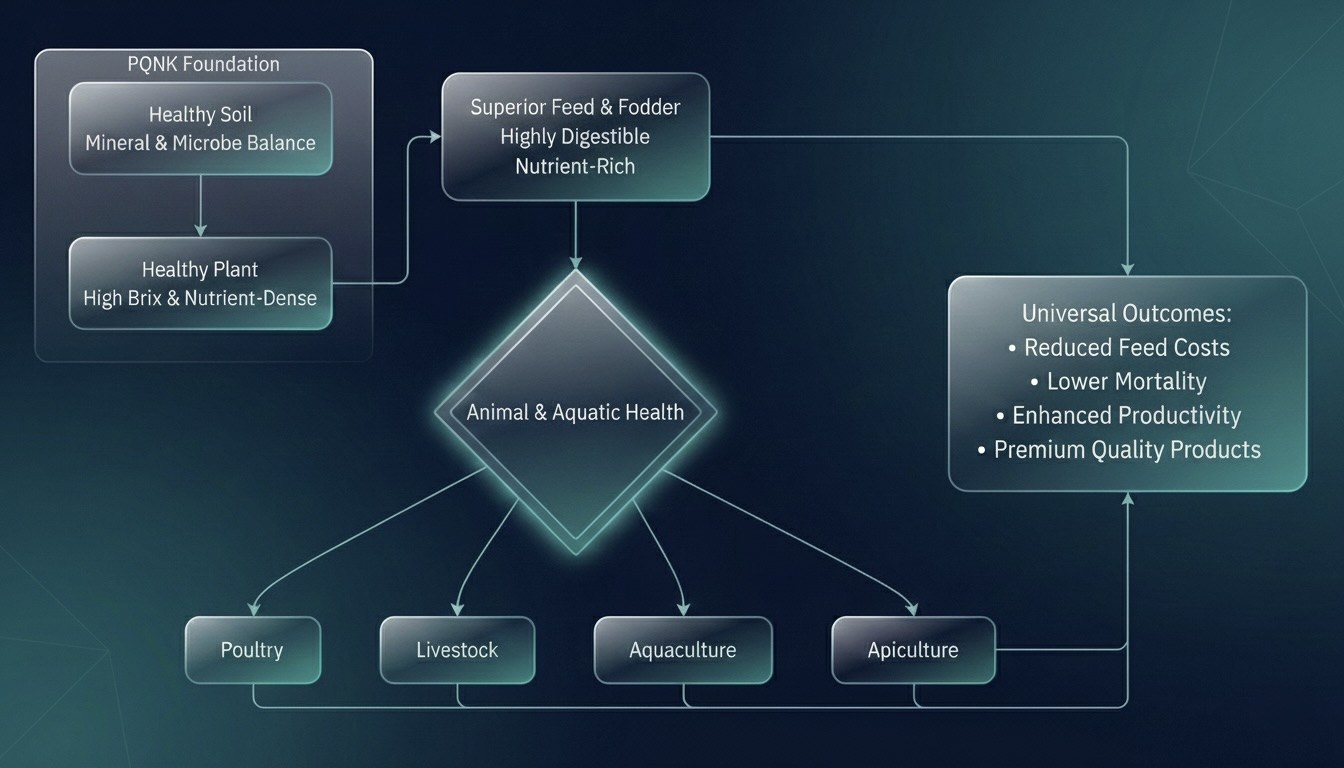
PQNK addresses this by fixing the problem at its source. The following chart illustrates the universal PQNK ecosystem:
3. Practical Application of PQNK Across Agricultural Sectors
a) PQNK in Poultry:
The Problem: Reliance on expensive, medicated feed. High mortality rates, poor feed conversion ratio (FCR), and weak shells.
The PQNK Solution: When poultry are fed grains, greens, and insects from a PQNK-managed farm, the plants have higher Brix levels (sugar and mineral density) and are more digestible.
The Outcome:
Reduced Feed Costs: Birds consume less because their nutritional needs are met with less volume.
Improved Health: Stronger immune systems reduce dependence on antibiotics and vaccines.
Enhanced Quality: Eggs have stronger shells, darker yolks, and richer taste. Meat is firmer and more flavorful.
b) PQNK in Aquaculture (Fishery):
The Problem: High cost of formulated feed, water pollution from waste feed, and disease outbreaks.
The PQNK Solution: A PQNK system produces nutrient-dense aquatic plants (like Azolla, Duckweed) and fosters a healthy ecosystem of insects and microbes in and around the pond. Fish fed with these plants achieve superior health.
The Outcome:
Lower Feed Input: Natural, on-farm feed sources replace a significant portion of expensive concentrates.
Cleaner Water: Highly digestible PQNK-based feed leads to less waste, improving water quality.
Healthier Fish: Improved natural resistance to pathogens and better growth rates.
c) PQNK in Livestock & Dairy:
The Problem: The milk-to-feed cost ratio is disastrous. As cited, in conventional systems, feed cost can be as high as 72% of the milk's value, making profitability nearly impossible.
The PQNK Solution: This is where PQNK delivers its most dramatic results. By growing high-Brix, diverse fodder crops (grasses, legumes, trees) on a PQNK-managed acre, the land's carrying capacity skyrockets.
The Outcome:
Transformed Economics: Feed cost is reduced to the ideal 22-30% of milk value.
Increased Carrying Capacity: The example from Pakistan is a testament: from 3-4 buffaloes per acre to 13 animals per acre is achievable.
Superior Animal Health: Reduced incidence of mastitis, hoof problems, and metabolic disorders.
Premium Milk & Meat: Products are richer in nutrients, CLA (Conjugated Linoleic Acid), and taste.
d) PQNK in Apiculture:
The Problem: Bees suffering from colony collapse disorder, low honey yields, and poor hive health.
The PQNK Solution: Bees forage on nectar and pollen from plants. PQNK-grown flowers produce nectar with higher mineral and sugar content, and pollen packed with vital nutrients.
The Outcome: Stronger hives, more resistant to pests and diseases, higher honey production, and a superior quality product.
4. Conclusion: PQNK is the Universal Key
To our fellow farmers in poultry, fishery, and all other fields: The PQNK model is absolutely for you.
The feeling that PQNK does not cater to your field is understandable if the model is viewed in fragments. When seen as a whole system, it becomes clear that PQNK is the master key that unlocks efficiency, sustainability, and profitability across the entire agricultural spectrum.
Do not see PQNK as just about crops. See it as about the base of the entire food pyramid. By fixing the base, we fix everything that rests upon it. Your choice to adopt PQNK is not a shift away from your specialty; it is the decision to build your specialty on the strongest possible foundation.
Adopt PQNK. Nourish the Plant, and it will Nourish Everything Else.
—————————
Footnote: Any Production Process That Inundates Soil With Water, Disturbs Soil Through Tillage, Or Leaves Soil Bare Without Organic Mulch Cover Does Not Qualify As Natural Ecosystem Science For Production Agriculture.
PQNK, to be pronounced as 'picnic', which stands for Paedar Qudratti Nizam Kashatqari, and means: the regenerative & sustainable Pristine Organic Farming System.
www.Facebook.Com/Pedaver
https://www.youtube.com/@pedaverpqnk3167/videos
pedaver@gmail.com
WhatsApp +92 320 677 6666
About This Paper
- Crop
- Pasture Grass (crop group) · Azolla · Duckweed
- Problem
- High Input / Production Cost · Animal Health / Welfare / Product Quality · Macro / Policy-Level Externalities
- Science
- Nutrition · Food Quality · Biodiversity · Economics
- Evidence
- Field Observation
- Authority
- Current / Approved PQNK Knowledge
Related PQNK Science
Key Takeaways
- States PQNK's core universal principle: all animal food chains (honey, eggs, milk, meat, fish) trace back to plant nutrition, so restoring plant health under PQNK improves outcomes across every downstream sector.
- Diagnoses a shared 'Input-Cost-to-Output-Value Ratio' crisis across poultry, aquaculture, and dairy, driven by rising concentrated-feed costs against stagnant animal productivity.
- Claims PQNK-grown poultry feed (higher Brix, more digestible) reduces feed volume needed, strengthens immunity, and improves egg shell strength, yolk color, and meat flavor.
- Cites a Pakistani example of PQNK fodder lifting land carrying capacity from 3-4 buffaloes per acre to 13, while reducing the milk-to-feed cost ratio from as high as 72% to a target of 22-30%.
- Describes PQNK-grown Azolla and duckweed as feed substitutes in aquaculture that reduce formulated-feed costs and improve water quality and fish disease resistance.
- Reframes PQNK as the foundational base of the entire food pyramid rather than a crop-specific technique, applicable to any specialty built on plant-derived nutrition.
Related Knowledge
same problem
The Chicken Is Not the Problem, the Production System Is: From Industrial Poultry to PQNK Integrated Poultry Production
A point-by-point PQNK response to a widely circulated critique of industrial poultry, separating the well-supported concerns, accelerated growth genetics, welfare under confinement, antimicrobial resistance, nutrient concentration in manure, from overstated claims about hormones and disease causation. The paper traces the poultry chain back through feed to the soil that grew it, and proposes PQNK Integrated Poultry Production: a near-closed biological loop in which feed crops restore soil, birds are kept under conditions that allow normal behaviour, and manure returns to the land at rates the system can absorb, closing with a specific list of what must actually be measured to compare production systems fairly.
same problem
Restoring Earth's Operating System: The PQNK Framework for Regenerative Agriculture
A comprehensive policy and investment brief that models global agriculture's degenerative trajectory against a PQNK-led alternative, laying out true-cost economics, a five-year implementation roadmap with quarterly KPIs, and specific financial instruments, from transition bonds to farmer cooperative financing, meant to move PQNK from pilot to planetary scale.
same problem
Chemical Fertiliser Dependency Through the PQNK Lens
An evidence-qualified review of the article “Chemical Fertilizer Industry”. It keeps the article's warning about soil degradation, nutrient pollution and biological decline, disciplines its headline numbers, and argues that fertiliser dependency is a symptom of a damaged production system (tillage, flooding, bare soil and simplified biology) that PQNK removes by restoring aerated, covered, living soil, reaching zero purchased fertiliser and pesticide at maturity.
same problem
Why the World Needs PQNK
A case for large-scale PQNK adoption addressed to five constituencies: farmers, governments, environmentalists, health professionals and poverty-alleviation institutions. Because agriculture sits where soil, water, biodiversity, food, farm economics and human health meet, restoring the farm as a living ecosystem benefits all of them at once.