

KP-151 · Soil Science & PQNK System
The Pest-Free Revolution: Eliminating Agrochemicals by Unleashing Soil Biology with the PQNK System
A knowledge paper arguing that a properly implemented PQNK system leaves crops 98-99% free of pest and disease pressure through native Bt bacteria and a conserved predator population, and that the system's single greatest failure point is not input scarcity but over-irrigation.
Read or listen to the full paper ↓Abstract
This paper presents PQNK as a shift from symptomatic, 'find and destroy' pest control toward Ecological Pest Management, reporting that a properly implemented system achieves 98-99% freedom from pest and disease pressure without chemical pesticides or GMO seed. It documents two core protective mechanisms: native, soil-resident Bacillus thuringiensis (Bt), whose Cry and Cyt protein crystals disrupt a susceptible larva's gut lining after ingestion, and a conserved predator population the paper describes with the field metaphor 'against every pest there are 1,700 predators,' citing examples such as lady beetle larvae consuming 300-400 aphids each and Trichogramma wasps parasitizing pest eggs directly.
A third mechanism, Induced Systemic Resistance (ISR), is described as arising from Plant Growth-Promoting Rhizobacteria that prime a plant's own defense responses, meaning the same practices that foster Bt and predator populations also 'vaccinate' the plant from within.
The paper's most consequential claim concerns failure mode: it identifies the field-observed 1-2% system failure rate as tracing consistently back to over-irrigation and root-zone saturation, not a lack of inputs. Waterlogging dilutes the concentration of Bt toxins and other defensive compounds in the soil solution below a lethal threshold for pests, while simultaneously driving out oxygen and favoring anaerobic pathogens like Pythium and Phytophthora; the resulting oxygen-starved roots trigger a stress cascade of compensatory leaf overgrowth, watery low-brix produce, and pest-attracting volatile organic compounds.
Actionable practice is organized around two levers. Soil preparation includes subsoiling to break hardpan (typically found 7 to 20 inches deep), permanent raised beds built up through in-situ residue recycling rather than imported compost, and precision-disturbance planting via SIPP or VIPP implements that preserve soil structure across 99% of the field. Water management centers on a furrow-irrigation method using lightly compacted furrow bottoms to force lateral, horizontal infiltration into raised beds, which the paper argues is superior to drip irrigation on three counts: it eliminates the bare-soil evaporation typical under drip emitters, avoids the saturated 'bulb' of soil that drip creates around each emitter, and encourages more extensive, resilient root systems.
Weeds are treated as facilitators rather than competitors, since tap-rooted species break up localized compaction and non-cropped field margins provide habitat, nectar, and pollen that sustain the predator population without dedicated insectary plantings.
Full Paper
If you use “Listen”, the text of the page may be sent to your browser or operating system’s speech provider, such as Apple, Google or Microsoft, depending on the voice your device uses. Pedaver does not process, transmit or store any audio.
A Knowledge Paper on Plant Quality through Natural Kinetics
Date: September 22, 2025 Author: The PQNK Research Team
Executive Summary
This knowledge paper presents a comprehensive analysis of the Plant Quality through Natural Kinetics (PQNK) system, a holistic agricultural management approach. PQNK moves beyond symptomatic pest control to address the root causes of plant stress and vulnerability. Field results consistently demonstrate that a properly implemented PQNK system results in crops that are virtually free (98-99%) from pest and disease pressure, eliminating the need for chemical pesticides and GMO seeds.
The core premise of PQNK is the cultivation of a robust soil ecosystem that naturally suppresses pests through two primary mechanisms: 1) the promotion of beneficial native microbes like Bacillus thuringiensis (Bt), and 2) the support of a diverse population of natural predator insects. The paper identifies the single greatest point of failure for this system not as a lack of inputs, but as a management error: over-irrigation leading to root zone saturation. This saturation dilutes plant defenses, creates anaerobic soil conditions, and triggers plant stress responses that manifest as pest attraction, disease susceptibility, and watery, nutrient-deficient produce.
This document details the scientific principles behind PQNK, validates field observations with established theory, and provides actionable recommendations for farmers to successfully transition to this resilient and productive system.
1. Introduction: The Paradigm Shift from Symptom Control to System Health
Conventional pest management operates on a "find and destroy" model, relying on broad-spectrum chemical pesticides and genetically modified organisms (GMOs). This approach presents significant challenges, including:
Pest Resistance: Rapid evolution of insect and disease resistance to treatments.
Environmental Harm: Negative impacts on non-target species, water quality, and soil biodiversity.
Economic Burden: High and recurring input costs for farmers.
Treadmill Effect: Eliminating pests also eliminates their natural predators, creating a dependency cycle on chemicals.
The PQNK system represents a paradigm shift towards Ecological Pest Management (EPM). It posits that a healthy, balanced agroecosystem is inherently resistant to outbreaks. The goal is not to eradicate all pests but to manage the farm's ecology so that natural control mechanisms keep pest populations below economically damaging thresholds.
2. The Science Behind PQNK: Core Mechanisms of Protection
2.1. The Role of Bacillus thuringiensis (Bt) as a Natural Bio-Inseciticide
Bt is not an external input in the PQNK system; it is a nurtured resident.
What is Bt? Bacillus thuringiensis is a gram-positive, soil-dwelling bacterium found naturally in soils worldwide. It has been used for decades as an organic microbial insecticide.
Mode of Action: During sporulation, Bt produces protein crystals (Cry and Cyt toxins). These protoxins are inert until ingested by a specific insect larva. Inside the alkaline gut of a susceptible insect, the proteins are solubilized and proteolytically activated. The activated toxin binds to specific receptors on the gut epithelium, creating pores that disrupt gut integrity. This leads to gut paralysis, septicemia, and death by starvation within hours.
Specificity: Different Bt strains produce different toxins, each targeting specific insect orders (e.g., kurstaki for caterpillars, israelensis for mosquitoes and black flies). This specificity is what makes it harmless to humans, animals, and most beneficial insects.
The PQNK Advantage: Instead of applying Bt spores as a spray (which degrades in sunlight), PQNK focuses on creating the soil conditions—optimal pH, organic matter, moisture, and aeration—that allow native Bt populations to thrive and continuously colonize the rhizosphere (root zone), providing a constant, natural defense for the plant.
2.2. The Predator-Prey Balance: Unleashing the "Army of Beneficials"
The field observation that "against every pest there are 1,700 predators" is a powerful metaphor for the immense diversity of natural enemies present in a functional ecosystem.
Ecological Foundation: A single square meter of healthy farmland can contain thousands of predatory and parasitic insects, mites, and spiders. For example:
Lady Beetles: A single larva can consume 300-400 aphids.
Parasitic Wasps: Species like Trichogramma lay eggs inside pest eggs, halting development.
Ground Beetles: Nocturnal predators of slugs, snails, and soil-dwelling pests.
Spiders: Generalist predators that provide constant background predation pressure.
The PQNK Approach: By eliminating broad-spectrum pesticides and providing habitat (e.g., flowering strips for nectar, undisturbed ground for nesting), PQNK conserves and amplifies this natural enemy complex. This creates a resilient, self-regulating system where pest populations are checked before they can explode.
2.3. The Plant-Health Connection: Induced Systemic Resistance (ISR)
A plant receiving balanced nutrition and not under stress is naturally more resistant.
Scientific Principle: Plants possess sophisticated immune responses. A healthily functioning root system, supported by a beneficial microbiome, can "prime" the plant's defenses through a phenomenon called Induced Systemic Resistance (ISR). Root-associated bacteria, including certain PGPR (Plant Growth-Promoting Rhizobacteria), trigger a physiological state in the plant that allows it to activate defense responses more rapidly and effectively upon pest or pathogen attack.
The PQNK Link: The practices that foster Bt and predators also foster these beneficial ISR-inducing microbes, effectively vaccinating the plant from within.
3. Validating Field Observations: The Critical Impact of Water Management
The consistent field report that the 1-2% system failure is linked to over-irrigation is not an anomaly; it is a perfect demonstration of ecological principles.
3.1. The Failure Mode: Root Zone Saturation and Its Consequences
The Dilution Effect: In a waterlogged soil, the concentration of minerals and dissolved compounds—including the toxic proteins produced by Bt and other defensive plant compounds—in the soil solution is drastically reduced. An insect larva ingesting this diluted solution receives a sub-lethal dose, insufficient to cause death. This allows pests to survive and thrive.
Shift to Anaerobiosis: Soil pores filled with water drive out oxygen. Beneficial microbes like Bt and other ISR-inducing bacteria are largely aerobic. Anaerobic conditions suffocate them and favor the proliferation of anaerobic, often pathogenic, fungi and bacteria (e.g., Pythium, Phytophthora), leading to root rot and disease.
Root Dysfunction: Oxygen-starved roots cannot perform respiration effectively. This cripples their ability to uptake water and nutrients, placing the entire plant under severe physiological stress.
3.2. Symptomatology of a Stressed System
Leaf Overgrowth: This is a classic stress response known as etiolation or compensatory growth. The plant, unable to uptake sufficient nutrients due to damaged roots, attempts to compensate by allocating resources to increase leaf area to capture more sunlight for photosynthesis. This is not a sign of vigor but of desperation, making the plant a target for pests.
Watery, Low-Nutrient Produce: The combination of disrupted mineral uptake and the physical dilution of the plant's cell sap results in produce with high water content and low "brix" (sugar and mineral content). This reduces nutritional density, flavor, and shelf-life.
Pest and Disease Appearance: Stressed plants emit different volatile organic compounds (VOCs) that are more attractive to pests. Furthermore, their weakened state and diluted chemical defenses make them easy targets, completing a vicious cycle.
4. The PQNK Practice: Actionable Recommendations for Farmers
4.1. Creating the "Enabling Environment" in the Soil
Break the Hardpan with Strategic Mechanical Intervention: The primary method for addressing a established hardpan (typically found from 7 to 20 inches deep) is subsoiling. This is a necessary first step to physically fracture the concrete-like layer and restore vertical water infiltration and root penetration. Deep-rooted cover crops like Daikon radish or alfalfa play a critical supplementary and long-term role. Once the hardpan is fractured, their roots grow through the cracks, enlarging pores to enhance water movement and, in sandy soils, their biomass helps choke large pores to improve water retention. They are essential for maintaining soil porosity and preventing the reformation of the hardpan.
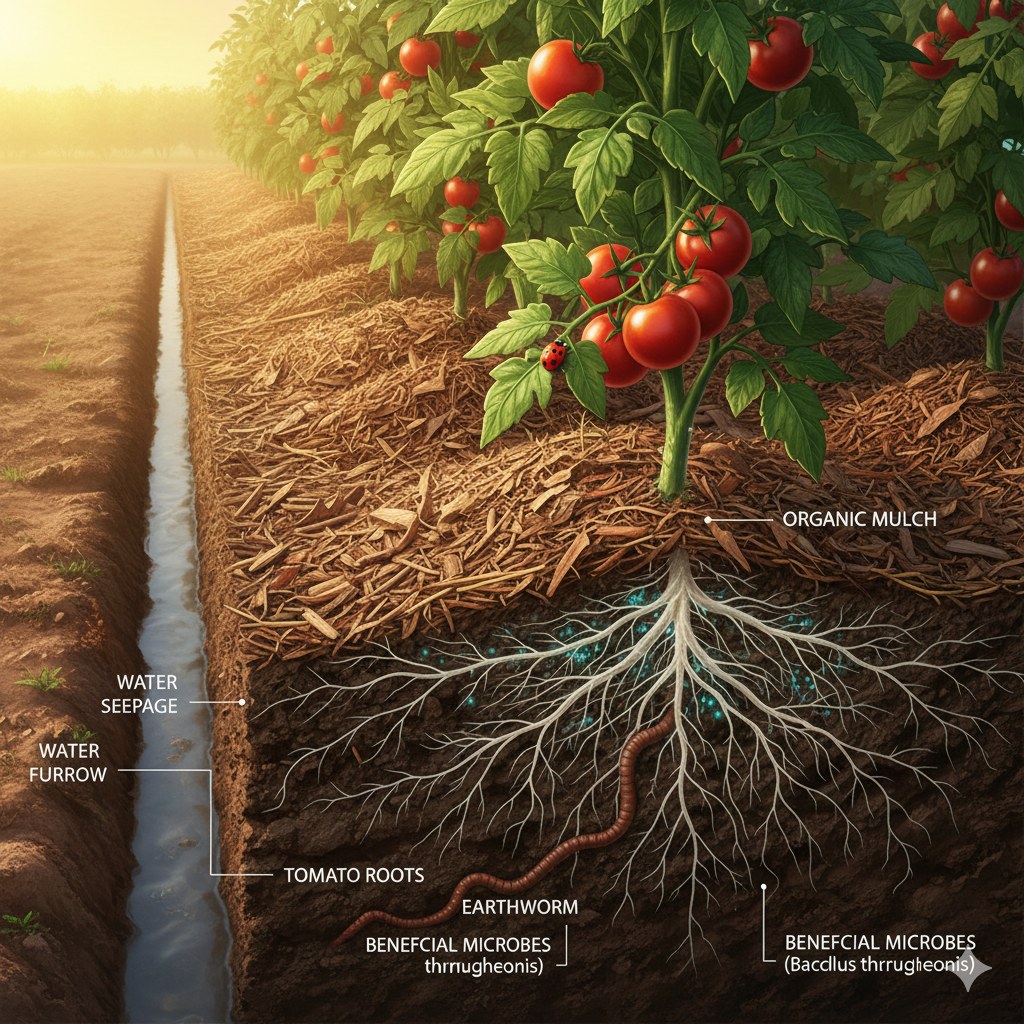
Build Organic Matter through In-Situ Biomass Production: The PQNK system operates on a permanent raised bed structure. Soil amendment is achieved not by importing compost or manure, but through the systematic recycling of crop residues. These residues are left on the surface as a thick organic mulch. Using specialized equipment (SIPP or VIPP planters), new crops are planted directly through this mulch layer. This practice continuously adds organic matter, which decomposes to feed the soil microbial life central to the PQNK system, all while protecting the soil surface.
Precision Soil Disturbance with SIPP/VIPP Technology: PQNK does not adhere to a strict no-till dogma. Instead, it utilizes precision disturbance technology:
The SIPP (Slot-In Planting and Plowing) implement makes a minimal disturbance, creating a narrow strip (approximately 1-inch wide and 1-3 inches deep) solely for seed placement, tailored to seed type and soil moisture.
The VIPP (V-Shape Intelligent Precision Planter) disturbs the soil even less, placing the seed through the organic mulch layer like a bird's beak, without tilling the soil. This approach preserves the soil structure, fungal networks, and insect habitat across 99% of the field, only intervening where absolutely necessary for seeding.
4.2. Precision Water Management: The PQNK Furrow-Irrigation System
The PQNK system employs a unique and highly efficient furrow-irrigation method that is fundamentally different from conventional practices.
The Mechanism of Horizontal Infiltration: Water is applied through furrows whose bottoms are lightly compacted by the passing of tractors. This compaction, combined with the raised bed structure, forces water to seep laterally and horizontally into the beds rather than percolating vertically beyond the root zone. The thick organic mulch covering the beds plays a vital role: it absorbs dew and humidity from the air, keeping the soil surface consistently moist and preventing capillary action that would draw water upward to evaporate.
The Result: Drastic Reduction in Irrigation Need: This system creates a highly stable, moist root environment with minimal evaporation loss. Consequently, irrigation water use often drops to nearly zero after the initial establishment of well-matured beds. Only one or two supplemental applications may be required under extreme drought conditions.
Superiority to Drip Irrigation: This method is more efficient than drip irrigation for several reasons:
Elimination of Evaporation: The organic mulch cover is far more effective at preventing evaporation than the exposed soil typical under drip lines.
Prevention of Root Saturation: Drip irrigation often creates a saturated "bulb" of soil around the emitter, leading to root suffocation, anaerobic conditions, and disease susceptibility. PQNK's horizontal infiltration provides uniform moisture without saturation.
Promotion of Robust Root Systems: Because moisture is evenly distributed and the soil is not saturated, roots are encouraged to grow extensively to seek water and nutrients, leading to better-anchored, healthier, and more resilient plants that are less prone to deficiencies and diseases.
4.3. Supporting the Predator Population: The Role of Weeds
Weeds as Facilitators, Not Foes: Within the PQNK framework, weeds are not eradicated. They are recognized as facilitators that emerge to amend the soil—for instance, tap-rooted weeds break up compaction in areas that need it, and pioneer species cover bare soil. When soil conditions are fully optimized through the PQNK system, weed pressure naturally diminishes.
Natural Habitat Provision: Therefore, dedicated insectary strips are not necessary. The weeds that grow in non-cropped areas of the field (e.g., furrows, borders) provide ample habitat, nectar, and pollen for beneficial predator insects. This managed coexistence ensures a permanent and thriving population of natural enemies within the farm's ecology without requiring separate planting programs. The system is designed to inherently provide "spaces where predators live.”
5. Results and Benefits: Documented Outcomes
A successfully implemented PQNK system leads to:
Near-Elimination of Pest Issues: >98% reduction in pest and disease pressure.
Elimination of Pesticide Costs: Significant reduction in input costs and breaking of the chemical treadmill.
Higher Quality Produce: Increased Brix levels, nutritional density, flavor, and storability.
Enhanced Soil Health: Improved water infiltration, soil structure, and microbial biomass.
Increased Farm Resilience: A biodiverse system is more adaptable to weather extremes and climate stress.
6. Conclusion and Future Directions
The PQNK system is a testament to the power of working with, rather than against, natural ecological processes. It demonstrates that the ultimate form of plant protection is not a product in a bottle, but a managed, thriving ecosystem beneath our feet. The focus shifts from killing pests to growing healthy plants, with water management emerging as the most critical leverage point for success.
Future work should focus on formalizing on-farm research to collect robust data on soil microbial shifts under PQNK, further quantifying the economic benefits, and refining water management protocols for different crops and climates. By adopting this knowledge-driven approach, farmers can build more profitable, sustainable, and resilient operations.Footnote: Any Production Process That Inundates Soil With Water, Disturbs Soil Through Tillage, Or Leaves Soil Bare Without Organic Mulch Cover Does Not Qualify As Natural Ecosystem Science For Production Agriculture.PQNK, to be pronounced as 'picnic', which stands for Paedar Qudratti Nizam Kashatqari, and means: the regenerative & sustainable Pristine Organic Farming System.www.Facebook.Com/Pedaver https://www.youtube.com/@pedaverpqnk3167/videos pedaver@gmail.comWhatsApp +92 320 677 6666
About This Paper
- Problem
- General Pest Pressure · Over-Irrigation · Hardpan · External Input Dependency
- Science
- Crop Protection · Water · Soil · Biodiversity
- Evidence
- Field Observation
- Authority
- Current / Approved PQNK Knowledge
Related PQNK Science
Key Takeaways
- A properly implemented PQNK system is reported to achieve 98-99% freedom from pest and disease pressure without chemical pesticides or GMO seed.
- The field-observed 1-2% system failure rate traces consistently to over-irrigation and root-zone saturation, not to a shortage of inputs, since waterlogging dilutes Bt toxin concentration below a lethal threshold and shifts soil anaerobic.
- Hardpan is typically found 7-20 inches deep and is addressed by one-time subsoiling; ongoing planting uses precision SIPP/VIPP implements that disturb less than 1% of the field.
- PQNK's lateral furrow-irrigation method is argued to outperform drip irrigation by eliminating bare-soil evaporation, avoiding drip's saturated root 'bulb,' and promoting more extensive root systems.
- Predator conservation relies on the field metaphor of roughly 1,700 predator species per pest, with examples including lady beetle larvae (300-400 aphids consumed each) and Trichogramma parasitic wasps, sustained through weedy field margins rather than dedicated insectary strips.
Related Knowledge
same problem
Chilli Production Under PQNK (PICNIC)
Chilli is biologically perennial and can remain productive for over a decade, but conventional short-cycle, urea-dependent management collapses that potential into a pest-prone annual grind. This paper shows how PQNK's soil-conversion framework and a single apical-pinching intervention restore chilli to a low-cost, high-density perennial crop, validated on a Hafizabad farm.
same problem
Knowledge Paper: PQNK Rose Production
Cut-flower rose production is reframed as a closed-loop perennial system under PQNK, reaching a striking 8,712 plants per acre on twin-row permanent beds, with weeds treated as mulch, alfalfa grown as living nitrogen-fixing ground cover, and strict soil-moisture management replacing scheduled irrigation.
same problem
Balangu & Basil Seed Production Under PQNK
A complete Punjab-focused production guide showing how Balangu (Lallemantia royleana) and Basil seed crops are grown on PQNK's permanent raised-bed system, from hardpan-breaking through harvest and storage.
same problem
Rethinking Agricultural Systems – The PQNK Framework (A1)
This framework document defines PQNK not as an addition of techniques to conventional farming but as a first-principles diagnostic standard, built on four non-negotiable axioms, for distinguishing genuine ecosystem agriculture from repackaged extraction dressed up as 'regenerative' or 'sustainable.'