

KP-025 · Crop-Specific Guides
Chilli Production Under PQNK (PICNIC)
Chilli is biologically perennial and can remain productive for over a decade, but conventional short-cycle, urea-dependent management collapses that potential into a pest-prone annual grind. This paper shows how PQNK's soil-conversion framework and a single apical-pinching intervention restore chilli to a low-cost, high-density perennial crop, validated on a Hafizabad farm.
Read or listen to the full paper ↓Abstract
The paper opens by recovering what it calls a forgotten reality: chilli (Capsicum spp.) is biologically perennial, similar in this respect to cotton, and can remain productive for many years, sometimes exceeding a decade, where severe cold stress is absent or properly managed. Yield decline, it argues, is not inherent to the plant but is induced by cold stress, soil ecosystem collapse, and repeated chemical and mechanical disturbance, so PQNK grows chilli with an explicit intention of longevity.
The root cause of chilli failure under conventional 'Ancient Conventional Industrial' (ACI) systems is traced to three decades of aggressive tillage, chemical fertilizer, and pesticide use destroying soil structure and biology. With microbial life, the plant's primary nutrition provider, absent, farmers are forced onto nitrogen fertilizers, especially urea, which the paper describes as attracting sucking insects the way honey attracts flies; the resulting pest pressure invites viral disease and repeated spraying, a self-reinforcing cycle of dependency and cost. The counter-principle is stated plainly: when soil biology is alive, fertilizers are unnecessary, pests do not dominate, and diseases do not express.
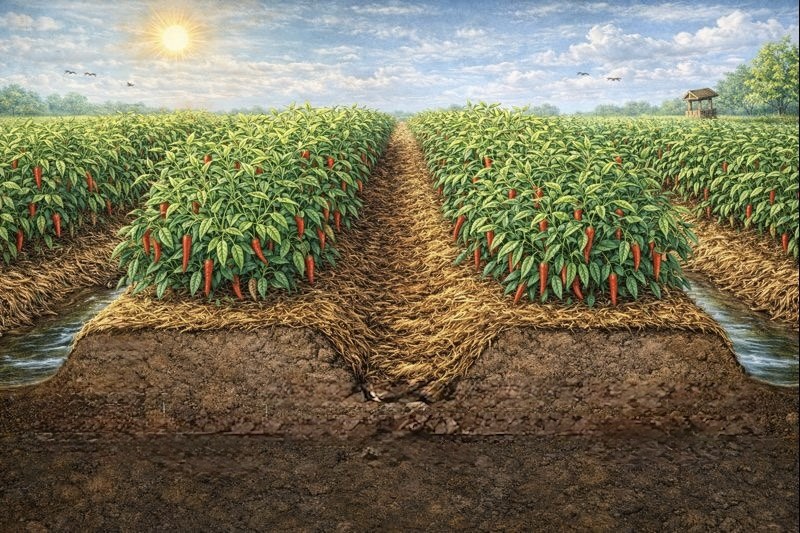
Every successful PQNK chilli crop rests on a mandatory conversion sequence: deep subsoiling to shatter the hardpan and restore root penetration and oxygenation; a single deep 'water washing' irrigation to leach salts and chemical residues and reset soil chemistry; permanent 42-inch raised beds aligned to standard tractor wheel spacing with 18-inch furrows; biological regeneration through a Jantar (Sesbania) cover crop whose taproots reopen blocked soil pores before being lodged and retained as the field's roots and mulch; and finally retain-mulch-no-till planting of the cash crop directly into that living system.
Water is managed by soil-moisture sensing rather than a fixed calendar, on the principle that plants, like humans, should drink only when needed; keeping plants slightly on the dry side enhances fruit set and quality while eliminating disease pressure that excess irrigation invites. Seeds are germination-tested before sowing, and planting geometry sets two rows per 42-inch bed (8 inches from each edge) at a density of 13,000-17,000 plants per acre, spaced 12 inches in harder soils and 14 inches in more fertile ones. Once 'crop stand completion' is achieved, the paper reports that no further weeding, fertilizing, or spraying is required: 'once the stand is complete, the rest is to rest.' Intercropping with bottle gourd, okra, and bitter gourd adds system diversity, and field validation at Nawab Zarif Farm in Hafizabad recorded exceptional flowering density, heavy fruiting, zero pest or disease pressure, uniform deep-green leaf color, and zero chemical inputs.
A significant closing section covers apical pinching as a biological correction rather than a cosmetic or yield-forcing practice. At 10-12 inches of plant height, pinching the leader shoot reduces auxin dominance concentrated at the shoot tip, allowing cytokinin expression from the root zone to activate lateral shoots, reproductive nodes, and root branching, redistributing plant energy from vertical escape growth into biological anchoring. The paper is explicit that this only works inside a functioning PQNK soil ecosystem, broken hardpan, active soil biology, moderated moisture and temperature under mulch, since in degraded, chemically driven soils the same pruning weakens rather than strengthens the plant.
Full Paper
If you use “Listen”, the text of the page may be sent to your browser or operating system’s speech provider, such as Apple, Google or Microsoft, depending on the voice your device uses. Pedaver does not process, transmit or store any audio.
1. Chilli as a Perennial Crop: A Forgotten Reality
Chilli is biologically a perennial plant, similar in many respects to cotton. In regions where severe cold stress is absent or properly managed, chilli plants can remain productive for many years, sometimes exceeding a decade. Decline in yield is not inherent to the plant but is induced by:
• Cold stress
• Soil ecosystem collapse
• Repeated chemical and mechanical disturbances
Under PQNK, chilli is grown with the intention of longevity, allowing the plant to express its full genetic potential for sustained fruiting.
2. Root Cause of Chilli Failure under ACI Systems
Over the last 25–30 years, aggressive tillage, chemical fertilizers, and pesticides have destroyed soil structure and biology. In collapsed soils:
• Microbial life (the plant’s primary nutrition provider) is absent
• Farmers are forced to apply nitrogen fertilizers (especially urea)
• Urea acts as an attractant for sucking insects, similar to honey attracting flies
• Pest pressure invites viral diseases, leading to repeated spraying
This creates a self-reinforcing cycle of dependency, cost escalation, and crop vulnerability.
PQNK Principle:
When soil biology is alive, fertilizers are unnecessary, pests do not dominate, and diseases do not express.
3. The PQNK Conversion Framework (Mandatory Foundation)
Every successful chilli crop under PQNK rests on the following non-negotiable steps:
3.1 Break the Hardpan
Deep subsoiling is essential to shatter the compacted hardpan layer. This restores:
• Deep root penetration
• Vertical water and air movement
• Soil oxygenation
The subsoiler shank must penetrate below the hardpan; otherwise, the operation is ineffective.
3.2 Water Washing (Soil Detoxification)
After hardpan breaking, apply one deep irrigation to:
• Leach accumulated salts and chemical residues
• Reset soil chemistry
• Prepare the soil for biological recovery
3.3 Permanent Raised Beds (42-inch System)
Beds are formed at 42 inches width, aligned with standard tractor wheel spacing:
• Total rear wheel spacing: 60 inches
• Furrows: 18 inches wide, used for traffic and irrigation
• Beds remain permanent to avoid repeated compaction
3.4 Biological Regeneration with Jantar (Sesbania)
A deep-rooted cover crop such as Jantar is grown initially:
• Its taproots reopen blocked soil pores
• Nutrients are lifted from deeper layers
• After reaching ~4 feet, the crop is lodged and retained
Roots remain in the soil; biomass becomes surface mulch.
3.5 Retain, Mulch, and No-Till Planting
This is the core PQNK loop:
• Roots are retained to feed microbes
• Biomass is chopped and used as mulch
• Cash crops are planted directly with no-till planters
4. Soil Moisture Management: Replacing Irrigation Schedules
PQNK replaces calendar-based irrigation with soil moisture sensing. Key Insight: Plants drink water only when needed—just like humans. Excess irrigation:
• Dilutes the water–mineral solution
• Pushes plants into vegetative growth
• Reduces flowering and fruiting
Optimal practice:
• Apply only enough water to avoid permanent wilting
• Keep plants slightly on the dry side
This strategy:
• Enhances fruit set
• Improves quality
• Eliminates disease pressure
5. Seed Handling and Plant Population
Chilli seeds are small and sensitive.
5.1 Germination Testing
Before planting:
• Soak seeds in cloth for 1–2 hours
• Keep warm for 2–3 days
• Assess germination percentage
This determines accurate seeding rate.
5.2 Planting Geometry
On a 42-inch bed:
• Leave 8 inches from each edge
• Plant two rows, one on each side
5.3 Plant Density
Recommended population:
• 13,000–17,000 plants per acre
Spacing:
• 12 inches in harder soils
• 14 inches in fertile soils
As PQNK soils mature, variability reduces and spacing becomes uniform.
6. Direct Seeding vs Transplanting
Direct Seeding
• Suitable when beds are mulched and moisture-stable
• Use dibblers or precision planters
Transplanting
• Preferred due to small seed size
• Nursery allows efficient stand establishment
• Transplants establish immediately in moist PQNK soil
7. Crop Stand Completion: The Turning Point
Under PQNK, crop stand completion is the only real work. Once achieved:
• No weeding is required
• No fertilizers are needed
• No pesticides or sprays are applied
• Insects and viruses (including leaf curl) do not express
“Once the stand is complete, the rest is to rest.”
8. Intercropping and System Diversity
PQNK encourages multi-crop systems:
• Chilli intercropped with bottle gourd, okra, bitter gourd
• Trellising systems enhance vertical space use
• Diverse crops stabilize microclimate and biology
Observed outcomes:
• Uniform leaf color
• No nutrient deficiencies
• Heavy flowering and fruit load
• Minimal flower drop (except under extreme cold)
9. Farmer Validation: Nawab Zarif Farm, Hafizabad
Field observations confirm:
• Exceptional flowering density
• Heavy fruiting even on small plants
• No pest or disease pressure
• Uniform deep green leaf color
• Zero chemical inputs
This practical validation demonstrates that PQNK is not theoretical—it is a fully functional, nature-aligned production system.
10. Pruning and Apical Balance (PQNK Perspective)
In PQNK, pruning is not a cosmetic or yield‑forcing practice; it is a biological correction of apical dominance to restore root–shoot equilibrium. When plants reach 10–12 inches in height, the leader shoot (apical meristem) must be gently pinched or pruned. At this stage, unchecked apical dominance channels excessive auxin flow downward, suppressing lateral branching above ground and lateral root proliferation below ground. In disturbed ACI soils—already constrained by compaction, toxicity, and weak biology—this hormonal imbalance further weakens root architecture. By pinching the leader shoot:
• Auxin dominance is reduced, allowing cytokinin expression from the root zone
• Lateral shoots and reproductive nodes are activated
• Root branching increases, improving soil exploration and microbial interaction
• Plant energy is redistributed from vertical escape growth to biological anchoring and resilience
Within PQNK’s living soil system—where roots interact with decomposing Jantar roots, active fungi, and buffered chemistry—this practice synchronizes plant physiology with soil regeneration. Pruning therefore becomes a signal correction, not a stress event, enabling plants to express their full genetic potential without external inputs. and Apical Pinching in Chilli under PQNK
10.1 Why Pruning Is Essential in PQNK
Under the PQNK (PICNIC) system, chilli is managed as a long-lived, productive perennial, not as a short-cycle annual crop. In natural ecosystems, plants are routinely subjected to browsing, grazing, clipping, and tip removal by animals and insects. This controlled stress is not damage—it is a biological signal that redirects plant energy from excessive vegetative expansion toward branching, flowering, and reproduction. Apical pinching replicates this natural ecological process in a precise and intentional manner.
10.2 Correct Stage and Method
• Stage: When chilli plants reach 10–12 inches (25–30 cm) in height
• Action: Pinch or cut off the apical (leader) shoot
• Frequency: One-time operation
• Method: Manual pinching is sufficient; no tools, chemicals, or sprays are required. Care must be taken not to damage lateral buds.
10.3 Physiological Basis (PQNK Lens)
Apical pinching interrupts apical dominance, which is hormonally regulated by auxins concentrated at the shoot tip. Once the leader is removed:
• Auxin dominance is reduced
• Cytokinin activity in lateral buds increases
• Energy flow shifts from vertical elongation to lateral branching
• More flower-bearing nodes are formed
• Canopy becomes balanced and uniform
This directly improves flower retention, pollination efficiency, fruit set consistency, and reduces false flowering and flower drop.
10.4 Relationship with Soil Health
Pruning is effective only when the PQNK soil ecosystem is functional, including:
• Broken hardpan enabling deep root anchorage
• Active soil biology supplying balanced nutrition
• Moderated soil moisture and temperature under organic mulch
In degraded, chemically driven soils, pruning weakens plants. In PQNK-regenerated soils, pruning activates the plant’s inherent reproductive intelligence.
10.5 Outcomes Observed under PQNK
Correct apical pinching results in:
• Strong, bushy plants with multiple productive branches
• Extended productive lifespan (multi-season potential)
• Heavier and more uniform fruiting
• Lower pest pressure due to balanced plant metabolism
• Improved light penetration and pollinator access
Pruning is not a corrective action; it is a synchronization tool that aligns plant architecture with soil-biology strength and ecological balance.
11. Conclusion
Chilli production under PQNK transforms a high-risk, high-cost crop into a stable, low-cost, high-quality perennial system. By restoring soil biology, structure, moisture balance, and ecological harmony, PQNK eliminates the need for external inputs and chemical interventions. The results are economically viable for farmers, environmentally regenerative, and nutritionally superior for consumers. PQNK does not treat symptoms. It restores the system.
Footnote
PQNK (pronounced “picnic”)—the regenerative & sustainable Pristine Organic Farming System —is grounded in Natural Ecosystem Science. This science employs perennial biodiversity, protects soil with organic mulch, and avoids practices such as water inundation, tillage disturbance, and leaving soil bare.
It is the process that matters most. PQNK is a pristine production system designed not merely for yield, but for optimal, balanced output—where quality, sustainability, and ecological harmony emerge from a self‑regulated, zero‑external‑input methodology.
About This Paper
- Crop
- Chilli · Bottle Gourd · Okra · Bitter Gourd · Jantar (Sesbania)
- Problem
- Yield Stagnation / Decline · General Pest Pressure · Hardpan · Saline / Alkaline / High-pH Soil · External Input Dependency
- Science
- Soil · Plants · Crop Protection · Production Architecture · Transition
- Evidence
- Field Observation
- Authority
- Current / Approved PQNK Knowledge
Related PQNK Science
Key Takeaways
- Chilli is biologically perennial and, absent cold stress and soil collapse, can remain productive for over a decade; yield decline is induced, not inherent to the plant.
- Under conventional systems, urea use to compensate for dead soil biology attracts sucking insects 'like honey attracts flies,' driving the pest and viral disease cycle PQNK avoids entirely.
- Once 'crop stand completion' is achieved on regenerated PQNK soil, the paper reports no weeding, fertilizing, or spraying is required for the rest of the season.
- Planting density runs 13,000-17,000 plants per acre on 42-inch permanent raised beds, at 12-14 inch spacing depending on soil fertility.
- A one-time apical pinch at 10-12 inches of height reduces auxin dominance and activates lateral branching and root proliferation, syncing the plant's physiology with the regenerated soil.
- Field validation at Nawab Zarif Farm in Hafizabad reported exceptional flowering density, heavy fruiting, uniform deep-green leaf color, and zero chemical inputs.
Related Crops
Related Knowledge
same problem
Knowledge Paper: PQNK Rose Production
Cut-flower rose production is reframed as a closed-loop perennial system under PQNK, reaching a striking 8,712 plants per acre on twin-row permanent beds, with weeds treated as mulch, alfalfa grown as living nitrogen-fixing ground cover, and strict soil-moisture management replacing scheduled irrigation.
same problem
Knowledge Paper: High-Density Amla Farming Under PQNK
Amla's naturally deep taproot makes it an ideal closed-loop PQNK crop, and this paper walks through the five-step protocol, hardpan breaking, pH correction, Jantar-built raised beds, no-till mulch planting, and phenology-timed pruning, that gets roughly 545 trees per acre to a sustained yield of 10-14 tonnes per acre by year five.
same problem
PQNK Factsheet: Production of HD Castor
A field factsheet for High-Density (HD) Castor grown as a 3-5 year perennial under PQNK, covering the mandatory land-preparation sequence, planting density, and the pruning schedule that keeps the crop productive across multiple harvest years.
same problem
Managing the Biological Transition: Protecting Crop Performance During the First Years of PQNK Conversion
The engineering side of PQNK conversion, hardpan breaking, bed formation, cover cropping, can be finished in weeks, but the soil biology that actually runs the system takes longer to rebuild. This paper explains why the first few crops need closer monitoring, and lays out the minimal, symptom-triggered temporary support (never a return to routine chemical use) that carries a farmer through that gap without abandoning PQNK.