

KP-020 · Crop-Specific Guides
Knowledge Paper: PQNK Rose Production
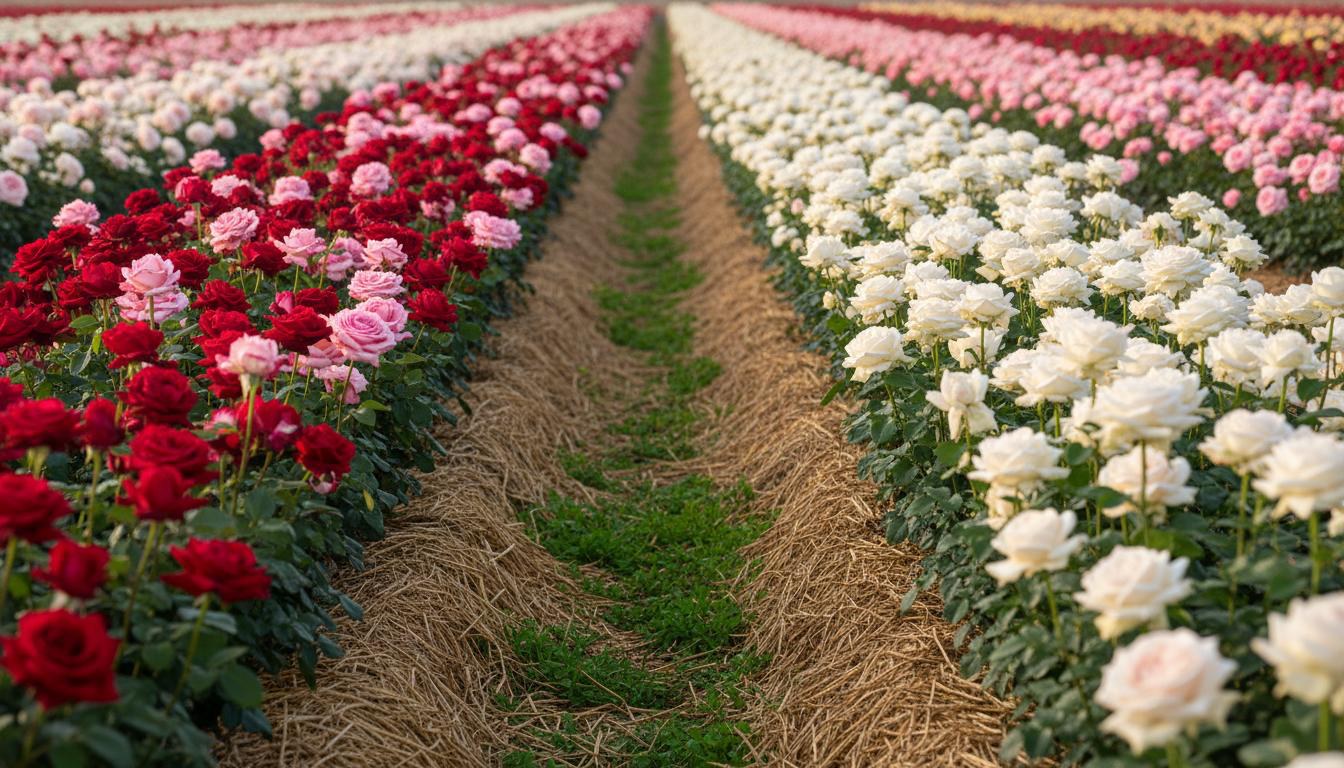
Cut-flower rose production is reframed as a closed-loop perennial system under PQNK, reaching a striking 8,712 plants per acre on twin-row permanent beds, with weeds treated as mulch, alfalfa grown as living nitrogen-fixing ground cover, and strict soil-moisture management replacing scheduled irrigation.
Read or listen to the full paper ↓Abstract
The paper positions rose as an excellent PQNK crop: perennial, responsive to soil regeneration, and well suited to closed-loop management, in contrast to conventional rose farming's reliance on synthetic fertilizers, hormones, and chemical pest control. As with other PQNK crops, the field is expected to supply everything, fertility from biomass, pest management from biodiversity, and structure from roots and mulch.
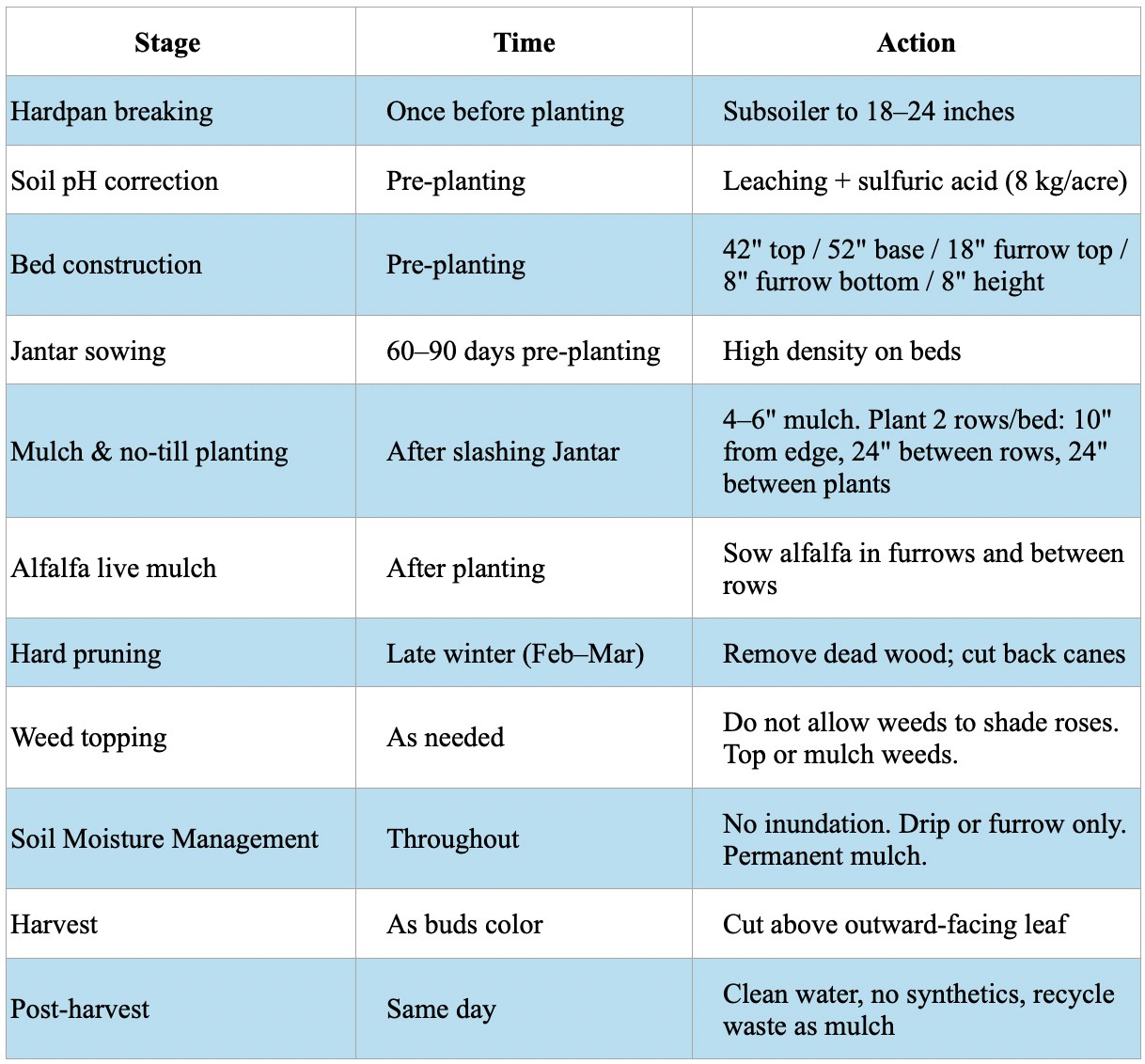
Establishment follows the now-familiar PQNK sequence adapted to rose's biology. A one-time subsoiling breaks the hardpan to 18-24 inches, letting rose's strong, branching root system reach deeper moisture and improve drought resilience. Where pH rises above 7.5-8, a deep leaching irrigation paired with a one-time 8kg-per-acre sulfuric acid application corrects it toward rose's preferred 6.0-7.0 range, supporting vibrant blooms and healthy foliage. The standard bed-furrow profile is fixed at 42 inches across the top, 52 inches at the base, an 18-inch furrow top narrowing to 8 inches at the furrow bottom, and 8 inches of bed height, adjustable to the tractor's wheel track. Those beds are then sown with Jantar (Sesbania) for 60-90 days before its roots are retained in place and its biomass chopped into a 4-6 inch mulch layer.
Rose is then planted no-till, directly through that mulch, in a distinctive twin-row geometry per 42-inch bed: 10 inches from each bed edge to the first row, 24 inches between the two rows, and 24 inches plant-to-plant within each row, yielding roughly 8,712 plants per acre across a 220ft by 198ft acre. Pruning follows a four-stage seasonal calendar rather than a single event: hard pruning in late winter/early spring (Feb-Mar), removing dead, weak, or crossing canes and cutting remaining canes back by a third to a half to stimulate strong new flowering shoots; deadheading of spent flowers just above an outward-facing bud after the first bloom flush (May-June) to encourage repeat blooming; light maintenance only, removing diseased or damaged wood, during the second growth flush (July-Aug); and no heavy pruning in late autumn (Nov-Dec) beyond removing dead or diseased wood, to prevent winter damage. All pruned biomass is returned as mulch on the bed, with no external hormones used.
A distinctive philosophy runs through weed and living-mulch management: weeds are treated as mulch, not competitors, since their roots don't meaningfully compete with crop plants once soil biology is healthy, and are only topped (never herbicided) if they begin shading the roses. Alfalfa is grown as a living mulch between rows and in furrows, fixing nitrogen, suppressing weeds, sheltering beneficial predators, and requiring only a single initial seeding to self-regenerate within the system thereafter. During the first 2-3 years before canopy closure, the same beds carry a seasonal intercrop rotation: Jantar, moong, and guar in the Kharif (monsoon) season for biomass and soil regeneration, and gram (chickpea), lentil, and barseem in the Rabi (winter) season for nitrogen fixation and mulch, with all residues returned to the bed.
Pest and disease pressure from aphids, black spot, and powdery mildew is managed through pruning hygiene, naturally occurring Bt and predator insects (the paper cites over 1,700 predator species enabled by PQNK soil), plant vigor from deep roots and permanent mulch, and weed/alfalfa management that removes pest habitat, all without synthetic fungicide or insecticide. Soil Moisture Management (SMM) is treated as a strict, non-negotiable requirement: furrow irrigation only, applied slowly and deeply, and only when soil checked at 4-6 inch depth feels dry to the touch, with no inundation irrigation permitted beyond the one-time leaching exception. Cut flowers are harvested when buds show color but before petals open, cut at a 45° angle above a five-leaflet leaf, with unsold or spent flowers returned to the mulch layer so nothing leaves the field.
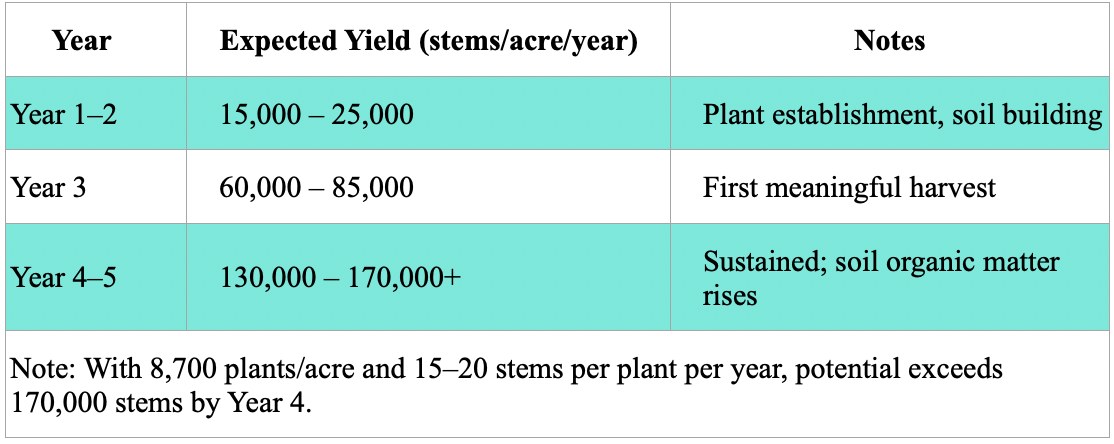
The paper closes with a year-by-year cut-flower yield projection for the 8,712-plants-per-acre design: 15,000-25,000 stems per acre in years 1-2 while the planting establishes and soil builds, 60,000-85,000 stems in year 3 as the first meaningful harvest arrives, and 130,000-170,000-plus stems per acre in years 4-5 once the system is sustained and soil organic matter has risen, a range the paper notes can exceed 170,000 stems by year four at 15-20 stems per plant per year.
Full Paper
If you use “Listen”, the text of the page may be sent to your browser or operating system’s speech provider, such as Apple, Google or Microsoft, depending on the voice your device uses. Pedaver does not process, transmit or store any audio.
(Paedar Qudratti Nizam Kashatqari – Pristine Organic Farming System)
1. Introduction
In the PQNK system, farming is not about extracting from the land but about regenerating the soil–food web. Rose is an excellent crop for this model—it is perennial, responds well to soil regeneration, and thrives under closed-loop management. Conventional rose farming often relies on synthetic fertilizers, hormones, and chemical pest control—all prohibited in PQNK.
This paper reframes rose production within the closed-loop, no-external-input philosophy of PQNK. The field provides everything: fertility from biomass, pest management from biodiversity, and structure from roots and mulch.
2. Step 1: Break the Hardpan – Foundation for Deep-Rooted Roses
Before planting roses, the hardpan beneath the soil surface must be shattered. In PQNK practice:
• Use a subsoiler to fracture the hardpan without inverting soil layers.
• Target depth: 18–24 inches (45–60 cm). Done once before planting.
Rose-specific note: Roses develop a strong, branching root system. Breaking the hardpan allows roots to reach deeper moisture and nutrients, reducing irrigation needs and improving drought resilience.
3. Step 2: Correct Soil Chemistry with Water and Acid
If soil pH rises above 7.5–8, nutrients like iron and phosphorus become locked. PQNK uses:
1. Deep leaching irrigation – to push down accumulated salts.
2. Sulfuric acid – 8 kg per acre with irrigation water (one-time correction tool). Rose-specific note: Roses prefer slightly acidic to neutral pH (6.0–7.0). Correcting pH ensures vibrant blooms and healthy foliage.
4. Step 3: Build Permanent Raised Beds and Plant Jantar (Sesbania)
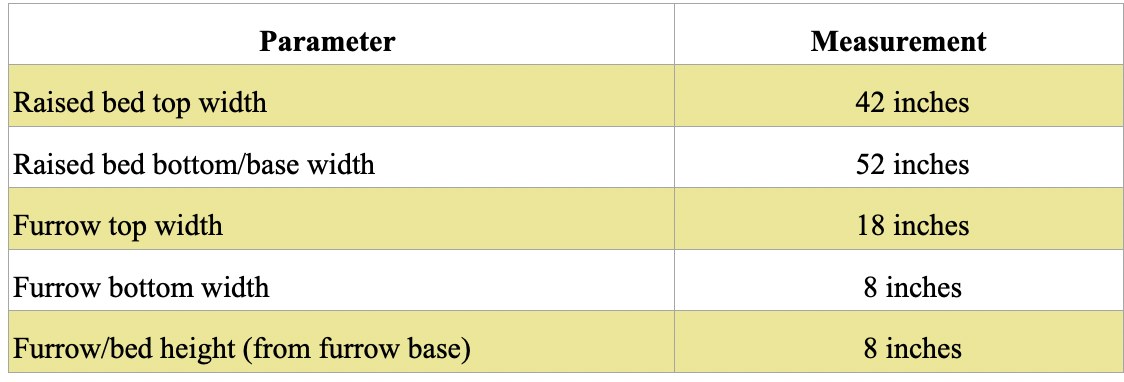
Standard PQNK Bed-Furrow Profile (Fixed for All Crops). This profile ensures rapid infiltration, root zone aeration, and permanent traffic lanes for tractor wheels. Bed and furrow dimensions may be adjusted according to the tractor track.
Planting Jantar (Sesbania) Immediately:
On these beds, before planting roses, sow Jantar (Sesbania aculeata) at high density. Allow it to grow for 60–90 days.
• Jantar taproots penetrate deep into the shattered hardpan.
• They pull up leached minerals and create vertical channels for water and rose roots.
This is a closed-loop fertility-building step. No external manure or fertilizer is brought in.
5. Step 4: Retain, Mulch, and Plant with No-Till
Do not remove the Jantar roots. After 60–90

| Parameter | Measurement |
|---|---|
| Distance from bed edge to first row | 10 inches (both sides) |
| Distance between the two rows on the bed | 24 inches (center to center) |
| Plant-to-plant distance within each row | 24 inches |
days, slash Jantar at ground level.
• Roots decompose, feeding earthworms and soil microbes.
• Chop above-ground biomass and lay it immediately as 4–6 inch mulch on the same raised bed.
Now, Plant Roses (No-Till) – Two Rows Per Bed
Using a no-till planter or manual dibbling, plant rose saplings directly through the mulch into undisturbed soil beneath.
Planting Geometry for Roses on 42" Bed:
Plants Per Acre Calculation
For an acre measuring 220 ft × 198 ft, 8,712 plants per acre are ideal.
6. Step 5: Pruning Through the PQNK Lens – Rose-Specific
Pruning in PQNK manages energy flow, not forced growth. Roses flower on current season’s growth.
For broad-acre farming, high-clearance tractors can be used for pruning operations, allowing efficient management of large rose plantings.
Pruning Calendar for Roses
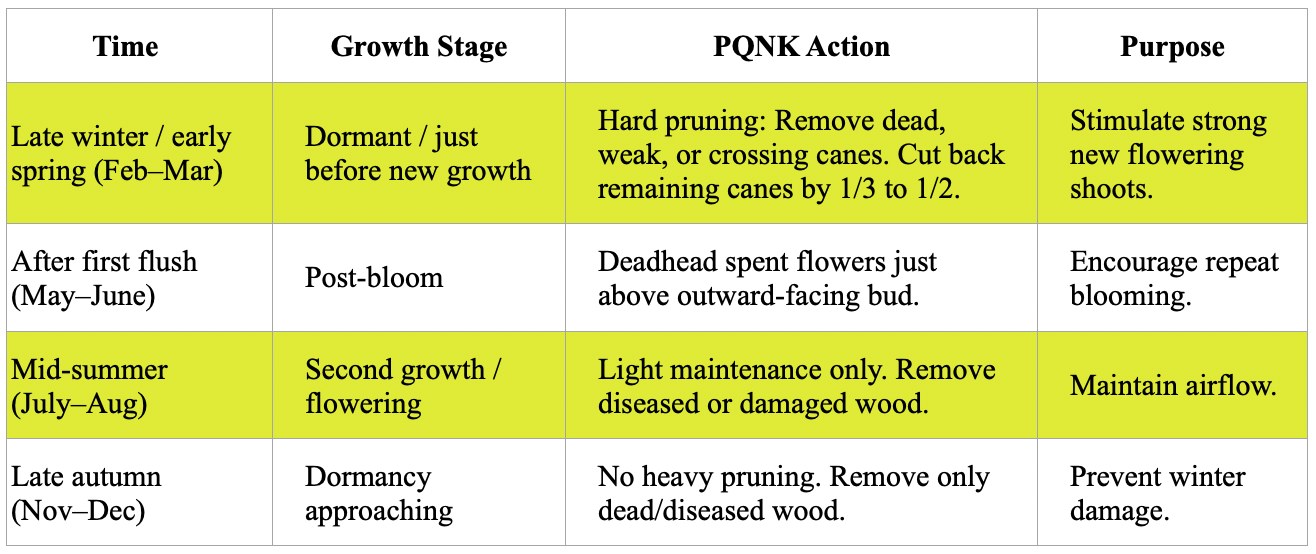
Key PQNK Rose Principle: All pruned biomass is returned as mulch on the bed. No external hormones are used.
7. Weed Management in PQNK – Weeds as Mulch
In PQNK, weeds are taken as mulch, not as competitors.
• The roots of weeds do not compete with crop plants when soil biology is healthy. Instead, they contribute to soil structure and feed the food web.
• However, weeds should not shade the crop plants. If shading occurs, weeds should be mulched or topped using available hand tools or machine tools.
• No herbicide is ever used.
Ideal Live Mulch: Alfalfa
Where possible, alfalfa is used as a living mulch between rose rows and in furrows. Alfalfa:
• Fixes atmospheric nitrogen.
• Suppresses undesirable weeds.
• Can be periodically slashed and left as additional mulch.
• Provides habitat for beneficial predators.
Alfalfa is grown from seed obtained once and then regenerated within the system – no external input required after establishment.
8. Intercropping – The "One More Crop" Within Closed Loop
During the first 2–3 years before rose canopy closes, intercrops are grown on the same beds.
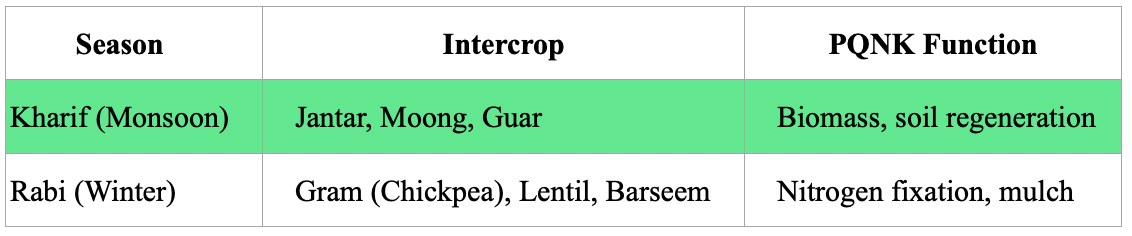
Crucial PQNK Rule: All intercrop residues remain as mulch. No external inputs.
9. Pest and Disease Management – PQNK Approach for Roses
Roses commonly suffer from aphids, black spot, and powdery mildew. In PQNK:
1. Pruning hygiene – Remove infested canes; bury temporarily in furrows if needed, then return as composted mulch.
2. Enable Bt and predators – PQNK soil encourages Bacillus thuringiensis and over 1,700 predator insects.
3. Vigor – Deep roots + balanced pH + permanent mulch + alfalfa live mulch = naturally resistant roses.
4. Weed management – Topped weeds and alfalfa slashing remove pest habitat without chemicals. No synthetic fungicides or insecticides are used.
10. Soil Moisture Management (SMM) – Strict PQNK Requirement
Soil Moisture Management (SMM) is strictly adhered to in PQNK. This means:
• No inundation irrigation – water is applied slowly, deeply, and only when needed.
• Permanent mulch (4–6 inches) reduces evaporation and keeps soil moisture stable.
• Deep roots (from hardpan breaking) access subsoil moisture, reducing irrigation frequency.
• Irrigation method: Furrow irrigation only.
• Monitoring: Soil is checked at 4–6 inch depth. Irrigate only when moisture feels dry to touch, not before.
Closed-loop water management means no external water source is assumed beyond rainfall and in-soil storage. Leaching irrigation for pH correction is a one-time exception.
11. Harvesting and Post-Harvest for Roses (PQNK)
Harvest timing:
• Cut flowers when buds show color but before petals open (for longest vase life).
• Harvest early morning or late evening.
Method:
• Use clean, sharp secateurs. Cut stem at 45° angle just above a 5-leaflet leaf facing outward.
• Leave at least 2–3 nodes on the plant for regrowth.
Post-harvest (closed-loop):
• Place stems immediately in clean water (no synthetic preservatives).
• For petal harvest (gulkand, rose syrup): collect fully open blooms on dry mornings.
• All unsold or spent flowers return to mulch layer – nothing leaves the field.
12. Yield Expectations in PQNK Roses (Cut-Flower)
13. Summary: PQNK Rose Production Protocol
14. Closing Note
The PQNK system for roses is a closed-loop philosophy:
• Soil never bare.
• No organic matter leaves the field.
• Weeds are mulch, not enemies.
• Alfalfa serves as living mulch and nitrogen source.
• Rose roots, Jantar roots, alfalfa roots, and intercrop roots regenerate subsoil together.
• Pruning follows natural phenology.
• Soil Moisture Management (SMM) is strictly followed – no inundation, permanent mulch, deep roots.
• The farmer manages the cycle, imports no solutions.
By following the five PQNK steps – break hardpan, correct chemistry, build beds with Jantar, mulch and no-till plant, and prune to manage energy flow – and by adhering to SMM and weed-as-mulch principles, the farmer creates a self-sustaining rose orchard that yields abundantly for decades without degrading the land or requiring external purchases.
This knowledge paper is prepared for farmers practicing Paedar Qudratti Nizam Kashatqari (PQNK) – the Pristine Organic Farming System. All recommendations adhere strictly to closed-loop, no-external-input principles and Soil Moisture Management (SMM).
Applying PQNK without understanding nature’s operating system will not deliver abundance, stability, or nutrient density.
PQNK (pronounced “picnic”)—the regenerative & sustainable Pristine Organic Farming System —is grounded in Natural Ecosystem Science. This science employs perennial biodiversity, protects soil with organic mulch, and avoids practices such as water inundation, tillage disturbance, and leaving soil bare.
It is the process that matters most. PQNK is a pristine production system designed not merely for yield, but for optimal, balanced output—where quality, sustainability, and ecological harmony emerge from a self‑regulated, zero‑external‑input methodology.
About This Paper
- Crop
- Rose
- Problem
- Saline / Alkaline / High-pH Soil · Hardpan · Sucking Insect Pressure (Aphid/Whitefly/Jassid) · External Input Dependency
- Science
- Soil · Plants · Water · Crop Protection · Production Architecture
- Evidence
- Scientific Mechanism
- Authority
- Current / Approved PQNK Knowledge
Related PQNK Science
Key Takeaways
- The twin-row bed geometry (24 inches between rows, 24 inches plant-to-plant) packs roughly 8,712 rose plants per acre onto standard 42-inch permanent raised beds.
- Projected cut-flower yield rises from 15,000-25,000 stems/acre in years 1-2 to 60,000-85,000 in year 3, reaching 130,000-170,000+ stems/acre by years 4-5.
- Pruning follows a four-stage seasonal calendar: hard pruning in Feb-Mar, deadheading after the May-June flush, light maintenance in Jul-Aug, and no heavy pruning in Nov-Dec.
- A 2-3 year intercrop rotation shares the same beds before canopy closure: Jantar/moong/guar in the Kharif season, gram/lentil/barseem in Rabi, all residues returned as mulch.
- PQNK treats weeds as mulch rather than competitors, topping them only if they shade the crop, and never using herbicide.
- Alfalfa is grown as living mulch between rows, fixing nitrogen, suppressing weeds, and sheltering beneficial predators, after a single initial seeding.
- Soil Moisture Management is strict: furrow irrigation only, applied slowly and only when soil at 4-6 inch depth feels dry, with no inundation.
- Aphids, black spot, and powdery mildew are managed through pruning hygiene, native Bt and predator populations, and plant vigor rather than fungicides or insecticides.
- Harvested stems are cut at a 45° angle above a five-leaflet leaf when buds show color but before opening, for maximum vase life.
Related Crops
Related Knowledge
same problem
Chilli Production Under PQNK (PICNIC)
Chilli is biologically perennial and can remain productive for over a decade, but conventional short-cycle, urea-dependent management collapses that potential into a pest-prone annual grind. This paper shows how PQNK's soil-conversion framework and a single apical-pinching intervention restore chilli to a low-cost, high-density perennial crop, validated on a Hafizabad farm.
same problem
Knowledge Paper: High-Density Amla Farming Under PQNK
Amla's naturally deep taproot makes it an ideal closed-loop PQNK crop, and this paper walks through the five-step protocol, hardpan breaking, pH correction, Jantar-built raised beds, no-till mulch planting, and phenology-timed pruning, that gets roughly 545 trees per acre to a sustained yield of 10-14 tonnes per acre by year five.
same problem
PQNK Factsheet: Production of HD Castor
A field factsheet for High-Density (HD) Castor grown as a 3-5 year perennial under PQNK, covering the mandatory land-preparation sequence, planting density, and the pruning schedule that keeps the crop productive across multiple harvest years.
same problem
Knowledge Paper: Achieving High-Density Pomegranate Production Through the PQNK (Picnic) Pristine Organic Farming System
This knowledge paper sets out the full methodology for a 544-plant-per-acre pomegranate orchard under PQNK: the four-step soil recovery protocol that converts degraded land into a closed-loop system, and the four management pillars, zero soil disturbance, natural irrigation, inherent pest management, and structural pruning, that keep it that way.