

KP-159 · Crop-Specific Guides
Balangu & Basil Seed Production Under PQNK
A complete Punjab-focused production guide showing how Balangu (Lallemantia royleana) and Basil seed crops are grown on PQNK's permanent raised-bed system, from hardpan-breaking through harvest and storage.
Read or listen to the full paper ↓Abstract
Balangu and Basil are high-value medicinal and aromatic seed crops with growing food, pharmaceutical, and cosmetic demand, yet this guide treats their production not as a fertilizer-and-spray schedule but as an application of the same four-step PQNK sequence used for any crop: breaking the hardpan where present, correcting soil pH above roughly 8.0 with the sulfuric acid protocol, constructing permanent 42-inch raised beds with 18-inch furrows and 8-inch furrow depth, and never disturbing the bed again once established.
Both crops prefer well-aerated, fast-draining soil with active biology, conditions the permanent bed supplies directly. Seeds go in through intact mulch with the Slit Insertion Precision Planter (SIPP), which plants five rows per pass on the 42-inch bed; a second, offset pass raises this to nine uniformly spaced rows where higher plant populations are wanted, with the choice between five and nine rows depending on seed size, target population, expected rainfall, and harvest method.
For Punjab conditions the guide sets out concrete windows: Balangu is sown October-November, flowers February-March, and is harvested March-April; Basil grown as a seed crop is sown February-March, flowers May-June, and is harvested June-July. In-row spacing runs roughly 2 to 6 inches depending on final plant architecture, and irrigation is applied only into the furrows, never onto the bed top, so that moisture reaches the root zone by lateral capillary movement while maintaining the vattar-wafsa air-water balance the guide treats as central to root and microbial health.
Nutrition under a matured bed comes from mycorrhizal fungi and bacteria mobilizing the soil's own geological mineral reserve rather than from routine fertilizer or compost applications, weeds are treated as a successional indicator rather than a target for chemical control, and pest pressure is managed by the beneficial-insect community a diverse, undisturbed field supports. The guide closes by generalizing from these two crops to the wider claim that once the ecological preconditions are established, only planting geometry and seasonal timing need adjusting for any other crop, soil type, or climate.
Full Paper
If you use “Listen”, the text of the page may be sent to your browser or operating system’s speech provider, such as Apple, Google or Microsoft, depending on the voice your device uses. Pedaver does not process, transmit or store any audio.
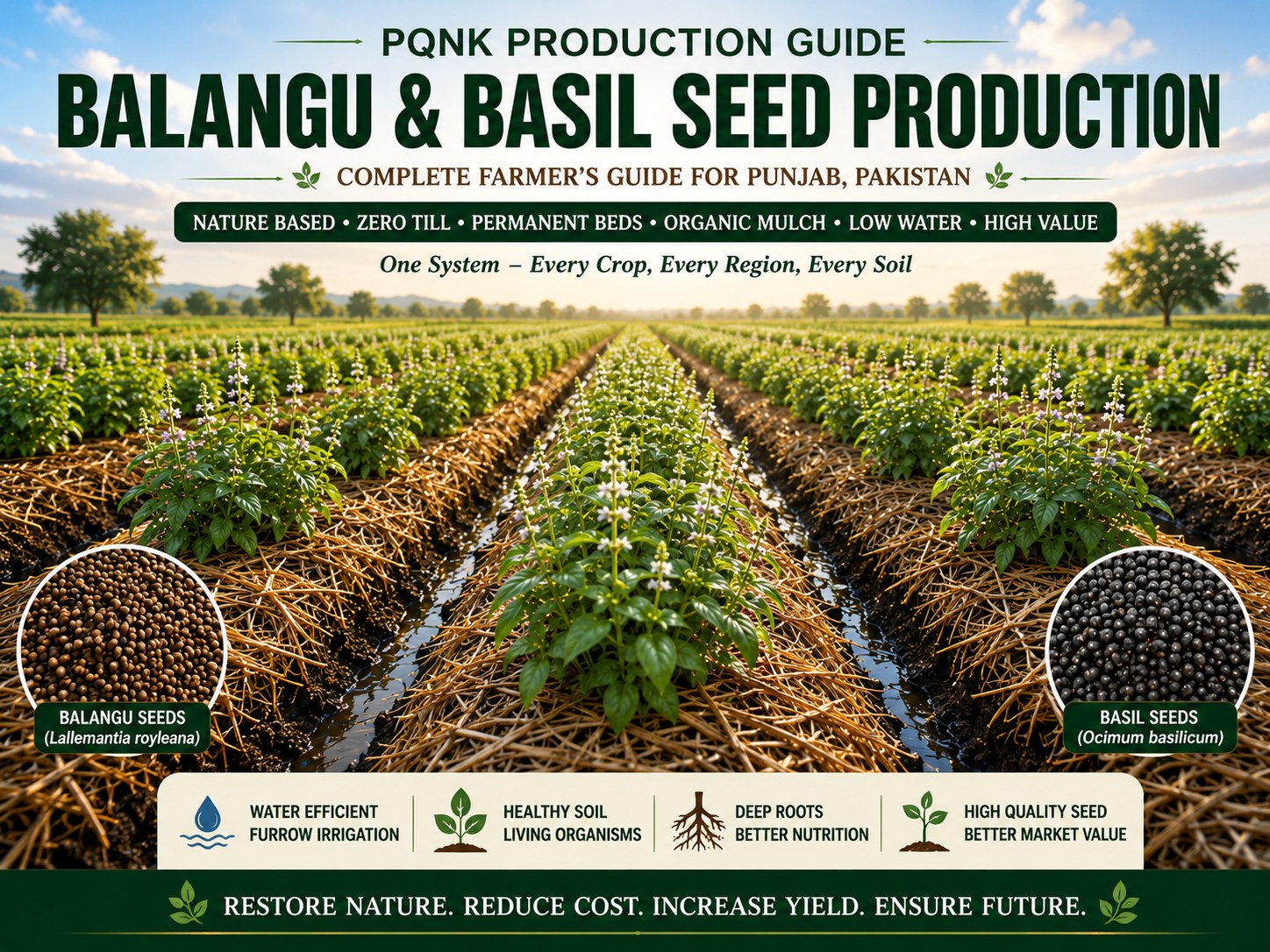
PQNK Production Guide
Balangu (Lallemantia royleana) & Basil (Ocimum basilicum) Seed Production
A Complete Farmer's Guide for Punjab, Pakistan
Introduction
Balangu (Lallemantia royleana) and Basil (Ocimum basilicum) are high-value medicinal and aromatic crops with increasing domestic and international demand. Both crops produce premium seeds used in the food, pharmaceutical, nutraceutical, cosmetic, and health industries. Their relatively low water requirement, high market value, and adaptability make them excellent choices for diversification within farming systems.
Unlike conventional production guides that focus primarily on fertilizers, pesticides, and irrigation schedules, this guide follows the PQNK (Paedar Qudratti Nizam Kashatqari) production system. PQNK is not a crop-specific technology; it is a nature-based production system designed to restore the operating conditions of natural ecosystems. Once these ecological conditions are established, the same production principles apply to every crop, every soil type, every topography, and every climatic region, with only planting geometry and seasonal timing adjusted according to the crop.
The objective is not merely to produce seed, but to produce healthy plants in biologically active soil with lower production costs, minimal water use, greater resilience, and improved seed quality.
Part I
Before Planting: Establish the PQNK System
No crop should be planted before the field has been converted to the PQNK production system.
Step 1 – Break the Hardpan
If a hardpan exists, it must first be fractured using a subsoiler to restore deep rooting, improve water infiltration, increase soil aeration, and reconnect the surface soil with the subsoil. This is normally a one-time operation.
Step 2 – Correct Excessive Soil Alkalinity
Where soil pH exceeds approximately 8.0, deep irrigation combined with the PQNK sulfuric acid correction protocol should be completed before raised beds are constructed. This restores biological activity and allows plant roots to gradually reclaim the soil.
Step 3 – Construct Permanent Raised Beds
Construct permanent raised beds with:
Bed top: 42 inches
Furrow top: 18 inches
Furrow depth: 8 inches
The furrows permanently serve as hydraulic and tractor traffic corridors, while the raised beds remain undisturbed biological production zones.
Step 4 – Never Disturb the Soil Again
After beds are established:
no ploughing,
no cultivation,
no rotavator,
no disc harrow.
Seeds are planted directly through mulch using the PQNK Slit Insertion Precision Planter (SIPP).
Part II
Why Balangu and Basil Perform Well in PQNK
Balangu and Basil naturally prefer:
well-aerated soils,
rapid infiltration,
active biological communities,
moderate moisture,
unrestricted root growth.
Permanent raised beds create exactly these conditions.
Instead of depending upon repeated fertilizer applications, PQNK allows plant roots, fungi, bacteria, earthworms, and soil organisms to mine nutrients from the geological reserve already present in the soil.
Part III
Climate Adaptation
PQNK is suitable for every climatic region because the production system restores the soil ecosystem rather than forcing plant growth through external inputs.
In Punjab:
Balangu
Preferred sowing: October–November
Flowering: February–March
Harvest: March–April
Basil (Seed Crop)
Preferred sowing: February–March
Flowering: May–June
Seed harvest: June–July
Local planting dates should always be adjusted slightly according to seasonal temperatures.
Part IV
Bed Layout and Plant Geometry
The standard PQNK raised bed has a 42-inch bed top.
Standard SIPP Configuration
The PQNK Slit Insertion Precision Planter plants five rows in one pass.
This spacing is suitable for most crops and allows rapid planting while maintaining excellent light interception and air circulation.
Higher Density Planting
Where greater plant populations are desirable, the planter may be operated a second time with its row positions shifted between the original rows.
This creates:
five original rows,
four additional intermediate rows,
for a total of nine uniformly spaced rows on a single 42-inch raised bed.
This method maintains accurate row spacing while substantially increasing plant population without disturbing the soil.
The choice between five-row and nine-row planting depends upon:
seed size,
final plant architecture,
desired plant population,
expected rainfall,
available irrigation,
harvesting method.
Part V
Plant-to-Plant Spacing
Within each row, spacing should be selected according to the final plant size rather than seed size.
The SIPP planter allows precise in-row spacing to be adjusted according to crop requirements.
Typical spacing ranges between approximately 2 and 6 inches, depending on the desired final population and branching habit.
Final spacing should ensure:
complete canopy closure,
adequate air circulation,
minimal weed establishment,
uniform seed maturation.
Part VI
Sowing Procedure
Before sowing:
ensure mulch remains intact,
verify adequate soil moisture,
avoid saturated soil.
The SIPP planter opens a narrow slit through the mulch, deposits seed at the required depth, closes the slit, and leaves the remainder of the bed completely undisturbed.
This preserves soil structure, fungal networks, pore continuity, and biological activity.
Part VII
Water Management
PQNK does not irrigate the crop by flooding the raised bed.
Water is applied only into the furrows.
Moisture then moves laterally and upward by capillary action into the raised bed.
This provides:
continuous oxygen supply,
adequate moisture,
deeper rooting,
improved biological activity.
The objective is to maintain the vattar–wafsa balance—a soil environment where water is present as thin films around soil particles while air continues to occupy the larger pore spaces. This balance supports vigorous root growth and active microbial life.
Part VIII
Plant Nutrition
Under PQNK, plant nutrition is supplied primarily through biological processes.
Crop residues remain on the soil surface as permanent mulch.
Living roots continuously feed microorganisms through root exudates.
Mycorrhizal fungi and bacteria mobilize nutrients from the soil's geological reserve.
Consequently, mature PQNK fields normally require neither synthetic fertilizers nor routine applications of compost or manure. During the transition period, biological amendments may be used where necessary to accelerate recovery, but they are viewed as transitional aids rather than permanent requirements.
Part IX
Weed Management
Weeds are indicators of ecological succession rather than enemies to be eliminated chemically.
Permanent mulch, rapid canopy closure, and an active soil ecosystem naturally suppress most weed emergence.
Where weeds do appear, they should be removed before seed production while leaving the soil undisturbed.
Part X
Crop Protection
Healthy PQNK fields support a diverse community of beneficial insects, spiders, birds, and microorganisms.
These natural predators help maintain ecological balance and reduce the likelihood of pest outbreaks.
Routine insecticide or fungicide applications are therefore avoided unless an exceptional situation demands intervention.
Part XI
Harvesting
Harvest when:
seed heads have fully matured,
moisture has declined sufficiently,
seed colour is fully developed,
shattering losses remain minimal.
Harvest should preferably be carried out during dry weather after morning dew has evaporated.
Part XII
Seed Drying and Storage
Seeds should be cleaned, dried to safe storage moisture, and stored in clean, dry, well-ventilated conditions.
Proper drying preserves:
germination,
seed vigour,
storage life,
market value.
Part XIII
Expected Outcomes
When the PQNK production system is properly established, farmers can expect:
substantially lower water use,
elimination or major reduction of synthetic fertilizers,
elimination or major reduction of pesticides,
improved soil structure,
deeper rooting,
higher biological activity,
improved seed quality,
lower production costs,
greater resilience to drought and heat,
long-term sustainability.
This approach transforms the original factsheet from a collection of research findings into a practical production manual centred on the PQNK system. Crop-specific recommendations for Balangu and Basil are integrated within a consistent ecological framework, so the same principles can be applied to other crops with only adjustments to planting geometry and seasonal timing.
——————————
Applying PQNK without understanding nature’s operating system will not deliver abundance, stability, or nutrient density.
PQNK (pronounced “picnic”)—the regenerative & sustainable Pristine Organic Farming System—is grounded in Natural Ecosystem Science. This science employs perennial biodiversity, protects soil with organic mulch, and avoids practices such as water inundation, tillage disturbance, and leaving soil bare.
It is the process that matters most. PQNK is a pristine production system designed not merely for yield, but for optimal, balanced output—where quality, sustainability, and ecological harmony emerge from a self‑regulated, zero‑external‑input methodology.
Connect & Resources Facebook: www.Facebook.Com/Pedaver YouTube (PQNK): https://www.youtube.com/@pedaverpqnk3167/videos YouTube: http://www.youtube.com/@aasifsharif PDF Knowledge Papers: https://drive.google.com/drive/folders/1iadwV6mdUPyrUIpB3oRfNv6DLiackaUL?usp=sharing Email: pedaver@gmail.com WhatsApp: +92 320 677 6666
About This Paper
- Crop
- Balangu · Basil
- Problem
- Saline / Alkaline / High-pH Soil · Hardpan · Weed Pressure · General Pest Pressure
- Science
- Soil · Water · Biodiversity · Production Architecture
- Evidence
- Scientific Mechanism
- Authority
- Current / Approved PQNK Knowledge
Related PQNK Science
Key Takeaways
- Standard PQNK bed geometry is a 42-inch bed top with an 18-inch furrow top and 8-inch furrow depth, matching the tractor tire spacing common in Punjab.
- The SIPP planter seeds five rows per bed in a single pass, or nine rows with a second offset pass, chosen by seed size, target population, and harvest method.
- Balangu is sown October-November and harvested March-April; Basil seed crop is sown February-March and harvested June-July, with local dates adjusted for seasonal temperature.
- Irrigation is applied only into furrows, never flooded onto the bed, so moisture and dissolved nutrients move laterally into the root zone while the bed centre stays aerated.
- In-row spacing runs roughly 2 to 6 inches depending on desired final population and branching habit, chosen for canopy closure, air circulation, and uniform seed maturation.
- Mature PQNK fields are expected to need neither synthetic fertilizer nor routine compost, since mycorrhizal fungi and bacteria draw nutrition from the soil's existing mineral reserve.
Related Knowledge
same problem
Motha Grass (Cyperus rotundus) Dominance: A PQNK Knowledge Paper
Conventional agronomy calls motha grass a 'cancer weed' to be eradicated with herbicide, but this paper reframes its aggressive spread as a diagnostic signal, an emergency-response species that colonizes exactly the compacted, oxygen-starved, biologically dead soils that herbicide and tillage create in the first place.
same problem
Chilli Production Under PQNK (PICNIC)
Chilli is biologically perennial and can remain productive for over a decade, but conventional short-cycle, urea-dependent management collapses that potential into a pest-prone annual grind. This paper shows how PQNK's soil-conversion framework and a single apical-pinching intervention restore chilli to a low-cost, high-density perennial crop, validated on a Hafizabad farm.
same problem
The Healer's Dialogue: From Weed Signal to Soil Silence — A PQNK Pathway to Self-Regulating Abundance
Responding to a farmer's question about using weeds as nutrient-deficiency indicators, this dialogue explains that in PQNK the goal isn't to manage weeds as permanent indicator crops, but to run a four-step protocol that resolves the soil problems they signal so the weeds voluntarily depart.
same problem
Managing the Biological Transition: Protecting Crop Performance During the First Years of PQNK Conversion
The engineering side of PQNK conversion, hardpan breaking, bed formation, cover cropping, can be finished in weeks, but the soil biology that actually runs the system takes longer to rebuild. This paper explains why the first few crops need closer monitoring, and lays out the minimal, symptom-triggered temporary support (never a return to routine chemical use) that carries a farmer through that gap without abandoning PQNK.