

KP-075 · PQNK Philosophy, Framework & Economics
Rethinking Agricultural Systems – The PQNK Framework (A1)
This framework document defines PQNK not as an addition of techniques to conventional farming but as a first-principles diagnostic standard, built on four non-negotiable axioms, for distinguishing genuine ecosystem agriculture from repackaged extraction dressed up as 'regenerative' or 'sustainable.'
Read or listen to the full paper ↓Abstract
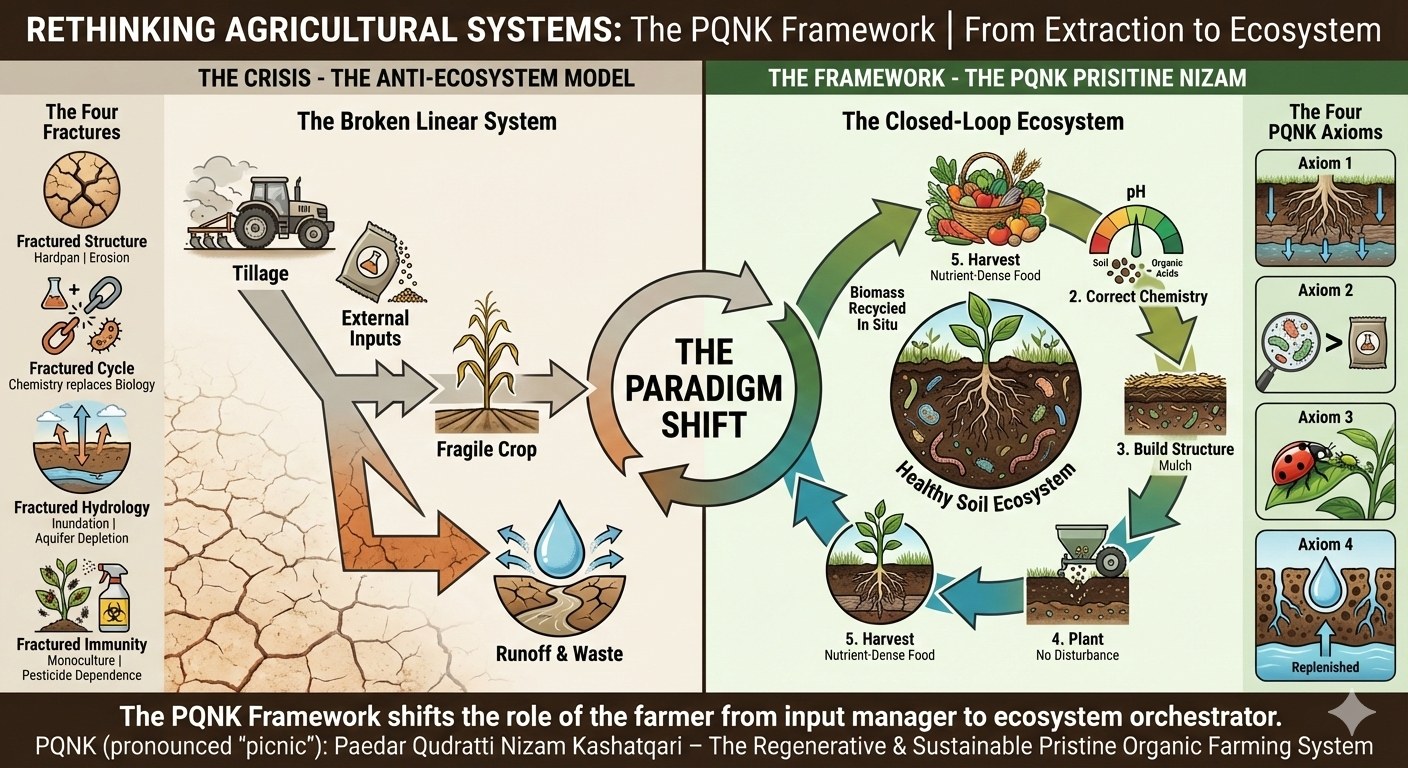
The paper opens by characterizing the dominant global agricultural system as more than inefficient: it names a 'process paradox' in which increasing external inputs (chemical, mechanical, financial) produce decreasing marginal returns in soil health, nutritional density, and farmer sovereignty. It defines this system by four failures, soil degradation from tillage-driven hardpan and topsoil loss, hydrological disruption from flood irrigation on compacted soil, chemical dependency that suppresses soil biology, and energetic inefficiency as a linear, extractive process that imports fertility and exports waste, and labels the whole model 'Anti-Ecosystem Agriculture.'
In place of this, the paper sets out four PQNK axioms as non-negotiable first principles derived from observing undisturbed ecosystems: the soil is a stratified, living organism whose primary pathology is subsoil hardpan; biology dominates chemistry, meaning plant-available nutrients should be provisioned on demand by the soil food web rather than bagged inputs; the protection system against pests and disease is inherent to a biodiverse ecosystem, not something to be imported; and water is a cycle to be managed through soil structure, not a commodity to be pumped and flooded.
These axioms translate into a sequential process protocol, described as a closed-loop Nizam (order): shatter the subsoil hardpan as a non-negotiable physical reset; correct pathological soil pH through managed leaching and mineral acids to liberate locked nutrients; form permanent raised beds and plant deep-rooted Jantar (Sesbania) to biologically fracture subsoil; and implement strict no-till planting into 100% retained crop residue, closing the loop so the farm's own biomass becomes its primary input.
A distinct section positions PQNK as a diagnostic benchmark against the corporate co-option of 'regenerative agriculture,' which the paper characterizes as a strategy of controlled opposition, adopting surface practices like no-till while preserving an input-dependent business model underneath. It offers three concrete tests: a 'regenerative' system using glyphosate for no-till fails the biology axiom; a 'sustainable' system relying on imported compost or organic fertilizer fails the biology-dominance axiom; and a 'water-efficient' system still using flood irrigation on flat fields fails the water-cycle axiom.
The paper concludes that the central agricultural challenge of the era is not a lack of technology but allegiance to a flawed foundational paradigm, and redefines the 'product' of PQNK as a regenerated farm ecosystem that is autonomous, resilient, predictable, and sovereign, with progress measured not by the next patented input but by the farmer's mastery of managing a self-renewing Nizam.
Full Paper
If you use “Listen”, the text of the page may be sent to your browser or operating system’s speech provider, such as Apple, Google or Microsoft, depending on the voice your device uses. Pedaver does not process, transmit or store any audio.
1.0 The Crisis of the Current Paradigm
The dominant global agricultural system is not merely inefficient; it is founded on a fundamental misalignment with natural law. This misalignment manifests as a process paradox, where increased external input (chemical, mechanical, financial) leads to decreasing marginal returns in soil health, nutritional density, and farmer sovereignty. The system is defined by:
• Soil Degradation: Reliance on tillage destroys soil structure, creating hardpans, eroding topsoil, and annihilating the soil microbiome.
• Hydrological Disruption: Flood irrigation combined with compacted soils leads to runoff, evaporation, and aquifer depletion, rather than infiltration and recharge.
• Chemical Dependency: The use of synthetic fertilizers and pesticides suppresses soil biology, locking up innate mineral wealth and creating pest and weed resistance.
• Energetic Inefficiency: It operates as a linear, extractive process—importing fertility and exporting waste—contrary to the cyclical, closed-loop logic of an ecosystem.
This paradigm, often rebranded as "industrial" or "conventional," is accurately defined as Anti-Ecosystem Agriculture. Its central failure is the replacement of nature's self-regulating provision and protection systems with purchased, toxic substitutes.
2.0 The PQNK Lens: Core Axioms of a Pristine System
The Paedar Qudratti Nizam Kashatqari (PQNK) is not an addition of techniques to the old model. It is a first-principles framework derived from observing the undisturbed ecosystem (Qudratti Nizam). Its foundational axioms are non-negotiable: Axiom 1: The Soil is a Stratified, Living Organism. Soil is not a homogenous growth medium. It is a structured, layered ecosystem. The primary pathology of industrial farming is the subsoil hardpan, a compacted layer that severs the connection between the root zone, mineral base, and deep-water table. PQNK’s first operational step is the physical remediation of this layer to restore vertical connectivity. Axiom 2: Biology Dominates Chemistry. In a pristine system, plant-available nutrients are not primarily supplied from a bag. They are provisioned on demand by the soil food web from the geological mineral abundance already present. The role of the farmer shifts from applying chemistry to orchestrating biology—creating the habitat (aeration, moisture, organic matter) for microbes to perform this work. Axiom 3: The Protection System is Inherent, Not Imported. A healthy, biodiverse ecosystem has built-in pest and disease regulation via predator-prey balances and plant systemic immunity. PQNK reactivates this natural protection command system by eliminating practices that create weak, susceptible plants (e.g., inundation, soil disturbance) and fostering habitats for beneficial organisms. Axiom 4: Water is a Cycle to be Managed, Not a Commodity to be Consumed. PQNK treats water management as a function of soil structure. Through permanent raised beds, mulch, and a restored soil sponge, the system maximizes infiltration, minimizes evaporation and runoff, and actively recharges aquifers. Irrigation becomes minimal and precise, mimicking the slow percolation of a forest floor.
3.0 The PQNK Process: A Closed-Loop Nizam (Order)
The framework translates into a sequential, self-reinforcing process protocol:
1. Diagnosis & Deconstruction: Shatter the subsoil hardpan. This is the non-negotiable physical reset.
2. Geochemical Rebalancing: Correct pathological pH levels (e.g., >8) using managed leaching and mineral acids (e.g., sulfuric acid) to liberate locked-up nutrients within the system's boundaries.
3. Structural Re-engineering: Form permanent, no-traffic raised beds. Plant deep-rooted bio-tillage crops (Jantar - Sesbania) to biologically fracture subsoil and generate biomass.
4. Cycle Closure: Implement strict no-till planting into mulch. Retain 100% crop residues in situ. The system’s output (biomass) becomes its primary input (mulch, soil organic matter), closing the loop. This Nizam creates a virtuous cycle: improved structure enhances biology, which improves nutrient cycling and water retention, which enhances plant health and biomass production, which further feeds soil life and structure.
4.0 Confronting Co-option: PQNK as a Benchmark
The rising corporate interest in "regenerative agriculture" represents a strategy of controlled opposition: the adoption of surface-level practices (e.g., no-till) while preserving the core input-dependent business model (e.g., herbicide-resistant GMO seeds, synthetic fertilizers). The PQNK framework serves as an essential tool to expose this. It provides a strict, integrated standard against which claims can be measured:
• A "regenerative" system that uses glyphosate for no-till fails Axiom 3 (it destroys biology).
• A "sustainable" system that relies on imported compost or organic fertilizers fails Axiom 2 (it does not activate the site's innate mineral provision system).
• A "water-efficient" system that still uses flood irrigation on flat fields fails Axiom
4. Thus, PQNK is not just a farming method. It is a diagnostic and analytical framework for distinguishing between genuine ecosystem agriculture and repackaged extraction.
5.0 Conclusion: The Paradigm is the Product
The PQNK framework posits that the central challenge of our time is not a lack of agricultural technology, but allegiance to a flawed foundational paradigm. True transformation requires a shift from input-centric thinking to process-centric thinking. The "product" of PQNK is not merely a higher-yielding organic crop. The product is a regenerated farm ecosystem that is:
• Autonomous: Minimally dependent on external inputs.
• Resilient: Climate-buffered through its hydrological and biological health.
• Predictable: Yielding consistent, high-nutrition produce.
• Sovereign: Placing control of the production process back in the hands of the land steward.
This framework redefines progress not as the next patented product, but as the farmer's mastery in managing the self-renewing Nizam of the Pristine system.
Footnote: Any Production Process That Inundates Soil With Water, Disturbs Soil Through Tillage, Or Leaves Soil Bare Without Organic Mulch Cover Does Not Qualify As Natural Ecosystem Science For Production Agriculture.
PQNK, to be pronounced as 'picnic', which stands for Paedar Qudratti Nizam Kashatqari, and means: the regenerative & sustainable Pristine Organic Farming System.
About This Paper
- Problem
- Hardpan · Flooding · External Input Dependency · Terminology / Framework Confusion
- Science
- Soil · Water · Crop Protection · Production Architecture
- Evidence
- Philosophical/Framework Argument
- Authority
- Current / Approved PQNK Knowledge
Related PQNK Science
Key Takeaways
- Names conventional agriculture's core failure a 'process paradox': more external input produces diminishing returns in soil health, nutrition, and farmer sovereignty, and labels the model 'Anti-Ecosystem Agriculture.'
- Sets out four non-negotiable PQNK axioms: soil is a stratified living organism, biology dominates chemistry, protection is inherent not imported, and water is a managed cycle rather than a consumed commodity.
- Translates the axioms into a sequential protocol: shatter the hardpan, correct soil chemistry, build permanent beds with Jantar bio-tillage, and close the loop with no-till planting into full residue retention.
- Positions PQNK explicitly as a diagnostic tool against corporate 'greenwashed' regenerative agriculture, offering concrete tests (e.g., glyphosate-based no-till fails the biology axiom).
- Argues the agricultural crisis is fundamentally a paradigm problem, not a technology problem, requiring a shift from input-centric to process-centric thinking.
- Redefines the 'product' of agriculture as a regenerated, autonomous, resilient, and sovereign farm ecosystem rather than a higher-yielding commodity crop.
Related Knowledge
same problem
Knowledge Paper: PQNK Rose Production
Cut-flower rose production is reframed as a closed-loop perennial system under PQNK, reaching a striking 8,712 plants per acre on twin-row permanent beds, with weeds treated as mulch, alfalfa grown as living nitrogen-fixing ground cover, and strict soil-moisture management replacing scheduled irrigation.
same problem
Chilli Production Under PQNK (PICNIC)
Chilli is biologically perennial and can remain productive for over a decade, but conventional short-cycle, urea-dependent management collapses that potential into a pest-prone annual grind. This paper shows how PQNK's soil-conversion framework and a single apical-pinching intervention restore chilli to a low-cost, high-density perennial crop, validated on a Hafizabad farm.
same problem
When 13 Inches of Rain Falls in Eight Hours
After 13 inches of rain in eight hours, the PQNK orchard beds of Jaskaran Singh in Fazilka district, Indian Punjab, had taken the water into the soil and could be walked on in slippers, while neighbouring conventional orchards and fields stood under water, and so did a strip of his own orchard where the hardpan had not been broken. The paper explains why hardpan is a water barrier as well as a root barrier, and why the soil is the first reservoir.
same problem
The Hidden Crisis: How Industrial Agriculture Has Broken Earth's Water Cycle
A quantified case that industrial agriculture has driven global groundwater tables from 20-30 feet to over 300 feet deep, creating a roughly $200 billion annual crisis addressable through a costed $15 billion, 24-month PQNK rollout plan.