

KP-029 · Crop-Specific Guides
Motha Grass (Cyperus rotundus) Dominance: A PQNK Knowledge Paper
Conventional agronomy calls motha grass a 'cancer weed' to be eradicated with herbicide, but this paper reframes its aggressive spread as a diagnostic signal, an emergency-response species that colonizes exactly the compacted, oxygen-starved, biologically dead soils that herbicide and tillage create in the first place.
Read or listen to the full paper ↓Abstract
The paper opens against the grain of conventional agronomy, which labels motha grass (Cyperus rotundus) an invasive, parasitic weed due to its tuber-based propagation and its release of phenolic acids, flavonoids, and terpenoids that suppress crop roots, hormones, mycorrhizae, and beneficial microbes, prescribing chemical eradication as the standard response. PQNK fundamentally disagrees with this diagnosis, on the premise that in natural ecosystems no species dominates without function: dominance of any plant, insect, or microbe is always a response, never an accident, and motha's dominance reflects a soil system that has lost its internal order, depth, and biological coherence.
This rests on a broader PQNK principle that plants function as active managers of their ecosystem, recruiting microbes through root exudates, assigning tasks of nutrient provisioning and protection, and regulating populations through energy flow, but only when the hardpan is broken, roots can penetrate deep, oxygen and moisture cycles are stable, soil temperature is moderated, and living roots are continuously present. When these conditions collapse, plants lose control of their ecosystem and emergency species step in to fill the gap.
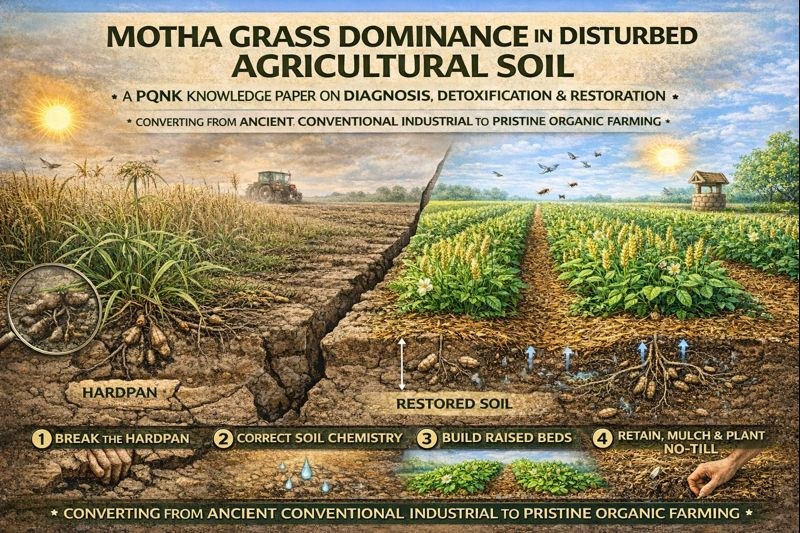
Motha grass, the paper argues, thrives precisely where hardpan blocks vertical root movement, oxygen diffusion is restricted, salts and alkalinity dominate, microbial diversity is suppressed, and soil energy has become stagnant and horizontal rather than vertical. Its tubers act as biological drills forcing entry into compacted layers, while its allelopathic chemicals slow down aggressive, shallow-rooted competitors, suppress dysfunctional microbial blooms, and pause root expansion until conditions improve, functioning as ecosystem stabilization rather than an attack on the crop.
Every standard ACI response is shown to backfire: herbicides kill surface biomass but leave tubers intact, tillage fragments those tubers and multiplies the plant, and fertilizers feed further chemical imbalance rather than biology, each intervention increasing soil stress, further killing beneficial organisms, and preventing the vertical energy flow the field actually needs to recover.
The prescribed remedy is the same four-step PQNK conversion framework used across the knowledge library: break the hardpan to restore deep water, air, and root movement; correct soil chemistry with leaching irrigation and 8kg of sulfuric acid per acre where pH exceeds 8, unlocking minerals and neutralizing allelopathic residues; build permanent raised beds and grow Jantar (Sesbania) to biologically fracture the subsoil and rebuild microbial highways; and retain Jantar's roots, mulch its biomass, and plant the cash crop no-till directly through it. Once implemented, motha loses dominance naturally as its tubers rot from an oxygen-balance shift and its allelopathic chemistry neutralizes biologically, with no spraying, pulling, or mechanical war on the weed; the paper's guidance to farmers is to treat its appearance as a diagnostic signal for soil correction, not an enemy to eliminate.
Full Paper
If you use “Listen”, the text of the page may be sent to your browser or operating system’s speech provider, such as Apple, Google or Microsoft, depending on the voice your device uses. Pedaver does not process, transmit or store any audio.
1. Introduction
Modern agronomy defines motha grass as an invasive, parasitic weed due to its tuber-based propagation and release of phenolic acids, flavonoids, and terpenoids that suppress crop roots, hormones, mycorrhizae, and beneficial microbes. Consequently, chemical eradication is prescribed. PQNK fundamentally disagrees with this diagnosis. In natural ecosystems, no species exists without function. Dominance of any species—plant, insect, or microbe—is always a response, never an accident. Motha grass dominance reflects a soil system that has lost its internal order, depth, and biological coherence.
2. PQNK Principle: Plants as Employers, Biology as Workforce
Under PQNK, plants are not passive organisms. They are active managers of their ecosystem:
• Plants recruit microbes through root exudates
• Assign tasks of nutrient provisioning and protection
• Regulate populations through energy flow
This system functions only when:
• Hardpan is broken
• Roots can penetrate deep
• Oxygen and moisture cycles are stable
• Soil temperature is moderated
• Continuous living roots are present
When these conditions collapse, plants lose control—and emergency species step in.
3. What Motha Grass Really Indicates
3.1 Motha as a Soil Emergency Species
Motha grass thrives where:
• Hardpan blocks vertical root movement
• Oxygen diffusion is restricted
• Salts and alkalinity dominate (high pH)
• Microbial diversity is suppressed
• Soil energy is stagnant and horizontal
Its tubers act as biological drills, forcing entry into compacted layers. Its allelopathic chemicals:
• Slow down aggressive, shallow-rooted plants
• Suppress dysfunctional microbial blooms
• Pause root expansion until soil conditions improve
Thus, motha is not attacking crop—it is stabilizing a broken system.
4. Why ACI Fails Against Motha
ACI responds with:
• Herbicides → kill surface biomass but not tubers
• Tillage → fragments tubers and multiplies motha
• Fertilizers → feed imbalance, not biology
Each intervention strengthens motha dominance by:
• Increasing soil stress
• Further killing beneficial organisms
• Preventing vertical energy flow
5. PQNK Conversion Framework (Mandatory in All PQNK Papers)
Once these steps are correctly implemented, motha grass naturally retreats without force.
Step 1: Break the Hardpan
Shatter the compacted subsoil layer to restore deep movement of:
• Water
• Air
• Roots
Deep rooting eliminates the ecological niche motha occupies.
Step 2: Correct Soil Chemistry with Water and Acid
If soil pH > 8:
• Apply deep irrigation to leach accumulated salts
• Apply 8 kg sulfuric acid per acre with irrigation
This:
• Unlocks minerals
• Neutralizes allelopathic residues
• Creates conditions hostile to parasitic weeds
Step 3: Build Permanent Raised Beds and Grow Jantar (Sesbania)
• Construct permanent raised beds with controlled traffic furrows
• Plant Jantar immediately
Jantar:
• Sends deep taproots
• Biologically fractures subsoil
• Pulls nutrients upward
• Rebuilds microbial highways
Step 4: Retain Roots, Mulch Biomass, and Plant No-Till
This is the non-negotiable core of PQNK:
• Do not remove Jantar roots
• Chop and mulch biomass on the same bed
• Plant crop directly using a no-till planter
This:
• Detoxifies allelopathic zones biologically
• Restores fungal networks
• Re-establishes plant–microbe contracts
6. What Happens to Motha Under PQNK
When the above steps are completed:
• Motha loses dominance naturally
• Tubers rot due to oxygen balance shift
• Allelopathic chemistry neutralizes biologically
• Crop roots grow deeper and outcompete
No spraying. No pulling. No war.
7. Practical Guidance for the New PQNK Practitioner
• Do not panic when motha appears
• Do not attempt chemical or mechanical eradication
• Treat motha as a diagnostic signal, not an enemy
• Focus on soil correction, not weed control
Nature never needs elimination—only correction.
8. Conclusion
Motha grass dominance is a symptom of soil distress, not a disease. PQNK restores order by rebuilding the natural hierarchy: soil → biology → plant → ecosystem. When the system is corrected from below, motha exits on its own. In PQNK, weeds do not disappear because they are killed— they disappear because they are no longer needed.
Footnote: PQNK (pronounced 'picnic')—the regenerative & sustainable Pristine Organic Farming System—is grounded in Natural Ecosystem Science. This science employs perennial biodiversity, protects soil with organic mulch, and avoids practices like water inundation, tillage disturbance, and leaving soil bare.
It is the process that matters most. PQNK is a pristine production system designed not merely for yield, but for optimal, balanced output—where quality, sustainability, and ecological harmony emerge from a self-regulated, zero-external-input methodology.
PDF Knowledge papers: https://drive.google.com/drive/folders/ 1iadwV6mdUPyrUIpB3oRfNv6DLiackaUL?usp=sharing
About This Paper
- Problem
- Weed Pressure · Hardpan · Saline / Alkaline / High-pH Soil · Low Root-Zone Oxygen / Poor Aeration
- Science
- Soil · Plants · Biodiversity · Crop Protection
- Evidence
- Scientific Mechanism
- Authority
- Current / Approved PQNK Knowledge
Related PQNK Science
Key Takeaways
- PQNK reframes motha grass dominance as a diagnostic signal of soil distress, hardpan, poor oxygen, high pH, and suppressed microbial diversity, rather than a weed to be eradicated.
- Motha's tubers act as 'biological drills' that force entry into compacted soil layers, and its allelopathic chemicals pause competing root expansion until soil conditions improve.
- Herbicides only kill surface biomass, tillage fragments and multiplies tubers, and fertilizers feed further imbalance; each conventional response actually strengthens motha's ecological niche.
- The same four-step PQNK conversion (break hardpan, correct chemistry, build Jantar-seeded raised beds, retain, mulch, and no-till plant) that regenerates soil for any crop causes motha to retreat naturally.
- Under PQNK, motha tubers rot as the soil's oxygen balance shifts and its allelopathic chemistry is neutralized biologically, with no spraying, pulling, or mechanical war on the weed.
- The paper's practical guidance for farmers: do not panic or attempt eradication when motha appears; treat it as a signal to correct the soil, not an enemy to fight.
Related Crops
Related Knowledge
same problem
The Healer's Dialogue: From Weed Signal to Soil Silence — A PQNK Pathway to Self-Regulating Abundance
Responding to a farmer's question about using weeds as nutrient-deficiency indicators, this dialogue explains that in PQNK the goal isn't to manage weeds as permanent indicator crops, but to run a four-step protocol that resolves the soil problems they signal so the weeds voluntarily depart.
same problem
Balangu & Basil Seed Production Under PQNK
A complete Punjab-focused production guide showing how Balangu (Lallemantia royleana) and Basil seed crops are grown on PQNK's permanent raised-bed system, from hardpan-breaking through harvest and storage.
same problem
Chilli Production Under PQNK (PICNIC)
Chilli is biologically perennial and can remain productive for over a decade, but conventional short-cycle, urea-dependent management collapses that potential into a pest-prone annual grind. This paper shows how PQNK's soil-conversion framework and a single apical-pinching intervention restore chilli to a low-cost, high-density perennial crop, validated on a Hafizabad farm.
same problem
Knowledge Paper: PQNK Rose Production
Cut-flower rose production is reframed as a closed-loop perennial system under PQNK, reaching a striking 8,712 plants per acre on twin-row permanent beds, with weeds treated as mulch, alfalfa grown as living nitrogen-fixing ground cover, and strict soil-moisture management replacing scheduled irrigation.