

KP-037 · Soil Science & PQNK System
The Healer's Dialogue: From Weed Signal to Soil Silence — A PQNK Pathway to Self-Regulating Abundance
Responding to a farmer's question about using weeds as nutrient-deficiency indicators, this dialogue explains that in PQNK the goal isn't to manage weeds as permanent indicator crops, but to run a four-step protocol that resolves the soil problems they signal so the weeds voluntarily depart.
Read or listen to the full paper ↓Abstract
A farmer asks whether, since weeds compensate for specific soil deficiencies (nitrogen-fixing weeds where nitrogen is low, erosion-preventing weeds where erosion is severe), PQNK farmers can deliberately use indicator plants to manage nutrition in early crops. The answer affirms the diagnosis but redirects the strategy: weeds are read as the soil's own healing response to a collapsed system, and the PQNK role is not to add inputs or manage intercrops but to remove obstacles so the soil's own intelligence completes the healing, after which the need for weeds-as-medicine disappears entirely.
The paper reads dominant native weeds as precise diagnostic tools: Dheet (Field Bindweed) and Kundi (Purple Nut Sedge) signal hardpan, severe compaction, and waterlogging; Jangli Jai (Wild Oat) and Maina (Wild Mustard) indicate a crusted surface and poor structure; Kulfa (Purslane) indicates compaction coupled with high salinity; broadleaf Chulai (Amaranth) signals disturbed, lifeless, low-organic-matter soil; and Leh (Cogon Grass) and Kans (Saccharum spontaneum) mark the final stage of severely degraded, acidic, exhausted soils.
The prescribed four-step correction sequence starts by breaking the hardpan with a subsoiler to reconnect the soil to the aquifer and end the waterlogging many weeds exploit, then corrects soil chemistry with a deep leaching irrigation combined with 8 kg of sulfuric acid per acre, a one-time action that reacts specifically with calcium carbonate to break apart tightly bound salt clusters into mobile, soluble particles that can now be leached downward through the enlarged pores the hardpan-breaking step created.
The third step builds permanent raised beds with dedicated furrows for all tractor traffic, and sows Jantar (Sesbania aculeata) densely across them; its deep taproot follows the subsoiler's path further into the subsoil, creating permanent biological channels and pulling minerals to the surface. The fourth step closes the loop: the Jantar is cut at flowering rather than uprooted, its roots left in place as earthworm food and fungal roadmap, its chopped biomass spread as the bed's first self-generated mulch, and the first cash crop planted directly into that mulch with a no-till planter.
The paper's closing argument is that this protocol resolves the five root causes that summoned the weeds in the first place, hardpan, pH/salt lock-up, bare soil, weak biology, and surface waterlogging, so that as the restored soil's own crops, fed by mineral abundance and ceaseless microbial work, become dominant, the weeds recede into the background seed bank, their diagnostic purpose fulfilled.
Full Paper
If you use “Listen”, the text of the page may be sent to your browser or operating system’s speech provider, such as Apple, Google or Microsoft, depending on the voice your device uses. Pedaver does not process, transmit or store any audio.
Answer:
Your question touches the very heart of the PQNK (Paedar Qudratti Nizam Kashatqari) system. You have correctly understood that weeds are the soil's own healing response—they are symptoms of a collapsed system attempting to restore itself. In the true, closed-loop PQNK system, our role is not to add inputs, but to remove obstacles and initiate processes that allow the soil's own immutable intelligence to complete the healing. Once this is done, the need for the "weeds-as-medicine" disappears, as the soil is restored to health.
Therefore, the answer is not a list of external inputs or managed intercrops, but a clear pathway to create the conditions where weeds are no longer required as indicators, because the soil has been fundamentally corrected.
The PQNK Principle: Intervention to End Intervention
We do not manage weeds as a permanent feature. We read their message, then act to resolve the root cause of their appearance so they voluntarily depart. They are signposts, not residents.
Native Weeds as Indicators of Soil Collapse
Observe the dominant native weeds on your land; they are precise diagnostic tools:
Dheet (Field Bindweed) / Kundi (Purple Nut Sedge): Signal of hardpan, severe compaction, and waterlogging. The soil is suffocated.
Jangli Jai (Wild Oat) / Maina (Wild Mustard): Often indicate crusted surface, poor soil structure, and imbalance.
Kulfa (Purslane): Can indicate compaction coupled with high salinity.
Broadleaf Weeds like Chulai (Amaranth): Often pioneers in disturbed, lifeless soil low in organic matter.
Leh (Cogon Grass) / Kans (Saccharum spontaneum): Final-stage invaders of severely degraded, acidic, and exhausted soils.
Seeing these plants confirms the soil is calling for help. The PQNK response is not to fight them, but to execute the following four-step system correction. After this, these weeds lose their competitive advantage and fade away.
The PQNK Four-Step Protocol to Heal Soil & Eliminate Weeds
Follow these steps in sequence to transition your land into a resilient, close-loop system.
1. Break the Hardpan: Liberate the Soil's Depth The hardpan is the prison wall. It locks away water, air, and roots, forcing plants to be weak and inviting parasites. Its collapse is the primary reason for most weed infestations. Action: Use a subsoiler to shatter this layer without inverting the soil profile. This single act reconnects the soil with the aquifer, allows deep root penetration, and ends the waterlogging that many weeds exploit.
2. Correct the Soil Chemistry with Water and Acid A pH above 8 indicates a soil where salts and minerals (like calcium carbonate) are physically locked in a tightly bound, clustered state. These clusters are too large to move through the soil pores, creating a "chemical prison." In our closed-loop system, we use two tools: Water as the carrier and Sulfuric Acid as the key.
Action: Apply a deep, leaching irrigation. With this water, apply 8 kg of sulfuric acid per acre. This is a one-time corrective action, not an annual input. The acid reacts specifically with calcium carbonate (lime). This reaction does not "neutralize" the salts but breaks the clusters apart—it displaces calcium ions and releases sulfate ions. This process bifurcates the large salt aggregates into smaller, soluble ionic particles (like calcium sulfate – gypsum).
Once the hardpan is broken (Step 1), these now-mobile particles can finally move freely with the water through the enlarged soil pores and subsoil channels. They are leached downward and out of the active root zone, breaking the chemical lock. This rapidly lowers the pH and liberates the broad spectrum of minerals that were trapped within the salt clusters, making them available for plant and microbial use. This step dissolves the physical-chemical prison, restoring the soil's natural chemistry.
3. Build Permanent Raised Beds and Plant Jantar (Sesbania) Now, structure the landscape for permanent health.
Action: Form permanent raised beds with defined furrows for tractor wheels. All traffic is confined to the furrows; the bed is never compacted again. Immediately sow Jantar (Sesbania aculeata) densely on the beds. Jantar is not an external input; it is a deep-rooted native healer plant. Its powerful taproot will travel down the subsoiler's path, further breaking up the subsoil, creating permanent biological channels, and pulling minerals from the deep strata to the surface.
4. Retain, Mulch, and Plant with No-Till: Close the Loop This is where the closed-loop is sealed. The Jantar crop is the system's first and most crucial harvest.
Action: Do not uproot the Jantar. Cut it at the base at flowering. Leave all roots in the soil—they are now food for earthworms and a roadmap for fungal highways. Chop the biomass and spread it as a thick mulch on the same bed. You have just created your own perfect, in-situ, nutrient-balanced mulch. The soil is covered, moist, and protected.
Now, plant your first cash crop directly into this mulched bed using a no-till planter. The seeds germinate in a perfect microbiome. The Jantar roots decay, feeding the crop. The mulch suppresses any remaining weed seeds. The soil is never disturbed again.
The Result: Why Weeds Disappear
By executing this protocol, you have addressed the root causes that summoned the weeds:
Hardpan is gone → No need for deep-taprooted "plough" weeds.
pH is balanced & salts leached → No advantage for saline-tolerant weeds.
Soil is permanently covered with thick mulch → No bare ground for pioneer weeds to colonize.
Biology is unleashed → A diverse, strong soil food web outcompetes and suppresses parasitic organisms. Mycorrhizal fungal networks connect to your crops, making them resilient.
Water infiltrates deeply → No surface waterlogging for sedges.
The "indicator plants" have done their job—they led you to heal the soil. In the restored, close-loop PQNK system, your crops, fed by the "Perpetual Abundance" of minerals and the ceaseless work of microbes, become the dominant, thriving species. Weeds, their purpose fulfilled, recede into the background seed bank, no longer required.
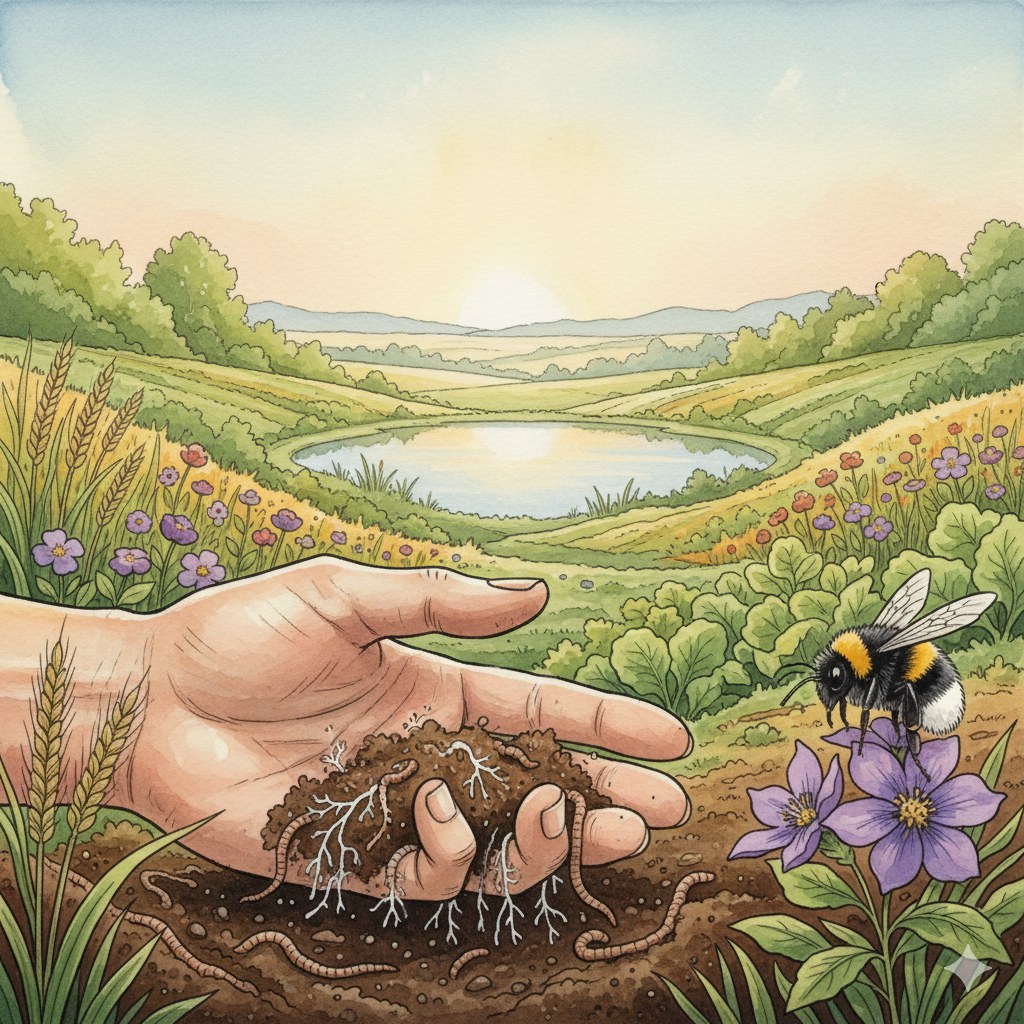
You have not fought nature. You have enabled it to achieve its own balance. That is the essence of PQNK.
—————————
Footnote: Any Production Process That Inundates Soil With Water, Disturbs Soil Through Tillage, Or Leaves Soil Bare Without Organic Mulch Cover Does Not Qualify As Natural Ecosystem Science For Production Agriculture.
PQNK, to be pronounced as 'picnic', which stands for Paedar Qudratti Nizam Kashatqari, and means: the regenerative & sustainable Pristine Organic Farming System.
www.Facebook.Com/Pedaver
https://www.youtube.com/@pedaverpqnk3167/videos
pedaver@gmail.com
WhatsApp +92 320 677 6666
About This Paper
- Problem
- Weed Pressure · Hardpan · Waterlogging · Saline / Alkaline / High-pH Soil · Poor Soil Structure / Aggregation · Soil Organic Matter / Carbon Loss
- Science
- Soil · Biodiversity
- Evidence
- Scientific Mechanism
- Authority
- Current / Approved PQNK Knowledge
Related PQNK Science
Key Takeaways
- PQNK treats weeds as diagnostic signposts, not residents: read the signal, fix the root cause, and the weed loses its competitive advantage and departs on its own.
- Specific mapping: Dheet/Kundi signal hardpan and waterlogging; Kulfa signals compaction plus salinity; Leh/Kans mark severely degraded, acidic, exhausted soil.
- The one-time chemistry correction applies 8 kg of sulfuric acid per acre with deep irrigation to break apart calcium carbonate clusters and leach salts, but only works once the hardpan is broken so the mobilized particles can actually move through the soil.
- Jantar (Sesbania) is sown densely on new permanent beds specifically to extend the subsoiler's fracture deeper into the profile and mine minerals to the surface.
- Jantar biomass is never removed from the field; it's cut at flowering, chopped, and left in place as the bed's first self-generated mulch layer.
- The protocol claims to resolve five separate root causes of weed pressure at once: hardpan, chemical lock-up, bare soil, weak biology, and surface waterlogging.
Related Knowledge
same problem
Knowledge Paper: Achieving High-Density Pomegranate Production Through the PQNK (Picnic) Pristine Organic Farming System
This knowledge paper sets out the full methodology for a 544-plant-per-acre pomegranate orchard under PQNK: the four-step soil recovery protocol that converts degraded land into a closed-loop system, and the four management pillars, zero soil disturbance, natural irrigation, inherent pest management, and structural pruning, that keep it that way.
same problem
Motha Grass (Cyperus rotundus) Dominance: A PQNK Knowledge Paper
Conventional agronomy calls motha grass a 'cancer weed' to be eradicated with herbicide, but this paper reframes its aggressive spread as a diagnostic signal, an emergency-response species that colonizes exactly the compacted, oxygen-starved, biologically dead soils that herbicide and tillage create in the first place.
same problem
The Weed-Indicator System
Instead of treating weeds as enemies to eliminate, PQNK reads them as diagnostic language the field uses to report its own underground condition. This paper works through three common indicator species, bindweed, nutsedge, and pigweed, explaining exactly which soil imbalance each one signals and why suppressing the weed without correcting that imbalance only produces temporary, repeating outbreaks.
same problem
Chilli Production Under PQNK (PICNIC)
Chilli is biologically perennial and can remain productive for over a decade, but conventional short-cycle, urea-dependent management collapses that potential into a pest-prone annual grind. This paper shows how PQNK's soil-conversion framework and a single apical-pinching intervention restore chilli to a low-cost, high-density perennial crop, validated on a Hafizabad farm.