

KP-054 · Water & Climate
Managing Saline Irrigation Water and Soil Reclamation Through PQNK
Faced with 6,000 ppm groundwater and pH 8 alkaline soil, a common combination across arid regions, this advisory paper walks through when acid-and-water leaching helps versus when it simply adds more salt to the soil. It sets out a decision framework by water TDS and soil pH, then a step-by-step biological reclamation protocol built around the salt-tolerant cover crop Jantar.
Read or listen to the full paper ↓Abstract
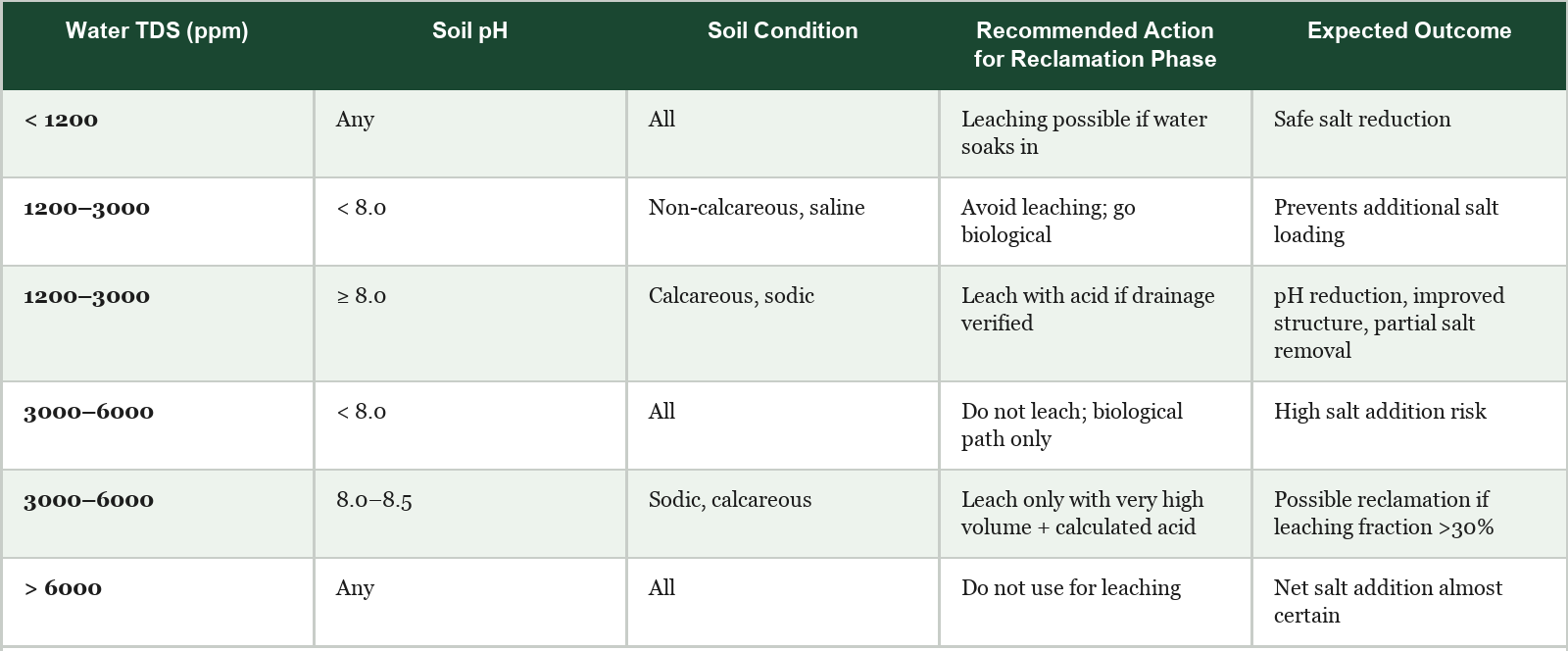
The paper addresses a specific, common dilemma in arid-region agriculture: whether to use high-TDS groundwater (in this case 6,000 ppm) to leach salts from alkaline soil (pH above 8) using sulfuric acid and heavy water volumes, the standard PQNK approach when water is below 2,000 ppm, or whether that intervention would add more salt than it removes. It builds a decision table cross-referencing water TDS and soil pH against recommended action, ranging from 'leaching possible' at low TDS to 'do not use for leaching' above 6,000 ppm, where net salt addition is judged almost certain.
For the specific case posed, 6,000 ppm water and pH 8 soil, the paper's conclusion is that water washing is not recommended unless excellent subsurface drainage exists and enormous water volumes can be applied, and that even then the net salt balance remains risky. It recommends skipping the water wash entirely and proceeding directly to biological reclamation using Jantar (Sesbania aculeata), a salt-tolerant cover crop, as the first-season planting.
The step-by-step protocol that follows is concrete: level land or cut contour furrows on slopes, break the hardpan once with a subsoiler, apply just enough saline water to moisten topsoil for germination, plant Jantar (broadcast or on raised beds, mulched immediately), maintain thick mulch to suppress salt rise through evaporation, chop and drop the Jantar at roughly 6 feet while leaving its roots intact, then plant the next cash crop no-till directly into that residue, using only minimal furrow irrigation (never flooding) as needed.
The paper's quantitative case for this approach rests on radically reduced water volume: it calculates that a conventional rice crop applies around 6.6 million liters of water per acre, introducing roughly 13,158 kg of dissolved solids, whereas PQNK rice needs only about 0.5 million liters, meaning the 6.1 million liters saved also avoids adding an estimated 12,130 kg of dissolved solids per crop. Because PQNK shows roughly a 90% reduction in externally supplied irrigation water compared to conventional irrigation, it adds roughly 90% less salt even when using the same high-TDS source.
It closes with guidance for extension advisors to look past salt and pH readings alone toward soil life and moisture as the more telling indicators, and reiterates a rider that these protocols describe a transitional phase only: in a fully established PQNK system, irrigation of any kind becomes largely unnecessary as the soil takes over water and mineral management on its own.
Full Paper
If you use “Listen”, the text of the page may be sent to your browser or operating system’s speech provider, such as Apple, Google or Microsoft, depending on the voice your device uses. Pedaver does not process, transmit or store any audio.
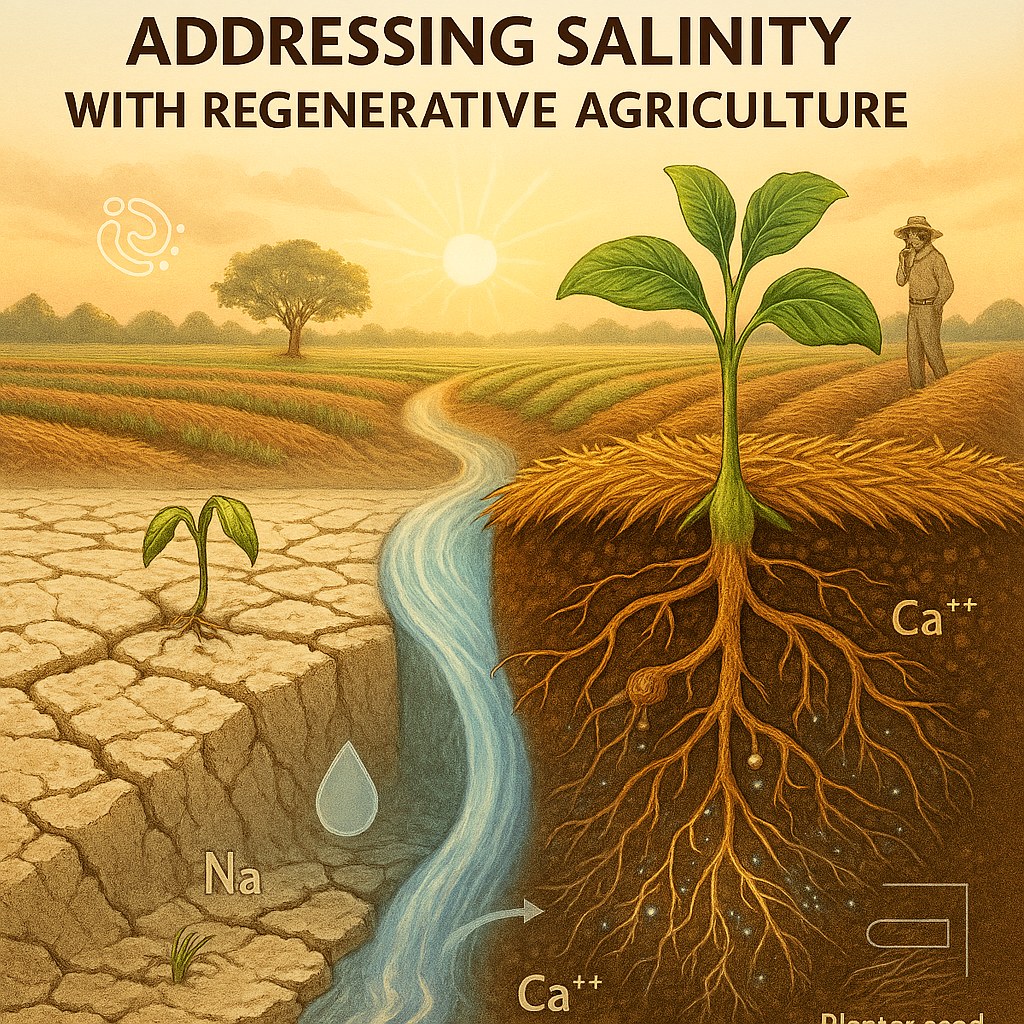
Managing Saline Irrigation Water & Soil Reclamation through PQNK - the Ecosystem Science
1. Introduction & Core Philosophy
Paedar Qudratti Nizam Kashatqari (PQNK) is a regenerative farming system that restores the soil’s natural biological capacity to manage water and minerals. It shifts agriculture from a chemical and flushingdependent model to a biologybased infiltration and cycling model. This paper addresses a common dilemma in arid regions: whether to use available highTDS groundwater (6000 ppm) to leach salts from alkaline soil (>pH 8) and when to instead rely entirely on biological reclamation.
2. Understanding the Challenge
• Saline Water: 6000 ppm water contains ~6 kg of dissolved salts per cubic meter.
• Alkaline Soil: pH 8 indicates calcareous conditions, often with poor structure and salt accumulation.
• Standard PQNK Approach: Add sulfuric acid and leach with large water volumes, where water is below 2000 ppm.
• PQNK Inquiry: Will this add more salts or remove them? Is water washing always necessary?
3. The PQNK Perspective: Two Distinct Objectives
A. Initial Reclamation (First Season – Cover Crop Establishment) Goal: Break hardpan, initiate biology, and begin salt management.
Options:
1. Water Wash + Acid: Only if specific conditions met (see Table 1).
2. Direct Biological Planting: Skip leaching, plant salt-tolerant cover crop (e.g., Jantar) with minimal irrigation.
B. Transition & Maintenance Cropping
Goal: Grow crops with radically reduced irrigation (up to 90% less water than conventional). PQNK Reality: Once soil life is restored, crops derive moisture from stored rainwater, dew, and air humidity. Irrigation is only occasionally supplemental.
4. Decision Framework: To Leach or Not to Leach?
Water Wash Advisory Based on Water TDS & Soil pH
| Water TDS (ppm) | Soil pH | Soil Condition | Recommended Action for Reclamation Phase | Expected Outcome |
|---|---|---|---|---|
| < 1200 | Any | All | Leaching possible if water soaks in | Safe salt reduction |
| 1200–3000 | < 8.0 | Non-calcareous, saline | Avoid leaching; go biological | Prevents additional salt loading |
| 1200–3000 | ≥ 8.0 | Calcareous, sodic | Leach with acid if drainage verified | pH reduction, improved structure, partial salt removal |
| 3000–6000 | < 8.0 | All | Do not leach; biological path only | High salt addition risk |
| 3000–6000 | 8.0–8.5 | Sodic, calcareous | Leach only with very high volume + calculated acid | Possible reclamation if leaching fraction >30% |
| > 6000 | Any | All | Do not use for leaching | Net salt addition almost certain |
Table 1: Water Wash Advisory Based on Water TDS & Soil pH Key Conclusion for the Farmer:
With 6000 ppm water and pH 8 soil, water washing is not recommended unless excellent subsurface drainage exists and enormous water volumes can be applied. Even then, the net salt balance is risky. PQNK recommends skipping water wash and proceeding directly to biological reclamation with Jantar.
5. Step-by-Step PQNK Reclamation Protocol (Without Water Wash)
When water washing is omitted, follow this sequence:
1. Land Formation: Level land in flat areas; create contour furrows on slopes.
2. Hardpan Breaking: Deep subsoiling once to restore infiltration.
3. Light Germination Irrigation: Apply just enough 6000 ppm water to moisten topsoil for seed germination.
4. Cover Crop Planting:
• If no planter: Broadcast Jantar seed, form raised beds, apply mulch.
• If planter available: Make raised beds, plant seed on beds, mulch immediately.
5. Mulch Management: Maintain thick organic mulch to conserve moisture and suppress salt rise.
6. Chop-and-Drop: When Jantar reaches ~6 feet, cut top growth and layer on beds as mulch. Roots remain intact.
7. No-Till Cash Crop Planting: Immediately plant next crop with no-till planter or handheld dribbler.
8. Minimal Furrow Irrigation (if needed):
• Run water slowly in furrows (≤ ½ furrow height).
• Check soil moisture at seed depth after 3–4 days.
• Repeat only if necessary until crop establishment.
6. Salt Dynamics in PQNK vs. Conventional Systems
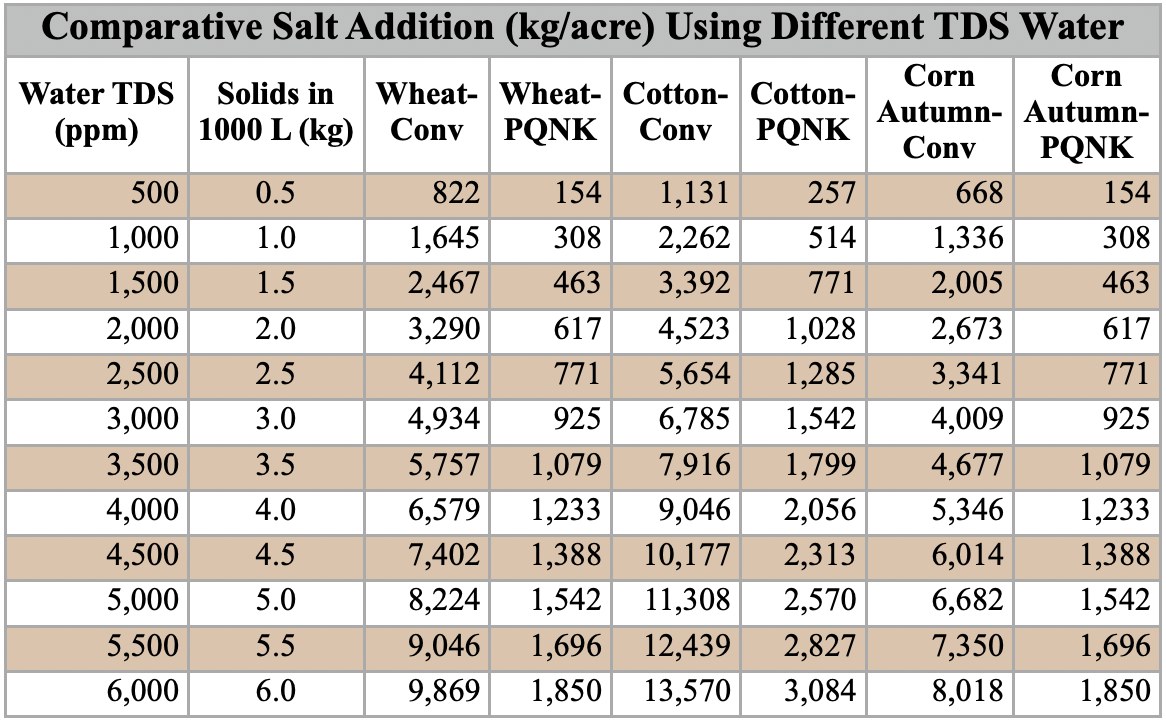
Table 2: Comparative Salt Addition (kg/acre) Using Different TDS Water PQNK Advantage: 90% less water means 90% less salt added, even with high-TDS water.
7. Long-Term Management of Saline Water in PQNK
Once soil biology is active:
• Salt-Tolerant Crops: Use in early transition (e.g., Jantar, barley, sorghum).
• Mulching: Non-negotiable to reduce evaporation-driven salt accumulation.
• Organic Amendments: Compost and root exudates enhance microbial processing of salts.
• Irrigation Strategy: Only light, infrequent furrow irrigation if necessary; prioritize soil moisture monitoring.
8. Final Advisory
For the Farmer with 6000 ppm Water & pH 8 Soil:
1. Test how freely the soil takes in water before considering leaching.
2. In most cases, skip water wash and sulfuric acid.
3. Proceed directly with Jantar planting as per Step-by-Step Protocol.
4. Trust the biological system: Jantar will improve soil structure, stimulate microbes, and begin natural salt cycling.
5. After Jantar, adopt full PQNK practices: no-till, mulch, minimal irrigation.
For Extension Advisors:
• Encourage farmers to observe soil life and moisture, not just salt and pH.
• Promote mulch-based systems for evaporative control.
• Use the decision table (Table 1) to customize advice for varying water quality and soil conditions.
9. PQNK Principle Reiterated
During the lifespan of a rice crop, around 6.6 million liters of water are applied, resulting in the introduction of 13,158 kilograms of dissolved solids per acre of land. However, when growing rice using PQNK, we know that the crop only needs 0.5 million liters of water. Thus, the remaining 6.1 million liters are wasted, adding an extra 12,130 kg of dissolved solids with every crop. Below is the table 2, split into two parts:
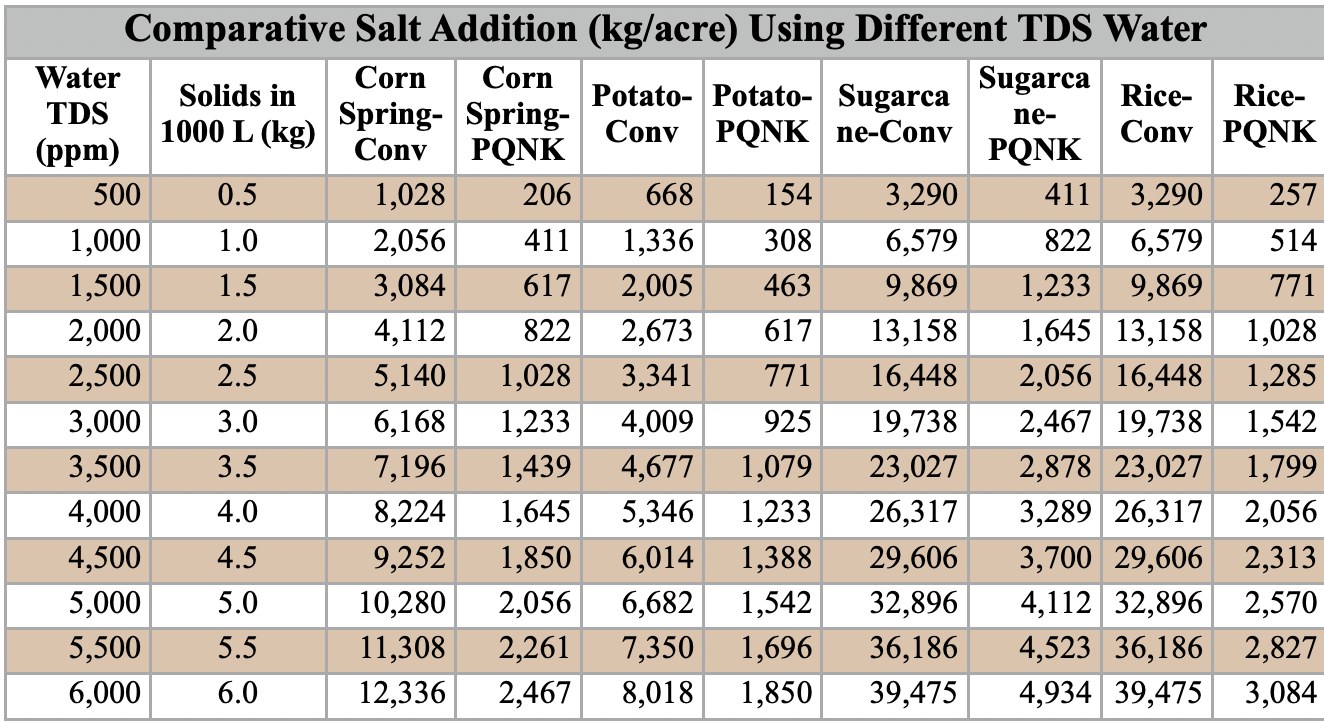
| Water TDS (ppm) | Solids in 1000 L (kg) | Corn Spring-Conv | Corn Spring-PQNK | Potato-Conv | Potato-PQNK | Sugarcane-Conv | Sugarcane-PQNK | Rice-Conv | Rice-PQNK |
|---|---|---|---|---|---|---|---|---|---|
| 500 | 0.5 | 1,028 | 206 | 668 | 154 | 3,290 | 411 | 3,290 | 257 |
| 1,000 | 1.0 | 2,056 | 411 | 1,336 | 308 | 6,579 | 822 | 6,579 | 514 |
| 1,500 | 1.5 | 3,084 | 617 | 2,005 | 463 | 9,869 | 1,233 | 9,869 | 771 |
| 2,000 | 2.0 | 4,112 | 822 | 2,673 | 617 | 13,158 | 1,645 | 13,158 | 1,028 |
| 2,500 | 2.5 | 5,140 | 1,028 | 3,341 | 771 | 16,448 | 2,056 | 16,448 | 1,285 |
| 3,000 | 3.0 | 6,168 | 1,233 | 4,009 | 925 | 19,738 | 2,467 | 19,738 | 1,542 |
| 3,500 | 3.5 | 7,196 | 1,439 | 4,677 | 1,079 | 23,027 | 2,878 | 23,027 | 1,799 |
| 4,000 | 4.0 | 8,224 | 1,645 | 5,346 | 1,233 | 26,317 | 3,289 | 26,317 | 2,056 |
| 4,500 | 4.5 | 9,252 | 1,850 | 6,014 | 1,388 | 29,606 | 3,700 | 29,606 | 2,313 |
| 5,000 | 5.0 | 10,280 | 2,056 | 6,682 | 1,542 | 32,896 | 4,112 | 32,896 | 2,570 |
| 5,500 | 5.5 | 11,308 | 2,261 | 7,350 | 1,696 | 36,186 | 4,523 | 36,186 | 2,827 |
| 6,000 | 6.0 | 12,336 | 2,467 | 8,018 | 1,850 | 39,475 | 4,934 | 39,475 | 3,084 |
Rider: These figures represent a transitional phase. In a well-established PQNK system, irrigation is not necessary.
“The soil is a living ecosystem. Feed its life, ensure its structure, and it will manage water and minerals for sustained productivity.” Water washing is a temporary, often risky, intervention. Building soil biology is the permanent, low-risk, regenerative solution.
Document Prepared by: PQNK Research & Advisory Group For Pristine Organic Transition “From salt problems to soil solutions.”
Footnote: PQNK (pronounced 'picnic')—the regenerative & sustainable Pristine Organic Farming System—is grounded in Natural Ecosystem Science. This science employs perennial biodiversity, protects soil with organic mulch, and avoids practices like water inundation, tillage disturbance, and leaving soil bare.
PDF Knowledge papers: https://drive.google.com/drive/folders/ 1iadwV6mdUPyrUIpB3oRfNv6DLiackaUL?usp=sharing
About This Paper
- Crop
- Jantar (Sesbania) · Rice
- Problem
- Saline / High-TDS Irrigation Water · Saline / Alkaline / High-pH Soil
- Science
- Water · Soil
- Evidence
- Field Observation
- Authority
- Current / Approved PQNK Knowledge
Related PQNK Science
Key Takeaways
- For 6,000 ppm irrigation water and pH 8 soil, the paper advises against acid-and-water leaching in most cases, judging the net salt balance too risky.
- The recommended path is direct biological reclamation: plant salt-tolerant Jantar (Sesbania aculeata) as a first-season cover crop rather than pre-treating with water and acid.
- A decision table cross-references water TDS and soil pH to recommend when leaching is safe, when it requires verified drainage, and when it should never be attempted.
- Because PQNK applies roughly 90% less irrigation water than conventional flood systems, it introduces roughly 90% less dissolved salt even when using the same high-TDS water source.
- The step-by-step protocol chops and drops Jantar at about 6 feet, leaves its roots intact, and plants the next cash crop no-till directly into the residue.
- A rider clarifies these are transitional-phase protocols; a fully established PQNK system is described as needing little to no irrigation at all.
Related Crops
Related Knowledge
same problem
Can High-TDS Water Be Used to Rehabilitate Saline Soils?
Conventional guidelines flag groundwater above 1,000-1,500 ppm TDS as unsuitable for irrigation, pushing farmers to abandon productive land. This paper argues the real determinant isn't the water's salt concentration but the soil's physical and biological capacity to keep those salts moving instead of accumulating in the root zone, backed by a crop-by-crop salt-load data table.
same problem
Evaluation of Tube-well Water Quality for Irrigation Under PQNK
A government laboratory classified both a 500-foot and a 580-foot tube-well sample as unsuitable for irrigation, even though deepening the bore cut salinity by a third and sodium hazard by half. This technical assessment argues that under PQNK's raised-bed, mulch-covered management, the 580-foot water becomes usable, because the soil the water enters, not just the water's chemistry, determines the outcome.
same problem
Chilli Production Under PQNK (PICNIC)
Chilli is biologically perennial and can remain productive for over a decade, but conventional short-cycle, urea-dependent management collapses that potential into a pest-prone annual grind. This paper shows how PQNK's soil-conversion framework and a single apical-pinching intervention restore chilli to a low-cost, high-density perennial crop, validated on a Hafizabad farm.
same crop
PQNK Farming in Practice: Site-Specific Solutions for Regenerative Agriculture — Questions & Detailed Answers
A practitioner's detailed field questions, on bed orientation, irrigation choice, land clearing, machine-hour budgets, and mulch selection, are answered directly, with the recurring caveat that most PQNK decisions are inherently site-specific and only become concrete once a farm's topography, water, climate, and objectives have been surveyed.