

KP-128 · Water & Climate
Can High-TDS Water Be Used to Rehabilitate Saline Soils?
Conventional guidelines flag groundwater above 1,000-1,500 ppm TDS as unsuitable for irrigation, pushing farmers to abandon productive land. This paper argues the real determinant isn't the water's salt concentration but the soil's physical and biological capacity to keep those salts moving instead of accumulating in the root zone, backed by a crop-by-crop salt-load data table.
Read or listen to the full paper ↓Abstract
For generations, farmers have been taught that irrigation water above 1,000-2,000 ppm TDS is unsuitable for sustainable agriculture, and laboratory reports at these levels routinely lead to abandoned land. PQNK argues the widespread belief conflates two different things: dissolved salts are not harmful simply by being present in irrigation water, they become harmful only when they accumulate in the root zone faster than biological and hydraulic processes can redistribute them. Conventional flood irrigation over hardpan-compacted soil creates exactly the conditions for that accumulation, water pools near the surface, evaporates, and leaves salts behind, with each irrigation cycle depositing another layer.
PQNK's response is not to alter the water's chemistry but the soil receiving it. A tine breaks the hardpan roughly twenty-two inches deep to restore vertical drainage; where pH exceeds 8, sulphuric acid is applied during the deep-wash phase to disperse compacted salt-rich zones and release calcium; and permanent raised beds, cover crops such as Jantar, and continuous mulch cover then let soil biology take over as the long-term regulator.
Once biologically active, soil doesn't just drain differently, it actively buffers the root environment: measurements near actively growing roots in alkaline soils (bulk pH 8 or higher) commonly show near-neutral pH right at the root surface, even though the surrounding soil hasn't changed. The paper attributes this to the plant continuously feeding root exudates to microbes, which in turn moderate pH, stabilize soil aggregates, and buffer excess salts specifically within the active root zone.
Because PQNK's Soil Moisture Management applies only the water a crop actually needs, typically cutting irrigation volume by 70-90%, the total mass of dissolved solids entering a field falls proportionally, even when the water's concentration is unchanged. The paper includes a crop-by-crop data table (wheat, cotton, corn, potato, sugarcane, rice) quantifying dissolved-solids accumulation at TDS levels from 500 to 6,000 ppm under conventional versus PQNK irrigation volumes.
Its practical conclusion: water at 1,500 ppm TDS can be used productively, but only within a fully established PQNK system, not as a standalone claim about the water itself. This doesn't eliminate the value of water testing, the paper argues, it just places that testing within the broader context of whether the soil receiving the water can actually manage the resulting salt load.
Full Paper
If you use “Listen”, the text of the page may be sent to your browser or operating system’s speech provider, such as Apple, Google or Microsoft, depending on the voice your device uses. Pedaver does not process, transmit or store any audio.
Why Water Quality Alone Does Not Determine Success in PQNK
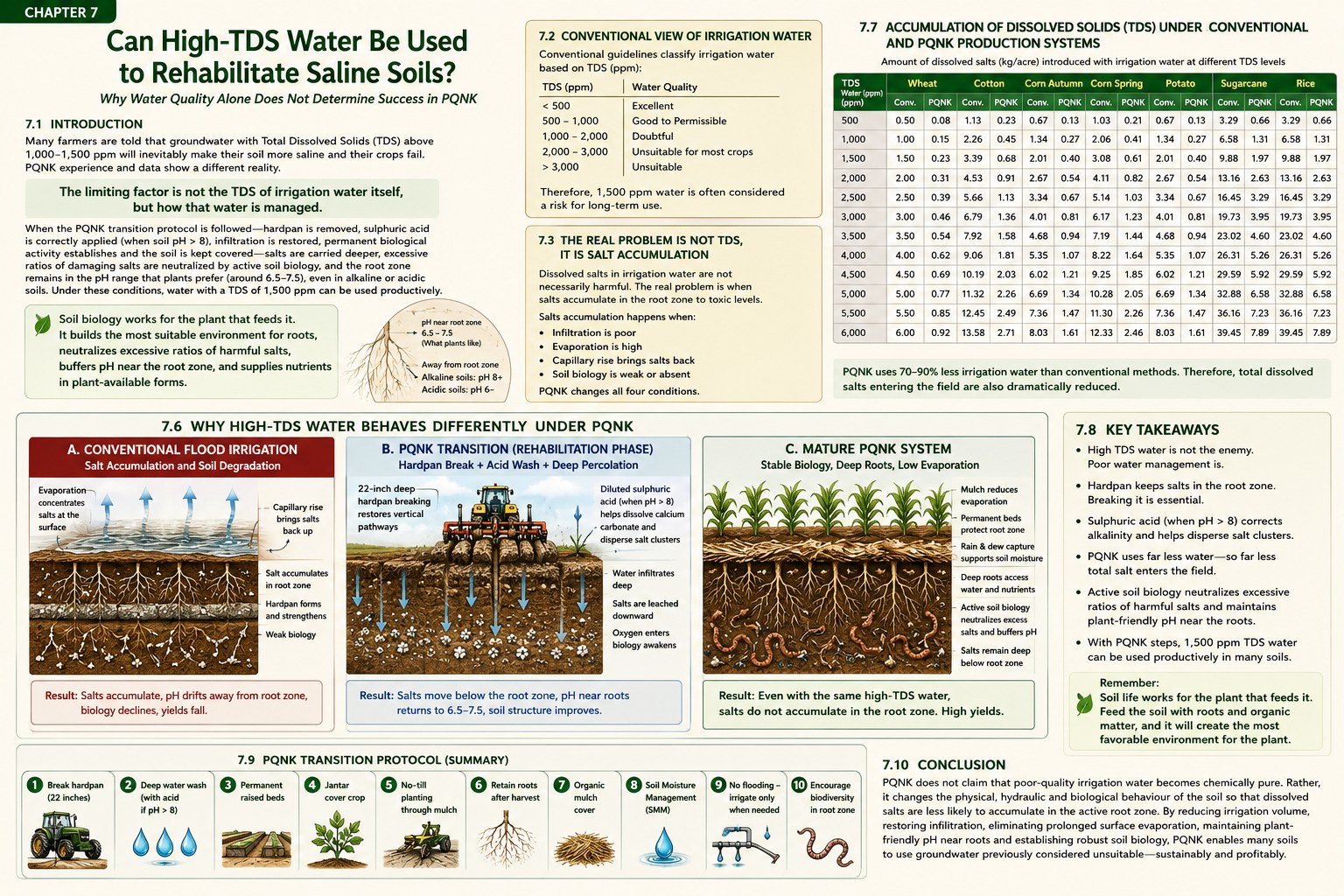
For generations, farmers have been taught that the quality of irrigation water is determined primarily by its Total Dissolved Solids (TDS). The higher the concentration of dissolved salts, the greater the perceived risk to soil health and crop production. Consequently, groundwater containing 1,000 to 2,000 parts per million (ppm) of dissolved solids is often regarded as unsuitable for sustainable agriculture. In many regions, farmers abandon productive land simply because laboratory reports indicate elevated TDS levels. PQNK arrives at a different conclusion. While dissolved salts undoubtedly influence crop production, the decisive factor is not the salt concentration of the irrigation water alone. The real determinant is the physical, hydraulic and biological condition of the soil into which that water is applied. The same groundwater that gradually destroys a conventionally managed field may sustain productive crops under a properly established PQNK system, because the soil behaves fundamentally differently. This distinction is the foundation of understanding irrigation water quality. Water should never be evaluated independently of the soil system receiving it.
The Misunderstood Problem
The widespread belief that high-TDS water inevitably causes soil salinity is an oversimplification. Dissolved salts do not become harmful merely because they are present in irrigation water. They become harmful only when they accumulate within the active root zone faster than natural biological and hydraulic processes can redistribute or neutralize them.
In conventional agriculture, this accumulation is almost inevitable. Flood irrigation applies very large volumes of water over a compacted soil surface. Because hardpan restricts downward movement, much of the applied water remains near the surface. As evaporation removes pure water, dissolved salts remain behind. Repeated irrigation cycles gradually concentrate these salts within the upper soil profile until root growth, nutrient uptake and soil biological activity begin to decline.
The problem, therefore, is salt accumulation, not simply salt concentration.
How Conventional Irrigation Creates Salinity
The conventional production system unintentionally creates ideal conditions for salt accumulation.
Hardpan forms a nearly impermeable barrier beneath the cultivated layer. Instead of infiltrating deeply, irrigation water spreads laterally across the field and remains within the shallow root zone. Under warm climatic conditions, evaporation begins almost immediately after irrigation. As water evaporates from the soil surface, dissolved salts are left behind. Later, capillary action draws additional saline moisture upward from deeper layers, depositing still more salts as evaporation continues.
Each irrigation cycle adds another layer of dissolved solids to the root zone.
This process repeats season after season. The soil gradually becomes denser, pore spaces collapse, infiltration declines further, and even more water is required to maintain crop growth. Eventually the farmer attributes declining productivity to poor-quality water, while the true cause is the inability of the soil to process that water correctly.
The irrigation water has not changed.
The soil system has failed.
The PQNK Perspective
PQNK begins by asking a different question.
Instead of asking,
“How saline is the irrigation water?”
it asks,
“Why is the soil retaining those salts?”
This change in perspective transforms the entire management strategy.
PQNK does not attempt to change the chemistry of the groundwater. It changes the architecture of the soil ecosystem.
The first requirement is the complete removal of the physical barrier preventing deep water movement. The hardpan is broken with a tine penetrating approximately twenty-two inches into the soil. This restores continuous vertical pathways through which water, air and roots can move freely.
Where alkaline conditions exist, indicated by soil pH values above approximately 8, sulphuric acid is introduced during the deep water washing phase. The purpose is not simply to acidify the soil. Sulphuric acid reacts with calcium carbonate, reduces excessive alkalinity, releases calcium into solution, improves soil aggregation and assists in dispersing compacted salt-rich zones. These changes allow irrigation water to penetrate deeply instead of remaining trapped near the surface.
The process prepares the soil for its most important transformation: the return of permanent biological activity.
Soil Biology Becomes the Primary Regulator
Conventional soil chemistry often treats the soil as a static mixture of minerals. PQNK views it as a living biological ecosystem.
Once permanent raised beds are established, the soil is protected from repeated disturbance. Cover crops such as Jantar produce deep, vigorous root systems that reopen natural pore networks while feeding microorganisms throughout the soil profile. After termination, the roots remain permanently within the soil and the above-ground biomass becomes protective mulch. Each crop contributes additional organic matter without disrupting the developing biological community.
As biological activity increases, the soil begins regulating its own environment.
Plants continuously supply carbohydrates and other organic compounds to microorganisms through their roots. In return, the soil biology works for the plant that feeds it. It reorganizes the rhizosphere into the environment most favourable for healthy plant growth. Nutrients are converted into plant-available forms, soil aggregates become more stable, harmful ion imbalances are moderated, and excessive concentrations of damaging salts are progressively buffered within the active root zone.
This biological regulation explains one of the most remarkable observations repeatedly seen under PQNK.
In alkaline soils where the bulk soil may remain at pH 8 or higher, measurements close to actively growing roots commonly indicate a pH approaching the range preferred by the plant, approximately neutral. Likewise, in acidic soils where the surrounding soil may remain below pH 6, the immediate rhizosphere often shifts toward a more favourable environment.
The bulk soil has not suddenly become chemically uniform.
Rather, the living biological community has modified the root environment into one better suited for plant growth.
The plant feeds the biology.
The biology protects the plant.
This relationship cannot develop where soil disturbance, prolonged flooding or the absence of organic cover repeatedly destroy biological communities.
Why High-TDS Water Behaves Differently Under PQNK
Once the soil becomes biologically active and physically open, irrigation water behaves differently.
Instead of spreading across the surface and evaporating, it infiltrates rapidly through deep pore networks created by roots, soil fauna and permanent structure. Because Soil Moisture Management applies only the quantity of water actually required by the crop, irrigation volumes are dramatically reduced. Less water enters the field, and therefore fewer dissolved salts enter with it.
Any dissolved salts that do enter the soil are no longer concentrated by prolonged surface evaporation. They move downward with infiltrating water, away from the active root zone, while biological processes continue maintaining favourable conditions around living roots.
Thus, identical irrigation water produces two entirely different outcomes.
In the conventional field, salts accumulate.
In the PQNK field, salts continue moving.
The difference lies not in the water, but in the soil system receiving it.
Understanding the Salt Load
The accompanying data illustrate an important but frequently overlooked principle.
Every irrigation introduces dissolved solids into the field. The total quantity depends upon two factors: the concentration of dissolved solids in the water, and the total volume of water applied.
Conventional agriculture applies several million litres of water per hectare or acre during a growing season. Even groundwater containing only moderate TDS therefore introduces enormous quantities of dissolved salts into the field.
PQNK changes this equation dramatically.
Because irrigation volumes are reduced by approximately seventy to ninety percent, the total mass of dissolved solids entering the field declines proportionally. The same groundwater that would introduce many tonnes of dissolved salts under conventional irrigation contributes only a fraction of that amount under PQNK management.
This reduction in salt loading is achieved not by changing the groundwater source, but by changing irrigation practice.
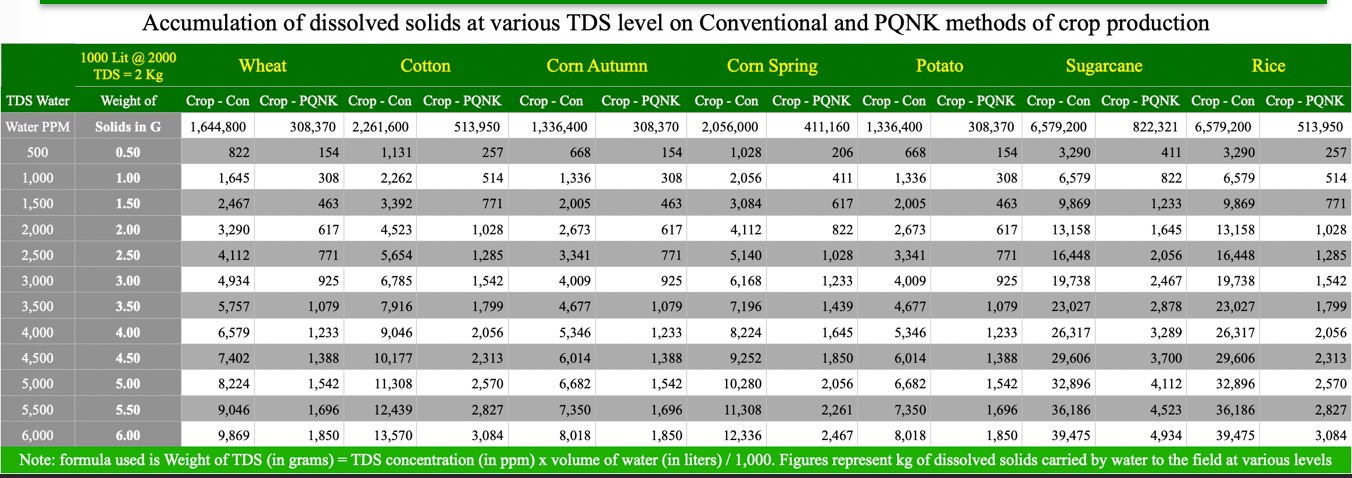
| TDS of water (ppm) | Solids (g per litre) | Wheat conventional | Wheat PQNK | Cotton conventional | Cotton PQNK | Corn Autumn conventional | Corn Autumn PQNK | Corn Spring conventional | Corn Spring PQNK | Potato conventional | Potato PQNK | Sugarcane conventional | Sugarcane PQNK | Rice conventional | Rice PQNK |
|---|---|---|---|---|---|---|---|---|---|---|---|---|---|---|---|
| Water used (litres per acre) | 1,644,800 | 308,370 | 2,261,600 | 513,950 | 1,336,400 | 308,370 | 2,056,000 | 411,160 | 1,336,400 | 308,370 | 6,579,200 | 822,321 | 6,579,200 | 513,950 | |
| 500 | 0.50 | 822 | 154 | 1,131 | 257 | 668 | 154 | 1,028 | 206 | 668 | 154 | 3,290 | 411 | 3,290 | 257 |
| 1,000 | 1.00 | 1,645 | 308 | 2,262 | 514 | 1,336 | 308 | 2,056 | 411 | 1,336 | 308 | 6,579 | 822 | 6,579 | 514 |
| 1,500 | 1.50 | 2,467 | 463 | 3,392 | 771 | 2,005 | 463 | 3,084 | 617 | 2,005 | 463 | 9,869 | 1,233 | 9,869 | 771 |
| 2,000 | 2.00 | 3,290 | 617 | 4,523 | 1,028 | 2,673 | 617 | 4,112 | 822 | 2,673 | 617 | 13,158 | 1,645 | 13,158 | 1,028 |
| 2,500 | 2.50 | 4,112 | 771 | 5,654 | 1,285 | 3,341 | 771 | 5,140 | 1,028 | 3,341 | 771 | 16,448 | 2,056 | 16,448 | 1,285 |
| 3,000 | 3.00 | 4,934 | 925 | 6,785 | 1,542 | 4,009 | 925 | 6,168 | 1,233 | 4,009 | 925 | 19,738 | 2,467 | 19,738 | 1,542 |
| 3,500 | 3.50 | 5,757 | 1,079 | 7,916 | 1,799 | 4,677 | 1,079 | 7,196 | 1,439 | 4,677 | 1,079 | 23,027 | 2,878 | 23,027 | 1,799 |
| 4,000 | 4.00 | 6,579 | 1,233 | 9,046 | 2,056 | 5,346 | 1,233 | 8,224 | 1,645 | 5,346 | 1,233 | 26,317 | 3,289 | 26,317 | 2,056 |
| 4,500 | 4.50 | 7,402 | 1,388 | 10,177 | 2,313 | 6,014 | 1,388 | 9,252 | 1,850 | 6,014 | 1,388 | 29,606 | 3,700 | 29,606 | 2,313 |
| 5,000 | 5.00 | 8,224 | 1,542 | 11,308 | 2,570 | 6,682 | 1,542 | 10,280 | 2,056 | 6,682 | 1,542 | 32,896 | 4,112 | 32,896 | 2,570 |
| 5,500 | 5.50 | 9,046 | 1,696 | 12,439 | 2,827 | 7,350 | 1,696 | 11,308 | 2,261 | 7,350 | 1,696 | 36,186 | 4,523 | 36,186 | 2,827 |
| 6,000 | 6.00 | 9,869 | 1,850 | 13,570 | 3,084 | 8,018 | 1,850 | 12,336 | 2,467 | 8,018 | 1,850 | 39,475 | 4,934 | 39,475 | 3,084 |
| Note: formula used is Weight of TDS (in grams) = TDS concentration (in ppm) x volume of water (in liters) / 1,000. Figures represent kg of dissolved solids carried by water to the field at various levels |
Figure 1. Accumulation of dissolved solids at various TDS levels, conventional vs. PQNK production, by crop.
Can Water Containing 1,500 ppm TDS Be Used?
The answer is yes, but only within the context of a correctly established PQNK system.
PQNK does not claim that water containing 1,500 ppm dissolved solids suddenly becomes chemically pure or universally safe under all conditions. Rather, it demonstrates that the risks associated with such water are greatly reduced when the soil is physically rehabilitated, biologically active and managed through Soil Moisture Management.
Where hardpan has been removed, alkaline conditions corrected where necessary, permanent raised beds established, biological cover maintained and irrigation carefully controlled, groundwater previously considered unsuitable may often become a productive resource.
This conclusion does not eliminate the importance of water analysis.
Instead, it places water analysis within the broader context of soil function.
The Living Soil Determines the Outcome
Perhaps the greatest lesson of PQNK is that soil should no longer be viewed as an inert growing medium requiring constant chemical correction. It is a living ecosystem capable of regulating itself when its natural processes are restored.
Healthy soil biology does far more than decompose organic matter. It moderates the chemical environment surrounding roots, buffers excessive ratios of harmful salts, maintains plant-friendly conditions within the rhizosphere and continuously supplies nutrients in forms that plants can absorb efficiently. It performs these functions because the plant continuously feeds it through root exudates.
The biology works for the plant.
But it can only do so when the farmer first works for the biology.
That is why PQNK insists upon the complete sequence of transition: breaking the hardpan, correcting excessive alkalinity where required, constructing permanent raised beds, establishing continuous biological cover, retaining roots, protecting the soil with mulch, avoiding flooding and maintaining Soil Moisture Management.
Only when these principles are implemented together does the soil recover its ability to regulate water, salts, nutrients and plant health.
Conclusion
The question is not whether irrigation water contains dissolved salts.
Every natural water source contains dissolved minerals.
The real question is whether the soil ecosystem possesses the physical structure and biological capacity to manage them.
Conventional agriculture frequently creates conditions that trap salts within the root zone, making irrigation water appear to be the problem. PQNK removes the barriers responsible for that accumulation. Through deep infiltration, permanent biological activity, greatly reduced irrigation volumes and active rhizosphere regulation, the soil itself becomes the primary defence against salt stress.
High-TDS water is therefore not the enemy.
A biologically inactive, physically damaged soil is.
When the soil is restored, water once considered unsuitable can often become an asset rather than a limitation, demonstrating once again that successful agriculture depends not upon overpowering nature, but upon restoring the natural processes that have sustained terrestrial ecosystems for hundreds of millions of years.
Applying PQNK without understanding nature’s operating system will not deliver abundance, stability, or nutrient density.
PQNK (pronounced “picnic”), the regenerative & sustainable Pristine Organic Farming System, is grounded in Natural Ecosystem Science. This science employs perennial biodiversity, protects soil with organic mulch, and avoids practices such as water inundation, tillage disturbance, and leaving soil bare.
It is the process that matters most. PQNK is a pristine production system designed not merely for yield, but for optimal, balanced output, where quality, sustainability, and ecological harmony emerge from a self-regulated, zero-external-input methodology.
About This Paper
- Crop
- Wheat · Cotton · Maize (Corn) · Potato · Sugarcane · Rice
- Problem
- Saline / High-TDS Irrigation Water · Saline / Alkaline / High-pH Soil
- Science
- Water · Soil
- Evidence
- Measured Field Result
- Authority
- Current / Approved PQNK Knowledge
Related PQNK Science
Key Takeaways
- Core reframe: dissolved salts become harmful only when they accumulate in the root zone faster than they can be redistributed, not simply because they're present in irrigation water.
- Hardpan is broken to roughly 22 inches deep; where soil pH exceeds 8, sulphuric acid is applied during the deep-wash phase to disperse salt-rich zones and release calcium.
- Active soil biology measurably buffers the root zone: near-neutral pH is commonly observed right at actively growing roots even when the bulk soil remains at pH 8 or higher.
- Because PQNK cuts irrigation volume by roughly 70-90%, the total mass of dissolved solids entering a field falls proportionally, independent of the water's concentration.
- Includes a crop-by-crop data table (wheat, cotton, corn, potato, sugarcane, rice) quantifying dissolved-solids accumulation from 500-6,000 ppm TDS, conventional versus PQNK irrigation volumes.
- Conclusion: 1,500 ppm TDS water can be used productively, but only within a fully established PQNK system, not as a standalone property of the water itself.
Related Crops
Related Knowledge
same problem
Pakistan's Agricultural Biotechnology Policy 2025: The Right Intention, The Wrong Diagnosis
A formal PQNK response to Pakistan's Federal Cabinet-approved National Agricultural Biotechnology Policy 2025, arguing the BT cotton experiment already proved that engineering the plant to compensate for a damaged environment fails within years, and that the real intervention point is restoring the soil biology and water systems the policy leaves untouched.
same problem
Managing Saline Irrigation Water and Soil Reclamation Through PQNK
Faced with 6,000 ppm groundwater and pH 8 alkaline soil, a common combination across arid regions, this advisory paper walks through when acid-and-water leaching helps versus when it simply adds more salt to the soil. It sets out a decision framework by water TDS and soil pH, then a step-by-step biological reclamation protocol built around the salt-tolerant cover crop Jantar.
same crop
Five Decades of Agricultural Innovation: Interventions and Achievements in Chronological Order, 1973–2023
Asif Sharif's own year-by-year record of fifty years of hands-on agricultural intervention in Pakistan, from early machinery and seed distribution through the 2008 development of PQNK and its crop-by-crop expansion since, presented as the primary evidentiary record behind PQNK: a ground-up, farmer-verified track record rather than a journal citation.
same problem
Breaking Hardpan Without Machinery
Written for small farmers without access to subsoiling equipment, this SOP treats hardpan as a symptom of interrupted biological function rather than a purely physical barrier, and lays out a six-step, machinery-free protocol, plus specific transitional expectations for wheat, pulses, and cotton, for repairing it entirely through roots, mulch, and time.