

KP-098 · Workforce & Practice Advisories
PQNK Farming in Practice: Site-Specific Solutions for Regenerative Agriculture — Questions & Detailed Answers
A practitioner's detailed field questions, on bed orientation, irrigation choice, land clearing, machine-hour budgets, and mulch selection, are answered directly, with the recurring caveat that most PQNK decisions are inherently site-specific and only become concrete once a farm's topography, water, climate, and objectives have been surveyed.
Read or listen to the full paper ↓Abstract
The paper opens by setting expectations for its own generality: before answering any specific question, it explains that most PQNK decisions are inherently site-specific, and that a proper project begins by finalizing production objectives, cataloguing land, water, financial, and human resources, and building a blueprint from topography surveys, rainfall and drought-period data, regional cropping norms, and locally serviceable machinery, with the answers that follow offered as generalized starting points rather than universal prescriptions.
On infrastructure questions, raised-bed orientation is tied to slope and drainage (perpendicular beds on sloped land reduce erosion), sunlight and wind patterns, crop-rotation sequencing, and machinery working-width compatibility, while irrigation choice for large fields weighs lateral pivot systems (efficient but requiring low pressure and complementary mulch to avoid compaction) against furrow irrigation paired with mulch and cover crops, with the paper noting that in a well-managed, mature PQNK system irrigation may not be required at all. Water-head ditch construction specifies shallow, broad ditches following natural contours with an 8-12 inch water head for siphon-tube function.
On land preparation, the paper explicitly rules out slash-and-burn and bulldozing as destructive, recommending forestry mulchers followed immediately by soil protection, retained root systems for infiltration, and targeted manual stump removal only where field crops specifically require it, stating the underlying PQNK principle as retaining the existing environment as much as possible rather than clearing it. It distinguishes alley cropping (annual crops between tree rows for quicker commercial returns) from full agroforestry (long-term ecological integration of trees, shrubs, and crops), recommending allocation by soil type, slope, and crop water need rather than a single universal system.
A concrete machine-hour template is offered for developing 100 acres with a 120 HP tractor in stable, clear soil: roughly 40 hours for one-time subsoiling to break hardpan, 25 hours for laser leveling, 40 hours for bed shaping aligned to contours, and 25 hours for primary sowing integrated with Jantar mulch seeding, explicitly flagged as adjustable to actual soil conditions and prior land use. Further answers cover choosing dry mulch (straw, leaves; best for heat and moisture retention) versus live mulch (cover crops; better for soil structure and nutrient cycling) by season and crop stage, tuber-harvest handling for potatoes and cassava using shallow implements to preserve soil structure, and ethanol-crop selection (sweet sorghum or cassava preferred, food-first over grain ethanol, rice residue preferred over rice grain).
The paper closes by returning to its opening caveat, reiterating that every decision, from bed orientation to crop choice, should be evaluated for whether it enhances ecological balance and long-term productivity for that specific site, and directing the practitioner to consult site-specific PQNK blueprints and knowledge papers for anything beyond these generalized starting answers.
Full Paper
If you use “Listen”, the text of the page may be sent to your browser or operating system’s speech provider, such as Apple, Google or Microsoft, depending on the voice your device uses. Pedaver does not process, transmit or store any audio.
Subject: Detailed Answers to Your Questions on PQNK Farming Practices
Dear Usman,
Thank you for your thoughtful and detailed questions. Your commitment to learning and implementing the Paedar Qudratti Nizam Kashtqari (PQNK) system is truly commendable. Below, I address each of your queries in light of PQNK principles, focusing on regenerative, sustainable, and pristine organic farming.
Before doing so, I would like to explain that most of your questions are site-specific. Appropriate answers to take steps in specific situations are, many times, not practical because answers are in general form.
To successfully undertake such projects, we first finalize the objectives—meaning what our production would be, what we wish to grow in terms of orchards, field crops, and timber plantations. Once the production plan is final, we check and list our resources: land, water, financial, human, and the level of knowledge and training our human resource has.
Based on this input, a blueprint is developed in which each step complements the other. Application methods are optimal and cost-effective.
Topography survey, climate data to select the most suitable plantation options, yearly rainfall—and the periods of most rain and the period of drought—conventional crops grown in the area, and the availability of machinery that has proper after-sales service arrangements: this is the foundational data on which the project is shaped.
The following are generalized answers:
1. Raised Beds: Orientation (Horizontal vs. Perpendicular)
In PQNK, raised beds are designed to optimize natural gradients, water flow, and micro-climate management. The orientation depends on:
Slope and water flow: Beds perpendicular to the slope reduce erosion and enhance water infiltration.
Sunlight and wind patterns: Horizontal beds may be used in flatter terrains to maximize sun exposure and airflow.
Crop sequence plans: Orientation may vary to facilitate crop sequencing and polyculture.
Machinery compatibility: Bed profile is designed to match the machinery’s working width, ensuring traffic passes through furrows without compacting the growing area.
Water management: Bed width should correlate to soil infiltration capacity and crop canopy size. Furrow depth must prevent water from flowing over beds.
Key takeaway: Align bed direction with the land’s natural topography to minimize disturbance and work with nature.
2. Irrigation: Lateral Pivot vs. Furrow for Large Fields
For a field measuring 600m+ in length and 200m in width:
Lateral pivot systems can be efficient for uniform water distribution, especially in high-rainfall areas. However, PQNK emphasizes minimal water use and soil moisture conservation.
Furrow irrigation, when combined with mulching and cover crops, reduces evaporation and enhances infiltration.
Recommendation: If using lateral pivots, ensure they are low-pressure and paired with soil health practices (e.g., organic mulches) to avoid compaction and runoff. PQNK generally favors furrow irrigation with tailored bed designs to mimic natural water movement. In most cases, under a well-managed PQNK system, irrigation may not be required at all once soil health and mulch systems are established.
3. Furrow Water Head Ditch Construction
Water head ditches should be designed to minimize erosion and distribute water evenly:
Construction: Use shallow, broad ditches aligned with natural water flow. Water should move slowly, with a head of 8–12 inches to allow siphon tubes to function properly.
Placement: Align ditches with natural contours to guide water without force.
Maintenance: Integrate ditches into polyculture systems (e.g., planting water-tolerant species along edges). Depending on operational scale, maintenance can be manual or mechanized. Tree plantation along banks helps stabilize soil.
4. Land Clearing and Reclamation
PQNK avoids slash-and-burn and bulldozing due to their destructive impacts.
Forestry mulchers can be used but must be followed by immediate soil protection:
Manage organic mulch at a thickness that still allows planters to cut through and place seed in soil. In many cases, tree plantation is preferable to seasonal field crops initially.
Retain existing root systems to aid water infiltration and soil structure.
Use targeted manual removal of persistent stumps only if necessary for field crop establishment.
Root regrowth: Manage through thick mulch layers and deep-rooted cover crops. Mechanical intervention may be needed in some cases.
PQNK principle: Retain the existing environment as much as possible. Wild growth mulch can suffice for soil coverage.
5. Alley Cropping vs. Agroforestry
Alley cropping focuses on annual crops between tree rows for quick returns, commercial benefits and microclimate benefits.
Agroforestry integrates trees, shrubs, and crops for long-term ecological balance.
PQNK Perspective: Both systems align with regenerative goals. Section fields strategically based on:
Soil type and slope: Allocate sensitive areas to agroforestry.
Crop needs: Group grains, oil seeds, tubers, and pastures where their requirements are met without disrupting the system.
Diversity: Mix systems where possible to enhance resilience.
6. Machine Use and Template for 100-Acre PQNK Development
PQNK emphasizes minimal tillage and precision tools. A general template for 100 acres (assuming a 120 HP tractor in stable, clear soil):
Subsoiling: 40 hours (once, to break hardpan without inversion).
Laser leveling: 25 hours (gentle grading, preferably furrow leveling to ensure water movement without bed overflow).
Bed shaping: 40 hours (using bed formers aligned with contours).
Primary sowing with Jantar: 25 hours (integrated seeding and mulch application).
Note: Adjust based on soil conditions and prior land use. In wild-grown areas, clearing may not be necessary—always conduct a PQNK assessment first.
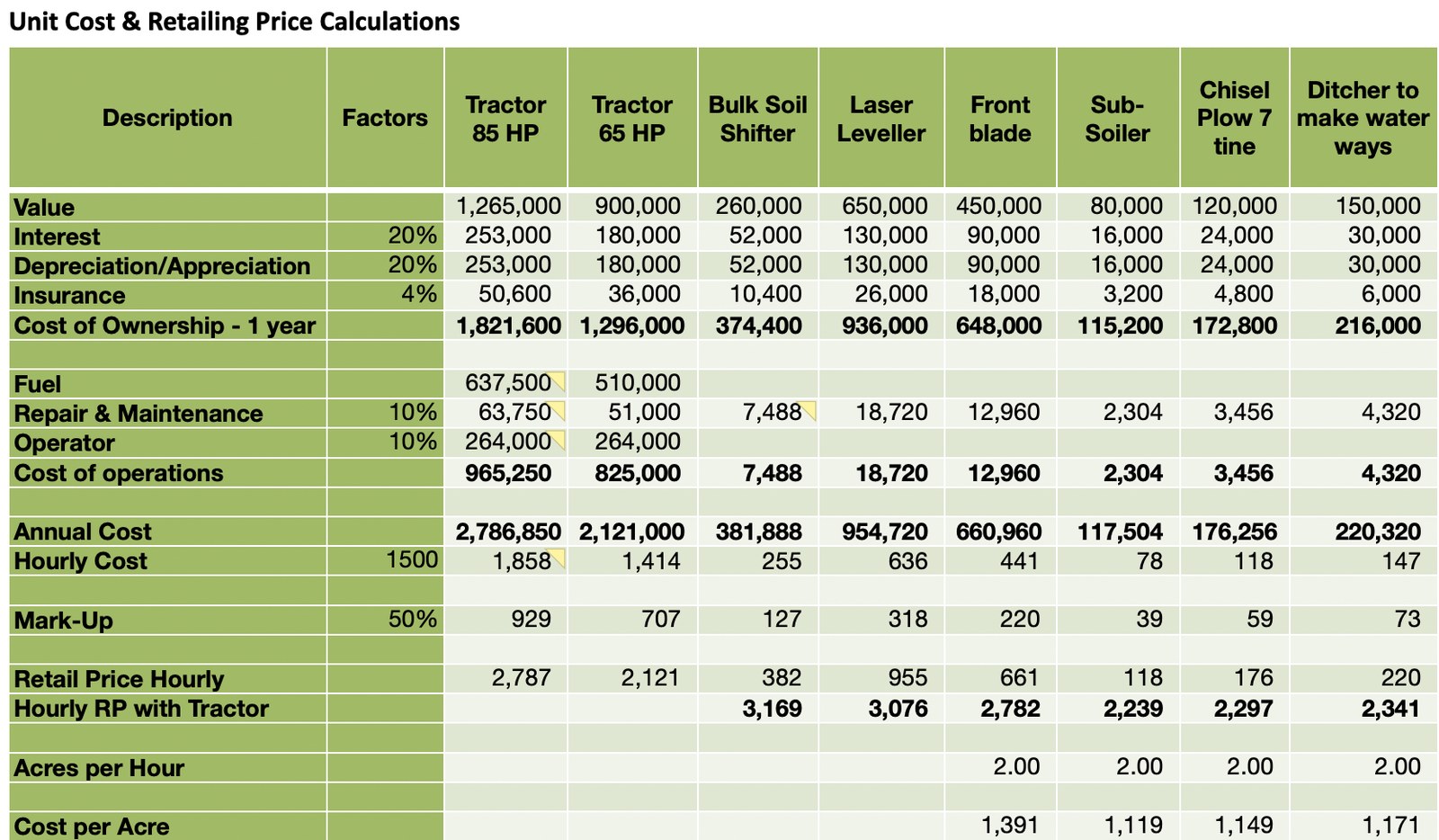
| Description | Factors | Tractor 85 HP | Tractor 65 HP | Bulk Soil Shifter | Laser Leveller | Front blade | Sub-Soiler | Chisel Plow 7 tine | Ditcher to make water ways |
|---|---|---|---|---|---|---|---|---|---|
| Value | 1,265,000 | 900,000 | 260,000 | 650,000 | 450,000 | 80,000 | 120,000 | 150,000 | |
| Interest | 20% | 253,000 | 180,000 | 52,000 | 130,000 | 90,000 | 16,000 | 24,000 | 30,000 |
| Depreciation/Appreciation | 20% | 253,000 | 180,000 | 52,000 | 130,000 | 90,000 | 16,000 | 24,000 | 30,000 |
| Insurance | 4% | 50,600 | 36,000 | 10,400 | 26,000 | 18,000 | 3,200 | 4,800 | 6,000 |
| Cost of Ownership - 1 year | 1,821,600 | 1,296,000 | 374,400 | 936,000 | 648,000 | 115,200 | 172,800 | 216,000 | |
| Fuel | 637,500 | 510,000 | |||||||
| Repair & Maintenance | 10% | 63,750 | 51,000 | 7,488 | 18,720 | 12,960 | 2,304 | 3,456 | 4,320 |
| Operator | 10% | 264,000 | 264,000 | ||||||
| Cost of operations | 965,250 | 825,000 | 7,488 | 18,720 | 12,960 | 2,304 | 3,456 | 4,320 | |
| Annual Cost | 2,786,850 | 2,121,000 | 381,888 | 954,720 | 660,960 | 117,504 | 176,256 | 220,320 | |
| Hourly Cost | 1500 | 1,858 | 1,414 | 255 | 636 | 441 | 78 | 118 | 147 |
| Mark-Up | 50% | 929 | 707 | 127 | 318 | 220 | 39 | 59 | 73 |
| Retail Price Hourly | 2,787 | 2,121 | 382 | 955 | 661 | 118 | 176 | 220 | |
| Hourly RP with Tractor | 3,169 | 3,076 | 2,782 | 2,239 | 2,297 | 2,341 | |||
| Acres per Hour | 2.00 | 2.00 | 2.00 | 2.00 | |||||
| Cost per Acre | 1,391 | 1,119 | 1,149 | 1,171 |
Following is the specimen (not updated) that should be based on the deployed machinery for cost estimation.
7. Mulches: Live vs. Dry Materials
Dry mulches (straw, leaves) excel in moisture retention and temperature moderation during hot periods.
Live mulches (cover crops) enhance soil structure, nutrient cycling, and soil pore formation.
PQNK Policy: Use both based on parameters:
Season and climate: Dry mulches in high heat; live mulches in wetter seasons.
Crop stage: Dry mulch for established plants; live mulch for fallow periods.
Soil needs: Combine to balance carbon addition, nitrogen fixation, and improve aeration, water infiltration, and microbial activity.
8. Tuber Crops: Harvesting and Cassava Suitability
Potatoes under mulch: Harvest can be manual or mechanical with care. Use modified diggers that lift tubers without disturbing the soil.
Cassava: Thrives in PQNK systems when planted in well-mulched beds with stable soil temperature and moisture.
Soil disturbance: Always minimize tillage during harvest. Use broadforks or shallow implements to preserve soil structure.
9. Ethanol Production: Crop Recommendations
PQNK prioritizes food-first approaches. If ethanol is pursued:
Recommended crops: Sweet sorghum or cassava due to high biomass, low input needs, and regenerative compatibility.
Rice for ethanol: PQNK systems use minimal water and avoid methane emissions, so rice can be suitable depending on local productivity and context. However, using rice residues for biogas is preferred over grain for ethanol.
Integration: Grow ethanol crops alongside food crops. Ensure crop combinations do not cause shading or operational inefficiencies.
Conclusion
Your questions reflect a deep engagement with sustainable farming. PQNK is about working with nature, not against it. Each decision—from bed orientation to crop choice—should enhance ecological balance, soil vitality, and long-term productivity.
May Allah bless your efforts and grant you abundant harvests and wisdom.
Warm regards, Asif Sharif
For site-specific planning, consult PQNK blueprints and knowledge papers.
—————————
Footnote: PQNK (pronounced 'picnic')—the regenerative & sustainable Pristine Organic Farming System—is grounded in Natural Ecosystem Science. This science employs perennial biodiversity, protects soil with organic mulch, and avoids practices like water inundation, tillage disturbance, and leaving soil bare.
www.Facebook.Com/Pedaver
https://www.youtube.com/@pedaverpqnk3167/videos
pedaver@gmail.com
WhatsApp +92 320 677 6666
About This Paper
- Crop
- Potato · Cassava · Sorghum · Rice
- Problem
- Soil Erosion · Soil Compaction (General) · Machinery / Field-Operation Decision Difficulty
- Science
- Production Architecture · Water · Soil
- Evidence
- Field Observation
- Authority
- Current / Approved PQNK Knowledge
Related PQNK Science
Key Takeaways
- Frames most PQNK implementation decisions as inherently site-specific, dependent on a prior survey of topography, water, climate, and production objectives, rather than universal rules.
- Ties raised-bed orientation to slope/drainage, sunlight/wind, crop rotation, and machinery compatibility; recommends beds run perpendicular to slope on sloped land to reduce erosion.
- States that in a well-managed, mature PQNK system, irrigation may not be required at all, while still offering guidance for lateral pivot versus furrow irrigation on large fields.
- Provides a concrete 100-acre, 120 HP tractor development budget: ~40 hours subsoiling, ~25 hours laser leveling, ~40 hours bed shaping, ~25 hours Jantar-integrated primary sowing.
- Explicitly rules out slash-and-burn and bulldozing for land clearing, recommending forestry mulching with immediate soil protection and maximal retention of existing root systems.
- Distinguishes alley cropping (quicker commercial returns) from full agroforestry (long-term ecological integration), recommending allocation by soil type, slope, and crop need rather than one universal choice.
Related Knowledge
same problem
Production Architecture: Engineering the Farm So the Living System Never Has to Be Rebuilt
Explains the physical engineering behind the four PQNK principles: permanent raised beds and furrows that separate destructive tractor traffic and irrigation from a protected biological zone, so a field accumulates biological function crop after crop instead of being torn down and rebuilt every season.
same problem
The Weeds as Soil Physicians: A PQNK Diagnostic Guide to Soil Health in the Punjab Region
This regional diagnostic guide teaches Punjab farmers to read specific weed combinations, not single species, as a whole-field soil diagnosis, then prescribes a 'principle of substitution': replacing each wild pioneer weed with a cultivated crop that performs the identical remediation function while also producing a yield.
same problem
The Future of Potato Cultivation: A Scientific and Economic Comparison of ACI, Global Best Practices, and the PQNK Framework
Conventional potato farming traps growers in a cycle of high input costs, a hard yield ceiling near 14 tonnes per acre, and boom-bust pricing. This paper compares conventional (ACI), Global Best Practice, and PQNK potato systems on plant physiology, economics, and risk, and lays out a year-by-year transition pathway for farmers.
same problem
Contour Line Farming through the PQNK (PICNIC) Lens
Large tracts of sloping, rainfed farmland already receive twice the water crops need, yet fail from runoff and erosion rather than drought. This paper applies PQNK's hardpan-breaking and mulch principles specifically to undulating terrain, using contour-aligned furrows as micro check-dams and citing practitioners who have farmed 7-8 consecutive years on rainfall alone.