

KP-058 · Water & Climate
Evaluation of Tube-well Water Quality for Irrigation Under PQNK
A government laboratory classified both a 500-foot and a 580-foot tube-well sample as unsuitable for irrigation, even though deepening the bore cut salinity by a third and sodium hazard by half. This technical assessment argues that under PQNK's raised-bed, mulch-covered management, the 580-foot water becomes usable, because the soil the water enters, not just the water's chemistry, determines the outcome.
Read or listen to the full paper ↓Abstract
The paper works from real laboratory data supplied by the Soil & Water Testing Laboratory, Government of the Punjab, comparing two samples from the same site: one from 500 feet and one after the bore was deepened to 580 feet. The deeper water shows meaningful improvement across every parameter measured, electrical conductivity down about 35%, sodium down roughly 49%, sodium adsorption ratio (SAR) falling from 17.30 to 6.88, and residual sodium carbonate improving from 4.49 to 3.20, yet the laboratory classified both samples as unsuitable for conventional flood irrigation.
The paper accepts the conventional interpretation on its own terms: under repeated cultivation, bare exposed soil, flood irrigation, and high evaporation, water carrying high salinity, sodium hazard, and residual sodium carbonate will progressively degrade soil structure, reduce infiltration, and increase sodicity, exactly as the lab's classification implies for the 500-foot sample, and as a real if smaller concern for the improved 580-foot sample.
Its central argument is that this assessment implicitly assumes a specific, and specifically vulnerable, production environment. PQNK changes that environment on every relevant axis: permanent raised beds protect soil structure and are never cultivated again after transition, organic mulch permanently covers the surface, water is applied only through permanent furrows rather than flooding the field, the root zone stays aerated and biologically active, rainfall infiltration improves, and surface evaporation drops substantially, meaning the same water behaves differently because it enters a living biological system rather than a repeatedly disturbed mineral soil.
For the 580-foot source specifically, the paper concludes that provided the complete PQNK transition protocol is followed, hardpan broken once, alkaline soil corrected before bed establishment, permanent beds and furrows built, no further cultivation, permanent mulch, living roots year-round, and irrigation only through furrows on an as-needed basis, never flooding, the water should perform satisfactorily despite its still-elevated bicarbonate and residual sodium carbonate levels, because soil biology, aeration, and organic matter increasingly buffer the water's chemical shortcomings over time.
The paper closes by stressing that PQNK does not claim to change the water's chemistry, only the soil's capacity to absorb and buffer marginal-quality water, and recommends periodic retesting of both the aquifer and key soil indicators (pH, EC, exchangeable sodium, infiltration rate, organic matter, biological activity) to confirm the transition is working as intended.
Full Paper
If you use “Listen”, the text of the page may be sent to your browser or operating system’s speech provider, such as Apple, Google or Microsoft, depending on the voice your device uses. Pedaver does not process, transmit or store any audio.
Comparison of Water from 500 ft and 580 ft Aquifers
Two water samples from the same location were analyzed by the Soil & Water Testing Laboratory, Government of the Punjab. The objective of this review is not only to interpret the laboratory results according to conventional irrigation science, but also to evaluate their practical suitability under the PQNK (Paedar Qudratti Nizam Kashtkari) production system, where irrigation management, soil biology and soil structure differ fundamentally from conventional agriculture.
The first sample was collected from a 500-foot depth, while the second was collected after deepening the bore to 580 feet.
Laboratory Results
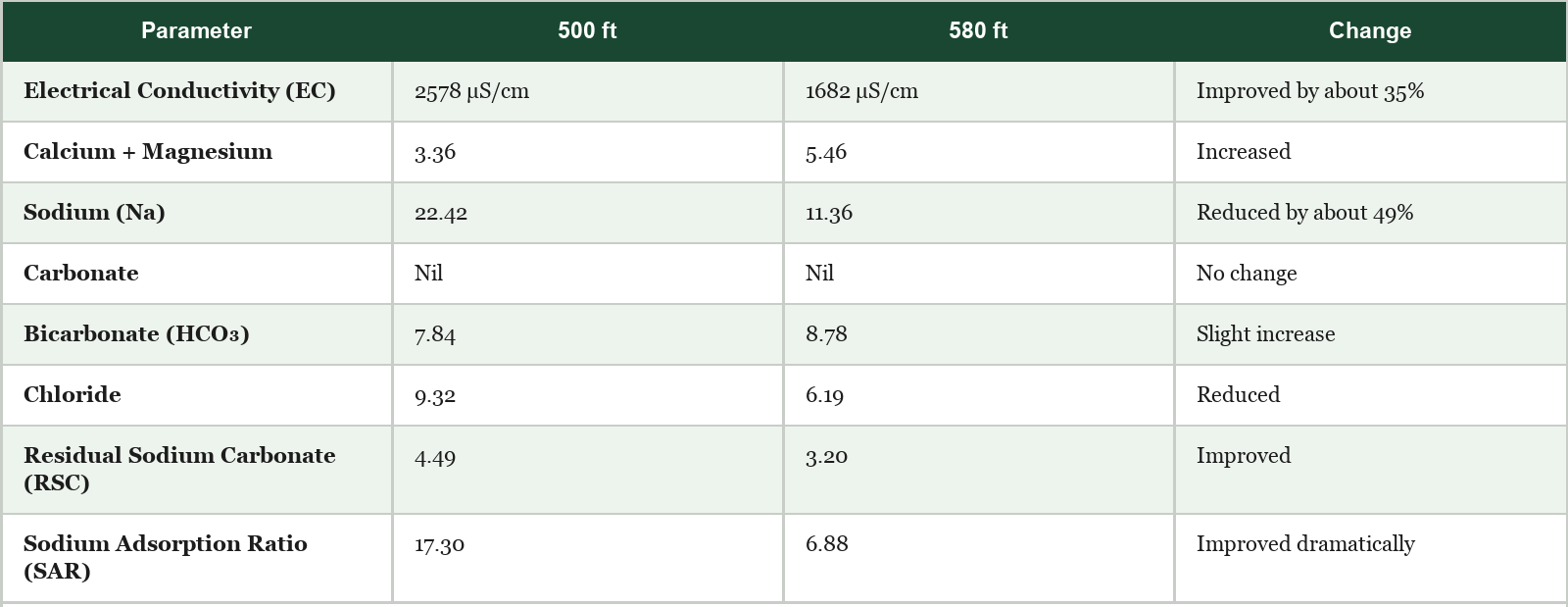
| Parameter | 500 ft | 580 ft | Change |
|---|---|---|---|
| Electrical Conductivity (EC) | 2578 µS/cm | 1682 µS/cm | Improved by about 35% |
| Calcium + Magnesium | 3.36 | 5.46 | Increased |
| Sodium (Na) | 22.42 | 11.36 | Reduced by about 49% |
| Carbonate | Nil | Nil | No change |
| Bicarbonate (HCO₃) | 7.84 | 8.78 | Slight increase |
| Chloride | 9.32 | 6.19 | Reduced |
| Residual Sodium Carbonate (RSC) | 4.49 | 3.20 | Improved |
| Sodium Adsorption Ratio (SAR) | 17.30 | 6.88 | Improved dramatically |
The laboratory classified both samples as unsuitable for irrigation, although the second sample is chemically much better than the first.
Conventional Interpretation
From the standpoint of conventional flood irrigation, the laboratory's conclusion is understandable.
The 500-foot water presents three major problems simultaneously:
high salinity,
very high sodium hazard,
high residual sodium carbonate.
Repeated use of such water under conventional cultivation is likely to deteriorate soil structure, reduce infiltration, increase sodicity and progressively lower productivity.
The 580-foot sample is significantly better. Salinity has decreased, sodium has been reduced by almost half and SAR has fallen from 17.30 to 6.88, representing a substantial improvement.
Nevertheless, the RSC remains relatively high at 3.20 meq/L, indicating that bicarbonate may continue to precipitate calcium and magnesium from the soil solution, gradually allowing sodium to dominate the exchange complex. Under conventional flood irrigation this remains a concern.
For this reason the laboratory continues to classify the water as unsuitable.
PQNK Interpretation
PQNK evaluates irrigation water from a different perspective.
The laboratory assessment assumes the water will be used under conventional agriculture, where fields are repeatedly cultivated, left bare, flooded during irrigation and exposed to high evaporation.
These practices magnify the harmful effects of marginal-quality irrigation water.
PQNK changes the production environment completely.
Permanent raised beds protect soil structure.
The soil is never cultivated after the transition.
Organic mulch permanently covers the surface.
Water is applied only through permanent furrows rather than flooding the entire field.
The biological root zone remains aerated and biologically active.
Rainfall infiltration improves naturally.
Evaporation from the soil surface decreases substantially.
Consequently, the same irrigation water behaves differently because it is entering a living biological system rather than a repeatedly disturbed mineral soil.
Which Water Should Be Used?
The comparison clearly demonstrates that deepening the bore from 500 feet to 580 feet accessed a considerably better aquifer.
The improvements are substantial.
Salinity declined by approximately one-third.
Sodium concentration was reduced by almost one-half.
SAR declined by approximately sixty percent.
Calcium and magnesium increased.
Chloride concentration decreased.
These changes indicate that the deeper aquifer contains significantly better irrigation water.
If irrigation must rely entirely on groundwater, the 580-foot source should always be preferred.
The 500-foot source should be avoided whenever possible.
Can the 580-foot Water Be Used Successfully?
Under conventional agriculture, continuous use of this water would still require caution because of its relatively high bicarbonate concentration and RSC.
Under PQNK, however, the answer is considerably more encouraging.
Provided the complete PQNK transition protocol is followed, this water should perform satisfactorily.
The key phrase is complete PQNK transition.
Water quality alone never determines success.
Soil biology, infiltration, aeration, organic matter and irrigation management determine how the water behaves after entering the soil.
PQNK Management Protocol
For successful long-term use of this groundwater, the following PQNK practices should be followed.
The hardpan should be broken once before conversion.
If the soil is alkaline, the PQNK soil correction protocol should be completed before establishing permanent beds.
Permanent raised beds and permanent furrows should then be constructed.
The soil should never again be cultivated.
Crop residues should remain on the surface as permanent mulch.
Living roots should remain in the soil throughout the year.
Irrigation should be applied only through permanent furrows and only when plants actually require water.
Flood irrigation should never be practiced.
As soil organic matter and biological activity increase, the soil becomes progressively more capable of buffering the effects of marginal irrigation water.
Future Monitoring
Because groundwater quality can change over time, the 580-foot water should be retested periodically.
Soil should also be monitored during the first few years of transition.
The important indicators include:
soil pH,
electrical conductivity,
exchangeable sodium,
infiltration rate,
organic matter,
biological activity.
If these indicators continue improving, the irrigation strategy is working successfully.
Final Conclusion
The laboratory correctly classified both samples according to conventional irrigation standards.
However, the comparison between the two depths clearly shows that the 580-foot aquifer is substantially superior to the 500-foot aquifer.
From the PQNK perspective, this deeper water source is acceptable for irrigation, provided it is used within a fully established PQNK production system and not under conventional flood irrigation.
The critical point is that PQNK does not claim to improve the chemistry of irrigation water. Instead, it improves the biological and physical condition of the soil so that marginal-quality irrigation water can be utilized far more efficiently and with significantly lower long-term risk.
The deeper aquifer therefore represents a practical and encouraging improvement, and when combined with the complete PQNK transition protocol, it should provide a reliable source of irrigation water for sustainable crop production.
——————————
Applying PQNK without understanding nature’s operating system will not deliver abundance, stability, or nutrient density.
PQNK (pronounced “picnic”)—the regenerative & sustainable Pristine Organic Farming System—is grounded in Natural Ecosystem Science. This science employs perennial biodiversity, protects soil with organic mulch, and avoids practices such as water inundation, tillage disturbance, and leaving soil bare.
It is the process that matters most. PQNK is a pristine production system designed not merely for yield, but for optimal, balanced output—where quality, sustainability, and ecological harmony emerge from a self‑regulated, zero‑external‑input methodology.
Connect & Resources Facebook: www.Facebook.Com/Pedaver YouTube (PQNK): https://www.youtube.com/@pedaverpqnk3167/videos YouTube: http://www.youtube.com/@aasifsharif PDF Knowledge Papers: https://drive.google.com/drive/folders/1iadwV6mdUPyrUIpB3oRfNv6DLiackaUL?usp=sharing Email: pedaver@gmail.com WhatsApp: +92 320 677 6666
About This Paper
- Problem
- Saline / High-TDS Irrigation Water · Saline / Alkaline / High-pH Soil
- Science
- Water · Soil
- Evidence
- Measured Field Result
- Authority
- Current / Approved PQNK Knowledge
Related PQNK Science
Key Takeaways
- Deepening a tube-well from 500 to 580 feet cut electrical conductivity by about 35%, sodium by roughly 49%, and SAR from 17.30 to 6.88, yet both samples were still lab-classified as unsuitable for irrigation.
- The paper's core distinction: laboratory classification assumes conventional flood irrigation on repeatedly disturbed, bare soil, a context PQNK deliberately eliminates.
- Under a complete PQNK transition (permanent beds, permanent mulch, furrow-only irrigation, no further cultivation), the improved 580-foot water is judged workable despite still-elevated bicarbonate and residual sodium carbonate.
- The 500-foot source should be avoided whenever possible; the deeper aquifer is unambiguously the better choice regardless of farming system.
- PQNK is explicit that it does not change irrigation water's chemistry, only the soil's biological and physical capacity to absorb and buffer it.
- Recommends periodic retesting of both groundwater and soil indicators (pH, EC, exchangeable sodium, infiltration, organic matter, biological activity) through the transition period.
Related Knowledge
same problem
Managing Saline Irrigation Water and Soil Reclamation Through PQNK
Faced with 6,000 ppm groundwater and pH 8 alkaline soil, a common combination across arid regions, this advisory paper walks through when acid-and-water leaching helps versus when it simply adds more salt to the soil. It sets out a decision framework by water TDS and soil pH, then a step-by-step biological reclamation protocol built around the salt-tolerant cover crop Jantar.
same problem
Can High-TDS Water Be Used to Rehabilitate Saline Soils?
Conventional guidelines flag groundwater above 1,000-1,500 ppm TDS as unsuitable for irrigation, pushing farmers to abandon productive land. This paper argues the real determinant isn't the water's salt concentration but the soil's physical and biological capacity to keep those salts moving instead of accumulating in the root zone, backed by a crop-by-crop salt-load data table.
same problem
Wheat Growing Checklist, Duly Vetted by Dr. Asif Sharif
A dense, numbered field checklist distilled from PQNK wheat lectures, covering land preparation, wheat spacing (revised to 5 rows on 42-inch beds at 8-inch spacing, about 62,000 hills per acre), tiller and grain-count benchmarks against conventional wheat, and a national-yield comparison projecting up to 136 maunds per acre against Pakistan's 28-maund average.
same problem
Balangu & Basil Seed Production Under PQNK
A complete Punjab-focused production guide showing how Balangu (Lallemantia royleana) and Basil seed crops are grown on PQNK's permanent raised-bed system, from hardpan-breaking through harvest and storage.