

KP-127 · Soil Science & PQNK System
Managing the Biological Transition: Protecting Crop Performance During the First Years of PQNK Conversion
The engineering side of PQNK conversion, hardpan breaking, bed formation, cover cropping, can be finished in weeks, but the soil biology that actually runs the system takes longer to rebuild. This paper explains why the first few crops need closer monitoring, and lays out the minimal, symptom-triggered temporary support (never a return to routine chemical use) that carries a farmer through that gap without abandoning PQNK.
Read or listen to the full paper ↓Abstract
Most attempts to introduce natural farming fail, the paper argues, because they attempt an immediate substitution of conventional inputs without first rebuilding the biological engine that performs those functions naturally. Conventional agriculture runs on soil system substitution: chemical fertilizer substitutes for biological nutrient cycling, pesticides substitute for natural predator populations, herbicides substitute for ecological weed regulation, and repeated tillage substitutes for biological soil structuring. PQNK's objective is not to substitute a different external input, but to restore the natural processes those inputs replaced, and that restoration takes time.
The transition is therefore framed as a gradual movement from substitution toward supplementation, and finally toward a fully self-regulating biological ecosystem. Hardpan can be broken in a single operation, permanent raised beds built immediately, and cover crops established within weeks, but millions of microorganisms, fungi, predators, and beneficial insects still need time to recolonize the restored habitat, which is why the first few crops demand closer observation than any later stage.
Because most transition problems trace back to incomplete implementation rather than a flaw in PQNK itself, the paper walks through the common omissions, incomplete hardpan breaking, a weak Jantar cover crop, insufficient residue retention, premature soil disturbance, excessive irrigation, or lax Soil Moisture Management, and treats each as the actual thing to fix, rather than a reason to fall back on conventional inputs.
Where a genuine, visible deficiency does appear, the recommended supplement is deliberately small: roughly 4 kg of NP fertilizer dissolved into furrow irrigation water, justified specifically by PQNK's own hydraulics, since irrigation volume is a fraction of conventional flood irrigation, the same small dose reaches the root zone far more concentrated than it would in a flooded field. In most cases one application is enough; occasionally two or three are needed across the first few crops. The same logic applies to pest and weed pressure: temporary pesticide use is justified only once monitored infestation crosses roughly a 10% economic-damage threshold, and herbicide only when weed competition genuinely threatens crop establishment, in both cases as an emergency measure expected to shrink with every successive crop as biological control and mulch-driven weed suppression strengthen.
The paper is explicit that none of this contradicts PQNK: a damaged ecosystem needs rehabilitation before it can become self-regulating, and every intervention it describes is triggered by field observation, not a calendar, and is expected to shrink toward zero as the soil takes over. Its closing argument is that the biological transition period is not a weakness in PQNK but evidence that living systems recover through progressive ecological succession rather than instantaneous change, and that a farmer who receives careful, minimal support during that recovery is far more likely to stay with the system than one who suffers an avoidable yield loss and abandons it.
Full Paper
If you use “Listen”, the text of the page may be sent to your browser or operating system’s speech provider, such as Apple, Google or Microsoft, depending on the voice your device uses. Pedaver does not process, transmit or store any audio.
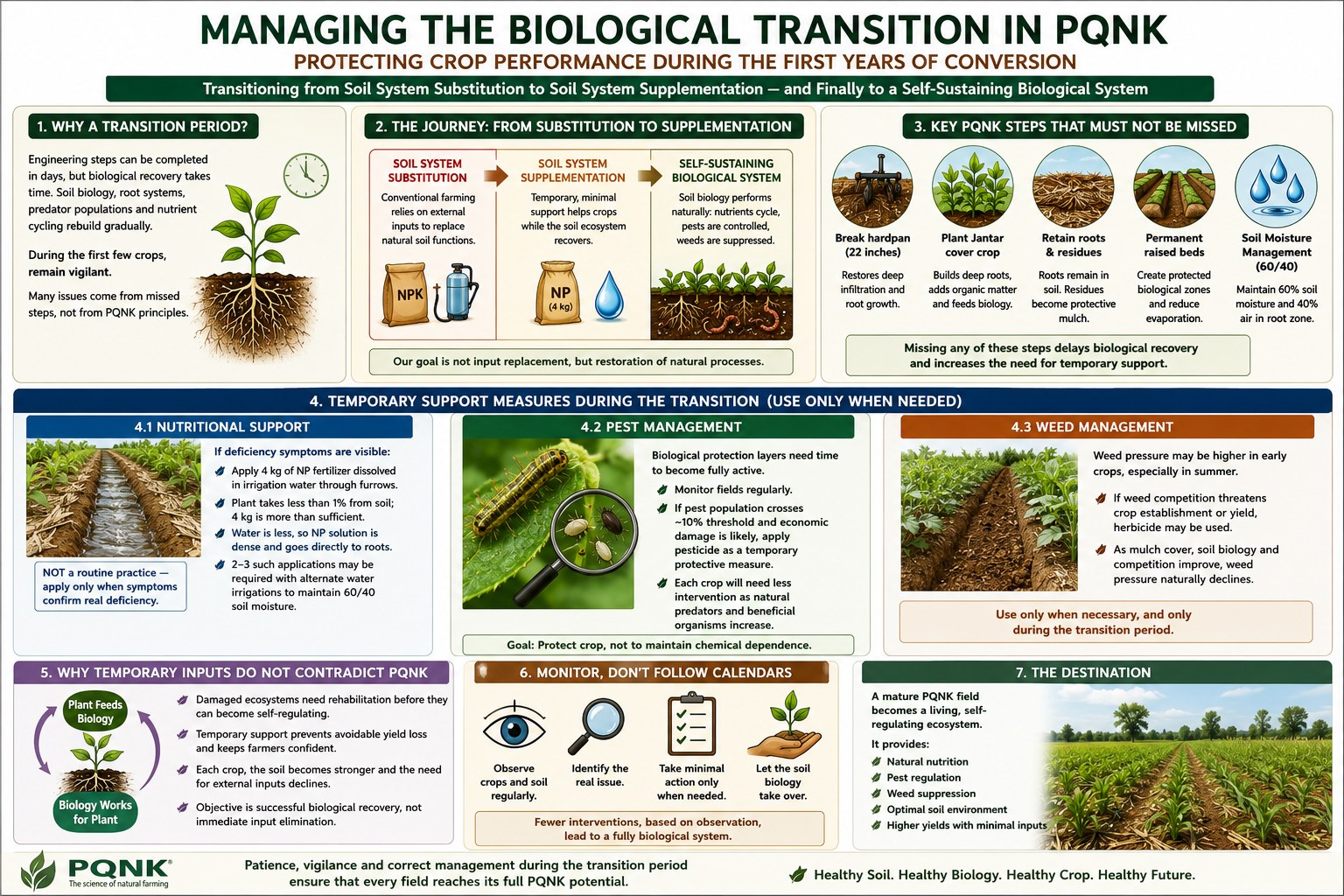
The Transition Is from Substitution to Supplementation
Most attempts to introduce natural farming fail because they attempt an immediate substitution of conventional inputs without first rebuilding the biological engine that naturally performs those functions.
Conventional agriculture operates largely through soil system substitution. Whenever a natural soil function declines, an external input is introduced to replace it. Chemical fertilizers substitute for biological nutrient cycling. Pesticides substitute for natural predator populations. Herbicides substitute for ecological weed regulation. Repeated tillage substitutes for biological soil structuring.
PQNK follows a fundamentally different philosophy. Its objective is not to replace one external input with another, but to restore the natural processes that originally performed these functions.
However, biological restoration requires time.
The transition should therefore be viewed as a gradual movement from substitution toward supplementation, and finally toward a self-regulating biological ecosystem.
Supplementation means providing only the minimum temporary assistance required while the natural system regains its own functional capacity.
Why the First Few Crops Require Greater Vigilance
The engineering work of PQNK can be completed within days, but soil biology cannot.
Hardpan may be broken in a single operation, permanent raised beds may be constructed immediately, and cover crops can be established within weeks. Nevertheless, millions of microorganisms, fungi, predators and beneficial insects require time to recolonize the restored habitat.
During this recovery period, the farmer should observe the crop more carefully than at any later stage.
This is particularly important because many transition problems do not arise from the PQNK principles themselves, but from incomplete implementation.
The most common omissions are:
• failure to break the hardpan completely,
• failure to establish a vigorous Jantar cover crop,
• insufficient residue retention,
• premature soil disturbance,
• excessive irrigation,
• or inadequate maintenance of Soil Moisture Management.
Each omitted step delays biological recovery and increases the likelihood of temporary nutritional imbalance or pest pressure.
The solution is not to abandon PQNK.
The solution is to identify the missing step and provide only the minimum temporary support required.
Temporary Nutritional Supplementation
Plants obtain only a very small proportion of their total biomass from soil minerals. More than ninety-five percent of plant dry matter is derived from atmospheric carbon dioxide and water, while approximately four percent originates through biological nitrogen fixation and only a tiny fraction consists of mineral nutrients absorbed from the soil.
Consequently, even when a temporary mineral deficiency appears during the transition period, the quantity required to correct it is remarkably small.
PQNK therefore recommends that visible nutrient deficiencies should never be corrected by returning to conventional fertilizer programmes.
Instead, where genuine deficiency symptoms become evident, approximately 4 kilograms of NP fertilizer may be dissolved into irrigation water flowing through the furrows.
This recommendation is based upon the hydraulic characteristics of PQNK rather than conventional fertilizer practice.
Because PQNK applies only a small fraction of the irrigation water used under conventional flood irrigation, the dissolved nutrient solution becomes considerably more concentrated around actively absorbing roots. The fertilizer is carried directly into the moist root zone rather than being dispersed throughout an entire flooded field.
In many situations a single application is sufficient.
Occasionally two or three supplementary applications may be required during the first few crops, with alternate irrigations consisting only of water in order to maintain the desired soil moisture balance without excessive nutrient loading.
These applications are not intended to replace biological nutrient cycling.
They merely support the crop while the biological nutrient delivery system becomes fully established.
Supporting Biological Pest Regulation
The restoration of biological pest control follows a similar pattern.
Healthy agricultural ecosystems contain numerous protective layers. Beneficial bacteria, predatory insects, spiders, parasitoids, soil organisms, birds and countless other species collectively maintain insect populations below economically damaging levels.
These protective communities require time to recover after years of intensive pesticide use.
Consequently, farmers should not expect complete biological control during the first season.
If pest populations remain below the economic threshold, no chemical intervention is required. However, if careful field monitoring indicates that pest infestation exceeds approximately ten percent and economic damage is likely, temporary pesticide application may be justified to protect the farmer's investment.
Such intervention should be viewed as an emergency protective measure rather than routine management.
Each successive crop should require less intervention as the biological protection system strengthens.
Weed Management During Transition
Weed populations may also remain unusually high during the early stages of conversion, particularly in summer crops where warm temperatures favour rapid weed growth.
This situation usually reflects the fact that the permanent mulch layer and biological ground cover have not yet developed sufficiently to suppress weed emergence.
Where weed competition threatens crop establishment or economic yield, herbicide application may occasionally be necessary during the transition period.
Again, the objective is not permanent dependence.
As permanent residue cover increases, biological competition strengthens, and soil disturbance is eliminated, weed pressure generally declines naturally.
The need for herbicides should therefore decrease with each successive crop.
Why These Recommendations Do Not Contradict PQNK
Some observers mistakenly assume that any temporary use of fertilizer, pesticide or herbicide contradicts the philosophy of PQNK.
The opposite is true.
PQNK recognizes the biological reality that damaged ecosystems require rehabilitation before they become fully self-regulating.
A patient recovering from major surgery may temporarily require medical support despite the ultimate objective of complete natural recovery.
Similarly, a biologically damaged soil may occasionally require carefully controlled supplementation while its ecological functions are being restored.
The objective has never been ideological purity.
The objective is successful biological recovery without exposing the farmer to unnecessary economic risk.
A farmer who suffers severe crop loss during the transition may abandon the system entirely.
A farmer who receives temporary support while the soil recovers gains the confidence to continue until the ecosystem becomes self-sustaining.
Monitoring Rather Than Routine Application
One of the defining characteristics of PQNK is that every intervention should be based upon field observation rather than predetermined schedules.
Supplementary fertilizer is not applied because a calendar recommends it.
It is applied only when visible deficiency symptoms confirm genuine need.
Likewise, pesticides are not applied because insects are present.
They are applied only when carefully monitored populations exceed economically acceptable thresholds.
Herbicides are not used because weeds exist.
They are considered only when weed pressure threatens crop establishment and biological suppression has not yet become effective.
As soil biology matures, these interventions become progressively less frequent until they are no longer required under normal management.
The Farmer's Responsibility During Transition
The first responsibility of the farmer is not to purchase supplementary inputs.
It is to verify that every PQNK transition step has been correctly completed.
The hardpan must be completely broken. Permanent raised beds must be correctly formed. Jantar or another suitable cover crop must establish a vigorous root system. Roots must remain within the soil after every harvest. Crop residues must protect the surface. Irrigation must follow Soil Moisture Management principles rather than calendar schedules.
Only after confirming that every biological requirement has been fulfilled should temporary supplementation be considered.
Most transition problems originate from incomplete implementation rather than biological failure.
The Destination Remains a Fully Biological System
The temporary measures described in this chapter should never become permanent management practices.
They represent a bridge between two fundamentally different production systems.
On one side lies an agricultural model dependent upon continual external substitution.
On the other lies a living soil ecosystem capable of regulating nutrient cycling, suppressing pests, moderating weed pressure, buffering chemical imbalances and supporting productive crops with minimal external intervention.
Every correctly managed PQNK field moves progressively toward that destination.
The farmer's task during the transition period is therefore not to eliminate every conventional input immediately, but to reduce dependence on them systematically as the biological capacity of the soil expands.
When the transition is complete, the soil itself once again performs the work that external inputs were previously purchased to replace.
Conclusion
The biological transition period should not be viewed as a weakness of PQNK, but as evidence that living systems recover through progressive ecological succession rather than instantaneous change.
Engineering operations can restore soil structure within days, but rebuilding a mature biological ecosystem requires patience, observation and sound management.
Temporary supplementation with small quantities of nutrients, carefully monitored pest control and limited weed management may occasionally be necessary during the first few crops. These measures protect the farmer from unnecessary financial risk while allowing the recovering soil ecosystem to assume its natural functions.
The ultimate objective remains unchanged: a production system in which healthy soil biology, permanent root systems, continuous organic cover and balanced Soil Moisture Management collectively provide nutrition, regulate pests, suppress weeds and maintain productive crops with minimal external intervention. Temporary supplementation is therefore not a departure from PQNK; it is a carefully managed pathway toward its full realization.
Applying PQNK without understanding nature’s operating system will not deliver abundance, stability, or nutrient density.
PQNK (pronounced “picnic”)—the regenerative & sustainable Pristine Organic Farming System —is grounded in Natural Ecosystem Science. This science employs perennial biodiversity, protects soil with organic mulch, and avoids practices such as water inundation, tillage disturbance, and leaving soil bare.
It is the process that matters most. PQNK is a pristine production system designed not merely for yield, but for optimal, balanced output—where quality, sustainability, and ecological harmony emerge from a self‑regulated, zero‑external‑input methodology.
About This Paper
- Problem
- Yield Stagnation / Decline · Nutrient Deficiency Symptoms (Plant-Visible) · General Pest Pressure · Weed Pressure · Hardpan
- Science
- Soil · Crop Protection · Nutrition · Transition
- Evidence
- Philosophical/Framework Argument
- Authority
- Current / Approved PQNK Knowledge
Related PQNK Science
Key Takeaways
- Core distinction: PQNK moves a field from soil system substitution (conventional inputs replacing lost biological functions) toward supplementation, and finally to a self-regulating biological ecosystem — engineering steps take days, biological recovery takes seasons.
- Most transition-period problems come from incomplete implementation, not from a failure of PQNK principles: incomplete hardpan breaking, a weak Jantar cover crop, insufficient residue retention, premature disturbance, or poor Soil Moisture Management are the usual causes.
- Where a genuine deficiency is visible, roughly 4 kg of NP fertilizer dissolved into furrow irrigation is the recommended temporary correction — small because PQNK's low irrigation volume concentrates it directly at the root zone; often just one application is enough.
- Temporary pesticide use is reserved for monitored pest pressure crossing roughly a 10% economic-damage threshold; temporary herbicide use only when weeds threaten crop establishment — both are emergency measures, not routine management, and should shrink with each successive crop.
- Every intervention described is triggered by field observation of actual symptoms, never by a fixed calendar — inputs are applied because deficiency, pest, or weed pressure is confirmed, not because a schedule says to.
- Frames the transition period itself as evidence PQNK works as intended (living systems recover through ecological succession, not overnight), and argues that giving a struggling farmer minimal, well-targeted support prevents the yield loss that would otherwise cause them to abandon the system entirely.
Related Knowledge
same problem
Chilli Production Under PQNK (PICNIC)
Chilli is biologically perennial and can remain productive for over a decade, but conventional short-cycle, urea-dependent management collapses that potential into a pest-prone annual grind. This paper shows how PQNK's soil-conversion framework and a single apical-pinching intervention restore chilli to a low-cost, high-density perennial crop, validated on a Hafizabad farm.
same problem
Balangu & Basil Seed Production Under PQNK
A complete Punjab-focused production guide showing how Balangu (Lallemantia royleana) and Basil seed crops are grown on PQNK's permanent raised-bed system, from hardpan-breaking through harvest and storage.
same problem
The Qudratti Nizam as a Holistic Organism: The Principle of Closed-Loop Perception
This foundational document asks farmers to stop seeing their fields as a collection of managed parts and instead see a self-executing, closed-loop organism, then works through what that lens means diagnostically when poor germination, insect presence, or start-up nutrient deficiency shows up in a converted PQNK field.
same problem
The Pest-Free Revolution: Eliminating Agrochemicals by Unleashing Soil Biology with the PQNK System
A knowledge paper arguing that a properly implemented PQNK system leaves crops 98-99% free of pest and disease pressure through native Bt bacteria and a conserved predator population, and that the system's single greatest failure point is not input scarcity but over-irrigation.