

KP-018 · Crop-Specific Guides
Knowledge Paper: Achieving High-Density Pomegranate Production Through the PQNK (Picnic) Pristine Organic Farming System
This knowledge paper sets out the full methodology for a 544-plant-per-acre pomegranate orchard under PQNK: the four-step soil recovery protocol that converts degraded land into a closed-loop system, and the four management pillars, zero soil disturbance, natural irrigation, inherent pest management, and structural pruning, that keep it that way.
Read or listen to the full paper ↓Abstract
The paper defines PQNK as a closed-loop, zero-external-input model in which 'Pristine' refers to restoring the soil's original, natural fertility and function, and 'Regenerative' to the system's capacity to improve soil health, biodiversity, and water retention year after year without external inputs once it reaches its sustained state. Pomegranate, with its deep root system and drought tolerance but marked intolerance for waterlogged conditions, is identified as an ideal candidate for this system when managed correctly.
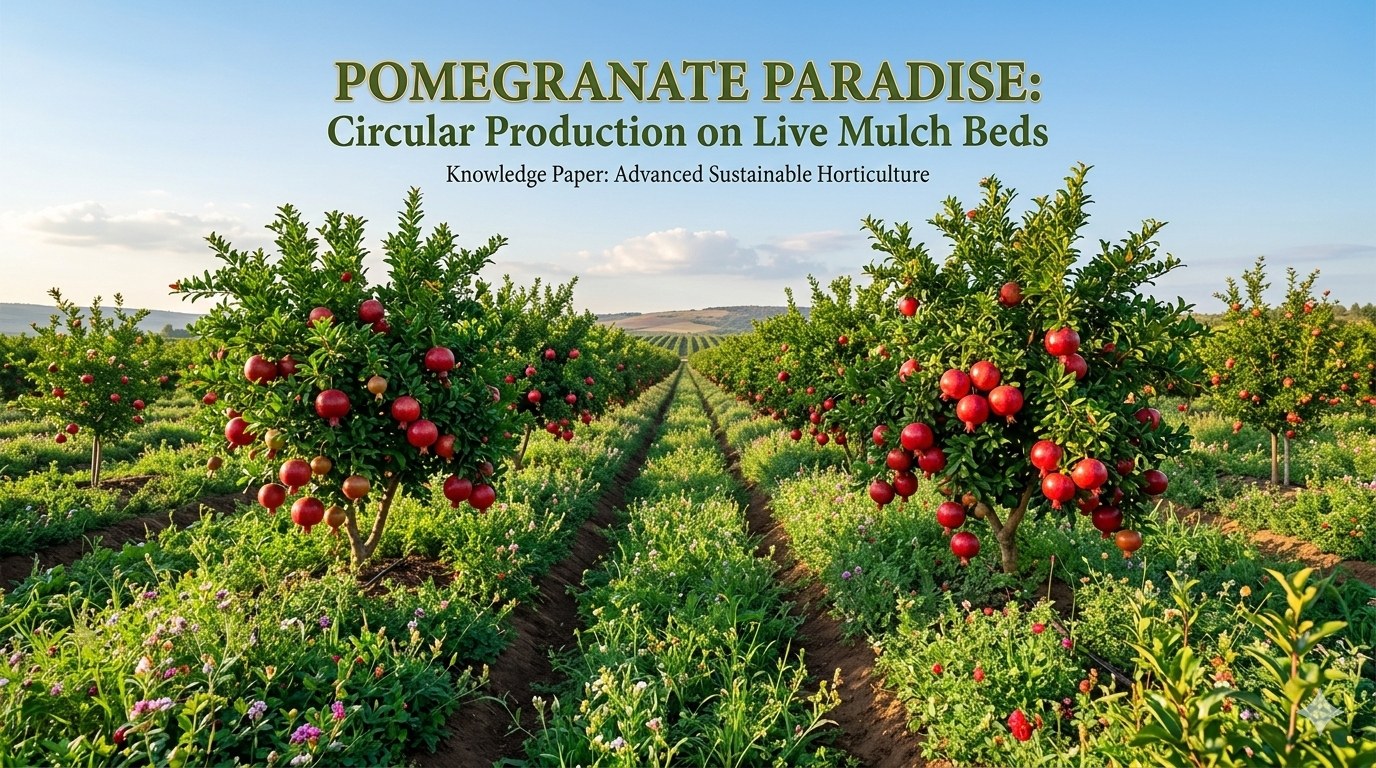
The high-density planting geometry uses alternate permanent raised beds oriented north-south for better sunlight hours: 42-inch beds with 18-inch furrows (5ft center to center), 10ft row spacing, and 8ft plant spacing within a row. For a modeled acre of 198ft by 220ft, this works out to roughly 19.8 rows of 27.5 plants each, yielding 544 plants per acre, well above the traditional 200-400, forcing root systems to interact while still allowing airflow and sunlight penetration through a managed canopy.
Before planting, the land passes through a four-step soil recovery protocol executed in strict sequence. Step one mechanically shatters the hardpan with a deep subsoiler without inverting soil layers, enabling deep root development. Step two corrects soil chemistry where pH exceeds 8 through a deep leaching irrigation combined with a one-time application of 8kg of sulfuric acid per acre, liberating locked minerals and discouraging parasitic weeds. Step three builds permanent raised beds with tractor traffic confined to furrows and immediately sows a Jantar (Sesbania) cover crop whose taproots further fracture the subsoil and mine nutrients from depth. Step four retains the Jantar's roots to decompose in place, mulches its above-ground biomass on the same bed, and plants pomegranate directly into that mulched, living soil with a no-till planter, moving the land from a degraded state through a 'Regenerative' phase into a self-sufficient 'Sustained State.'
Once established, the orchard is managed through four non-negotiable pillars. Zero soil disturbance means no ploughing or tilling after initial de-compaction, with all bare ground permanently occupied by compatible cash crops or a periodically cut cover-crop live mulch. Natural irrigation eliminates active watering entirely, relying instead on the permanent beds' capacity to capture rainfall, high-organic-matter soil's ability to absorb dew and atmospheric humidity, and a gradient of moisture tensions across soil pores that supplies water as needed while preserving the air-filled pores pomegranate roots require. Inherent pest and disease management treats outbreaks as a symptom of imbalance, relying on plant vigor, beneficial-insect habitat from cover and cash crops, and naturally occurring Bacillus thuringiensis and other beneficial microbes rather than sprays.
The fourth pillar, essential pruning, is the one non-negotiable human intervention, shaping trees into an open-center or vase form so sunlight and air reach the full canopy and dry the foliage and fruit against fungal disease. This runs from establishment pruning that selects 3-4 scaffold branches in the early years, through annual dormant-season maintenance pruning that removes dead, crossing, or crowded wood and basal suckers, to fruiting-wood management that renews the short spurs on mature wood where pomegranate actually fruits. The paper concludes that this combination of internal biological management over external inputs delivers not just a profitable 544-plant-per-acre yield, but land left more fertile for future generations.
Full Paper
If you use “Listen”, the text of the page may be sent to your browser or operating system’s speech provider, such as Apple, Google or Microsoft, depending on the voice your device uses. Pedaver does not process, transmit or store any audio.
Executive Summary
This paper outlines the methodology for establishing and managing a high-density (HD) pomegranate orchard under the "PQNK" (pronounced 'Picnic') system. PQNK, an acronym for Paedar Qudratti Nizam Kashatqari, translates to the Regenerative & Sustainable Pristine Organic Farming System. It is a closed-loop, zero-external-input agricultural model designed to work in harmony with natural ecological processes. This document details the specific geometric planting design achieving 544 plants per acre, the foundational four-step soil recovery protocol, and the four key management principles—zero soil disturbance, natural irrigation, inherent pest management, and essential pruning—required to ensure the success and sustainability of the system.
1. Introduction: The PQNK (Picnic) Philosophy
The PQNK system is more than a set of techniques; it is a holistic philosophy that views the farm as a complete, self-sustaining ecosystem. The term 'Pristine' refers to the goal of restoring the soil's original, natural fertility and biological function. 'Regenerative' signifies the system's capacity to improve soil health, biodiversity, and water retention year after year, without external inputs when it reaches the sustained state.
The fundamental principle of PQNK is the complete elimination of off-field inputs. All nutritional needs of the crop, all pest and disease management, and all water retention must be provided by the biological processes within the field. This closed-loop approach fosters resilience, reduces costs, and produces nutrient-dense, chemical-free fruit. Pomegranate (Punica granatum), with its deep root system and relative drought tolerance, is an ideal candidate for this system when managed correctly, especially regarding its intolerance for waterlogged conditions.
2. High-Density Planting Geometry: The Foundation of Yield
The specific planting geometry is critical to maximizing land use while ensuring adequate airflow and sunlight—key factors in disease prevention. The design is based on Alternate Permanent Raised Beds, preferably in the North-South direction for better sunlight hours.
• Bed Dimensions: Each bed is 42 inches (3.5 feet) wide. The furrow between beds is 18 inches (1.5 feet) wide. Therefore, the center-to-center distance from one bed to the next is 5 feet.
• Row Spacing: The distance from row to row (along the length of the field) is 10 feet.
• Plant Spacing: Within a row on the permanent bed, plants are spaced 8 feet apart.
High-Density Planting Geometry
Calculating Plant Population per Acre: For the purpose of this model, we consider an acre of land measuring 198 feet by 220 feet.
1. Number of Rows per Acre: With a total width of 198 ft and row-to-row spacing of 10 feet (center to center), the number of rows is 198 / 10 = 19.8 rows. (In practice, this means 19 full rows and one partial row, or an adjusted field layout).
2. Plants per Row: With a row length of 220 ft and plant-to-plant spacing of 8 feet, the number of plants per row is 220 / 8 = 27.5 plants.
3. Total Plants: 19.8 rows x 27.5 plants/row = 544 plants per acre. This high-density planting (544 plants per acre, compared to the traditional 200-400) optimizes land use while ensuring adequate airflow and sunlight penetration. It forces root systems to interact and creates a canopy that, when managed correctly with the PQNK system, maximizes solar interception and yield potential per unit area.
3. The Foundational Four-Step PQNK Soil Recovery Protocol
Before planting the pomegranate, the land must undergo a rigorous soil regeneration protocol. This is not merely a preparation phase; it is the critical intervention that transitions degenerative soil into a regenerative and finally the sustained state. These four steps are based on natural ecosystem science and are designed to be executed in sequence, using no external inputs other than those specified. The Four Steps:
Step 1: Break the Hardpan
The first and most fundamental step is to physically shatter the hardpan layer beneath the soil surface. This compacted layer, often caused by years of tillage or chemical runoff, restricts the deep, free movement of water, air, and roots.
• Action: Using a deep subsoiler, the hardpan is mechanically fractured without inverting the soil layers.
• Purpose: By breaking this barrier, you enable future crops to develop a deep and robust root system. Deep roots are essential for accessing subsoil moisture and nutrients, and crucially, they make the plant less susceptible to parasites and pathogens that typically prey on weak, shallow-rooted plants.
Step 2: Correct the Soil Chemistry with Water and Acid
If the soil pH is above 8, it indicates a lock-up of essential minerals and an accumulation of salts. To rebalance this within our closed-loop system, we use water and a targeted amendment.
• Action: Apply a deep, controlled irrigation to wash down (leach) accumulated salts and residual chemicals beyond the root zone. In conjunction with this irrigation, carefully apply 8 kg of sulfuric acid per acre, metered into the water.
• Purpose: This actively corrects high pH, liberating locked-up nutrients and making them bioavailable to plants. Furthermore, it creates a soil environment that is naturally hostile to parasitic weeds while remaining favorable for your intended crops. This is a one-time corrective measure to establish chemical balance.
Step 3: Build Permanent Raised Beds and Plant Jantar
With the physical and chemical barriers addressed, we now establish the permanent physical infrastructure of the farm and initiate biological regeneration.
• Action: Construct permanent raised beds. The bed profile is designed with tractor wheel traffic confined to the furrows, ensuring the growing area of the bed is never compacted again. Immediately sow a deep-rooted cover crop, specifically Jantar (Sesbania) , on these beds.
• Purpose: The powerful taproots of Jantar serve multiple functions. They naturally further fracture the subsoil opened in Step 1, they create deep, vertical channels for water infiltration and air exchange, and they pull up minerals and nutrients from deep in the subsoil, depositing them in the plant biomass. This action actively regenerates the soil structure from within, using biology as the primary tool.
Step 4: Retain, Mulch, and Plant with No-Till
This is the core, cyclical step of the PQNK system. It is the moment the system begins to close the loop and transitions from regeneration to a sustained state.
• Action: Once the Jantar has reached full maturity, do not remove it from the field.
1. Retain: All Jantar roots are left undisturbed in the soil to decompose. As they decay, they feed the soil food web, create macropores for future crop roots, and add deep organic matter.
2. Mulch: The above-ground biomass (stems and leaves) is cut and laid down as a thick mulch layer directly on the surface of the same bed. This mulch protects the soil from erosion, retains moisture, suppresses weeds, and slowly adds organic matter to the topsoil.
3. Plant with No-Till: Finally, the cash crop—in this case, pomegranate—is planted directly into this mulched, living soil using a no-till planter. This avoids disturbing the restored soil ecosystem, preserving the fungal networks, root channels, and soil structure that have been carefully built. Upon completion of these four steps, the land is biologically primed, chemically balanced, and physically structured. The soil has now entered the 'Sustained State' , ready to support the high-density pomegranate planting as a closed-loop system. Upon completion of these four steps, the land is biologically primed, structured, and fertile. This marks the end of the transitional 'Regenerative' phase. The soil has been moved from a degenerative state to a regenerative one.
The next stage is the planting of the pomegranate. When the cover crop's roots are retained in the permanent raised beds to decompose and feed the soil food web, and the above-ground biomass is used as mulch, the system transcends the transitional phase. It enters the 'Sustained State'.
In this 'Sustained State', the biological engine is fully operational. The cycling of nutrients from the decomposing roots, the protection from the mulch, and the permanent plant cover from the cash crops create a true closed-loop system. No external inputs are ever needed again; the farm's ecology provides for the crop's every need for provision and protection indefinitely.
4. Post-Planting Management: The Four Pillars of PQNK Maintenance
Once the pomegranate is established, the system is managed by four key principles, which are non-negotiable for success.
4.1. Principle of Zero Soil Disturbance
The soil life (fungi, bacteria, earthworms) creates a delicate network of tunnels and aggregates that hold water and air.
• Action: No ploughing, digging, or tilling occurs after the initial deep de-compaction.
• Method: All open spaces between the pomegranate plants and in the furrows are never left bare. They are permanently occupied by either:
◦ Cash Crops: Low-growing, compatible crops (e.g., alfalfa, turmeric, ginger, beans) that provide income without competing for sunlight with the pomegranate.
◦ Cover Crops / Live Mulch: A managed sward of native grasses and legumes that is periodically cut and dropped onto the beds. This protects the soil surface, feeds biology, and provides a habitat for beneficial predators.
• Benefit: Soil structure is preserved and enhanced, water infiltration is maximized, and the soil food web remains intact.
4.2. Principle of Natural Irrigation
Pomegranate is highly susceptible to root rot and fungal diseases in waterlogged soil. The PQNK system eliminates irrigation, relying on the soil's enhanced capacity to capture and retain atmospheric water.
• Method:
4. Rainwater Capture: The permanent raised beds and furrows are designed to capture and hold rainfall, allowing it to percolate deeply rather than run off and evaporate.
5. Dew and Humidity Absorption: The high organic matter content in the soil (from cover cropping and mulching) acts like a sponge, actively absorbing moisture from the air during periods of high humidity and overnight dew.
6. Gradient Moisture: The soil structure created by permanent raised beds and organic matter holds moisture at various tensions within its pores (gradient moisture), making water available to the plant as needed while maintaining the air-filled pores that pomegranate roots require.
• Benefit: A perfectly balanced moisture-air regime in the root zone, eliminating irrigation costs and the risk of over-watering.
4.3. Principle of Inherent Pest and Disease Management
In a PQNK system, pest outbreaks are viewed as a symptom of an imbalance, often caused by a lack of biodiversity or stressed plants. Protection is biological and systemic.Method:
7. Plant Health: A plant growing in biologically active, nutrient-dense soil with a balanced water supply is naturally more resistant to pests and diseases. Its own defense mechanisms (secondary metabolites) are robust.
8. Beneficial Insect Habitat: The permanent cover crop and diverse cash crops provide nectar, pollen, and shelter for predators like spiders, ladybugs, and parasitic wasps, creating a stable ecosystem that keeps pest populations in check.
9. Microbial Backup: The soil and plant surfaces teem with beneficial bacteria and fungi. In particular, Bacillus thuringiensis (Bt) and other beneficial microbes which are naturally present. These microbes act as a first line of defense against many caterpillar pests and fungal pathogens. The system's biodiversity ensures these microbial populations remain robust and effective.
4.4. Principle of Essential Pruning
While nature manages most things, strategic pruning is the one non-negotiable human intervention required for productivity.
• Objective: To create an "open-center" or "vase" shape. This allows sunlight to penetrate the entire canopy and air to circulate freely, which is essential for drying the foliage and fruit, thereby preventing fungal diseases.
• Method:
1. Establishment Pruning: In the first few years, select 3-4 strong, well-spaced scaffold branches and remove the central leader.
2. Maintenance Pruning (Annual Dormant Season): Remove dead, diseased, or broken wood. Remove crossing or rubbing branches. Thin out crowded interior growth to maintain the open center. Remove water sprouts and suckers from the base.
3. Fruiting Wood Management: Understand that pomegranate fruits on short spurs on mature wood. Pruning should encourage the renewal of this fruiting wood while maintaining the tree's structural integrity and size for high-density planting.
• Benefit: Maximized fruit yield and quality, minimized disease pressure, and maintained tree health and accessibility.
5. Conclusion
The PQNK system for high-density pomegranate cultivation is a paradigm shift from industrial agriculture. It replaces high external inputs (synthetic fertilizers, pesticides, irrigation) with high internal biological management. By following the foundational four-step soil recovery process and adhering strictly to the four management pillars, the farmer creates a self-sustaining, resilient, and highly productive ecosystem. The result is not only a profitable yield of 1,089 plants per acre but also the regeneration of the land, leaving it more fertile and vibrant for future generations. It is farming in harmony with nature, not in opposition to it. Applying PQNK without understanding nature’s operating system will not deliver abundance, stability, or nutrient density.
PQNK (pronounced “picnic”)—the regenerative & sustainable Pristine Organic Farming System —is grounded in Natural Ecosystem Science. This science employs perennial biodiversity, protects soil with organic mulch, and avoids practices such as water inundation, tillage disturbance, and leaving soil bare. It is the process that matters most. PQNK is a pristine production system designed not merely for yield, but for optimal, balanced output—where quality, sustainability, and ecological harmony emerge from a self‑regulated, zero‑external‑input methodology.
About This Paper
- Crop
- Pomegranate
- Problem
- Waterlogging · Saline / Alkaline / High-pH Soil · Hardpan
- Science
- Soil · Water · Crop Protection · Production Architecture
- Evidence
- Scientific Mechanism
- Authority
- Current / Approved PQNK Knowledge
Related PQNK Science
Key Takeaways
- The design achieves 544 pomegranate plants per acre (versus a traditional 200-400) using 42-inch permanent raised beds, 10ft row spacing, and 8ft plant spacing.
- A four-step soil recovery protocol, break the hardpan, correct pH with a one-time leaching irrigation and 8kg/acre sulfuric acid, build permanent beds and plant Jantar, then retain, mulch, and no-till plant, transitions the land into a self-sustaining 'Sustained State.'
- Once established, the orchard receives no active irrigation at all: rainwater capture, dew absorption, and gradient moisture in mulch-rich soil meet the plant's full water needs.
- Pest and disease management relies on plant vigor, beneficial-insect habitat from cover crops, and naturally occurring Bacillus thuringiensis rather than sprays.
- Pruning to an open 'vase' shape is the one non-negotiable human intervention, required to maintain the airflow and sunlight penetration that prevent fungal disease.
- The system is explicitly designed around pomegranate's intolerance for waterlogged soil, using raised-bed drainage rather than irrigation control to manage moisture risk.
Related Crops
Related Knowledge
same problem
The Healer's Dialogue: From Weed Signal to Soil Silence — A PQNK Pathway to Self-Regulating Abundance
Responding to a farmer's question about using weeds as nutrient-deficiency indicators, this dialogue explains that in PQNK the goal isn't to manage weeds as permanent indicator crops, but to run a four-step protocol that resolves the soil problems they signal so the weeds voluntarily depart.
same problem
Knowledge Paper: PQNK Rose Production
Cut-flower rose production is reframed as a closed-loop perennial system under PQNK, reaching a striking 8,712 plants per acre on twin-row permanent beds, with weeds treated as mulch, alfalfa grown as living nitrogen-fixing ground cover, and strict soil-moisture management replacing scheduled irrigation.
same problem
Chilli Production Under PQNK (PICNIC)
Chilli is biologically perennial and can remain productive for over a decade, but conventional short-cycle, urea-dependent management collapses that potential into a pest-prone annual grind. This paper shows how PQNK's soil-conversion framework and a single apical-pinching intervention restore chilli to a low-cost, high-density perennial crop, validated on a Hafizabad farm.
same problem
Knowledge Paper: High-Density Amla Farming Under PQNK
Amla's naturally deep taproot makes it an ideal closed-loop PQNK crop, and this paper walks through the five-step protocol, hardpan breaking, pH correction, Jantar-built raised beds, no-till mulch planting, and phenology-timed pruning, that gets roughly 545 trees per acre to a sustained yield of 10-14 tonnes per acre by year five.