

KP-019 · Crop-Specific Guides
Knowledge Paper: High-Density Amla Farming Under PQNK
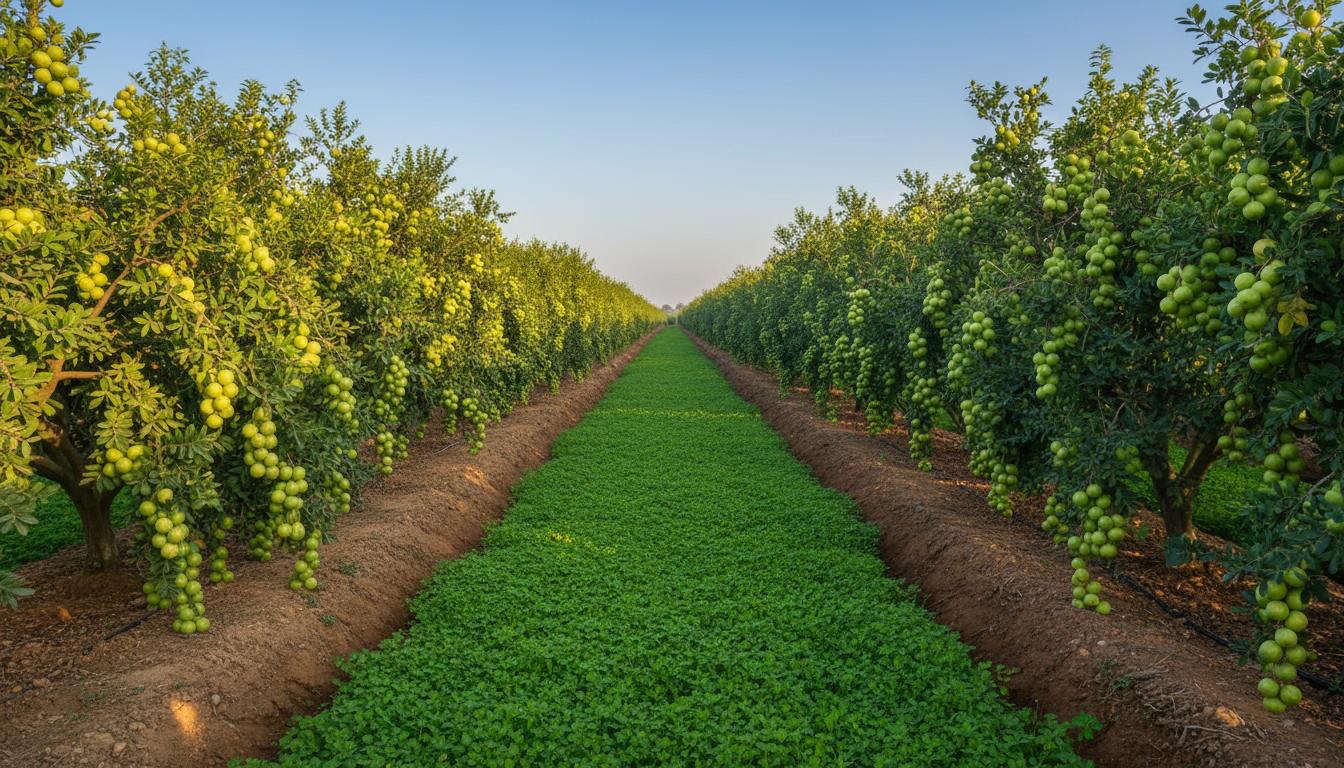
Amla's naturally deep taproot makes it an ideal closed-loop PQNK crop, and this paper walks through the five-step protocol, hardpan breaking, pH correction, Jantar-built raised beds, no-till mulch planting, and phenology-timed pruning, that gets roughly 545 trees per acre to a sustained yield of 10-14 tonnes per acre by year five.
Read or listen to the full paper ↓Abstract
The paper reframes conventional high-density Amla (Emblica officinalis) planting, which typically relies on external fertilizers, synthetic hormones, and chemical pest control, within PQNK's closed-loop, no-external-input philosophy, where the field provides everything: fertility from biomass, pest management from biodiversity, and structure from roots and mulch. Amla is described as an ideal crop for this reframing, hardy, perennial, and exceptionally responsive to soil regeneration.
Step one breaks the hardpan to a depth of 18-24 inches using a subsoiler, a one-time operation before first planting that lets Amla's taproot, which in a healthy system reaches 10-12 feet, access subsoil moisture and anchor the tree for decades. Step two corrects soil chemistry where pH exceeds 8 through deep leaching irrigation and a one-time application of 8kg of sulfuric acid per acre, bringing soil into the 6.5-7.5 range that unlocks fruit size, Vitamin C content, and juice content, since Amla grown in alkaline, salt-stressed soil produces small, hard, low-juice fruit.
Step three builds permanent raised beds, 42-inch beds with 18-inch furrows and 8-inch bed height, and sows Jantar (Sesbania aculeata) at high density for 60-90 days before Amla planting, its taproots continuing to fracture the shattered hardpan and pulling leached minerals upward. Step four is where PQNK diverges sharply from conventional high-density recommendations: the Jantar is never removed. Its roots decompose in place feeding earthworms and microbes, its chopped above-ground biomass becomes a 4-6 inch mulch layer, and Amla saplings are planted directly through that mulch with a no-till planter, at roughly 545 plants per acre (6-8ft within-row spacing, 10ft between rows for tractor access).
Step five treats pruning as energy-flow management rather than yield forcing. Because Amla fruits on current-season growth and PQNK applies no external hormones to induce flowering, timely hard pruning after the March-April harvest is essential, triggering a flush of new growth that flowers in June-July and sets fruit in August-September; skipping it costs the following year's crop entirely. Seasonal legume intercrops, Jantar, moong, and guar in kharif, and gram, lentil, and barseem in rabi, occupy the bed space during the orchard's first 3-4 years, fixing nitrogen and adding mulch biomass with residues retained rather than removed.
Pest management for threats like gall maker relies on pruning hygiene (removing and temporarily burying infested twigs before returning them as composted mulch), naturally occurring Bacillus thuringiensis cultivated by PQNK's living soil, and the inherent resistance of a vigorous, deep-rooted tree. Yield builds progressively rather than starting high: 1.5-2.5 tonnes per acre in years 2-3 while the soil is still building, 6-8 tonnes in years 3-4 for the first meaningful harvest, and a sustained 10-14 tonnes per acre by year five as soil organic matter continues to rise, ultimately exceeding chemical-system yields once the soil is fully regenerated.
Full Paper
If you use “Listen”, the text of the page may be sent to your browser or operating system’s speech provider, such as Apple, Google or Microsoft, depending on the voice your device uses. Pedaver does not process, transmit or store any audio.
The Protocol:
Deep Leaching Irrigation: Apply a heavy, slow irrigation to dissolve and push down accumulated salts from previous farming cycles. This mimics natural groundwater recharge.
Sulfuric Acid Application: Apply 8 kg of sulfuric acid per acre with the irrigation water. This acid is a permitted input in PQNK (derived from elemental sulfur oxidation or available as a one-time correction tool) to rapidly lower pH, liberate locked nutrients, and create a soil environment hostile to parasitic weeds while favorable to Amla.
Why this matters for Amla: Amla grown in alkaline, salt-stressed soil produces small, hard fruits with low juice content. Correcting pH to the 6.5–7.5 range unlocks the tree’s genetic potential for fruit size, Vitamin C content, and yield.
4. Step 3: Build Permanent Raised Beds and Plant Jantar (Sesbania)
With the hardpan broken and chemistry balanced, the next step is to build permanent raised beds. This is the structural backbone of PQNK.
Bed Design for High-Density Amla:
Bed width: 42 inches – this is where Amla trees will be planted in a single row.
Furrow width: 18 inches – tractor wheels run here, ensuring the growing zone is never compacted.
Bed height: 8 inches above furrow bottom level for root zone aeration.
Planting Jantar (Sesbania) Immediately:
On these beds, before planting Amla, sow Jantar (Sesbania aculeata) at a high density.
Allow it to grow for 60–90 days.
The Jantar’s powerful taproots penetrate deep into the shattered hardpan, naturally continuing the fracturing process. They pull up leached minerals from the subsoil and create vertical channels for water and Amla roots.
This is a closed-loop fertility-building step. No external manure or fertilizer is brought in. Jantar is the factory.
5. Step 4: Retain, Mulch, and Plant with No-Till
This step is where PQNK diverges completely from conventional high-density planting recommendations.
Do Not Remove the Jantar.
After 60–90 days, slash the Jantar at ground level, leaving all roots intact in the soil. These roots will decompose, feeding earthworms and soil microbes, and the channels they created remain open.
Chop the above-ground biomass and lay it immediately as thick mulch (4–6 inches) on the same raised bed.
This mulch layer:
Suppresses weeds without herbicides.
Retains soil moisture, reducing irrigation frequency.
Feeds soil biology as it decomposes.
Protects the soil surface from sun and wind.
Now, Plant Amla (No-Till):
Using a no-till planter or manual dibbling, plant Amla saplings directly through the mulch into the undisturbed soil beneath.
Spacing in PQNK System:
Between plants on the bed: 6–8 feet depending on variety.
Between beds (center to center): 10 feet spacing between the plant rows accommodates passing of tractor to facilitate pruning and fruit picking when plants are fully developed and allows sunlight penetration.
Plants per acre: Approximately 545 in an acre of 220 x198 feet, similar to high-density models, but achieved without synthetic inputs.
Why No-Till is Essential: Tilling destroys the fungal networks, earthworm channels, and soil structure that the Jantar built. In PQNK, we disturb the soil only once (hardpan breaking) and then never again.
6. Step 5: Pruning Through the PQNK Lens
Pruning in PQNK is not merely about yield optimization—it is about managing the energy flow within a closed system. We do not prune to force unnatural growth; we prune to maintain balance, airflow, and to recycle biomass back into the system.
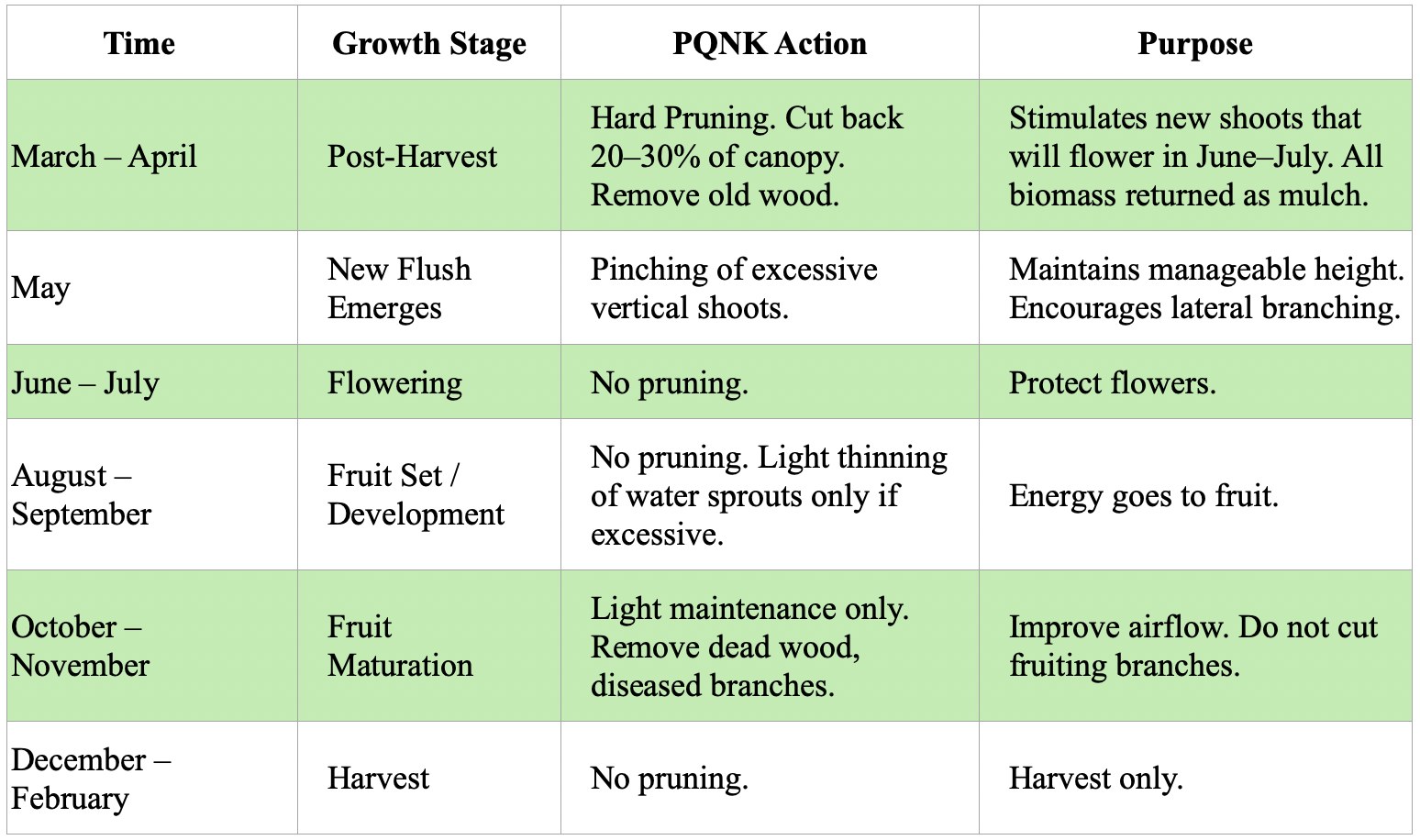
| Time | Growth Stage | PQNK Action | Purpose |
|---|---|---|---|
| March – April | Post-Harvest | Hard Pruning. Cut back 20–30% of canopy. Remove old wood. | Stimulates new shoots that will flower in June–July. All biomass returned as mulch. |
| May | New Flush Emerges | Pinching of excessive vertical shoots. | Maintains manageable height. Encourages lateral branching. |
| June – July | Flowering | No pruning. | Protect flowers. |
| August – September | Fruit Set / Development | No pruning. Light thinning of water sprouts only if excessive. | Energy goes to fruit. |
| October – November | Fruit Maturation | Light maintenance only. Remove dead wood, diseased branches. | Improve airflow. Do not cut fruiting branches. |
| December – February | Harvest | No pruning. | Harvest only. |
Key PQNK Pruning Principle: Amla fruits on current season’s growth. In a closed-loop system, we do not apply external hormones to induce flowering. Instead, timely, hard pruning after harvest (March–April) ensures a flush of new growth that will naturally flower in June–July and fruit setting in August-September. If pruning is skipped, the next year’s crop is lost.
7. Intercropping – The "One More Crop" Within Closed Loop
In PQNK, intercropping is not an afterthought—it is an integral part of soil regeneration. The permanent raised beds (42 inch wide) with 18” furrows allow ample space for intercrops without competing with Amla.
Recommended Intercrops (No External Inputs)

| Season | Intercrop | PQNK Function |
|---|---|---|
| Kharif (Monsoon) | Jantar, Moong, Guar | Jantar is the primary soil regenerator. Moong and guar, add biomass. |
| Rabi (Winter) | Gram (Chickpea), Lentil (Masoor), Barseem | Their roots are left in soil after harvest. Barseem provides mulch biomass. |
Crucial PQNK Rule: Intercrops are grown on the same beds as Amla during the first 3–4 years, using the space between young trees. After canopy closure, intercrops shift to the beds in the middle only.
No external seed treatment, synthetic fertilizer, or pesticide is used. Intercrop residues are retained as mulch, completing the nutrient cycle.
8. Pest and Disease Management – PQNK Approach
Conventional high-density Amla farming relies on insecticides for gall maker and other pests. In PQNK, pest management is achieved through:
Pruning Hygiene: All pruned material is left as mulch on the bed. If gall maker infests twigs, those infested twigs are removed during October pruning and buried temporarily in the furrow to break the life cycle, then later returned as composted mulch.
Bt (Bacillus Thuringiensis) is a microbe naturally found in soil. It makes proteins that are toxic to immature insects (larvae). There are many types of Bt. Each targets different insect groups: sucking, chewing, eating, caterpillars, bollworms, beetles, mosquitoes, flies, and moths
Bt makes toxins that target insect larvae, when eaten. In their gut, the toxins are activated which breaks down their gut, and the insects die within few hours of infection and starvation
PQNK develop enabling environment in soil for BT microbes to grow, this is why crop/plants are free from pest and virus damage
Against every pests there are 1,700 predators Tree
Vigor: Deep roots from hardpan breaking + balanced pH + permanent mulch create trees that are naturally resistant to pest outbreaks. Weak, stressed trees attract parasites—PQNK eliminates the conditions that create weakness.
9. Yield Expectations in PQNK High-Density Amla
Because PQNK uses no synthetic fertilizers, yields in the first 1–2 years may be slightly lower than conventional chemical HDP. However, by Year 3 onward, yields stabilize and often exceed chemical systems because soil health is continuously improving rather than degrading.

| Year | Expected Yield (kg/acre) | Notes |
|---|---|---|
| Year 2–3 | 1.5 – 2.5 tons | Focus on soil building, Jantar cycles, intercrops. |
| Year 3-4 | 6 – 8 tons | First meaningful harvest. |
| Year 5 | 10 – 14 tons | Sustained yield; soil organic matter continues to rise. |
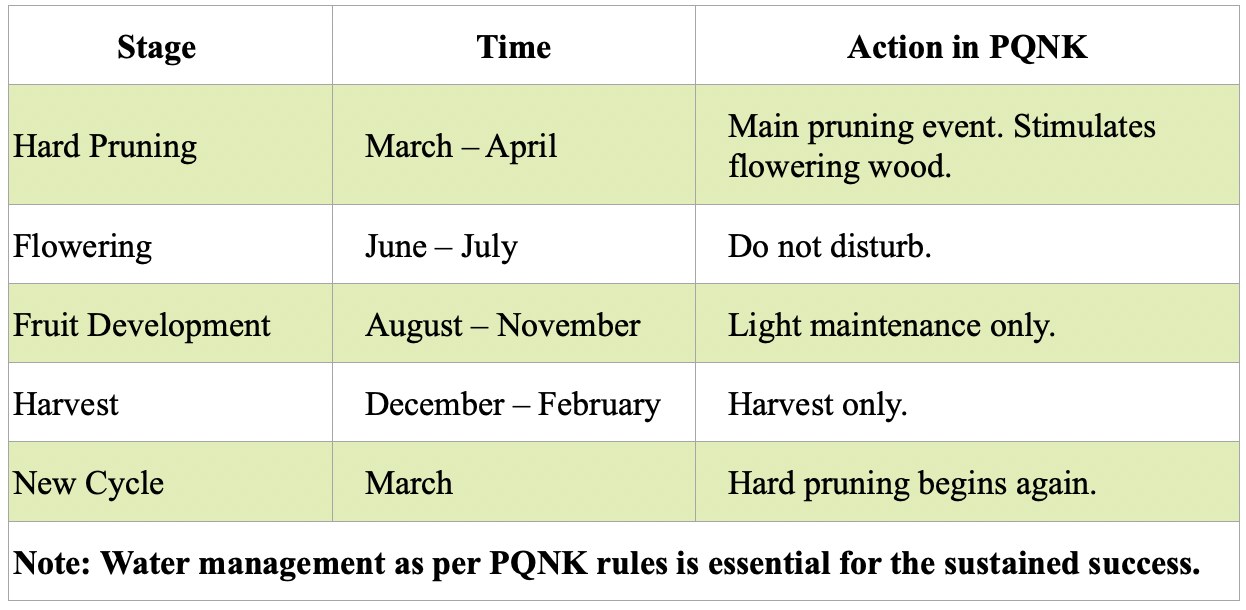
| Stage | Time | Action in PQNK |
|---|---|---|
| Hard Pruning | March – April | Main pruning event. Stimulates flowering wood. |
| Flowering | June – July | Do not disturb. |
| Fruit Development | August – November | Light maintenance only. |
| Harvest | December – February | Harvest only. |
| New Cycle | March | Hard pruning begins again. |
| Note: Water management as per PQNK rules is essential for the sustained success. |
10. Summary: PQNK High-Density Amla Protocol
11. Closing Note
The PQNK system is not a set of isolated practices—it is a closed-loop philosophy. In high-density Amla farming, this means:
The soil is never left bare.
No organic matter leaves the field.
Tree roots, Jantar roots, and intercrop roots work together to regenerate subsoil structure.
Pruning is timed to the tree’s natural phenology, not to external chemical schedules.
The farmer’s role is to manage the cycle, not to import solutions.
By following the five PQNK steps—break hardpan, correct chemistry, build beds with Jantar, mulch and no-till plant, and prune to manage energy flow… the farmer creates a self-sustaining Amla orchard that yields abundantly for decades without degrading the land or requiring external purchases.
This knowledge paper is prepared for farmers practicing Paedar Qudratti Nizam Kashatqari (PQNK)—the Pristine Organic Farming System. All recommendations adhere strictly to the closed-loop, no-external-input principles of natural ecosystem science.
——————————
Applying PQNK without understanding nature’s operating system will not deliver abundance, stability, or nutrient density.
PQNK (pronounced “picnic”)—the regenerative & sustainable Pristine Organic Farming System—is grounded in Natural Ecosystem Science. This science employs perennial biodiversity, protects soil with organic mulch, and avoids practices such as water inundation, tillage disturbance, and leaving soil bare.
It is the process that matters most. PQNK is a pristine production system designed not merely for yield, but for optimal, balanced output—where quality, sustainability, and ecological harmony emerge from a self‑regulated, zero‑external‑input methodology.
Connect & Resources Facebook: www.Facebook.Com/Pedaver YouTube (PQNK): https://www.youtube.com/@pedaverpqnk3167/videos YouTube: http://www.youtube.com/@aasifsharif PDF Knowledge Papers: https://drive.google.com/drive/folders/1iadwV6mdUPyrUIpB3oRfNv6DLiackaUL?usp=sharing Email: pedaver@gmail.com WhatsApp: +92 320 677 6666
About This Paper
- Crop
- Amla
- Problem
- Saline / Alkaline / High-pH Soil · Hardpan · Weak Flavor / Aroma / Quality Sensory Markers · Named Pest Infestation (Bollworm, Fruit Fly, Nematode, etc.)
- Science
- Soil · Plants · Crop Protection · Production Architecture
- Evidence
- Scientific Mechanism
- Authority
- Current / Approved PQNK Knowledge
Related PQNK Science
Key Takeaways
- The protocol plants roughly 545 Amla trees per acre on permanent 42-inch raised beds, unlocking a 10-12ft taproot depth through one-time hardpan breaking.
- A one-time application of 8kg/acre sulfuric acid with deep leaching irrigation brings alkaline soils to the 6.5-7.5 pH range Amla needs for fruit size and Vitamin C content.
- Amla fruits on current-season growth, so timely hard pruning after the March-April harvest is essential; skipping it costs the entire next year's crop.
- Yields build over time without synthetic inputs: 1.5-2.5 tonnes/acre in years 2-3, rising to a sustained 10-14 tonnes/acre by year five as soil organic matter accumulates.
- Seasonal legume intercrops (moong, guar, gram, lentil, barseem) fix nitrogen and add mulch biomass during the orchard's first 3-4 years before canopy closure.
- Pest control relies on pruning hygiene and naturally occurring Bacillus thuringiensis rather than insecticides, even against pests like gall maker.
Related Crops
Related Knowledge
same problem
Knowledge Paper: PQNK Rose Production
Cut-flower rose production is reframed as a closed-loop perennial system under PQNK, reaching a striking 8,712 plants per acre on twin-row permanent beds, with weeds treated as mulch, alfalfa grown as living nitrogen-fixing ground cover, and strict soil-moisture management replacing scheduled irrigation.
same problem
Chilli Production Under PQNK (PICNIC)
Chilli is biologically perennial and can remain productive for over a decade, but conventional short-cycle, urea-dependent management collapses that potential into a pest-prone annual grind. This paper shows how PQNK's soil-conversion framework and a single apical-pinching intervention restore chilli to a low-cost, high-density perennial crop, validated on a Hafizabad farm.
same problem
PQNK Factsheet: Production of HD Castor
A field factsheet for High-Density (HD) Castor grown as a 3-5 year perennial under PQNK, covering the mandatory land-preparation sequence, planting density, and the pruning schedule that keeps the crop productive across multiple harvest years.
same problem
Knowledge Paper: Achieving High-Density Pomegranate Production Through the PQNK (Picnic) Pristine Organic Farming System
This knowledge paper sets out the full methodology for a 544-plant-per-acre pomegranate orchard under PQNK: the four-step soil recovery protocol that converts degraded land into a closed-loop system, and the four management pillars, zero soil disturbance, natural irrigation, inherent pest management, and structural pruning, that keep it that way.