

KP-208 · Soil Science & PQNK System
White Grub: Friend, Foe, or Part of the Living Soil?
A farmer noticed that soil with white grubs looked more porous and full of small dark aggregates. This paper explains why finding an insect is not the same as having a pest problem, how white grubs take part in the soil food web, and the PQNK field protocol: observe first, compare roots, and intervene only when measurable damage shows the biological balance is failing.
Read or listen to the full paper ↓Abstract
A farmer observed white grubs in pots and noticed that wherever they were present the soil looked more porous, with very small dark aggregates forming. His question was whether the white grub should be treated as an enemy, a friend, or left alone. The PQNK answer is that no label should be applied merely because an organism has been found; the first question is what is actually happening to the plant and to the soil ecosystem.
White grub is a general name for the larvae of many scarab beetles. Species and developmental stages differ: some feed heavily on living roots, others on mixtures of roots, organic matter and soil. Their burrowing, feeding and frass can influence aeration, aggregation, microbial activity and nutrient cycling, but an observation in pots is not proof that the grub alone created the aggregates or that they are beneficial.
Treatment thresholds vary with species, crop, soil, climate and plant condition, so PQNK does not import a threshold from another crop or country. Its general transition rule still applies: intervention is considered only when pest pressure or damage crosses about 10 percent, and for white grub that damage is read in the roots and the stand of the crop, not in the number of larvae found.
The paper sets out a five-step PQNK field protocol: observe the crop; examine and compare the roots of healthy and affected plants; look for a consistent link between root damage and unusually high grub numbers; observe natural regulation by birds, predators and diseased or parasitised grubs; and intervene only when measurable damage shows the balance is failing, favouring the narrowest, least disruptive response.
Full Paper
If you use “Listen”, the text of the page may be sent to your browser or operating system’s speech provider, such as Apple, Google or Microsoft, depending on the voice your device uses. Pedaver does not process, transmit or store any audio.
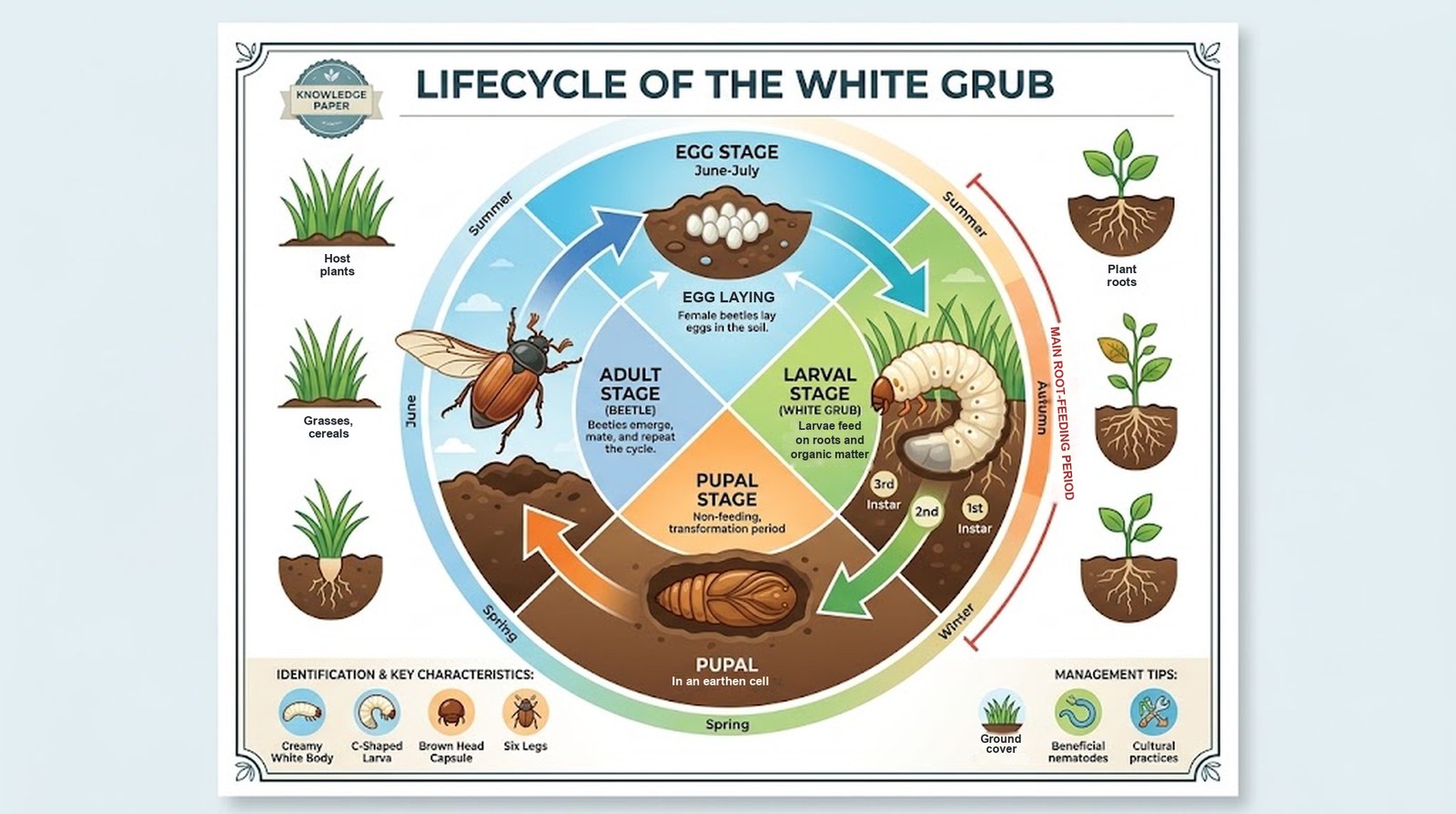
A generalised white grub life cycle. Species, timing and the extent of root damage vary by region and crop.
Presence is not damage, and an organism is not a pest merely because it can become one.
The Farmer’s Question
A farmer recently raised an unusually perceptive question. White grubs are generally described as root-feeding pests. Yet, after observing them closely in pots, he noticed something quite different. Wherever white grubs were present, the soil appeared more porous, and very small, dark aggregates were being formed. The soil looked better aerated rather than simply damaged.
His question was simple: Should we regard the white grub as an enemy, a friend, or leave it alone?
The PQNK answer is that none of these labels should be applied merely because an organism has been found. The first question should be: What is actually happening to the plant and to the soil ecosystem?
1. “White grub” is not one organism
White grub is a general name for the larval stage of numerous scarab beetles. They are commonly recognised as whitish, C-shaped larvae living below the soil surface. Different species, and even different developmental stages, do not necessarily behave identically. Some feed significantly on living roots, while others consume varying mixtures of roots, organic matter and soil material.
Therefore, seeing a white grub does not by itself tell us what it is doing. This distinction is fundamental. Damaging populations can prune crop roots sufficiently to cause stunting, wilting and stand loss, while low populations can occur without economically significant damage.
2. What was happening to the soil in the pots?
The farmer’s observation of increased porosity deserves particular attention. Scarabaeid larvae move through soil, and their burrowing can alter soil physical structure. They may ingest soil and organic material and return processed material as frass. This activity can influence aeration, aggregation, microbial activity and nutrient cycling.
The tiny dark aggregates observed in the pots could therefore plausibly be associated with grub movement, feeding, excretion and microbial processing around those materials. We should not, however, turn an observation into a universal conclusion. Without identifying the grub and analysing those aggregates, we cannot say that the grub alone created them or that their formation is necessarily beneficial.
The important point is broader: the grub may be doing more in that soil than simply eating roots. This is why PQNK avoids reducing the soil ecosystem to lists of “good organisms” and “bad organisms.”
3. The conventional question and the PQNK question
The conventional approach commonly begins: There is a pest. What should we apply to kill it?
PQNK begins differently: Is measurable damage occurring, and is the ecosystem regulating the organism itself?
If grubs are discovered while plants remain vigorous, roots are healthy, soil structure is improving and there is no abnormal plant mortality, there is no justification for intervention merely because larvae are present. The farmer watches.
If young plants begin wilting or dying despite adequate soil moisture, roots should be examined. Healthy and affected plants should be compared. If affected plants show substantial root pruning and unusually high grub populations are concentrated around them, we then have evidence connecting the organism with crop damage. Only then does the discussion move from presence toward pest pressure.
4. There is no universal magic number
Treatment thresholds vary with grub species, crop, soil, climate and plant condition. A plant with a small, stressed root system cannot tolerate the same root grazing as a vigorous plant with a large root system.
PQNK therefore does not import a threshold developed for another crop, soil or country and declare it universal for a Pakistani PQNK field. The crop itself, the roots and the condition of the living system must remain part of the diagnosis.
PQNK’s general transition rule still applies: intervention is considered only when pest pressure or damage crosses about 10 percent. For white grub, that damage is read in the roots and the stand of the crop, not in the number of larvae found.
5. A root is part of a food web
PQNK asks us to reconsider another assumption: must every organism consuming a small amount of living root tissue necessarily be eliminated?
Natural ecosystems do not operate that way. Roots grow, branch, die, regenerate and interact continuously with microorganisms and soil fauna. Below-ground herbivory is one component of this biological system. Root feeding, frass deposition and larval movement can alter microbial activity, nutrient dynamics and soil physical properties. These effects are complex and are not automatically beneficial. Heavy root herbivory can clearly damage plants.
The objective of PQNK is therefore not to maximise white grubs. Nor is it to eradicate them. The objective is biological balance.
6. Who controls the white grub?
A white grub does not live alone. It exists inside a food web containing predators, parasitoids, entomopathogenic nematodes, bacteria, fungi, birds and other organisms. In an undisturbed and biologically diverse system, these organisms can contribute to regulating grub populations.
This is where indiscriminate treatment can create a paradox. A farmer sees one organism and poisons the soil to eliminate it. The treatment may reduce the target population, but it may also disturb organisms involved in keeping that population within bounds. The farmer has treated the visible organism while potentially weakening the invisible regulatory system.
PQNK instead asks whether biodiversity can perform that regulatory function.
7. When does the friend become a foe?
Neither description is quite correct. The white grub is an ecosystem participant whose effect depends upon species, population, plant condition and ecological balance.
At low populations it may coexist with the crop without measurable economic injury. Its movement and processing of soil material may contribute to changes in soil structure and microbial activity. At excessive populations, particularly where root-feeding species are involved, the same organism can remove roots faster than young plants can replace them. At that point plant growth slows, wilting occurs, stands thin and yield can be affected.
The biological function has not suddenly become morally “bad.” The balance has changed. That distinction is central to PQNK.
8. The PQNK field protocol
When white grubs are found, do not spray automatically.
First, observe the crop. If plants are healthy and growing normally, leave the system alone and continue monitoring.
Second, if unexplained wilting, stunting or mortality appears, examine the roots of both healthy and affected plants.
Third, look for a relationship. Are damaged roots associated consistently with unusually high grub populations, or are grubs simply present throughout healthy and unhealthy soil alike?
Fourth, observe the wider biology. Birds feeding in the field, predatory organisms, and diseased or parasitised grubs may indicate that natural regulation is already operating.
Finally, intervene only when measurable crop damage demonstrates that the biological balance is failing to protect production. Even then, PQNK favours the narrowest biological or least disruptive response appropriate to the identified organism rather than routine broad-spectrum chemical treatment.
The decision is therefore based not simply on the number of insects seen, but on the relationship among pest pressure, root damage, plant performance and the regulatory capacity of the living system.
9. From pest management to ecosystem management
Industrial agriculture trained generations of farmers to think that successful farming means identifying and eliminating organisms that consume the crop. Nature works differently.
A forest does not survive because nothing eats its roots or leaves. It survives because enormous biological diversity prevents any one organism from permanently dominating the system. PQNK attempts to restore that principle to production agriculture.
The farmer’s observation of white grubs and improved soil porosity therefore teaches something much larger than how to manage one insect. It teaches us to observe before we interfere.
The question is not: “Is the white grub my friend or my enemy?”
The better question is: “Is this organism participating in a balanced living soil, or has its population reached the point where it is causing measurable damage faster than the ecosystem can regulate it?”
If the crop is healthy, do not kill an organism simply because you can see it. If measurable root damage and crop loss are developing, investigate and respond.
That is the difference between trying to control nature and learning to manage production within nature.
PQNK Principle: An organism becomes a pest not merely by being present, but when ecological imbalance allows its activity to cause unacceptable crop damage. Biodiversity is the first regulator. Observation determines whether intervention is necessary.
References
1. University of Maryland Extension. White Grubs in Lawn and Garden Soil.
2. Iowa State University Extension and Outreach. True White Grub Identification and Management.
3. Cornell Integrated Pest Management. Grubs.
4. Rutgers New Jersey Agricultural Experiment Station. White Grub Management.
5. Pedaver. PQNK: The Natural Ecosystem Science of Production Agriculture, Chapter Six: Nature’s Pest Protection. Pedaver, Pakistan, 2026.
About This Paper
- Problem
- Named Pest Infestation (Bollworm, Fruit Fly, Nematode, etc.) · General Pest Pressure · Weak / Shallow Root Establishment · Beneficial Insect / Predator Decline · Biodiversity Loss · Soil Biology / Microbiome Decline
- Science
- Crop Protection · Soil · Biodiversity
- Evidence
- Farmer Testimony
- Authority
- Current / Approved PQNK Knowledge
Related PQNK Science
Key Takeaways
- Presence is not damage: an organism is not a pest merely because it can become one.
- "White grub" covers many scarab species with different feeding habits; identification matters before any conclusion.
- Grub burrowing and frass can change soil structure and microbial activity, but a pot observation is not proof of benefit.
- PQNK does not import foreign thresholds; its about-10-percent transition rule is judged from root damage and crop stand, not larva counts.
- Predators, parasitoids, entomopathogenic nematodes, fungi, bacteria and birds help regulate grubs; indiscriminate soil treatment can weaken that regulation.
- Field protocol: observe, compare roots, look for a relationship, watch natural regulation, and only then intervene with the narrowest response.
Related Knowledge
same problem
Pest Ecology and the Collapse of Biological Balance
Industrial agriculture treats pest outbreaks as attacks requiring stronger poison, yet pest pressure often intensifies the more a field is sprayed. This paper explains why, tracing outbreaks to the collapse of predator webs and to vegetative imbalance that makes plants physiologically attractive to sap feeders, and argues PQNK's response is ecosystem stabilization rather than escalating chemical suppression.
same problem
Above-Soil Ecosystems in PQNK: Plant-Directed Insect Dynamics, Pollination, and Natural Regulation
Extending PQNK's below-soil 'plants as employers' framework above ground, this paper argues plants deliberately recruit and regulate pollinators, predators, and even sap-sucking insects like aphids, using them as tools to shift energy from vegetative growth into reproduction. It reframes pre-flowering aphid activity as an invited pruning mechanism rather than an infestation.
same problem
Pakistan's Agricultural Biotechnology Policy 2025: The Right Intention, The Wrong Diagnosis
A formal PQNK response to Pakistan's Federal Cabinet-approved National Agricultural Biotechnology Policy 2025, arguing the BT cotton experiment already proved that engineering the plant to compensate for a damaged environment fails within years, and that the real intervention point is restoring the soil biology and water systems the policy leaves untouched.
same problem
The Sacred Symbiosis: Why PQNK Feeds Plants, While Chemical Agriculture Only Force-Feeds Them
Answering a practitioner's question about active versus passive nutrient absorption, this paper contrasts PQNK's living root-microbe dialogue with the 'intravenous drip' of soluble chemical fertilizer, and asks how the Amazon has sustained itself for 40 crore years while chemical farming has exhausted soils worldwide in barely 200.