

KP-060 · Plant Physiology & Production Systems
The Sacred Symbiosis: Why PQNK Feeds Plants, While Chemical Agriculture Only Force-Feeds Them
Answering a practitioner's question about active versus passive nutrient absorption, this paper contrasts PQNK's living root-microbe dialogue with the 'intravenous drip' of soluble chemical fertilizer, and asks how the Amazon has sustained itself for 40 crore years while chemical farming has exhausted soils worldwide in barely 200.
Read or listen to the full paper ↓Abstract
The paper is structured as a direct answer to an Indian PQNK practitioner's question about how nutrient absorption actually works, and why chemical and biological systems produce such different long-term outcomes despite both ultimately delivering nutrients to a plant's roots. Its central distinction is between nutrient absorption as a 'living dialogue' under PQNK and as a 'chemical monologue' under conventional fertilization.
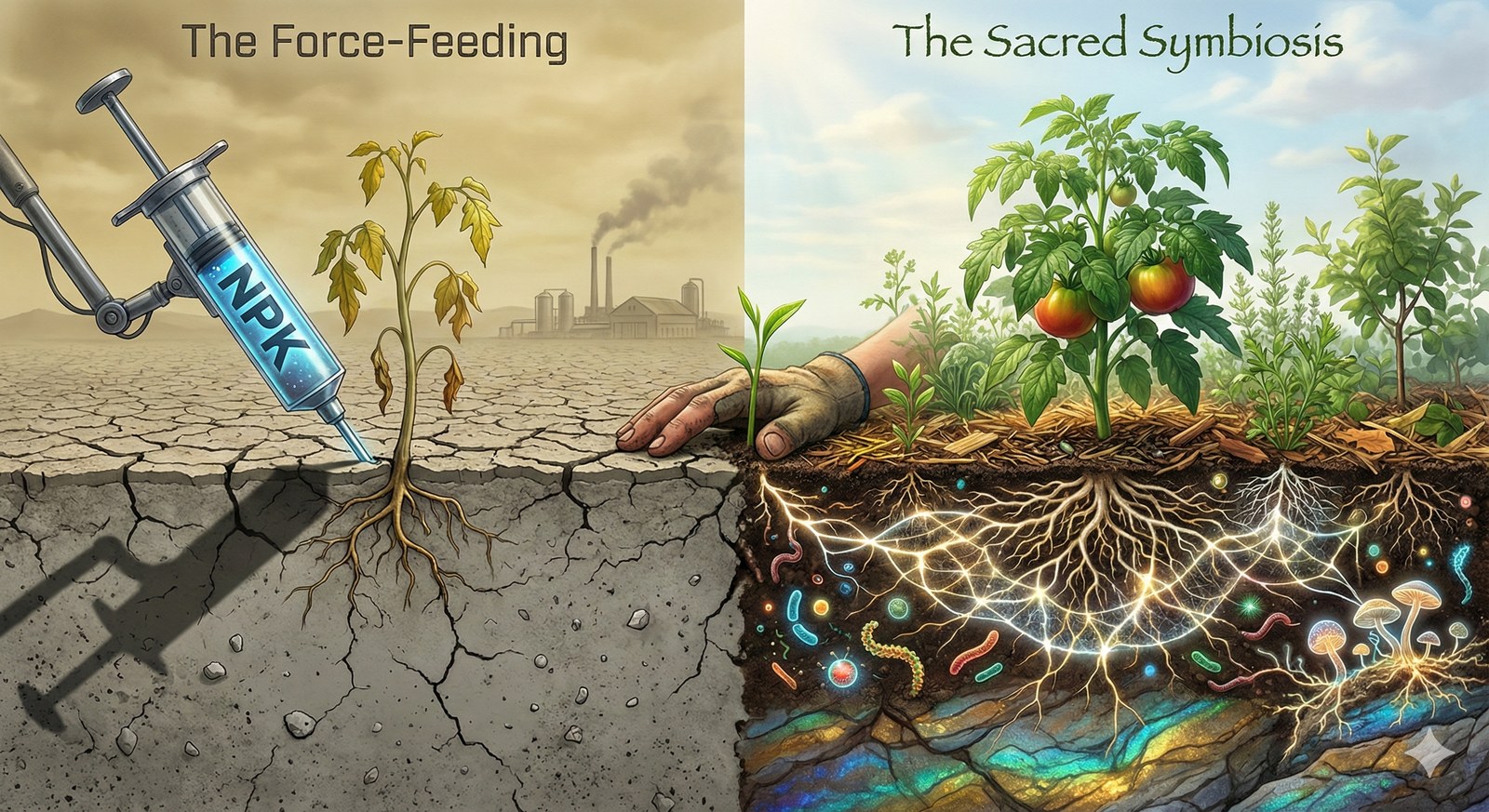
Under PQNK, the plant is described as pumping carbon-rich sugar exudates from its roots to feed a specific microbial community in the rhizosphere, effectively paying bacteria and fungi to weather parent rock and soil particles, unlocking the full mineral spectrum and presenting it back to the plant in balanced, bioavailable form. Under chemical fertilization, water-soluble NPK salts are forced directly into the soil solution and absorbed passively with water, bypassing this microbial digestive system entirely; the paper likens this to an intravenous sugar drip, technically nutrition, but incomplete, unbalanced, and requiring no living relationship at all.
The consequences of that bypass are traced in detail: high salt concentrations poison the soil food web outright, and a plant with its food delivered directly to its doorstep has no reason to invest energy in a large root system or fungal partnerships, so the symbiotic relationship collapses (what the paper calls 'lazy root syndrome'), starved microbial life dies off, and soil structure collapses without the microbial glues and fungal hyphae that held it together, turning living sponge into dead, compacted dirt. In this degraded state, the paper argues, the microbes that remain skew toward weed-friendly and pathogenic populations, since the diverse, protective microbiome (including beneficial species like Bacillus thuringiensis) that would otherwise defend the plant has been eliminated.
The paper's rhetorical centerpiece is a direct comparison: the Amazon rainforest as the ultimate closed-loop PQNK system, cycling nutrients and mining bedrock minerals continuously for over 40 crore (400 million) years on sunlight and geological wealth alone, against industrial chemical agriculture, an extractive, open-loop system that has visibly degraded soils, water, and air worldwide within roughly 200 years by mining only soluble NPK while ignoring the trace minerals and biological engine needed to access the rest.
It closes by affirming the practitioner's own understanding of active and passive absorption as correct and scientifically grounded, and frames her PQNK practices, mulching, no-till, avoiding water inundation, as directly rebuilding the soil food web and restoring what the paper calls the 'sacred symbiosis' between plant, microbe, and rock.
Full Paper
If you use “Listen”, the text of the page may be sent to your browser or operating system’s speech provider, such as Apple, Google or Microsoft, depending on the voice your device uses. Pedaver does not process, transmit or store any audio.
Our esteemed PQNK practitioner from India has raised a specific question that we are delighted to address, not only for her benefit but also for the benefit of all farmers.
“Namaste Dr Saab, for the valuable knowledge on the "absorption of nutrients in PQNK farming". I didn't even know the terms 'active' and 'passive absorption' of nutrients. Here we know both are live processes acting thru symbiosis of plant and microbes.
What is the process of absorption of nutrients in the chemical fertilizers? Are they ready -to-eat type or some process is necessary?
What happens to the fertilisers and to the soil microbes?
Is there any role of soil microbes in making nutrients in synthetic fertilizers available to plants, too?
What are the implications?
The natural ecosystems like Amazon forests are alive and thriving for over 40 crore years.
How is it that the modern chemical farming has exhausted the soil, spoiled air and water, worldwide, within 200 years?
Dr Saab, your valuable guidance please. Regards,
Vasudha”
Namaste Vasudha Behn,
Your questions are profound and touch the very heart of the conflict between life-giving and life-destroying agriculture. As a practitioner of PQNK, you have already felt the truth in the soil. Let PQNK, provide the scientific explanation for what you observe.
Your understanding that both 'active' and 'passive' absorption are live processes acting through symbiosis is perfectly correct. This is the cornerstone of PQNK. Let us explore the details.
1. The Process of Nutrient Absorption: A Living Dialogue vs. a Chemical Monologue
In the PQNK system, nutrient absorption is a sophisticated, symbiotic dialogue:
The Plant's Role: The plant, through photosynthesis, creates carbon-rich sugars (exudates) which it deliberately secretes from its roots to feed a specific microbial community in the rhizosphere. It is essentially "ordering" its dinner.
The Microbes' Role: This is where your insight is crucial. Our understanding is that the soil possesses everything in geological abundance. The role of the microbes—bacteria and fungi—is to act as the plant's digestive system. They break down organic mulch and, more importantly, weather the parent rock and soil particles, unlocking the vast spectrum of minerals. They then present these nutrients to the plant in a balanced, proportionate, and bioavailable form. The plant residue from the mulch is not just fertilizer; it is the primary fuel for this microbial workforce.
In chemical farming, this dialogue is broken and replaced by a monologue:
Are they "Ready-to-Eat"? Yes, but in the way that an intravenous sugar drip is "ready-to-eat." Water-soluble salts (NPK) are forced into the soil solution, bypassing the microbial "digestive system" entirely.
No Process Needed: The plant absorbs these salts primarily through passive absorption with water. There is no need for a symbiotic relationship. The meal is delivered, but it is incomplete and unbalanced, leading to a malnourished plant and a starving soil ecosystem.
2. The Fate of Fertilizers and Soil Microbes: A Story of Destruction
This force-feeding has catastrophic consequences:
Microbial Poisoning: The high salt concentration of chemical fertilizers is a preservative and a poison to the delicate soil food web. Beneficial organisms die or go dormant.
The "Lazy Root" Syndrome: Why would a plant invest precious energy in growing a vast root network or supporting fungal partners when its food is dumped on its doorstep? The symbiotic contract is nullified. The microbial life, now starved of root exudates, perishes.
Soil Structure Collapse: Without microbial glues and fungal hyphae to bind it, the soil structure collapses. It becomes compacted, loses its porosity, and turns from a living sponge into dead, inert dirt.
3. The Perverse Role of Microbes in a Chemical System
In a perverse twist, microbes are forced into a destructive role:
Weed-Friendly Bacteria: Chemical salts favor certain bacterial populations that thrive in degraded environments. PQNK see weeds as a solution, not a problem. They are nature's emergency response team, pioneer species that emerge to restore balance and structure in soils ruined by chemical amendments. They are a rescue force, a symptom of the disease, not the disease itself.
Pathogen Proliferation: Weak plants in dead soil are easy targets. The lack of a diverse microbiome means no natural defense. This includes the collapse of beneficial systems led by bacteria like Bacillus thuringiensis (Bt), which naturally control pests. In a healthy PQNK soil, a thousand different microbes protect the plant; in a chemical system, this army is gone.
4. The Great Divergence: 40 Crore Years of Amazon vs. 200 Years of Exhaustion
Your comparison is the most powerful one can make.
The Amazon Forest is the ultimate PQNK system: a self-sustaining, closed loop.
No Waste, Only Food: Everything is recycled.
Living Soil Accessing Geological Abundance: The immense biodiversity of microbes and fungi does two things simultaneously: it decomposes organic matter and it continuously mines the vast mineral bank in the bedrock, making it available to plants. The system runs on sunlight and the mineral wealth already present.
Chemical Agriculture is an extractive, open-loop system.
It Mines the Soil: It focuses only on soluble NPK, ignoring the trace minerals and the biological engine needed to access them. The result, as PQNK imply, is food of low nutrient density and diversity. This is a primary reason for the rise of dietary-related illnesses in our population. We are eating empty calories.
It Destroys the Engine: It systematically dismantles the very biological system that creates topsoil and cycles nutrients.
It is Addicted to Inputs: It is not sustainable. It requires constant external inputs to function, making it inherently fragile and costly.
Conclusion: Your Role as a PQNK Practitioner
Vasudha Behn, by practicing PQNK, you are not just farming; you are practicing ecosystem restoration.
You are:
Rebuilding the Soil Food Web: Your mulch and no-till practices are feeding the microbial workforce.
Honoring the Water Cycle: By avoiding the inundation of soil with water, you protect the soil structure and the aerobic organisms within. This is a non-negotiable PQNK principle: Any production process that inundates soil with water, disturbs soil through tillage, or leaves soil bare without organic mulch cover does not qualify as natural ecosystem science for production agriculture.
Restoring the Sacred Symbiosis: You are re-establishing the ancient partnership between plant and microbe, between rock and root.
You are aligning your work with the same principles that have sustained the Amazon for 40 crore years. You are not just growing food; you are reclaiming our agricultural future, one handful of living soil at a time.
Continue with confidence and profound respect for the work you are doing.
In service,
Asif Sharif (PQNK - The Regenerative & Sustainable Pristine Organic Farming System)
—————————
Footnote: Any Production Process That Inundates Soil With Water, Disturbs Soil Through Tillage, Or Leaves Soil Bare Without Organic Mulch Cover Does Not Qualify As Natural Ecosystem Science For Production Agriculture.
PQNK, to be pronounced as 'picnic', which stands for Paedar Qudratti Nizam Kashatqari, and means: the regenerative & sustainable Pristine Organic Farming System.
www.Facebook.Com/Pedaver
https://www.youtube.com/@pedaverpqnk3167/videos
pedaver@gmail.com
WhatsApp +92 320 677 6666
About This Paper
- Problem
- General Soil Fertility / Land Degradation · Weak / Shallow Root Establishment · Soil Compaction (General) · Soil Biology / Microbiome Decline
- Science
- Soil · Plants · Nutrition
- Evidence
- Scientific Mechanism
- Authority
- Current / Approved PQNK Knowledge
Related PQNK Science
Key Takeaways
- Frames PQNK nutrient uptake as a 'living dialogue,' where root exudates pay microbes to mine and deliver balanced minerals, versus chemical fertilization as a 'chemical monologue' of forced, unbalanced soluble salts.
- Argues synthetic fertilizer triggers 'lazy root syndrome': plants stop investing in root growth and microbial partnerships once nutrients are delivered directly, causing the starved soil food web to collapse.
- Without microbial glues and fungal hyphae, soil structure is said to collapse from a living sponge into compacted, inert dirt.
- Contrasts the Amazon rainforest, a self-sustaining closed-loop system for roughly 40 crore years, against chemical agriculture's documented global soil exhaustion within about 200 years.
- Notes that degraded, chemically dominated soils favor weed-friendly and pathogenic microbial populations over the protective, diverse microbiome (including species like Bacillus thuringiensis) that a healthy soil hosts.
- Frames mulching, no-till, and avoiding water inundation as the direct, practical mechanisms by which a farmer rebuilds the plant-microbe-mineral relationship.
Related Crops
Related Knowledge
same problem
The Weeds as Soil Physicians: A PQNK Diagnostic Guide to Soil Health in the Punjab Region
This regional diagnostic guide teaches Punjab farmers to read specific weed combinations, not single species, as a whole-field soil diagnosis, then prescribes a 'principle of substitution': replacing each wild pioneer weed with a cultivated crop that performs the identical remediation function while also producing a yield.
same problem
Deep Subsoil Remediation & Activation: Strategic Pathways for Compacted Soils
This paper lays out PQNK's two-track response to hardpan: a preferred one-time mechanical subsoiling where machinery is available, and a patient, plant-and-fungi-driven biological pathway for farms where it isn't, with mycorrhizal fungi cast as the ecosystem's 'stone breaker.'
same problem
Chemical Fertiliser Dependency Through the PQNK Lens
An evidence-qualified review of the article “Chemical Fertilizer Industry”. It keeps the article's warning about soil degradation, nutrient pollution and biological decline, disciplines its headline numbers, and argues that fertiliser dependency is a symptom of a damaged production system (tillage, flooding, bare soil and simplified biology) that PQNK removes by restoring aerated, covered, living soil, reaching zero purchased fertiliser and pesticide at maturity.
same problem
Why PQNK Sugarcane Does Not Need Earthing Up
Earthing up is mandatory in conventional sugarcane: the set is placed in a furrow 6 to 8 inches deep between ridges 6 to 8 inches high, above a compacted hardpan, roots stay shallow, and the profile has to be reversed with soil piled around the stool. PQNK removes the cause instead: the hardpan is broken once, cane grows on permanent beds, roots go deep, the crown stays near the aerated surface and the full sugar-rich base can be harvested.