

KP-062 · Plant Physiology & Production Systems
Above-Soil Ecosystems in PQNK: Plant-Directed Insect Dynamics, Pollination, and Natural Regulation
Extending PQNK's below-soil 'plants as employers' framework above ground, this paper argues plants deliberately recruit and regulate pollinators, predators, and even sap-sucking insects like aphids, using them as tools to shift energy from vegetative growth into reproduction. It reframes pre-flowering aphid activity as an invited pruning mechanism rather than an infestation.
Read or listen to the full paper ↓Abstract
The paper opens by establishing preconditions: a functional above-soil ecosystem can only operate once the below-soil PQNK ecosystem, broken hardpan, mature permanent raised beds, continuous and retained roots, and stable moisture and temperature from mulch, is already established. Without these foundations, it argues, recycling organisms dominate above ground instead of the provisioning and protection organisms a healthy system depends on.
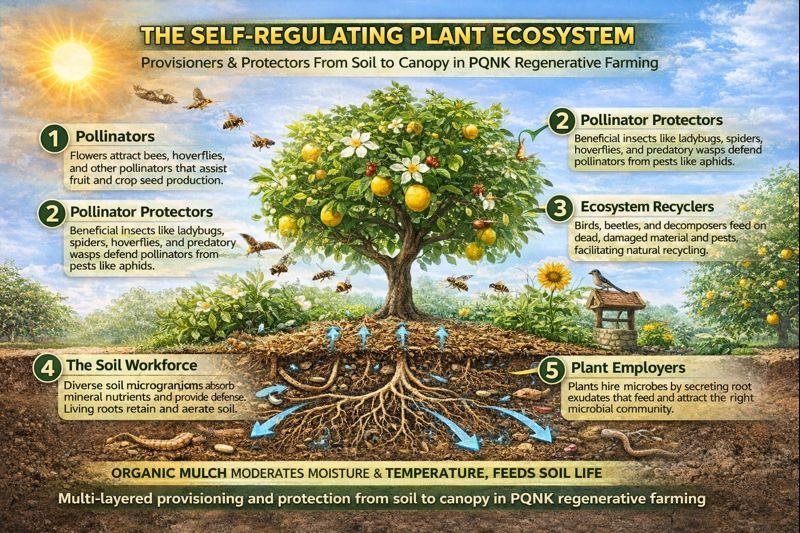
Its central reframing is that plants are active coordinators, not passive victims, both below and above soil. Below, they hire microbes through root exudates; above, they recruit pollinators, predators, parasitoids, browsers, and recyclers through volatile organic compounds, flower color and structure, nectar composition, and sap chemistry, signals the paper describes as intentional biological invitations rather than accidental vulnerabilities. Pollinators are drawn by fragrance, visual cues, and nectar as reproductive provisioners, while predators (lady beetles, lacewings, spiders, predatory wasps) arrive to protect pollinators and regulate scavengers, becoming dominant specifically when plants are healthy and signaling stability.
The paper's most counterintuitive claim concerns sucking insects: aphids appearing before flowering, it argues, represent a plant-initiated invitation and a mechanism for reducing excess vegetative energy, since plants deliberately overproduce leaves and sap, and controlled sap removal by insects reduces vegetative dominance and redirects carbon flow toward flowers and seed, mirroring natural browsing, trampling, and clipping pressure at a micro scale. This overgrowth, the paper argues, is intentional: surplus biomass feeds insects, predators, and soil, and when associated species are well fed, plant stress hormones fall and reproductive hormones rise.
This directly contradicts what the paper calls the Ancient Conventional Industrial (ACI) model, which treats aphids, caterpillars, beetles, and thrips as external enemies by default. It argues chemical spraying interrupts plant-directed signaling, kills pollinators and predators, and collapses natural suppression cycles, producing short-term visual cleanliness at the cost of long-term ecological instability and permanent dependency on repeated intervention, breaking both the workforce and the management system plants have built.
The paper closes with a practical distinction between provisioning/protecting organisms, which dominate in healthy systems, and recycling organisms, which dominate when plants are unhealthy or dying (framed as cleaners responding to failure, not causes of it), and recommends no intervention during flowering, diagnostic rather than emotional interpretation of insect presence, and localized, comparative, observational assessment over field-wide reactive spraying.
Full Paper
If you use “Listen”, the text of the page may be sent to your browser or operating system’s speech provider, such as Apple, Google or Microsoft, depending on the voice your device uses. Pedaver does not process, transmit or store any audio.
1. Foundation: Preconditions for a Functional PQNK Ecosystem
A functional above‑soil ecosystem can only operate effectively when the below‑soil PQNK ecosystem is already established. These preconditions include:
• Properly broken hardpan, restoring deep movement of water, air, and roots
• Permanent raised beds mature enough to host stable microbial habitats
• Continuous live roots and retained dead roots, keeping soil pores open and feeding soil life
• Active soil aeration through biology, not mechanical disturbance
• Stable soil moisture and temperature, maintained through organic mulch
Without these foundations, above‑ground biological regulation weakens, and recycling organisms dominate instead of provisioning and protection organisms.
2. Plants as Central Coordinators (Employers)
In PQNK, plants are not passive victims; they are active coordinators of biological labor.
• Below soil: plants hire microbes to mobilize nutrients, structure soil, and provide immunity.
• Above soil: plants recruit pollinators, predators, parasitoids, browsers, and recyclers.
Plants communicate through:
• Volatile organic compounds (VOCs)
• Flower color and structure
• Nectar composition
• Sap chemistry
These signals are intentional biological invitations, not accidental vulnerabilities.
3. The Above‑Soil Workforce: Provisioners and Protectors
3.1 Pollinators – Reproductive Provisioners
During flowering, plants emit:
• Specific fragrances
• Visual cues (color, symmetry, contrast)
• Nectar rewards
These attract bees, flies, butterflies, and other pollinators. Pollination is not an isolated event but part of a coordinated ecosystem service required to shift plants from vegetative growth to reproduction.
3.2 Predators – Pollinator Protectors
Alongside pollinators, predators arrive:
• Lady beetles
• Lacewings
• Spiders
• Predatory wasps
Their role is not random hunting, but protection of pollinators and regulation of scavengers. Predators become dominant when plants are healthy and signaling stability. When plants are weak, injured, or dying, predators reduce, and recyclers increase.
4. Sucking Insects Before Flowering: Invitation, Not Infestation
4.1 Aphids and Sap‑Feeders as Biological Tools
Sucking insects such as aphids commonly appear before flowering, not during it. In PQNK, this is understood as:
• A plant‑initiated invitation
• A mechanism to reduce excess vegetative energy
• A trigger for hormonal rebalancing toward reproduction
Plants deliberately overproduce leaves and sap. Controlled sap removal:
• Reduces vegetative dominance
• Redirects carbon flow toward flowers and seeds
4.2 Parallel to Natural Pruning
In natural ecosystems, plants experience:
• Browsing by animals
• Stamping and trampling
• Clipping and breakage
These are not stresses but regulatory steps. Sap‑sucking and chewing insects perform the same function at a micro scale.
5. Overgrowth Is Intentional: Feeding the Ecosystem
Plants always grow more biomass than they need.
This surplus is designed to:
• Feed insects
• Feed predators
• Feed soil via leaf drop and root turnover
When associated species are well‑fed:
• Plant stress hormones reduce
• Reproductive hormones increase
• Flowering and fruiting stabilize
This principle directly contradicts ACI yield‑maximization logic, which attempts to preserve every leaf and drop of sap.
6. ACI Misinterpretation and Its Consequences
The Ancient Conventional Industrial (ACI) model labels:
• Aphids
• Caterpillars
• Beetles
• Thrips
as pests, assuming they are external enemies.
6.1 Impact of Chemical Intervention
Spraying poisons:
• Interrupts plant‑directed signaling
• Kills pollinators
• Eliminates predators
• Collapses natural suppression and activation cycles
The result is:
• Short‑term visual cleanliness
• Long‑term ecological instability
• Dependency on repeated chemical intervention
In effect, ACI breaks both the workforce and the management system created by plants.
7. Recycling vs Provisioning Organisms
A key PQNK distinction:
• Provisioners & protectors dominate in healthy systems
• Recyclers dominate when plants are unhealthy or dying
Recyclers are not enemies; they are cleaners. Their dominance signals ecosystem failure, not pest pressure. Spraying during flowering disrupts this balance precisely at the moment when ecosystems are most synchronized.
8. Implications for Farm Management Under PQNK
Under PQNK:
• No intervention is recommended during flowering
• Insect presence is interpreted diagnostically, not emotionally
• Single‑plant observation is preferred over field‑wide action
Intervention, if ever considered, must be:
• Localized
• Comparative (treated vs untreated)
• Observational, not reactionary
9. Conclusion
Above‑soil ecosystems operate on the same principle as soil ecosystems: plants are employers, biology is the workforce. Sucking insects, pollinators, and predators are not random invaders but participants in a coordinated biological economy. ACI disrupts this economy through fear‑based intervention. PQNK restores it by:
• Establishing strong soil foundations
• Allowing plants to regulate biology
• Trusting natural suppression and activation cycles
Healthy plants do not need protection from nature; they need freedom to work with nature.
Footnote: PQNK (pronounced 'picnic')—the regenerative & sustainable Pristine Organic Farming System—is grounded in Natural Ecosystem Science. This science employs perennial biodiversity, protects soil with organic mulch, and avoids practices like water inundation, tillage disturbance, and leaving soil bare.
It is the process that matters most. PQNK is a pristine production system designed not merely for yield, but for optimal, balanced output—where quality, sustainability, and ecological harmony emerge from a self-regulated, zero-external-input methodology.
PDF Knowledge papers: https://drive.google.com/drive/folders/ 1iadwV6mdUPyrUIpB3oRfNv6DLiackaUL?usp=sharing
About This Paper
- Problem
- Sucking Insect Pressure (Aphid/Whitefly/Jassid) · Beneficial Insect / Predator Decline · General Pest Pressure
- Science
- Biodiversity · Crop Protection · Plants
- Evidence
- Scientific Mechanism
- Authority
- Current / Approved PQNK Knowledge
Related PQNK Science
Key Takeaways
- Extends PQNK's below-soil 'plants as employers, microbes as workforce' model above ground: plants recruit pollinators, predators, and even sap-suckers through VOCs, flower color, nectar, and sap chemistry.
- Reframes pre-flowering aphid activity as a plant-initiated tool for shedding excess vegetative energy and triggering reproductive hormonal rebalancing, not an infestation to spray.
- Argues predators (lady beetles, lacewings, spiders, predatory wasps) become dominant specifically when plants are healthy and signaling stability, not through random colonization.
- Distinguishes provisioning/protecting organisms, which dominate healthy systems, from recycling organisms, which dominate failing ones and are described as cleaners, not causes.
- Argues chemical spraying during flowering interrupts plant-directed signaling and collapses natural suppression cycles, producing short-term cleanliness and long-term dependency.
- Recommends no intervention during flowering and localized, comparative, observational assessment of insect presence over field-wide reactive spraying.
Related Knowledge
same problem
Pest Ecology and the Collapse of Biological Balance
Industrial agriculture treats pest outbreaks as attacks requiring stronger poison, yet pest pressure often intensifies the more a field is sprayed. This paper explains why, tracing outbreaks to the collapse of predator webs and to vegetative imbalance that makes plants physiologically attractive to sap feeders, and argues PQNK's response is ecosystem stabilization rather than escalating chemical suppression.
same problem
White Grub: Friend, Foe, or Part of the Living Soil?
A farmer noticed that soil with white grubs looked more porous and full of small dark aggregates. This paper explains why finding an insect is not the same as having a pest problem, how white grubs take part in the soil food web, and the PQNK field protocol: observe first, compare roots, and intervene only when measurable damage shows the biological balance is failing.
same problem
The PQNK Strawberry Production System: Achieving Commercial Abundance Through Ecosystem Logic
A full production system for open-field commercial strawberries under PQNK, covering ultra-high-density planting (19,600 plants/acre, nearly double the conventional standard), a mulch-hydration system that eliminates irrigation, a three-layer pest defense, and a post-harvest cold-chain protocol, plus a winter-crop rotation that keeps the same permanent bed productive year-round.
same problem
Restoring Prosperity in Citrus and Mango Orchards Through the PQNK Regenerative System
Decades of industrial orchard management have driven a 60% decline in Kinnow nutrition density and widespread orchard abandonment. This paper presents field data from a Toba Tek Singh comparison and the Sujjahabad Mango Research Station showing how PQNK reverses that decline, lifting A-grade fruit yield by up to 80%.