

KP-181 · PQNK Philosophy, Framework & Economics
Pakistan's Agricultural Biotechnology Policy 2025: The Right Intention, The Wrong Diagnosis
A formal PQNK response to Pakistan's Federal Cabinet-approved National Agricultural Biotechnology Policy 2025, arguing the BT cotton experiment already proved that engineering the plant to compensate for a damaged environment fails within years, and that the real intervention point is restoring the soil biology and water systems the policy leaves untouched.
Read or listen to the full paper ↓Abstract
The paper opens by acknowledging the Federal Cabinet's genuine intent behind the National Agricultural Biotechnology Policy 2025, a framework for biotechnology research, product commercialization, and crop productivity, before turning to what it calls Pakistan's own uncontrolled precedent: BT cotton, engineered with a Bacillus thuringiensis gene, was introduced as a permanent solution to the cotton pest crisis, but within eight seasons the pink bollworm had adapted, and what replaced the collapsed technology was a more expensive, more chemically dependent version of the same broken model. The lesson drawn is that biotechnology treats the symptom while the underlying cause, decades of tillage, flooding, synthetic fertilizer, and pesticide destroying soil biology, remains untreated; a soil with intact biology already hosts Bacillus thuringiensis as a resident organism, which is why PQNK fields untreated with pesticide for three or more seasons show no economically significant pest pressure.
It then presents what it calls the full ledger of Ancient, Conventional, and Industrial (ACI) agriculture's damage, which it argues the policy addresses only partially. On soil, it cites Pakistan's intensively farmed districts falling from a natural organic-matter baseline of 3 to 5 percent to measured averages below 0.5 percent, noting that below 0.2 percent, Rhizobium bacteria can no longer sustain viable nitrogen-fixing colonies in the root zone, making purchased nitrogen a biological necessity rather than a preference. On water, it links flood irrigation's oxygen displacement and salt deposition to waterlogging and salinization affecting millions of hectares across Punjab and Sindh, comparable to the Nile Delta, Mexico's Central Plateau, and India's Indo-Gangetic Plain.
On carbon, the paper estimates that ACI-managed soils globally have released 130 to 150 billion tonnes of carbon since commercial synthetic fertilizer began reshaping agriculture in the mid-nineteenth century, against which it positions a PQNK bed as actively sequestering carbon season after season. On biodiversity, it cites a contraction of the world's cultivated food base from 7,000 to 8,000 historically grown plant species to fewer than 200 commercially significant ones today, with four crops supplying more than half of global caloric intake, alongside catastrophic pollinator decline under neonicotinoid regimes despite pollinators enabling reproduction in 75 percent of food crops.
On nutrition, it argues that iron, zinc, calcium, magnesium, and vitamin C concentrations measured in wheat, rice, and vegetables in the 1950s are materially higher than the same crops measured in the same regions today, a soil biology effect rather than primarily a varietal one, meaning the policy's stated goal of nutrition security cannot be met by engineering plants to extract nutrients from biologically dead soil that no longer contains them. On rural livelihoods, it links Pakistan's farm debt burden and sustained rural-to-urban migration directly to a production model requiring purchased seed, fertilizer, pesticide, and irrigation energy every season, transferring value from farmer to input supplier with each cycle.
The paper concedes one area of legitimate overlap, plant tissue culture for disease-free nursery material in sugarcane, potato, and fruit trees, calling this biotechnology in service of biological farming rather than a replacement for it. Its closing argument is that the Amazon has produced 800 tonnes of biomass per hectare for 400 million years without a single edited gene, and that Pakistan's Cabinet could, with the same policy stroke that approved biotechnology, commission a national adaptation of the ecological alternative already documented and field-tested on Pakistani farms.
Full Paper
If you use “Listen”, the text of the page may be sent to your browser or operating system’s speech provider, such as Apple, Google or Microsoft, depending on the voice your device uses. Pedaver does not process, transmit or store any audio.
PQNK response to The National Agricultural Biotechnology Policy 2025
The Approved Policy:
The Federal Cabinet has approved the National Agricultural Biotechnology Policy 2025 to provide a framework for biotechnology research, product commercialisation, crop productivity and food and nutrition security.
Business Recorder reported that the policy aims to support the development of a biotechnology industry in Pakistan and provide a unified direction for work on genetically modified products, gene editing, plant tissue culture, genomic research and animal biotechnology.
The Ministry of National Food Security and Research informed the Cabinet that agricultural biotechnology is changing farming practices globally and that Pakistan has the scientific base, regulatory structure and research institutions needed to benefit from the sector.
The PQNK Response:
Pakistan's Agricultural Biotechnology Policy 2025: The Right Intention, The Wrong Diagnosis
The Federal Cabinet's approval of the National Agricultural Biotechnology Policy 2025 reflects a genuine desire to improve crop productivity and food security in Pakistan. That intention deserves respect. The direction it proposes, however, deserves scrutiny.
Pakistan has already conducted one of the largest uncontrolled biotechnology experiments in agricultural history. BT cotton, carrying the gene of Bacillus thuringiensis, was introduced as the permanent solution to the cotton pest crisis. Within eight seasons, the pink bollworm had adapted. The technology collapsed. What replaced it was not a functioning biological immune system but a more expensive, more chemically dependent version of the same broken model.
The lesson of BT cotton is not that Pakistan lacks the scientific capacity to implement biotechnology. It is that biotechnology addresses the symptom while the cause remains untreated. The cause is the destruction of soil biology through decades of tillage, flooding, synthetic fertiliser, and pesticide application. A soil with intact biological architecture already contains Bacillus thuringiensis as a resident organism. It does not need to be engineered into the crop because it is already present in the system. PQNK farms across Pakistan demonstrate this. Fields that have not received a pesticide application in three or more seasons show no economically significant pest pressure, because the biological balance that manages pest populations has been restored.
The Full Ledger of Ancient Conventional Industrial (ACI) Agriculture Damage
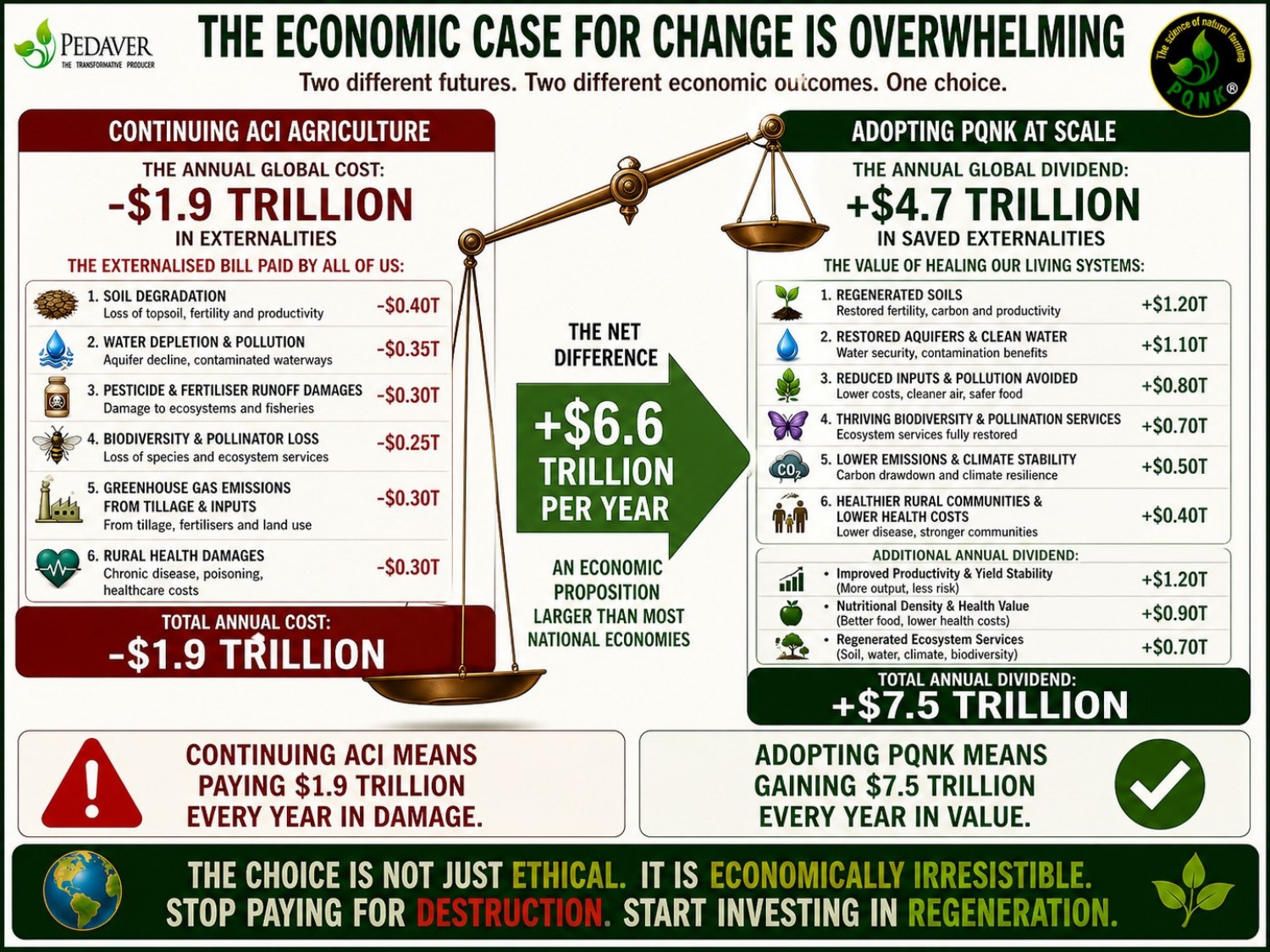
The policy frames biotechnology as the answer to a productivity problem. But productivity is only one dimension of what industrial chemical agriculture has damaged over more than a century and a half of commercial practice. The complete ledger is wider than the policy acknowledges.
Soil biology and structure. Every pass of a tillage implement collapses the fungal networks, bacterial colonies, protozoa, nematodes, and earthworm channels that constitute the soil's living architecture. Synthetic nitrogen, applied continuously, favours fast-metabolising bacteria that consume organic matter rather than build it. Soil organic matter in Pakistan's intensively farmed districts has fallen from natural baselines of 3 to 5 percent to measured averages below 0.5 percent across most irrigated areas. Below 0.2 percent, the Rhizobium bacteria that fix atmospheric nitrogen into plant-available form can no longer sustain viable colonies in the root zone. At that point, the crop becomes entirely dependent on purchased nitrogen. The dependency is not a farmer preference. It is a biological necessity that ACI created and that biotechnology is being asked to deepen.
Water systems. Flood irrigation saturates the soil profile, displaces oxygen, collapses aerobic biology, and deposits sodium salts with each watering cycle. Waterlogging and salinisation have rendered millions of hectares progressively less productive across Pakistan's Punjab and Sindh, and across every other flood-irrigated agricultural system in the world, from Egypt's Nile Delta to Mexico's Central Plateau to India's Indo-Gangetic Plain. The hardpan formed by tillage compounds this: rainfall cannot infiltrate. It runs off the surface. Groundwater aquifers that took millennia to fill are being drawn down at rates that exceed recharge by orders of magnitude. The water crisis is not a rainfall deficit. It is a soil structural collapse that ACI created and that a biotechnology policy cannot address.
Atmospheric carbon and climate. Every tillage operation releases stored soil carbon as carbon dioxide. The global soils under ACI management have released an estimated 130 to 150 billion tonnes of carbon since commercial synthetic fertiliser began reshaping agriculture in the mid-nineteenth century. The agricultural sector is simultaneously a major contributor to and a major victim of the resulting atmospheric imbalance. A PQNK bed moves in the opposite direction: it sequesters carbon actively, accumulating organic matter season after season, deepening the biological bank rather than drawing it down.
Biodiversity across every dimension. Commercial agriculture under ACI has contracted the world's cultivated food base from an estimated 7,000 to 8,000 plant species grown historically to fewer than 200 commercially significant species today, with four crops providing more than half of global caloric intake. This concentration is not a nutritional preference. It is a product of which crops respond most predictably to soluble nitrogen and tolerate mechanical harvest at scale. Pollinators, including bees, butterflies, and the broader insect community that enables reproduction of 75 percent of food crops, have declined catastrophically under neonicotinoid pesticide regimes that ACI monoculture requires. Mycorrhizal fungi, the networks that connect plants to mineral nutrition across entire fields, are eliminated by tillage and fungicide application. A PQNK polyculture system supports all of these simultaneously. The biotechnology policy's gene editing programme will produce plants designed to function in the absence of a system that ACI destroyed. PQNK restores the system.
Human nutrition. The nutritional content of commercially grown crops has declined measurably across every major nutrient category since systematic measurement began in the mid-twentieth century. Iron, zinc, calcium, magnesium, and vitamin C concentrations measured in wheat, rice, and vegetables in the 1950s are materially higher than those measured in the same crops from the same regions today. This is not primarily a variety effect. It is a soil biology effect. Plants obtain micronutrients from the complex exchange network of living soil organisms, not from soluble synthetic fertiliser. When the soil organisms are eliminated, the plant produces calories but not nutrition. The policy's stated goal of food and nutrition security cannot be achieved by engineering the plant to extract nutrients from a biologically dead soil that no longer contains them. The only durable path to nutritional security is the restoration of the soil biology that produces it.
Rural livelihoods and economic sovereignty. ACI requires purchased inputs every season: proprietary seed, synthetic fertiliser, pesticide, herbicide, and irrigation energy. The cost structure of this model has made smallholder farming progressively unviable across every country where it has been fully adopted. Pakistan's farm debt burden and the sustained rural-to-urban migration of the past three decades are not independent social phenomena. They are direct consequences of a production model that transfers value from the farmer to the input supply chain with each successive season. A biotechnology policy that deepens proprietary seed and agrochemical dependency accelerates this transfer. PQNK moves in the opposite direction: open-pollinated seed, zero external inputs after establishment, and compounding biological capital that belongs to the farmer and cannot be invoiced.
The policy's intention is to strengthen Pakistan's food system. The record of ACI across all of these dimensions suggests that the intervention point is not the gene. It is the system in which the gene operates. Restore the system, and the gene expresses its full biological potential without engineering.
The policy's reference to gene editing, genomic research, and genetically modified products follows the same logic: engineer the plant to compensate for the environment the plant is growing in. PQNK inverts this. Restore the environment, and the plant performs to its biological potential without engineering. The Amazon has produced 800 tonnes of biomass per hectare for four hundred million years without a single edited gene. The mechanism is not genetic. It is ecological.
There is one area where the policy's scope and PQNK principles can coexist without contradiction: plant tissue culture for the production of disease-free nursery material. Clean planting stock, particularly for sugarcane, potato, and fruit trees, addresses a real and legitimate constraint. This is biotechnology in service of biological farming, not as a replacement for it.
The Ministry is correct that agricultural biotechnology is changing farming practices globally. What the policy does not acknowledge is that in every country where the ecological alternative has been properly implemented, the case for biotechnology as a productivity solution has weakened rather than strengthened. The science Pakistan needs is not the science of engineering plants to survive a damaged environment. It is the science of restoring the environment so that plants, animals, and farmers thrive within it.
That science already exists. It is documented, field-tested, and producing results on Pakistani farms today. The Cabinet that approved this policy could, with the same stroke, commission a national adaptation of the ecological alternative. The comparison would be instructive.
——————————
Footnote:
Applying PQNK without understanding nature’s operating system will not deliver abundance, stability, or nutrient density.
PQNK (pronounced “picnic”)—the regenerative & sustainable Pristine Organic Farming System—is grounded in Natural Ecosystem Science. This science employs perennial biodiversity, protects soil with organic mulch, and avoids practices such as water inundation, tillage disturbance, and leaving soil bare.
It is the process that matters most. PQNK is a pristine production system designed not merely for yield, but for optimal, balanced output—where quality, sustainability, and ecological harmony emerge from a self‑regulated, zero‑external‑input methodology.
Connect & Resources Facebook: www.Facebook.Com/Pedaver YouTube (PQNK): https://www.youtube.com/@pedaverpqnk3167/videos YouTube: http://www.youtube.com/@aasifsharif PDF Knowledge Papers: https://drive.google.com/drive/folders/1iadwV6mdUPyrUIpB3oRfNv6DLiackaUL?usp=sharing Email: pedaver@gmail.com WhatsApp: +92 320 677 6666
About This Paper
- Crop
- Cotton · Wheat · Rice · Sugarcane · Potato
- Problem
- Named Pest Infestation (Bollworm, Fruit Fly, Nematode, etc.) · Soil Organic Matter / Carbon Loss · Saline / Alkaline / High-pH Soil · Beneficial Insect / Predator Decline · Declining Nutrient Density in Food · Farmer Income Instability / Debt
- Science
- Soil · Biodiversity · Nutrition · Climate · Water · Economics
- Evidence
- Philosophical/Framework Argument
- Authority
- Current / Approved PQNK Knowledge
Related PQNK Science
Key Takeaways
- Cites Pakistan's BT cotton history directly: introduced as a permanent solution to bollworm, it collapsed within eight seasons as the pink bollworm adapted, leaving a more expensive, more chemically dependent system in its place.
- Reports soil organic matter in Pakistan's intensively farmed districts falling from a 3 to 5 percent natural baseline to measured averages below 0.5 percent, with viable Rhizobium colonies unsustainable below 0.2 percent, forcing dependence on purchased nitrogen.
- Estimates 130 to 150 billion tonnes of carbon released globally from ACI-managed soils since the mid-nineteenth century, contrasted with PQNK beds actively sequestering carbon season over season.
- Cites the world's cultivated food base contracting from 7,000-8,000 historically grown species to fewer than 200 commercially significant ones, with four crops supplying over half of global caloric intake, alongside pollinator collapse affecting 75 percent of food crops.
- Argues measured iron, zinc, calcium, magnesium, and vitamin C in wheat, rice, and vegetables have declined materially since the 1950s in the same regions, attributed to soil biology loss rather than plant variety changes.
- Concedes one legitimate area of overlap between the policy and PQNK: plant tissue culture for disease-free nursery material in sugarcane, potato, and fruit trees.
Related Crops
Related Knowledge
same problem
What Science Delivered: The Documented Balance Sheet of a Century of Input-Funded Agricultural Research
Prompted by an online dismissal of scientific consensus, this paper turns the same skepticism on a century of input-industry-funded agricultural research and totals its documented balance sheet across soil, water, climate, cost, yield, food quality, and smallholder viability, using named published sources throughout and flagging PQNK's own field data separately wherever it appears.
same problem
Can High-TDS Water Be Used to Rehabilitate Saline Soils?
Conventional guidelines flag groundwater above 1,000-1,500 ppm TDS as unsuitable for irrigation, pushing farmers to abandon productive land. This paper argues the real determinant isn't the water's salt concentration but the soil's physical and biological capacity to keep those salts moving instead of accumulating in the root zone, backed by a crop-by-crop salt-load data table.
same crop
Five Decades of Agricultural Innovation: Interventions and Achievements in Chronological Order, 1973–2023
Asif Sharif's own year-by-year record of fifty years of hands-on agricultural intervention in Pakistan, from early machinery and seed distribution through the 2008 development of PQNK and its crop-by-crop expansion since, presented as the primary evidentiary record behind PQNK: a ground-up, farmer-verified track record rather than a journal citation.
same crop
Supplemental Knowledge Paper: Quantifying the Abundance
A data supplement to 'The Perpetual Abundance Principle' that extends its phosphorus, potassium, and nitrogen soil-bank-versus-crop-uptake ratios across six major subcontinental crops, wheat, rice, corn, potato, cotton, and sugarcane, showing the 'undeniable disparity' holds even for the heaviest feeders.