

KP-112 · PQNK Philosophy, Framework & Economics
What Science Delivered: The Documented Balance Sheet of a Century of Input-Funded Agricultural Research
Prompted by an online dismissal of scientific consensus, this paper turns the same skepticism on a century of input-industry-funded agricultural research and totals its documented balance sheet across soil, water, climate, cost, yield, food quality, and smallholder viability, using named published sources throughout and flagging PQNK's own field data separately wherever it appears.
Read or listen to the full paper ↓External Knowledge — this paper is sourced from outside Pedaver/PQNK. It is presented as supporting evidence, not as PQNK's own approved doctrine.
Abstract
The paper's trigger is small and specific: an online joke dismissing climate consensus as something scientists simply agree with whoever funds them. It sets that specific claim aside as unsupported, then asks a narrower, more answerable version of the same instinct: has a century of agricultural research, funded overwhelmingly through channels tied to tillage equipment, irrigation infrastructure, fertilizer, and pesticide sales, delivered what it promised, cheaper food, healthier soil, a stable climate, and a viable living for the people growing it? Every figure that follows is drawn from a named, published source, with claims resting on PQNK's own field observation marked as such at the point they are made.
On soil and climate, Punjab's average soil organic matter has fallen from an estimated 3-4% in 1960 to under 1% today; global topsoil loss has risen from roughly 15 billion to 24 billion tonnes a year, at an estimated annual cost of $400 billion (UNCCD); and agriculture's share of global greenhouse gas emissions has risen from 8-10% in 1960 to 24% today (IPCC, 2022), driven substantially by tillage-released soil carbon and nitrous oxide from synthetic nitrogen.
On cost and yield, US farm input costs (fertilizer, interest, overhead) rose more than 70% between 2007 and 2025 while crop prices fell, and nitrogen fertilizer hit a record high in April 2022, 26% above the previous 2008 record. Against that rising cost, a landmark 2012 analysis of 2.5 million census observations found yields stagnated or collapsed across 24-39% of the world's maize, rice, wheat, and soybean area, and a 2024 follow-up finds 84% of rice-growing area and 56% of wheat-growing area now sitting under 'ceiling pressure,' the stage immediately preceding stagnation.
On food quality and smallholder viability, a 2004 study of USDA nutrient composition data across 43 garden crops found statistically reliable declines between 1950 and 1999 in protein, calcium, phosphorus, iron, riboflavin, and vitamin C, most likely a dilution effect from crops bred for size and speed outpacing the soil's matching mineral supply; PQNK's own tracked wheat data shows a comparable pattern, current micronutrient density at roughly 50-75% of a 1960 baseline. Small farms under two hectares, 84% of the world's estimated 570 million farms, have persisted despite decades of consolidation predictions, but their margins have not: research across 55,000 African smallholdings found productivity declining 3.5% annually between 2008 and 2019.
Part Two turns to why the record looks this way: whose research questions got funded, the Green Revolution's foundational input-for-soil-restoration bargain, and why PQNK's self-funded, non-commercial status, not superior insight, is what let it pursue a different starting premise, one not required to keep an input industry's product necessary.
Full Paper
If you use “Listen”, the text of the page may be sent to your browser or operating system’s speech provider, such as Apple, Google or Microsoft, depending on the voice your device uses. Pedaver does not process, transmit or store any audio.
ABSTRACT
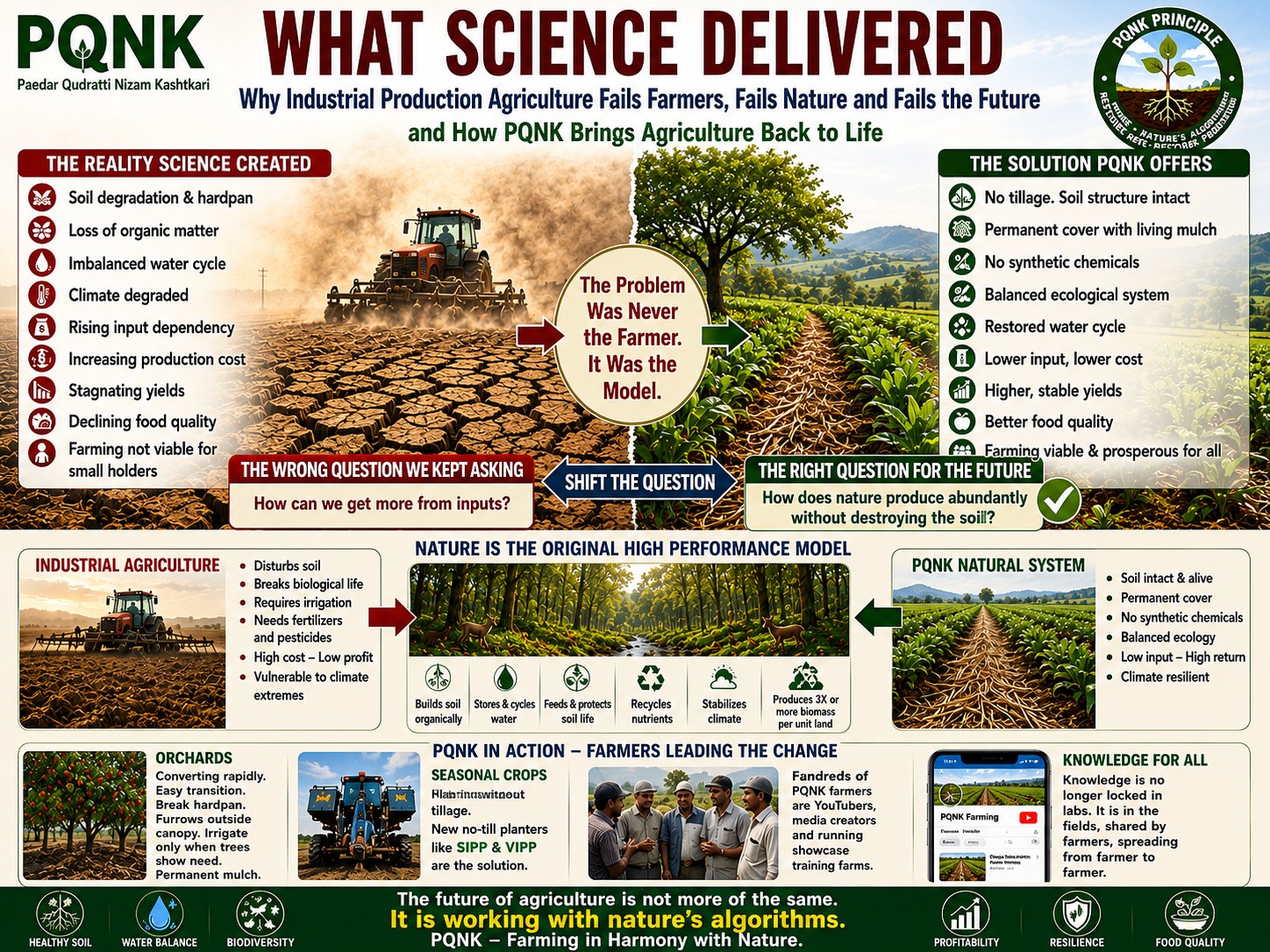
A recent exchange put a plain question on the table: if scientific consensus is dismissed as something that simply follows the funder, what, in documented fact, has the funded science of industrial production agriculture actually delivered? This paper answers that question directly, using published, citable data rather than assertion, and marks clearly the few places where the evidence is PQNK's own field observation rather than external research.
Across seven measurable dimensions, soil, water, climate, production cost, yield, food quality, and smallholder viability, the record of a century of agricultural research conducted under a funding structure dominated by input-supply interests is not a record of open inquiry into how natural systems sustain fertility. It is a record of engineering refinements around a fixed premise: that tillage, irrigation, and agrochemical inputs are the necessary starting point. We document what that record shows, trace the funding structure that produced it, and explain why PQNK, a self-funded, non-commercial research effort, was able to pursue a different starting premise entirely, not because its founders were more insightful than a century of agronomists, but because they were never required to find an answer that kept an input industry's product necessary.
PART ONE: THE RECORD
1. A QUESTION WORTH ANSWERING PLAINLY
The trigger for this paper was small: a joke, the kind that circulates online, dismissing the well-known finding that the overwhelming majority of climate scientists agree on human-caused warming with the line that scientists simply agree with whoever funds them. Read as a factual claim about that specific finding, it does not hold up; the consensus figure has been independently checked by more than one research team using different methods, and industry-funded doubt campaigns are a documented pattern working against an existing consensus, not evidence that the consensus itself was manufactured.
But a narrower, more specific version of the same instinct turns out to be worth taking seriously, applied not to climate science but to production agriculture. Has a century of agricultural research, funded overwhelmingly through channels tied to the sale of tillage equipment, irrigation infrastructure, synthetic fertiliser, and pesticide, delivered what it promised: cheaper food, healthier soil, a stable climate, and a viable living for the people growing it? That is a question with a documented answer, not a matter of opinion, and this paper sets out that answer plainly, dimension by dimension.
A note on method before the record itself. Every figure in Part One and Part Two below is drawn from a named, published source, cited in full at the end of this paper. Where a claim rests on PQNK's own field observation, protocol data, or programme experience rather than external research, it is marked as such at the point it is made. The two categories are not interchangeable, and this paper does not blur them.
2. SOIL: WHAT A CENTURY OF TILLAGE LEFT BEHIND
Tillage was taught, for a century, as the default first step of crop production, the near-universal starting instruction of agricultural extension and research curricula built up over the same decades that agricultural science became dependent on inputs it did not sell to farmers directly but validated the need for. The measurable result of that instruction is now well documented.
In Punjab, average soil organic matter has fallen from an estimated 3 to 4 percent in 1960 to under 1 percent across many areas today, the same collapse in the biological carbon base that everything else in this paper traces back to. Globally, topsoil loss has risen from an estimated 15 billion tonnes a year in 1960 to 24 billion tonnes a year today (FAO), and the United Nations Convention to Combat Desertification now puts the annual global cost of soil degradation at approximately $400 billion (UNCCD). None of this happened by accident or by natural climatic drift; it happened under continuous cultivation, using methods actively recommended by the same research and extension system this paper traces the funding of in Part Two.
3. WATER: THE CYCLE MODERN AGRICULTURE BROKE
The companion PQNK Knowledge Paper, The Underground Air, sets out in full mechanical detail why flood irrigation delivered onto a tillage-compacted, hardpan-bound soil traps the majority of applied water in a shallow, evaporation-exposed layer rather than banking it safely below the reach of the sun. The consequence of applying that method at scale for decades is visible in the water table record.
In Punjab, the water table has fallen from an estimated 6 to 10 metres in 1960 to more than 100 to 200 metres in some areas today. Globally, NASA's GRACE satellite gravity data shows 21 of the world's 37 largest aquifers now in deficit, up from an estimated 6 to 8 in 1960. Flood irrigation, the method a century of tillage-dependent agronomy standardised, is not a neutral input choice; it is a primary driver of the depletion this section documents.
4. CLIMATE: FROM MINOR CONTRIBUTOR TO MAJOR DRIVER
Agriculture's own contribution to the problem it is now expected to help solve has grown, not shrunk, across the same period. An estimated 8 to 10 percent of global greenhouse gas emissions were attributable to agriculture in 1960; the IPCC's 2022 assessment puts that figure at 24 percent today, driven substantially by soil carbon release from tillage and nitrous oxide from synthetic nitrogen fertiliser, both practices a century of input-aligned agricultural science actively promoted rather than questioned.
5. COST: RISING INPUTS, FALLING MARGINS
Whatever else the input-intensive model delivered, it did not deliver falling costs to the farmer applying it. Between 2007 and 2025, the cost of fertiliser, interest, and general farm overhead rose more than 70 percent in the United States; seed, chemicals, hired labour, taxes and insurance, machinery, and land more than doubled; custom services and repairs more than tripled (farmdoc daily, University of Illinois). Nitrogen fertiliser prices hit a record high in April 2022, 26 percent above the previous record set in September 2008. US farm sector production expenses rose by a further $26.2 billion, 6.0 percent, in a single year between 2022 and 2023 (Congressional Research Service, 2025).
The American Farm Bureau Federation's own market reporting describes the result plainly: crop prices declining while production expenses remain high, margins squeezed to the point where breaking even is unachievable for many operations. This is not a claim from outside agriculture. It is the trade organisation representing American farmers describing the economics its own members face under the model a century of research was funded to refine.
6. YIELD: THE PLATEAU NOBODY ADVERTISES
Rising cost would be easier to defend against rising output. It has not been matched by one. A landmark analysis of roughly 2.5 million census observations across 1961 to 2008 found that across 24 to 39 percent of the world's maize, rice, wheat, and soybean growing area, yields either never improved, stagnated, or collapsed outright (Ray, Ramankutty, Mueller, West, & Foley, 2012). A more recent, spatially explicit follow-up extending the analysis through 2010 confirms the pattern has not reversed: yield gaps have widened steadily across most cropped area for eight of the ten major crops studied, and 84 percent of rice-growing area and 56 percent of wheat-growing area now sit under what the researchers call ceiling pressure, the stage immediately preceding stagnation (Gerber et al., 2024).
Specific regions illustrate the pattern concretely. Western European wheat yields plateaued at 8 to 9 tonnes per hectare by the late 1990s. South Asian rice yields have stagnated around 4.2 tonnes per hectare since 2010. France now accounts for stagnation across 79 percent of its harvested wheat area; China, 79 percent of its harvested rice area; India, 70 percent of its harvested rice area (Ray et al., 2012; Gerber et al., 2024).
Put Sections 5 and 6 side by side and the shape of the problem becomes unmistakable. The input bill kept rising for four decades while the output it was meant to secure flattened out across roughly a third of the world's most important cropland. That combination, rising cost purchasing flat or falling return, is the textbook definition of diminishing returns on a fixed technological premise, not evidence of a system still delivering on its original promise.
7. FOOD QUALITY: MORE FOOD, LESS NUTRITION
A landmark comparison of USDA nutrient composition data for 43 garden crops found statistically reliable declines between 1950 and 1999 in six nutrients: protein, calcium, phosphorus, iron, riboflavin, and vitamin C (Davis, Epp, & Riordan, 2004). The most likely mechanism the study's authors identify is a dilution effect: crops bred for higher yield and larger size grow faster and bigger than their 1950 counterparts, but the plant's capacity to draw minerals from the soil at a matching rate did not increase alongside it, so the same-sized serving now carries less of what it used to. PQNK's own tracked wheat data shows a comparable pattern, current micronutrient density running at roughly 50 to 75 percent of a 1960 baseline (PQNK field data).
This is worth stating precisely: the input-intensive model has, on its own terms, succeeded at producing more food. It has done so partly by producing less nutritious food per unit of that increased volume, an outcome consistent with a research agenda optimised for yield and shelf appearance rather than for the nutrient density a farmer's own soil, left biologically active, would otherwise support.
8. THE SMALLHOLDER SQUEEZE
The honest picture here is more precise than smallholder farming has simply become unviable. Small farms under two hectares, roughly 84 percent of the world's estimated 570 million farms, have persisted, and in places increased in number, despite decades of predictions that consolidation would sweep them away (Lowder, Bhalla, & Davis, 2025). What has not persisted is their margin. Research tracking 55,000 smallholder farms across six African countries found productivity declining 3.5 percent annually between 2008 and 2019, and the same profitability squeeze between rising input costs and flat or falling commodity prices documented in Section 5 for large American operations shows up in that research from Sub-Saharan Africa to the American Midwest alike.
A further finding cuts directly against the assumption that bigger, more input-intensive operations are simply more efficient: where small-scale farmers have adequate access to land, water, credit, and equipment, their productivity per hectare is higher than large intensive farming systems (Global Agriculture). The constraint on smallholder viability, in other words, is not farm size. It is access to resources within a cost structure built around continuous input purchase, precisely the structure Part Two traces the origin of.
The Balance Sheet
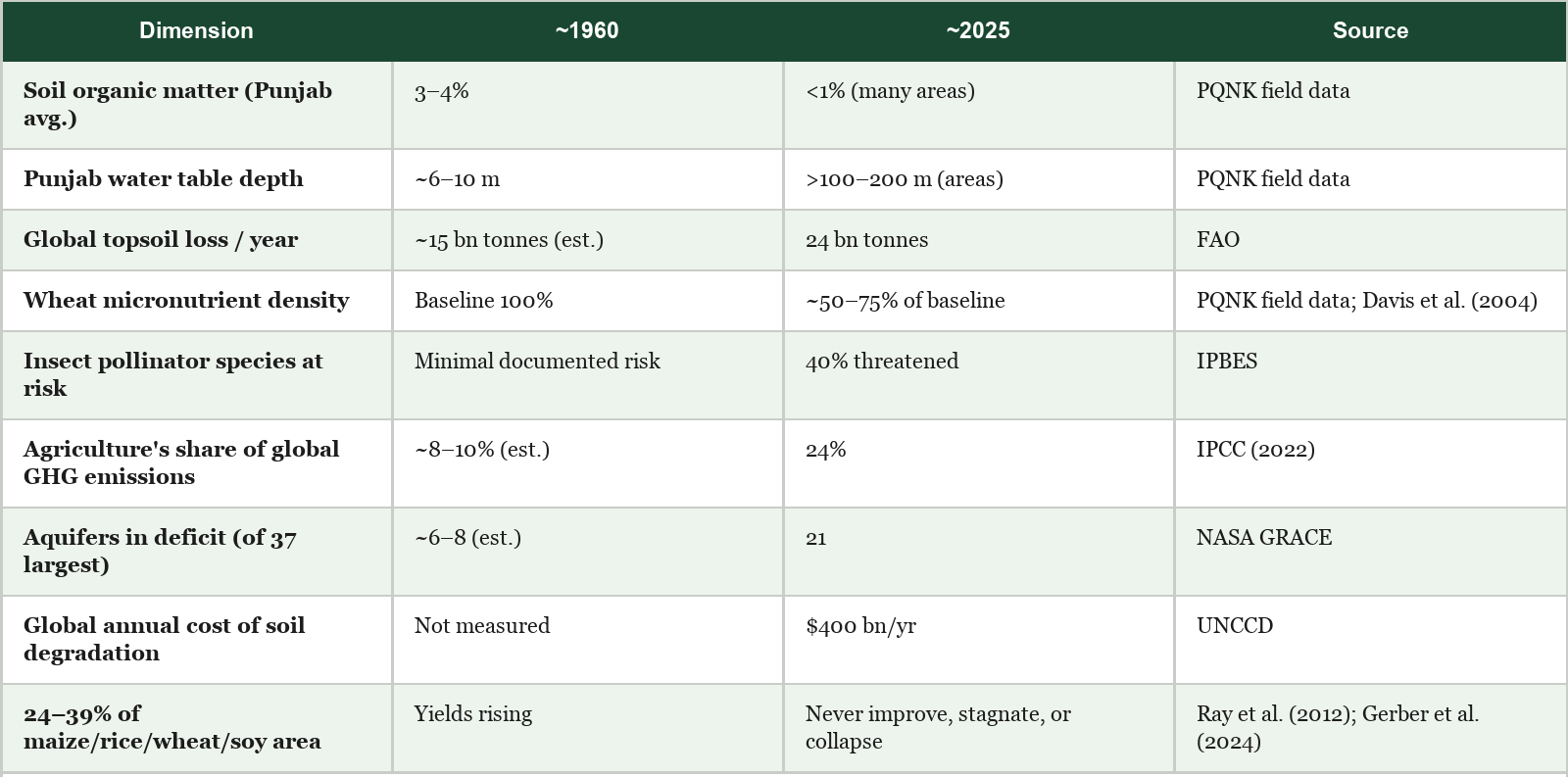
| Dimension | ~1960 | ~2025 | Source |
|---|---|---|---|
| Soil organic matter (Punjab avg.) | 3–4% | <1% (many areas) | PQNK field data |
| Punjab water table depth | ~6–10 m | >100–200 m (areas) | PQNK field data |
| Global topsoil loss / year | ~15 bn tonnes (est.) | 24 bn tonnes | FAO |
| Wheat micronutrient density | Baseline 100% | ~50–75% of baseline | PQNK field data; Davis et al. (2004) |
| Insect pollinator species at risk | Minimal documented risk | 40% threatened | IPBES |
| Agriculture's share of global GHG emissions | ~8–10% (est.) | 24% | IPCC (2022) |
| Aquifers in deficit (of 37 largest) | ~6–8 (est.) | 21 | NASA GRACE |
| Global annual cost of soil degradation | Not measured | $400 bn/yr | UNCCD |
| 24–39% of maize/rice/wheat/soy area | Yields rising | Never improve, stagnate, or collapse | Ray et al. (2012); Gerber et al. (2024) |
PART TWO: WHY THE RECORD LOOKS LIKE THIS
9. WHOSE QUESTIONS GOT FUNDED
The record in Part One is not an accident of insufficient scientific effort. It is a predictable outcome of who paid for the effort that was made. In the United States, public funding covered roughly half of agricultural research and development spending between 1970 and 2008; by 2014 that share had fallen below 30 percent, with private industry money filling the gap (Congressional Research Service, 2024). The 1980 Bayh-Dole Act accelerated this shift deliberately, encouraging universities to license research to private industry partners, which in turn gave university administrators and researchers a direct financial incentive to keep their findings useful to the companies funding them.
The consequence is well documented in the academic literature on research integrity, not merely alleged by critics outside it: corporate funding shifts the public research agenda toward the ambitions of the funder, whose profit motive is frequently at odds with the public interest the research nominally serves, and industry-funded studies routinely produce findings favourable to the industry funding them, a pattern academic reviews describe as well documented rather than speculative (Civil Eats, 2012; The Counter). Faculty at land-grant universities report direct pressure to shape their research toward the interests of the agribusiness funders paying for it.
10. THE GREEN REVOLUTION'S FOUNDATIONAL BARGAIN
The pattern above intensified after 1980, but its roots are older. The Rockefeller Foundation invested an estimated $600 million over fifty years building the international research infrastructure of the Green Revolution, joined from 1961 by the Ford Foundation, together establishing the International Rice Research Institute and the International Maize and Wheat Improvement Center. Both foundations had close ties to industrial corporations, and the varieties this infrastructure bred were high-yielding specifically because they were bred to respond to synthetic fertiliser and reliable irrigation, not because they were bred to perform well without either.
This was, in its own historical context, a genuine and partially successful attempt to prevent famine, and this paper does not dispute that. But it built input dependency into the genetics of the crop itself, at the exact historical moment when the funding structure described in Section 9 was also beginning to concentrate research attention on refining those same inputs. Agroecology researchers, particularly in Africa, have argued for decades that the resulting model entrenches reliance on purchased inputs at the expense of practices built around the ecological knowledge already present in the farming systems it replaced, a concern still active in current debates over how agricultural development funding should be allocated.
11. A RECOGNISED PATTERN, NOT A NEW ONE
It is worth being precise about what can and cannot be claimed here. There is a well-documented historical playbook, laid out with the industry's own internal documents by historians Naomi Oreskes and Erik Conway, in which an industry facing scientific findings that threaten its product funds an alternative body of research specifically to manufacture public doubt: the tobacco industry directed research funding several times larger than the American Cancer Society's own budget toward researchers who consistently failed to find a conclusive link between smoking and cancer, and reused the identical strategy on acid rain, ozone depletion, secondhand smoke, and climate change (Oreskes & Conway, 2010).
This paper does not claim to have found an equivalent internal-memo trail proving that agricultural research into ecological, no-till, or input-free systems was deliberately underfunded as a distraction. That would be a stronger claim than the evidence assembled here supports. What can be said, and is supported directly by Sections 9 and 10, is the structural precondition that made such a pattern possible elsewhere: a funding system in which the parties paying for research have a direct financial stake in a specific answer. Whether that produces active suppression or simple, unremarkable neglect, chronic underfunding of the alternative rather than a conspiracy against it, the visible effect on which paradigm gets developed and which does not is the same either way.
12. WHAT WAS NEVER PROPERLY TRIED
It would overstate the case to say no one studied how natural systems sustain fertility without external inputs. Ecology as a discipline, soil science outside its input-testing applications, agroecology, and generations of indigenous and traditional farming knowledge all did exactly that, in some cases for far longer than industrial agriculture has existed. Masanobu Fukuoka published a fully realised no-till, no-input rice and grain system in Japan decades before this paper was written (Fukuoka, 1978).
What these efforts did not receive, consistently, was the funding, institutional backing, and engineering investment that industrial agriculture's inputs received across the same decades. The honest claim is therefore not that natural-systems agriculture went unstudied. It is that it was studied by individuals and small movements working with a fraction of the resources directed at the input-intensive alternative, and was never funded to the point of being engineered into a mechanised, field-deployable, commercial-scale system. That gap, not a gap in insight, is what Part Three addresses.
PART THREE: WHAT AN UNFUNDED ALTERNATIVE BUILT INSTEAD
13. STANDING OUTSIDE THE SYSTEM: WHY SELF-FUNDING MATTERED
Section 9 establishes a simple structural fact: a research system funded predominantly through channels tied to input sales has no institutional incentive to fund a conclusive demonstration that those inputs are unnecessary. This is not a claim about the motives of any individual scientist, most of whom work honestly within the questions their funding allows them to ask. It is a claim about which questions get asked at all.
PQNK's founding condition, a self-funded, non-commercial research effort with no product to sell and no revenue model tied to input volume, removes that structural constraint entirely. This is offered here as an explanation, not a boast: it explains why an input-free, zero-external-input production system could be developed and tested to field scale outside universities that, per Section 9's own documented funding structure, would have had little institutional appetite to fund the same question.
14. NOT THE FIRST TO SEE IT, BUT THE FIRST TO ENGINEER IT
PQNK does not claim to be the first to recognise that agriculture could work with natural processes rather than override them. Fukuoka's natural farming demonstrated a no-till, no-input grain system decades earlier (Fukuoka, 1978). Subhash Palekar's Zero Budget Natural Farming movement has, since the 1990s, spread a comparable input-free philosophy across millions of farms in India. Ernst Götsch's syntropic agroforestry work in Brazil has, over four decades, demonstrated that degraded land can be returned to high-yield, multi-strata production without external chemical input. Each of these efforts is a genuine, serious precedent, and PQNK's own companion Knowledge Paper, The Missing Synthesis, sets out that lineage in full.
What distinguishes PQNK's contribution from these precedents is not the founding insight, which it shares with all three, but the engineering built around it: the raised-bed water:air gradient architecture described in The Underground Air, and the SIPP and VIPP precision-planting machinery described in the companion paper Every Seed Should Have an Address, together turning a philosophy and a set of smallholder practices into a mechanised, field-deployable system that a commercial-scale farm can adopt in a defined transition sequence. That synthesis, not priority of insight, is the claim this paper is willing to defend.
15. THE GROUND-UP THRESHOLD
The following figures describe PQNK's own programme experience and are marked as such; they are not externally audited statistics. Universities and public research institutions have shown limited appetite to engage with PQNK directly, consistent with the funding structure Section 9 documents, so PQNK's growth has been built farmer to farmer rather than through institutional validation.
By PQNK's own tracking, adoption is now approaching what the programme considers a threshold level of self-sustaining growth, driven in large part by the economics documented in Sections 5 and 6: industrial crop production is becoming less reliably profitable at the same time as PQNK's input-free protocol removes the cost side of that equation entirely. A growing number of practising PQNK farms now operate as informal showcase and training sites for neighbouring farmers, and, by PQNK's own count, several hundred PQNK farmers have become independent YouTubers and media creators documenting their own conversions, a distribution channel that exists entirely outside the peer-review and extension-service system described in Sections 9 through 11.
16. ORCHARDS FIRST: WHY PERENNIAL SYSTEMS CONVERT FASTER THAN SEASONAL CROPS
Adoption has not been uniform across crop types, and the reason is mechanical rather than a reflection of doubt about the system. Orchard conversion is comparatively simple: break the hardpan once, cut furrows outside the canopy line of the existing trees, apply water in those furrows only when the plant shows afternoon wilting, and stop cultivating entirely, allowing volunteer weed growth to form a permanent living mulch cover. None of this requires specialised planting machinery, because the trees are already established.
Seasonal, row-planted crops face a harder conversion, for a specific and identifiable reason: precision no-till planting through an established mulch layer requires the SIPP or VIPP planters described in Every Seed Should Have an Address, and most transitioning farmers do not yet own one. This is the same machinery-availability constraint that paper documents in detail, not a limitation of the underlying biological system. It is, in effect, one further way in which the input-equipment economy described in Part Two shapes which parts of PQNK spread fastest: perennial systems that need no new machinery convert first; systems that do need it convert only as fast as that machinery reaches the farmers who need it.
17. THE TRUTH FOR FARMERS
Set plainly, without the qualifying language a peer-reviewed journal would insist on and this paper has otherwise tried to use carefully: a century of agricultural science, funded overwhelmingly by the companies selling tillage, irrigation, and agrochemical inputs, delivered thinner soil, a broken water table, a larger share of global emissions, a rising cost of production, a yield curve that has flattened across a third of the world's most important cropland, food with measurably less of some nutrients than it had seventy years ago, and a profit margin for the smallholder that keeps shrinking regardless of how hard that smallholder works. Every figure behind that sentence is cited above, from named, published sources.
None of this required a conspiracy to happen. It required only a research and funding system in which the people paying for the answers had a financial stake in one particular answer, repeated across enough decades that the alternative was never funded to the point of being engineered into something a working farm could actually adopt. PQNK exists because it was built outside that funding system, not because its founders discovered something no one else had ever noticed.
The adoption now under way, farm by farm, farmer to farmer, without waiting for a university's endorsement, is not happening because a marketing campaign convinced anyone of anything. It is happening because the economics documented in this paper's own balance sheet have made the input-intensive alternative harder to justify every season that passes, and because a different starting premise, tested first as philosophy by others and then engineered to field scale by PQNK, is now visibly working in the same fields where the old premise is visibly failing.
We do not ask farmers to trust a new authority. We ask them to compare a documented balance sheet against the field in front of them, and to decide for themselves which one is telling the truth.
REFERENCES
American Farm Bureau Federation. Declining Farm Economy Continues to Pressure Profitability. Market Intel.
Civil Eats. (2012). The Corporate Hijacking of America's Land-Grant Universities.
Congressional Research Service. (2024). The U.S. Land-Grant University System: Overview and Role in Agricultural Research. CRS Report R45897.
Congressional Research Service. (2025). 2023 and 2024 Farm Sector Profitability: Issues for Congress. CRS Report R48278.
Davis, D. R., Epp, M. D., & Riordan, H. D. (2004). Changes in USDA food composition data for 43 garden crops, 1950 to 1999. Journal of the American College of Nutrition, 23(6), 669-682.
farmdoc daily, University of Illinois. (2023). Update on Growth Rates of Fertilizer, Pesticide and Seed Costs Over Time.
Food and Agriculture Organization of the United Nations (FAO). Global topsoil loss estimates.
Fukuoka, M. (1978). The One-Straw Revolution: An Introduction to Natural Farming. Rodale Press.
Gerber, J. S., Ray, D. K., Makowski, D., Butler, E. E., Mueller, N. D., West, P. C., et al. (2024). Global spatially explicit yield gap time trends reveal regions at risk of future crop yield stagnation. Nature Food, 5(2), 125-135.
Global Agriculture (globalagriculture.org). Industrial Agriculture and Small-scale Farming.
HistPhil. (2016). The Green Revolution as Philanthropy.
Intergovernmental Panel on Climate Change (IPCC). (2022). Sixth Assessment Report, Working Group III: Mitigation of Climate Change.
Intergovernmental Science-Policy Platform on Biodiversity and Ecosystem Services (IPBES). Pollinator species at risk assessment.
Lowder, S., Bhalla, G., & Davis, B. (2025). Decreasing farm sizes and the viability of smallholder farmers: Implications for resilient and inclusive rural transformation. Global Food Security.
NASA GRACE (Gravity Recovery and Climate Experiment). Global aquifer deficit data.
Oreskes, N., & Conway, E. M. (2010). Merchants of Doubt: How a Handful of Scientists Obscured the Truth on Issues from Tobacco Smoke to Global Warming. Bloomsbury Press.
PQNK Team. (2026). Engineering a Perpetual Abundance Machine.
PQNK Team. (2026). Every Seed Should Have an Address: From Excessive Seeding to Precision Plant Establishment.
PQNK Team. (2026). The Missing Synthesis.
PQNK Team. (2026). The Underground Air.
Ray, D., Ramankutty, N., Mueller, N. D., West, P. C., & Foley, J. A. (2012). Recent patterns of crop yield growth and stagnation. Nature Communications, 3, 1293.
The Counter. Academics across the country say agribusiness has outsize influence on their research.
United Nations Convention to Combat Desertification (UNCCD). Global annual cost of soil degradation estimate.
U.S. Right to Know. African groups want Gates Foundation, USAID to shift agricultural funding as hunger crisis worsens.
Washington State University, Center for Sustaining Agriculture and Natural Resources. Follow the Energy: How Cropping Systems Fundamentally Differ From Natural Systems.
PQNK — Paedar Qudratti Nizam Kashatqari
Connect & Resources
Facebook: www.Facebook.Com/Pedaver
YouTube (PQNK): https://www.youtube.com/@pedaverpqnk3167/videos
YouTube: http://www.youtube.com/@aasifsharif
PDF Knowledge Papers: https://drive.google.com/drive/folders/1iadwV6mdUPyrUIpB3oRfNv6DLiackaUL?usp=sharing
Email: pedaver@gmail.com
WhatsApp: +92 320 677 6666
About This Paper
- Crop
- Maize (Corn) · Rice · Wheat · Soybean
- Problem
- Soil Organic Matter / Carbon Loss · Price Volatility / Market Glut · Yield Stagnation / Decline · Declining Nutrient Density in Food · Farmer Income Instability / Debt
- Science
- Soil · Climate · Nutrition · Food Quality · Economics
- Evidence
- External Scientific Evidence
- Authority
- External Knowledge / Evidence
Related PQNK Science
Key Takeaways
- Punjab soil organic matter has fallen from an estimated 3-4% in 1960 to under 1% today; global topsoil loss has risen from 15 billion to 24 billion tonnes a year, costing an estimated $400 billion annually (UNCCD).
- Agriculture's share of global greenhouse gas emissions has risen from roughly 8-10% in 1960 to 24% today (IPCC, 2022), driven substantially by tillage-released soil carbon and synthetic-nitrogen nitrous oxide.
- A landmark 2012 analysis of 2.5 million census observations found yields stagnated or collapsed across 24-39% of the world's maize, rice, wheat, and soybean area; a 2024 follow-up finds 84% of rice area and 56% of wheat area now under 'ceiling pressure.'
- A 2004 USDA-data study found statistically reliable nutrient declines across 43 garden crops between 1950 and 1999 in protein, calcium, phosphorus, iron, riboflavin, and vitamin C; PQNK's own tracked wheat data shows current micronutrient density at roughly 50-75% of a 1960 baseline.
- US farm input costs rose over 70% between 2007 and 2025 while crop prices fell; small farms under two hectares, 84% of the world's ~570 million farms, have persisted in number but seen productivity fall 3.5% a year across 55,000 African smallholdings tracked 2008-2019.
- Argues PQNK's self-funded, non-commercial status, not superior insight, is what let it pursue soil restoration as a starting premise rather than treat an input industry's product as a fixed constraint.
Related Knowledge
same problem
Pakistan's Agricultural Biotechnology Policy 2025: The Right Intention, The Wrong Diagnosis
A formal PQNK response to Pakistan's Federal Cabinet-approved National Agricultural Biotechnology Policy 2025, arguing the BT cotton experiment already proved that engineering the plant to compensate for a damaged environment fails within years, and that the real intervention point is restoring the soil biology and water systems the policy leaves untouched.
same problem
Transforming Wheat Production through the Paedar Qudratti Nizam Kashatqari (PQNK)
Conventional wheat farming is locked into a cycle of high input costs and stagnant yields around 30 maunds per acre. This paper lays out the PQNK cost and revenue model for wheat, comparing it head-to-head against the conventional system and projecting the foreign exchange impact of national-scale adoption.
same problem
PQNK Knowledge Paper: The Twofold Art of Pruning as Compensatory Grazing
With grazing animals absent, plants read the lack of browsing pressure as a sign their foliage isn't wanted and pour energy into ever more vegetative growth instead of fruit. This paper sets out a two-phase pruning protocol, formative and reproductive, standing in for that missing herd, with a detailed crop-by-crop benchmark table and a full sugarcane case study covering two distinct harvest strategies.
same problem
The Farmers' Crisis Will Not Be Solved by Another Support Price: Why Pakistan's Farmers Must Reduce Cost, Improve Quality and Build Independence Through PQNK
A nationwide farmers' association's press conference voiced real distress over diesel, fertiliser, wheat and sugarcane policy, and the danger that one failed crop leaves a farmer unable to finance the next. This paper argues that distress is real but the standard remedy, another support price or subsidy, cannot be the permanent foundation of farm viability, because it exchanges biological dependence for political dependence. PQNK reframes the question: since a farmer cannot control the market price, government policy, rainfall or the exchange rate, his strongest and most durable defence is progressively lowering his own cost of production by restoring the soil's biological functions, while building resilience to climate shocks and competing through demonstrable produce quality.