

KP-072 · Plant Physiology & Production Systems
PQNK Knowledge Paper: The Twofold Art of Pruning as Compensatory Grazing
With grazing animals absent, plants read the lack of browsing pressure as a sign their foliage isn't wanted and pour energy into ever more vegetative growth instead of fruit. This paper sets out a two-phase pruning protocol, formative and reproductive, standing in for that missing herd, with a detailed crop-by-crop benchmark table and a full sugarcane case study covering two distinct harvest strategies.
Read or listen to the full paper ↓Abstract
The paper's opening premise is that a plant is a 'generous engine' designed to produce far more foliage than it needs for itself, surplus meant to sustain the wider food web of microbes, insects, grazers, and pollinators. Under PQNK's optimized soil conditions, high organic matter, active microbial life, and protective mulch, that generosity persists, but the paper identifies a specific gap: the constant, gentle grazing pressure from wild animals that would normally confirm to the plant its surplus is being used. Without it, the plant reads the absence of grazing as a signal its offering isn't good enough, and diverts more Life Force into excess vegetative growth rather than into seed and fruit.
The proposed fix, Strategic Leaf Harmonization, is explicitly twofold. Formative pruning, applied when plants are young, mirrors light early grazing that stimulates tillering in grasses like wheat and rice and a stronger, more open branching architecture in shrubs and trees, telling the plant to 'become stronger' on a secure foundation. Reproductive pruning, applied later as the plant transitions toward flowering and fruiting, simulates a larger but non-lethal grazing event that signals the plant's foliage duty is fulfilled and its energy should now go toward reproductive legacy.
Sugarcane receives the paper's most detailed treatment as what it calls a paradigm case, presenting two deliberate management paths from the same crop. In the 'cut-and-multiply' model for mill delivery, the farmer physically removes the mother shoot once enough secondary tillers have initiated, breaking apical dominance so the plant redirects Life Force uniformly across all remaining tillers, producing a synchronized cohort (the paper cites up to 12x multiplication from roughly 4,000 setts to 50,000 stalks) suited to a single mechanical harvest. In the 'sustained-yield' model for jaggery or fresh juice, the mother shoot is preserved like a bamboo grove's central structure, apical dominance is maintained, and individual mature canes are harvested continuously over multiple years from the same rootstock.
A detailed benchmark table maps formative and reproductive pruning specifics across cereal grasses, stout staple crops like maize, sugarcane, indeterminate vining crops, leafy greens, tuber crops, and shrubby crops, each with a stated physiological goal, for example clipping wheat at 15-20cm to stimulate tillering, removing the lowest 25-35% of maize canopy before tasseling to divert energy to grain fill, or cutting back potato foliage after tuber bulking begins to stop vine growth and concentrate energy in the tubers.
It closes with four 'Golden Rules': never remove more than 30% of living foliage at once, prioritize removing the oldest and lowest-priority leaves first, time pruning to dry, cool parts of the day, and treat the plant's own response, vigorous regrowth versus stunting, as the ultimate guide for whether the intervention was correctly calibrated.
Full Paper
If you use “Listen”, the text of the page may be sent to your browser or operating system’s speech provider, such as Apple, Google or Microsoft, depending on the voice your device uses. Pedaver does not process, transmit or store any audio.
Subject: Establishing the Principle and Preliminary Benchmark for Foliar Management within the Paedar Qudratti Nizam Kashatqari (PQNK)
Date: 15 November 2025

1.0 Preamble: The Plant as a Generous Engine
Within the PQNK framework, we recognize a fundamental truth: a plant is not an isolated production unit. It is a generous engine of the food web, designed by nature to absorb atmospheric energy and geological minerals, converting them into an abundance of food that far exceeds its own needs. This surplus sustains the entire Qudratti Nizam—the soil microbes, the insects, the grazers, the pollinators, and finally, the dependent species that consume its fruit. Our historical error was the domestication and caging of this generous engine, isolating it from the dynamic dance of the ecosystem it was designed to fuel.
2.0 The PQNK Paradox: Perfect Conditions, Missing Partners
Under PQNK, we have masterfully recreated the ideal conditions for provision and protection:
Optimized Soil System: High organic matter, thriving microbial life, perfect aeration, and stable temperature.
SMM (Soil Moisture Management): Effective water conservation in permanent raised beds.
Protection: Elimination of agrochemicals and tillage, with soil kept under a protective blanket of organic mulch.
However, we have missed a crucial ecological force: the stamping, grazing, pruning, pinching, and bruising by wild animals. In a pristine ecosystem, this constant, gentle pressure is a form of communication. It tells the plant that its surplus foliage is being effectively utilized. Without this feedback, the plant, in its innate generosity, perceives its foliage as inadequate. It interprets the lack of grazing as a signal that the ecosystem's demand for fodder is not being met or that its offering is not good enough in look, color, smell, and taste. This is why no one comes for grazing.
Consequently, it diverts a massive portion of its Life Force into excessive and often less nutritious vegetative growth, compromising its energy for the final produce—the seeds and fruits we depend upon.
3.0 The Twofold Path of Strategic Leaf Harmonization
Therefore, the PQNK farmer must step into the role of the missing keystone species. Our intervention, Strategic Leaf Harmonization, is a conscious, twofold simulation of natural grazing pressures, each with a distinct purpose.
3.1 Phase One: Formative Pruning (The Encouragement of Community)
This initial intervention, applied when plants are young, mirrors the early, light grazing that stimulates robust growth. As detailed in our paper "The Philosophy of the 'Central Leader'," the goal is not to reduce the plant, but to encourage it. By gently removing the apical dominance or making strategic cuts, we signal the plant to become bushier, sturdier, and more collaborative within its own structure.
In Grasses (Wheat, Rice): This is the practice of early grazing or "cutting back" to stimulate tillering. The plant responds by producing more stems, creating a denser, more productive community from a single seed.
In Shrubs and Trees: This is the principle of shaping a strong, open architecture that can bear heavy fruit loads and resist disease.
This phase tells the plant: "Become stronger. Your foundation is secure; now build a thriving community."
3.2 Phase Two: Reproductive Pruning (The Directive towards Legacy)
This second intervention occurs later in the plant's life cycle, typically as it transitions from vegetative growth to reproduction. It simulates a more significant, but non-lethal, grazing event that redirects the plant's priorities.
This practice sends a clear signal: "Your surplus has been received. The community is fed and strong. You have fulfilled your duty of foliage; now, invest your supreme energy into your reproductive legacy—the fruit and the seed."
3.3 Sugarcane: A Paradigm Case of Strategic Energy Management
Sugarcane stands as a supreme example of the PQNK pruning philosophy, where the farmer's intervention is strategically tailored to the final harvest goal. The system moves beyond mere facilitation to active, intelligent guidance.
The Core Principle: The "mother shoot" or primary tiller exhibits apical dominance, suppressing the growth of younger, secondary tillers. The PQNK practitioner must decide whether to maintain or break this dominance based on the desired outcome.
Option One: Single Harvest for the Sugar Mill (The "Cut-and-Multiply" Model)
Objective: To produce a single, massive harvest where the majority of stalks are mature, thick, and millable simultaneously.
The Intervention: The farmer performs a precise, physical pruning cut to remove the mother shoot once a sufficient number of secondary tillers have initiated.
The Physiological Outcome: This decisive act breaks apical dominance. The hormonal signal to suppress subordinate tillers is removed. The plant, sensing the loss of its primary leader, redirects the Life Force uniformly to all remaining tillers. This results in a synchronized cohort of stalks that develop evenly, ensuring that a high percentage (e.g., from 4,000 setts to 50,000 stalks) become millable canes of uniform height and girth, ideal for a single mechanical harvest for the sugar mill.
Option Two: Continuous Harvest for Jaggery or Juice (The "Sustained-Yield" Model)
Objective: To establish a perennial stand for continuous, year-round harvesting of individual mature canes for fresh juice or jaggery production.
The Intervention: The farmer does not cut the mother shoot. The plant is managed like a bamboo grove, where the central, mature structure is preserved.
The Physiological Outcome: Apical dominance is maintained, creating a natural succession of growth. The mother shoot and early tillers mature first and are harvested individually. This continuous removal of mature "poles" (canes) naturally reduces competition for light and resources, allowing for a continuous cycle of new tiller generation and maturation from the same rootstock. This model provides a sustained yield over multiple years from a single planting.
The PQNK Foundation: Both models are built upon the foundational PQNK system, which provides the "energetic facilitation" of optimal soil, moisture, and mulch to support the chosen strategy, whether for explosive, synchronized growth or for long-term, sustained productivity.
4.0 Preliminary PQNK Benchmark for Twofold Foliar Management
The following table provides a preliminary guideline for these two distinct phases of pruning across key crops.
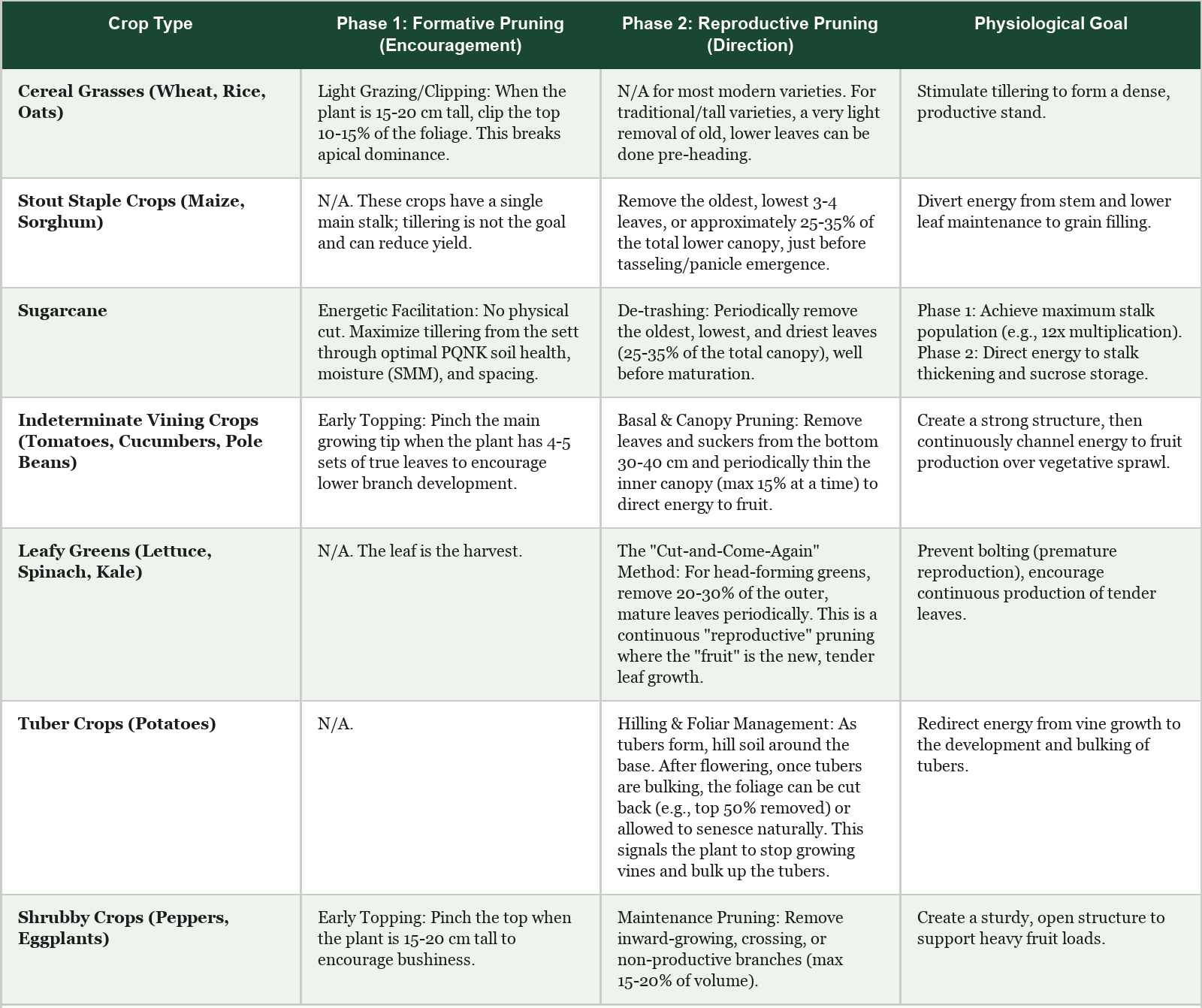
| Crop Type | Phase 1: Formative Pruning (Encouragement) | Phase 2: Reproductive Pruning (Direction) | Physiological Goal |
|---|---|---|---|
| Cereal Grasses (Wheat, Rice, Oats) | Light Grazing/Clipping: When the plant is 15-20 cm tall, clip the top 10-15% of the foliage. This breaks apical dominance. | N/A for most modern varieties. For traditional/tall varieties, a very light removal of old, lower leaves can be done pre-heading. | Stimulate tillering to form a dense, productive stand. |
| Stout Staple Crops (Maize, Sorghum) | N/A. These crops have a single main stalk; tillering is not the goal and can reduce yield. | Remove the oldest, lowest 3-4 leaves, or approximately 25-35% of the total lower canopy, just before tasseling/panicle emergence. | Divert energy from stem and lower leaf maintenance to grain filling. |
| Sugarcane | Energetic Facilitation: No physical cut. Maximize tillering from the sett through optimal PQNK soil health, moisture (SMM), and spacing. | De-trashing: Periodically remove the oldest, lowest, and driest leaves (25-35% of the total canopy), well before maturation. | Phase 1: Achieve maximum stalk population (e.g., 12x multiplication). Phase 2: Direct energy to stalk thickening and sucrose storage. |
| Indeterminate Vining Crops (Tomatoes, Cucumbers, Pole Beans) | Early Topping: Pinch the main growing tip when the plant has 4-5 sets of true leaves to encourage lower branch development. | Basal & Canopy Pruning: Remove leaves and suckers from the bottom 30-40 cm and periodically thin the inner canopy (max 15% at a time) to direct energy to fruit. | Create a strong structure, then continuously channel energy to fruit production over vegetative sprawl. |
| Leafy Greens (Lettuce, Spinach, Kale) | N/A. The leaf is the harvest. | The "Cut-and-Come-Again" Method: For head-forming greens, remove 20-30% of the outer, mature leaves periodically. This is a continuous "reproductive" pruning where the "fruit" is the new, tender leaf growth. | Prevent bolting (premature reproduction), encourage continuous production of tender leaves. |
| Tuber Crops (Potatoes) | N/A. | Hilling & Foliar Management: As tubers form, hill soil around the base. After flowering, once tubers are bulking, the foliage can be cut back (e.g., top 50% removed) or allowed to senesce naturally. This signals the plant to stop growing vines and bulk up the tubers. | Redirect energy from vine growth to the development and bulking of tubers. |
| Shrubby Crops (Peppers, Eggplants) | Early Topping: Pinch the top when the plant is 15-20 cm tall to encourage bushiness. | Maintenance Pruning: Remove inward-growing, crossing, or non-productive branches (max 15-20% of volume). | Create a sturdy, open structure to support heavy fruit loads. |
Golden Rules for PQNK Pruning:
The 30% Rule of Thumb: As a starting point, never remove more than 30% of the total living foliage at one time. This simulates a sustainable harvest, not a catastrophe.
Prioritize the Old and Inefficient: Remove the oldest, lowest, most shaded, or damaged leaves first. These are the plant's lowest-priority assets.
Timing is Everything: Prune during dry, cool parts of the day. Formative pruning is for youth; reproductive pruning is for the transition to maturity.
Observe and Adapt: This benchmark is a starting point. The plant is the ultimate guide. Vigorous new growth and fruit set indicate success; stunting indicates over-pruning.
5.0 Conclusion: Completing the Sensory and Energetic Circle
By embracing the twofold role of the mindful grazer, we complete the sacred circle of the Qudratti Nizam. We acknowledge the plant's inherent design and provide the critical feedback loop it evolved to expect—not just through the physical act of pruning, but by understanding the sensory message it sends about the quality and desirability of its foliage.
This preliminary benchmark, distinguishing between the Encouragement of Youth and the Direction of Maturity, is our next collective step. Let the coming years of observation and experimentation under the PQNK system refine these principles into a finely tuned dialogue between human and plant, yielding not just abundance, but deep, systemic harmony.
—————————
Footnote: Any Production Process That Inundates Soil With Water, Disturbs Soil Through Tillage, Or Leaves Soil Bare Without Organic Mulch Cover Does Not Qualify As Natural Ecosystem Science For Production Agriculture.
PQNK, to be pronounced as 'picnic', which stands for Paedar Qudratti Nizam Kashatqari, and means: the regenerative & sustainable Pristine Organic Farming System.
www.Facebook.Com/Pedaver
https://www.youtube.com/@pedaverpqnk3167/videos
pedaver@gmail.com
WhatsApp +92 320 677 6666
About This Paper
- Crop
- Wheat · Rice · Maize (Corn) · Sugarcane · Potato
- Problem
- Excess Vegetative Growth (at expense of yield/flowering) · Poor Tillering · Yield Stagnation / Decline
- Science
- Plants · Production Architecture
- Evidence
- Philosophical/Framework Argument
- Authority
- Current / Approved PQNK Knowledge
Related PQNK Science
Key Takeaways
- Frames pruning as 'compensatory grazing,' a deliberate human substitute for the wild browsing pressure that would otherwise signal a plant its vegetative surplus is being used.
- Splits the practice into two distinct phases: formative pruning (young plants, encourages structure and tillering) and reproductive pruning (maturing plants, redirects energy from foliage to fruit and seed).
- Presents sugarcane as its central case study with two deliberately different management paths from the same crop: 'cut-and-multiply' (mother shoot removed for synchronized mill harvest, up to 12x stalk multiplication) versus 'sustained-yield' (mother shoot preserved, bamboo-grove-style continuous harvest for jaggery/juice).
- Provides a detailed crop-by-crop pruning benchmark table spanning cereals, maize, sugarcane, vining crops, leafy greens, tubers, and shrubby crops, each with specific timing and a stated physiological goal.
- Establishes a '30% Rule': never remove more than 30% of a plant's living foliage in a single pruning event, simulating a sustainable graze rather than a shock event.
- Treats the plant's own regrowth response as the ultimate feedback signal for whether a pruning intervention was correctly calibrated.
Related Crops
Related Knowledge
same problem
Channeling Plant Energy: A PQNK Guide to Managing Vegetative Growth for Regenerative Production
With no grazing animals left to signal plants that their surplus foliage is being used, PQNK farmers must manually replicate that missing pressure. This guide sets out four directives, stamping, grazing, pruning and pinching, and bruising, with a crop-by-crop protocol for redirecting a plant's vegetative surplus into reproductive yield.
same problem
Plants Respond to Disturbance
In nature plants are browsed, trampled, clipped and broken, and they answer by branching, flowering and setting more seed. PQNK uses the same response on purpose: rolling potato and peanut with a light drum, cutting the sugarcane mother shoot, pruning the leader tiller of wheat and rice, topping rapeseed and other branching crops, and 3D pruning of cucurbit vines. Checking the dominant growing point breaks apical dominance, and in a living soil the plant turns its energy into more branches, tillers, flowers and yield.
same crop
Supplemental Knowledge Paper: Quantifying the Abundance
A data supplement to 'The Perpetual Abundance Principle' that extends its phosphorus, potassium, and nitrogen soil-bank-versus-crop-uptake ratios across six major subcontinental crops, wheat, rice, corn, potato, cotton, and sugarcane, showing the 'undeniable disparity' holds even for the heaviest feeders.
same problem
Achieving High Yields in Potato Cultivation within Mature PQNK Systems
A short field advisory for farmers whose PQNK soil has matured to the point where potato plants grow vigorous vines but underperform on tubers, explaining the hormonal mechanism behind excess vegetative growth and giving two concrete practices, wider plant spacing and a timed mechanical vine-pressing pass, to redirect that energy into yield.