

KP-119 · PQNK Philosophy, Framework & Economics
Wealth Generation, Value Addition, and Money Circulation: The Biological Foundations of Economy
A macroeconomic framework paper arguing modern economics has inverted the natural order by putting money and markets ahead of biological production, and that PQNK-grown nutrition is the only form of primary wealth capable of sustaining civilization, with financial, industrial, and technological wealth all treated as derivative of it.
Read or listen to the full paper ↓Abstract
The paper opens by naming what it calls the foundational error in modern economics: treating wealth, value, and money as interchangeable, an error it traces to expansion of money without expansion of real assets, ecological depletion presented as growth, and food abundance coexisting with nutritional poverty. Against this, it draws a non-negotiable three-way distinction between what generates wealth, what modifies wealth, and what merely circulates wealth.
Wealth generation is defined as a biological act, not an economic one: to qualify as primary wealth, something must sustain life directly, be biologically tangible, regenerate its own productive base, and increase future capacity, a bar only nutrition produced through living soil systems clears, since plants uniquely convert sunlight, atmospheric gases, water, and minerals into food, fiber, and energy, generation rather than creation.
A dedicated section separates creation, symbolic or administrative expansion such as currency printing, digital money creation, or credit expansion, from generation, which is slow, compounding, and governed by biology and physics rather than belief systems. The paper draws a direct and pointed parallel: ACI (Ancient-Conventional-Industrial) agriculture's high yields with low nutrition and total input dependency is, in its terms, the same kind of illusory abundance as monetary creation without underlying production.
Technology is argued incapable of substituting for biology: natural ecosystems, evolved over more than 400 million years, already operate as closed-loop systems requiring no monitoring or inputs, and PQNK is described as fundamentally a two-pass operation, go-planting, go-harvesting, with all nutrient cycling, pest balance, and moisture control handled internally by the restored system rather than by external management.
The paper closes on money's proper, subordinate role: 'if money disappeared but food systems remained, humanity would survive; if food systems collapsed, no amount of money or gold could preserve life.' It positions grassroots, smallholder production, not redistribution alone, as the structural foundation for solving poverty, since small producers operate with immediate feedback and cannot externalize failure, and calls for measurement systems (beyond GDP, yield, or income alone) that prioritize biological integrity, nutrient density, and input independence over time.
Full Paper
If you use “Listen”, the text of the page may be sent to your browser or operating system’s speech provider, such as Apple, Google or Microsoft, depending on the voice your device uses. Pedaver does not process, transmit or store any audio.
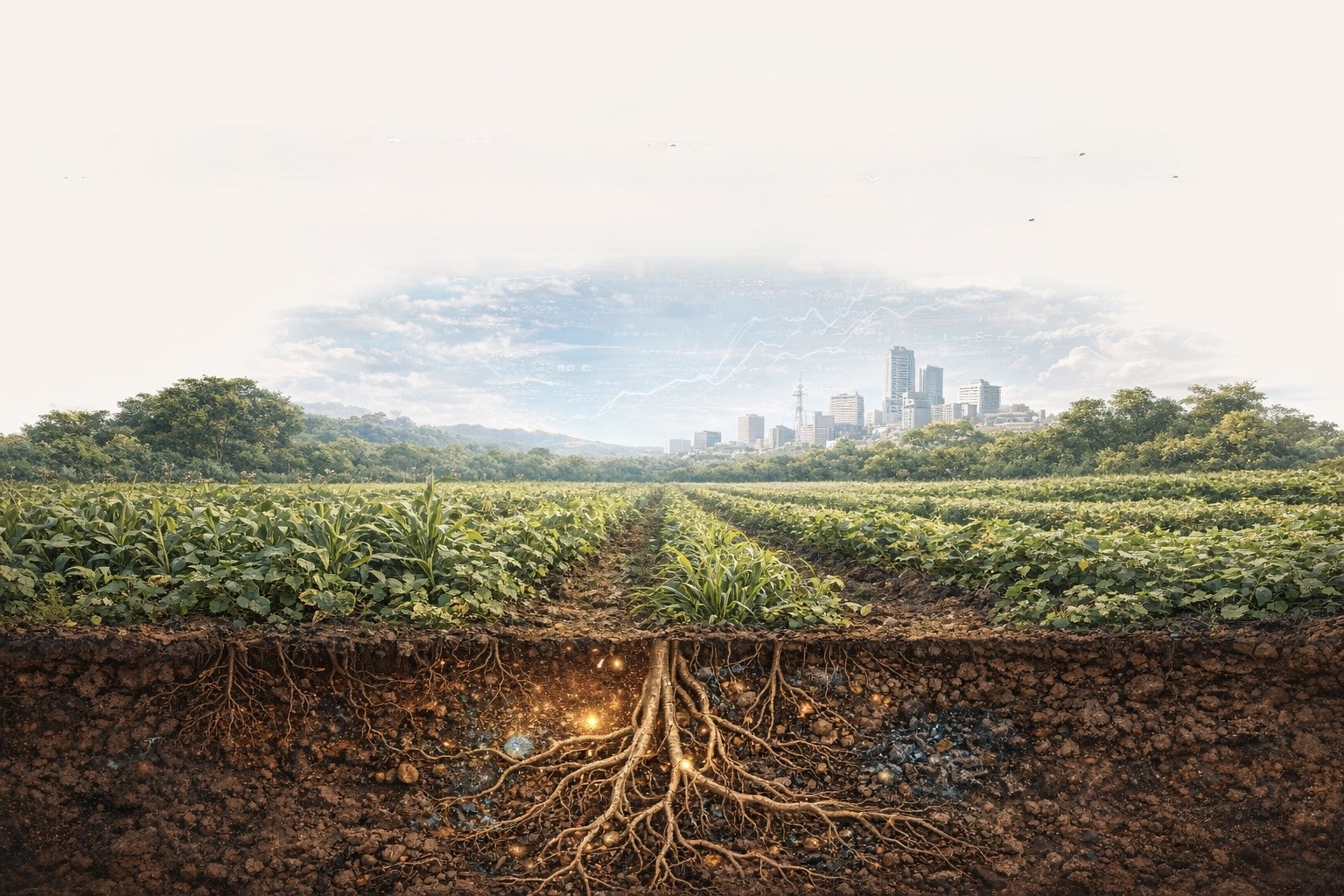
What generates wealth
What modifies wealth
What merely circulates wealth
Failure to maintain this distinction guarantees systemic collapse.
2. Wealth Generation: A Biological Act
2.1 What Is Wealth?
Under PQNK, wealth is defined by function, not by price or exchange value.
For something to qualify as primary wealth, it must:
Sustain life directly
Be biologically tangible
Regenerate its own productive base
Increase future capacity rather than deplete it
Only nutrition produced through living soil systems satisfies all four conditions.
Plants uniquely convert:
Sunlight
Atmospheric gases
Water
Minerals
into food, fiber, biomass, and energy. This is generation, not creation.
2.2 Nutrition as Civilizational Wealth
Nutrition is stored solar energy embedded in biological complexity—minerals, enzymes, microbes, diversity, and density.
Without nutrition:
No human survives
No workforce functions
No market operates
All civilizations ultimately rise or fall with their food systems. Nutrition is therefore not one sector of the economy; it is the precondition for every sector.
3. Creation vs. Generation: A Non-Negotiable Distinction
3.1 Creation: Symbolic Expansion Without Substance
Creation refers to administrative or symbolic expansion—bringing something into existence without biological grounding.
Examples include:
Currency printing
Digital money creation
Credit expansion
Such creation:
Relies on belief systems
Operates independently of ecology
Inflates numbers without increasing nourishment
This mirrors food systems produced by Ancient Conventional Industrial (ACI) agriculture: high yields, low nutrition, total input dependency, and progressive soil degradation.
Both are illusory abundance.
3.2 Generation: Emergence Through Natural Law
Generation is governed by biology and physics. It is:
Slow but compounding
Self-reinforcing when conditions are correct
Impossible to outsource or accelerate artificially
Under PQNK, wealth is generated by restoring the conditions under which soil biology thrives.
Generation cannot be printed. It must be grown.
4. Technology Cannot Substitute Biology
Natural ecosystems have evolved over more than 400 million years and already operate at maximum systemic efficiency. They:
Do not deplete resources
Do not waste
Do not pollute
Do not require monitoring
Do not require inputs
They function as closed-loop systems that produce continuous abundance without human intervention.
Natural food production operates as a two-pass operation:
Go-planting
Go-harvesting
All regulation—nutrient cycling, pest balance, moisture control—is handled internally.
Technology can support logistics and coordination. It cannot replace the self-organizing intelligence of living soil. Systems that require constant monitoring and correction are structurally inferior to systems that self-regulate.
Policy implication: Technology must serve biology, not attempt to replace it.
5. Why Scale Fails When It Centralizes
Industrial agriculture is often presented as peak productivity. This claim ignores history.
Production agriculture was already degraded by ancient conventional practices:
Repeated tillage
Inundation of soil with water
Keeping soil bare
These practices destroyed soil structure, killed aerobic life, and oxidized organic matter. Industrial inputs emerged as a compensatory response to degraded soils, not as an improvement over pristine systems.
Critically, industrial systems have never been compared against intact natural food production systems, which:
Maintain permanent cover
Preserve soil aeration
Produce biomass at massive scale
Operate without degradation
Natural vegetation already exceeds industrial agriculture in scale and durability.
PQNK does not limit scale. It removes artificial constraints created by degradation.
Policy implication: Centralized scale reflects degraded systems, not biological limits.
6. Regeneration Is a Process; Sustainability Is a State
Regeneration is a corrective, time-bound phase. Sustainability is the stable condition that follows.
A system requiring permanent correction is not sustainable by definition.
PQNK explicitly separates these stages to prevent perpetual dependency on inputs, subsidies, or expert management.
7. Transition Is Biological Correction, Not Engineering
Soil biology responds rapidly when physical conditions are restored.
Key requirements:
Moderate soil temperature
Adequate moisture without saturation
Continuous organic cover
Well-aerated root zones
Raised beds with organic covers create these conditions naturally. By contrast, flood irrigation—and even sprinkler or drip systems when misapplied—fill soil pores with water, drown aerobic microbes, and halt regeneration.
When air–water balance is restored, soil life multiplies rapidly, similar to fermentation processes. Biology does not need management; it needs conditions.
8. Value Addition: A Secondary Activity
Value addition modifies wealth; it does not create it.
Processing, cooking, packaging, and transport are legitimate only when they:
Follow real biological generation
Preserve nutrition
Do not externalize ecological costs
When value addition precedes generation, it becomes extraction.
9. Money Circulation: A Tool, Not Wealth
Money facilitates exchange. It does not generate food, regenerate soil, or sustain life.
If money disappeared but food systems remained, humanity would survive. If food systems collapsed, no amount of money or gold could preserve life.
Money regains legitimacy only when it circulates biologically generated wealth.
10. Measurement Without Illusion
During the regenerative phase, vigilance is required.
To prevent yield loss:
Up to 4 kg NP may be applied through furrow irrigation, or
A 2% NP foliar spray may be used temporarily
Even if minor yield reductions occur in early crops:
Nutrition density increases
Produce is poison-free
Market prices improve
Production costs drop sharply
Net farmer profit increases even during transition.
Current metrics—GDP, yield alone, income—fail to capture system health. Measurement must prioritize biological integrity, nutrient density, and input independence over time.
11. Grassroots Production as Structural Foundation
Poverty is not solved through redistribution alone. It is solved at the production level.
Small and marginal producers operate with immediate feedback and cannot externalize failure. They form the biological foundation of society.
Conclusion
Creation without generation is illusion. Generation without depletion is wealth.
PQNK does not oppose markets, money, or trade. It restores sequence: Life first. Economy second.
This is not ideology. It is ecology.
And ecology does not negotiate.
Proper application of PQNK is essential for abundance, stability, and nutrient density.
——————————
PQNK (pronounced “picnic”)—the regenerative & sustainable Pristine Organic Farming System—is grounded in Natural Ecosystem Science. This science employs perennial biodiversity, protects soil with organic mulch, and avoids practices such as water inundation, tillage disturbance, and leaving soil bare.
It is the process that matters most. PQNK is a pristine production system designed not merely for yield, but for optimal, balanced output—where quality, sustainability, and ecological harmony emerge from a self‑regulated, zero‑external‑input methodology.
Connect & Resources Facebook: www.Facebook.Com/Pedaver YouTube (PQNK): https://www.youtube.com/@pedaverpqnk3167/videos YouTube: http://www.youtube.com/@aasifsharif PDF Knowledge Papers: https://drive.google.com/drive/folders/1iadwV6mdUPyrUIpB3oRfNv6DLiackaUL?usp=sharing Email: pedaver@gmail.com WhatsApp: +92 320 677 6666
About This Paper
- Science
- Economics · Nutrition
- Evidence
- Philosophical/Framework Argument
- Authority
- Current / Approved PQNK Knowledge
Related PQNK Science
Key Takeaways
- Draws a non-negotiable three-way distinction between wealth generation (biological), value addition (modification), and money circulation (a tool), arguing modern economics collapses all three into one interchangeable concept.
- Defines primary wealth strictly: it must sustain life directly, be biologically tangible, regenerate its own productive base, and increase future capacity, a bar only nutrition from living soil systems clears.
- Draws a direct parallel between currency creation (printing, digital money, credit expansion) and ACI agriculture's high-yield, low-nutrition, input-dependent model, calling both 'illusory abundance.'
- States the paper's central formulation: if money disappeared but food systems remained, humanity would survive; if food systems collapsed, no amount of money or gold could preserve life.
- Argues centralized industrial scale reflects existing soil degradation rather than a biological ceiling, and that PQNK 'does not limit scale, it removes artificial constraints created by degradation.'
- Positions grassroots, smallholder production, not redistribution alone, as the structural foundation for solving poverty, since small producers face immediate feedback and cannot externalize failure.
Related Crops
Related Knowledge
same science
Restoring Prosperity in Citrus and Mango Orchards Through the PQNK Regenerative System
Decades of industrial orchard management have driven a 60% decline in Kinnow nutrition density and widespread orchard abandonment. This paper presents field data from a Toba Tek Singh comparison and the Sujjahabad Mango Research Station showing how PQNK reverses that decline, lifting A-grade fruit yield by up to 80%.
same science
Comprehensive Guide: High-Anthocyanin Black Carrot Under the PQNK Closed-Loop System
Written for a farmer under contract to supply anthocyanin for nutraceutical extraction, this guide explains the cold-stress biochemistry behind pigment concentration in black carrot and how PQNK's stable 13-26°C root zone lets a farmer trigger that stress deliberately, through timed irrigation intervals, cool nights, and a low-dose ethanol spray, without ever starving the plant.
same science
The Global Cost of Agricultural Degradation & the PQNK Restoration Dividend
The visible price of food does not represent its full cost. Earlier versions of this Knowledge Paper attempted to combine several external estimates into a single $1.9 trillion annual cost and a $2.8 trillion restoration opportunity; source verification showed those figures combined studies with different scopes and could not be defended as one additive model, so Pedaver withdraws that composite calculation. The corrected analysis uses independently sourced estimates, FAO's ~$12 trillion/year hidden agrifood-system costs, UNCCD's ~$878 billion/year cost of inaction on land degradation, FAO's ~$400 billion/year soil-loss figure, within their own stated boundaries, and explicitly does not add them together.
same science
PQNK Knowledge Paper: The Universal Application of the PQNK Model — From Soil to Supper
Responding to a Nigerian farmer's question about whether PQNK applies outside crop farming, this paper argues that because every link in the food chain, honey, eggs, milk, meat, or fish, ultimately traces back to plant nutrition, restoring plant health under PQNK automatically improves outcomes across poultry, aquaculture, dairy, and apiculture.