

KP-021 · Crop-Specific Guides
Comprehensive Guide: High-Anthocyanin Black Carrot Under the PQNK Closed-Loop System
Written for a farmer under contract to supply anthocyanin for nutraceutical extraction, this guide explains the cold-stress biochemistry behind pigment concentration in black carrot and how PQNK's stable 13-26°C root zone lets a farmer trigger that stress deliberately, through timed irrigation intervals, cool nights, and a low-dose ethanol spray, without ever starving the plant.
Read or listen to the full paper ↓Abstract
Framed around a farmer with three years of experience growing black carrot under a buyer contract that prices output directly on anthocyanin content, the guide opens with the underlying biochemistry: anthocyanin functions as a plant's natural sunscreen and antifreeze, produced in response to cold, intense light, and mild drought through a MYB transcription-factor 'master switch' that activates the gene pathway converting sugars and phenylalanine into pigment. Because PQNK's closed-loop system uses no external NPK and holds soil temperature stable at 13-26°C year-round via mulch, the plant never faces starvation stress, leaving air temperature, light exposure, and controlled water stress as the primary levers for boosting pigment.
The guide is specific about optimal conditions: 20-25°C daytime air for photosynthesis and sugar production, 4-10°C nighttime air to powerfully trigger anthocyanin synthesis, and a 10-15°C diurnal swing that strengthens the signal, all while PQNK's stable soil temperature keeps roots metabolically active even when air is cold. It resolves the winter-versus-summer question decisively in favor of winter: cold nights create a persistent low-grade stress that maximizes pigment concentration, producing smaller but more pigment-dense roots, while summer heat above 30°C actively degrades anthocyanins and shifts the plant toward rapid, paler growth.
Practical optimization centers on timing stress precisely: the first 60-70 days favor uninterrupted root-size development, while the final 25-30 days introduce mild stress, cooler nights and extended irrigation intervals, to shift the plant toward pigment production as root expansion slows. Because no external N, P, or K is added, all nutrition comes from the soil's own gradient, and the guide notes that low soil nitrogen actually favors higher pigment, so farmers are directed to avoid fresh, fast-releasing organic matter in favor of mature mulch. Water stress via extended furrow-irrigation intervals is identified as the single most powerful tool available, since it creates a moisture gradient the plant reads as mild drought.
A specific agronomic package follows: 10-15cm plant spacing to reduce leaf shading, furrow irrigation with a maximum 4-inch head in an 8-inch furrow (syphon removed once water reaches three-quarters of furrow length) to create the horizontal moisture gradient, and a soil-ball moisture test at two points across the bed to confirm the intended mild water-stress condition, erring toward the aerated side rather than saturated, has been reached. A 1-2% food-grade ethanol foliar spray, applied at 60 and 75 days after sowing, primes heat-shock proteins and antioxidant pathways for added heat tolerance and disease resistance, alongside a year-round staggered sowing model, planting a fixed acreage daily for continuous harvest, that the guide pairs with a call for annual-average buyer pricing rather than per-batch peaks.
Varietal selection favors a solid black or purple core with no white or orange center, high acylated anthocyanins for extraction stability, and genetic purity, recommending the Punjab-developed 'Punjab Black Beauty' at 90-95 days for the region, purchased fresh each season rather than farm-saved. A Punjab-specific recovery table anchors the market case: winter crop peaks around 182-519 mg/100g fresh weight with 85-95% extraction efficiency at industrial scale, against a summer crop below 100 mg/100g and only 30-45% recovery, leading the guide to recommend weighting 70-80% of contracted acreage to the October-February window and negotiating annual-average pricing that accounts for anthocyanin's health, natural-colorant, and smart-packaging market applications.
Revision R1 (28 September 2026): the ethanol foliar-spray strength has been standardised across Pedaver material at 1-2% food-grade ethanol in clean water (about 10-20 ml per litre), used against ambient heat or cold stress and sprayed in the cooler part of the day; stronger solutions can scorch leaves. The PDF opens with a revision note; the original text follows unchanged.
Full Paper
If you use “Listen”, the text of the page may be sent to your browser or operating system’s speech provider, such as Apple, Google or Microsoft, depending on the voice your device uses. Pedaver does not process, transmit or store any audio.
Knowledge Paper KP-021 - Revision R1, 28 September 2026
The ethanol foliar-spray strength in this paper has been standardised across all Pedaver material.
PQNK's recommended strength for an ethanol foliar spray is 1 to 2 percent food-grade ethanol in clean water, about 10 to 20 ml of ethanol per litre. It relieves ambient heat or cold stress, is sprayed in the cooler part of the day, and supports, rather than replaces, the protection of mulch-covered permanent beds. Stronger solutions can scorch leaves.
Where this paper gives a 3 to 5 percent ethanol spray (30 to 50 ml per litre) at 60 and 75 days after sowing, use 1 to 2 percent (10 to 20 ml per litre); the timing it recommends is unchanged.
The original paper follows unchanged.
COMPREHENSIVE GUIDE: HIGH-ANTHOCYANIN BLACK CARROT UNDER PQNK CLOSED-LOOP SYSTEM
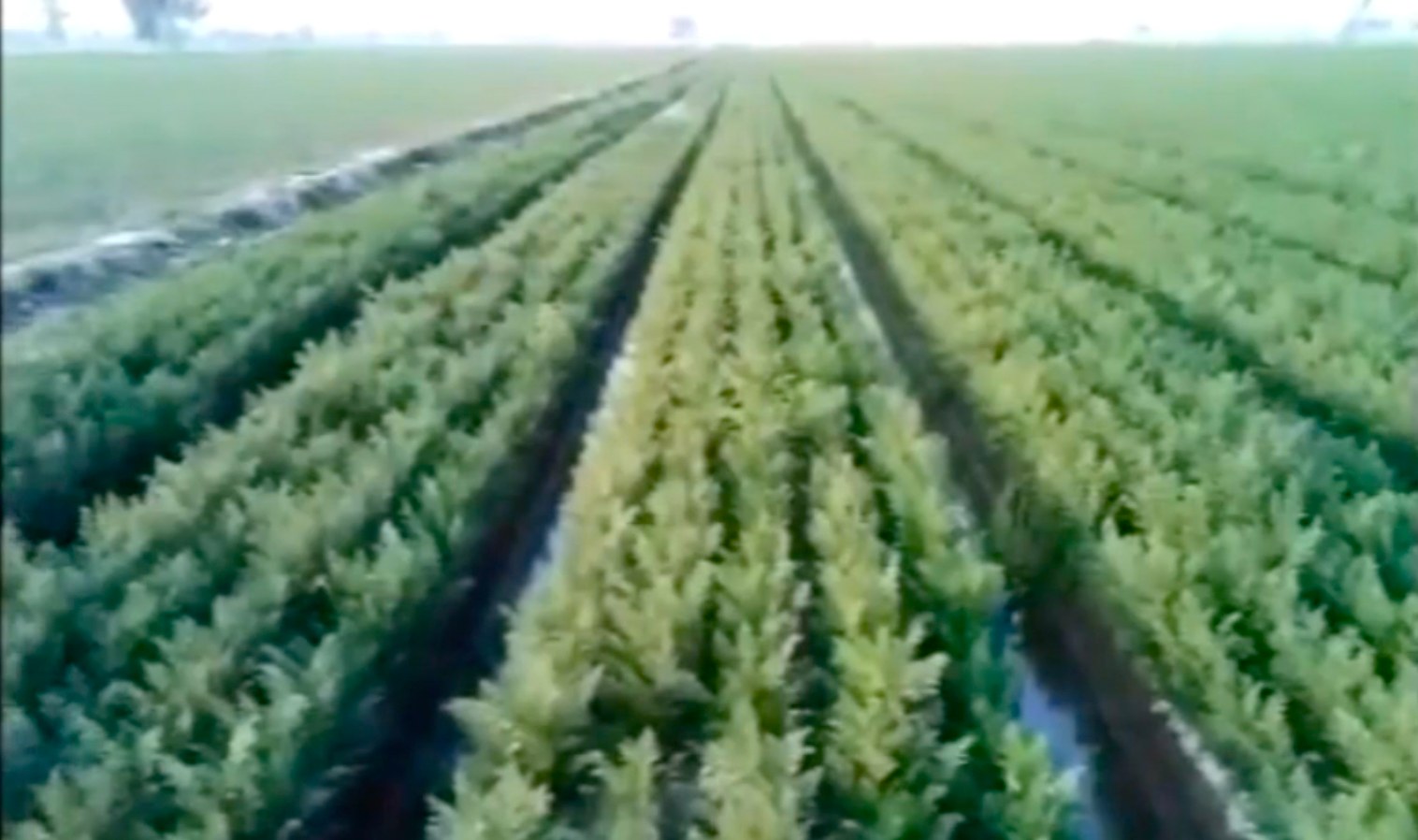
Broad Acre Production of Carrot on PQNK
Farmer with 3 years’ experience growing black carrot for nutraceutical anthocyanin extraction. Context: Buyer offers contract farming with price directly linked to anthocyanin content. System: PQNK (Paidar Qudarti Nizam Kashtkari) – closed-loop, no external NPK or micronutrients. Soil temperature and moisture stable year-round (13–26°C) due to thick organic mulch. Water applied via furrow with horizontal gradient, allowing roots to self-select optimal moisture and nutrient density.
PART ONE: SCIENTIFIC FOUNDATION
1. Core Biochemical & Environmental Mechanism
Anthocyanin is a plant’s natural sunscreen and antifreeze. It is produced in response to environmental stress signals (cold, intense light, mild drought). A low-temperature signal upregulates a genetic “master switch” (MYB transcription factor), which activates an assembly line of genes (PAL, F3H, DFR) that convert sugars and phenylalanine into anthocyanin pigments.
In your PQNK system, because soil temperature is stable (13–26°C) and nutrients are continuously available via the gradient, the plant never faces starvation stress. The primary levers for anthocyanin enhancement are:
• Air temperature (especially night cold)
• Light exposure (full sun)
• Mild water stress (controlled irrigation intervals)
2. Optimal Temperature & Diurnal Variation

| Parameter | Optimal Range for Maximum Anthocyanin |
|---|---|
| Day air temperature | 20–25°C (supports photosynthesis & sugar production) |
| Night air temperature | 4–10°C (powerfully triggers anthocyanin synthesis) |
| Diurnal difference | 10–15°C (greater difference = stronger signal) |
| Soil temperature (your PQNK advantage) | 13–26°C year-round – roots remain active even when air is cool |
3. Winter vs. Summer: Which is Scientifically Superior?
Winter is superior for anthocyanin concentration (mg/g root). Cold nights create a low-grade, persistent stress signal that maximally upregulates the pigment pathway. Summer heat (above 30°C) actively degrades anthocyanins and shifts plant metabolism toward rapid growth, producing larger but paler roots. Trade-off: Winter roots are smaller but more pigment-dense. Summer roots are larger but have lower concentration.
PART TWO: PQNK-SPECIFIC PRACTICAL OPTIMIZATION
4. Balancing Root Size with High Anthocyanin
The goal is to induce pigment without stopping growth. In PQNK, this happens naturally:
• Early stage (first 60–70 days): Optimal conditions for root size development.
• Late stage (last 25–30 days): Introduce mild stress (cool nights, extended irrigation intervals). The plant shifts to pigment production while root expansion slows.
5. Role of Soil System (No External NPK)
Since no external N, P, K are added, all nutrition comes from your soil’s innate balance via the moisture gradient. Roots access nutrients by choosing the appropriate soil zone.
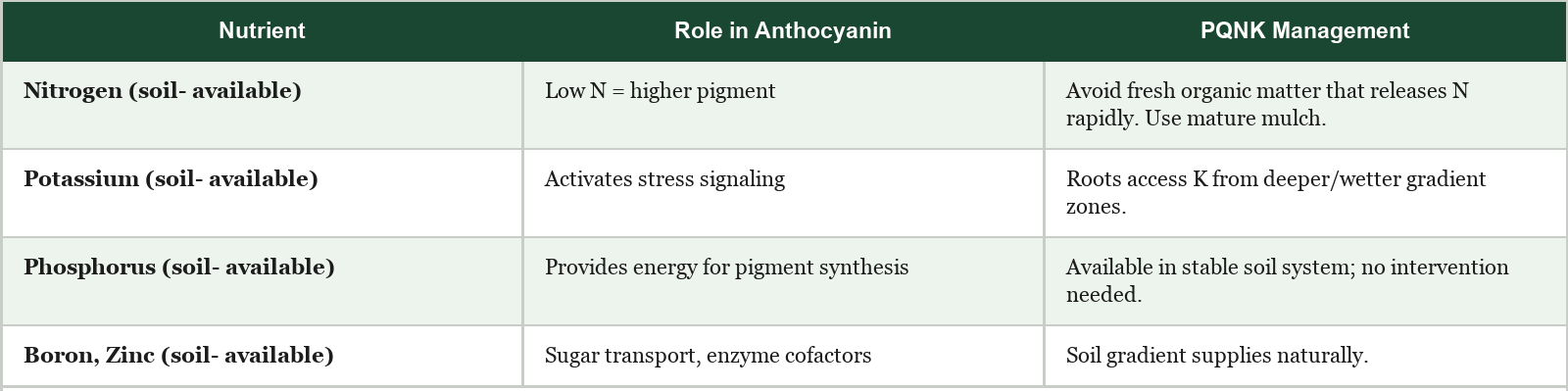
| Nutrient | Role in Anthocyanin | PQNK Management |
|---|---|---|
| Nitrogen (soil- available) | Low N = higher pigment | Avoid fresh organic matter that releases N rapidly. Use mature mulch. |
| Potassium (soil- available) | Activates stress signaling | Roots access K from deeper/wetter gradient zones. |
| Phosphorus (soil- available) | Provides energy for pigment synthesis | Available in stable soil system; no intervention needed. |
| Boron, Zinc (soil- available) | Sugar transport, enzyme cofactors | Soil gradient supplies naturally. |
Water stress is your most powerful tool. By extending the interval between furrow irrigations, you create a natural moisture gradient that the plant interprets as mild drought, boosting anthocyanin.
6. Agronomic Practices for Uniform Size & Deep Color
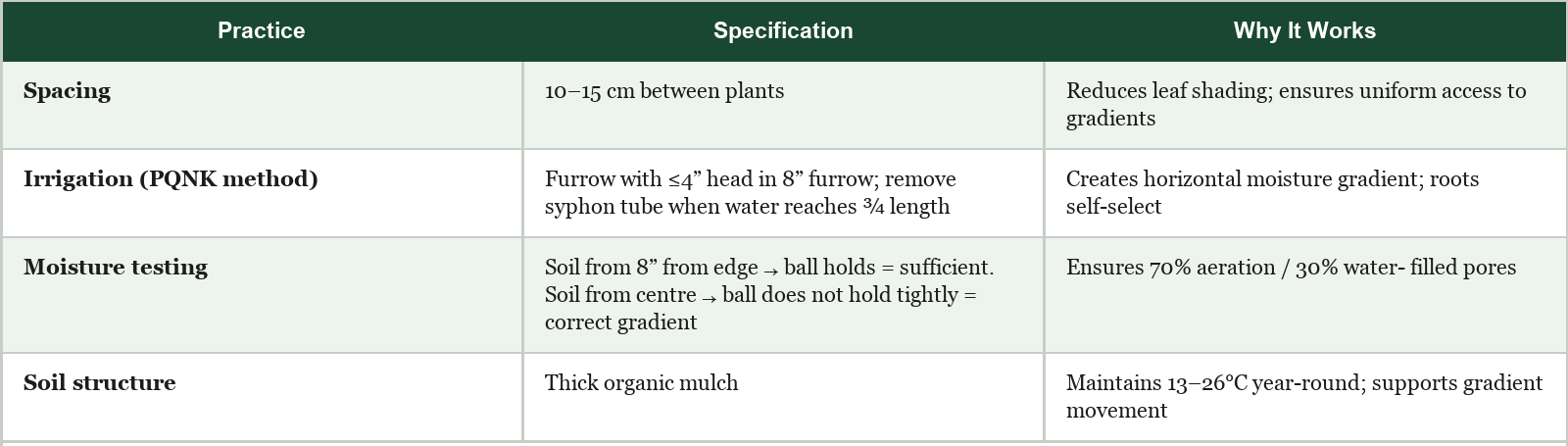
| Practice | Specification | Why It Works |
|---|---|---|
| Spacing | 10–15 cm between plants | Reduces leaf shading; ensures uniform access to gradients |
| Irrigation (PQNK method) | Furrow with ≤4” head in 8” furrow; remove syphon tube when water reaches ¾ length | Creates horizontal moisture gradient; roots self-select |
| Moisture testing | Soil from 8” from edge → ball holds = sufficient. Soil from centre → ball does not hold tightly = correct gradient | Ensures 70% aeration / 30% water- filled pores |
| Soil structure | Thick organic mulch | Maintains 13–26°C year-round; supports gradient movement |
7. Controlled Stress Induction (Farm-Level, PQNK-Compliant)

| Stress Type | Method | Timing |
|---|---|---|
| Thermal (air) | Expose plants to cool night air (remove any shade) | Entire maturation phase |
| Water | Extend interval between furrow irrigations | Last 25–30 days before harvest |
| Light | Ensure full sun on canopy; no weed shade | Entire growth |
8. Ethanol Spray for Immunity & Heat Tolerance
Scientific basis: Lowconcentration ethanol (1–2%) acts as a priming agent. It triggers mild oxidative stress, upregulating heat shock proteins (HSPs), antioxidant enzymes, and anthocyanin pathways. This makes plants more heat-tolerant and disease-resistant. PQNK-compliant protocol:
• Dilute ethanol to 1–2% in water (e.g., 10–20 ml ethanol per liter).
• Spray on foliage once at 60 days and once at 75 days after sowing.
• Apply in evening to avoid rapid evaporation.
Note: Do not exceed 5%; higher concentrations damage leaf tissue.
9. Year-Round Supply via Daily Staggered Sowing
Because your soil temperature is stable (13–26°C) year-round due to thick organic mulch, the limiting factor for production is air temperature and photoperiod, not soil. This enables circular production: Example for buyer requiring 2 acres harvested daily:
• Plant 2 acres every day.
• Harvest after fixed duration (e.g., 90 days).
• This yields a continuous, daily harvest of 2 acres.
Anthocyanin variation: Winter harvests = highest concentration. Summer harvests = lower but still acceptable. The extraction factory averages over the year. The buyer must agree to an annual average pricing model, not seasonal peaks.
10. Varietal Selection for Nutraceutical Grade
Without external inputs, genetics become even more critical. Select for:

| Trait | Why |
|---|---|
| Solid black/purple core (no white/ orange center) | High pigment density |
| High acylated anthocyanins | Stable for extraction, high bioavailability |
| Genetic purity (F1 hybrid or stable OP) | Uniform response to your PQNK system |
Punjab-specific variety: “Punjab Black Beauty” (PAU-developed) takes 90–95 days and is recommended for your region. Do not produce your own seed unless you isolate from wild carrots (>1 mile). Purchase fresh certified seed annually for consistency.
11. Biological / Foliar Treatments (PQNK-Compatible)
Recommended: Fermented fruit juice (FPJ) as natural ethylene source. Method: Ferment overripe apples or bananas in jaggery (1:1 by weight) for 7–10 days. Dilute 1:500 and spray. Ethylene from fermentation mimics stress signal, boosting anthocyanin. Ethanol spray (as above) also serves this purpose and is simpler. Not recommended: Any external microbial inoculants unless produced on-farm. Your closed-loop system already contains native soil microbes adapted to your field.
12. Harvest Stage Indicator for Peak Anthocyanin

| Method | Practicality |
|---|---|
| Lab test (best) | Sample weekly before harvest; coordinate with buyer |
| Visual | Root skin deep jet-black with waxy sheen; internal cut uniformly purple |
| Field indicator | Harvest as late as possible before air temperatures rise above 10°C at night (for winter crop) |
For summer crops, harvest at full maturity (leaves starting to senesce) for maximum pigment under warm conditions.
13. Canopy Management (Leaf Trimming)
Not recommended for carrots. Leaves are the sole photosynthetic source. Trimming reduces sugar supply, directly lowering anthocyanin.
14. Seed Generation Method for Consistency
Carrots are biennials. To maintain true-to-type seed:

| Method | Who Does It | Recommendation |
|---|---|---|
| Certified seed purchase | Seed company (isolated steppe environment) | Primary method – buy fresh each season |
| Farm-saved seed (advanced) | Farmer, with isolation >1 mile from any wild or other carrot varieties | Only for developing your own adapted line over 2–3 years |
PQNK note: If you eventually produce your own seed, select only the most perfectly black, uniform, healthy roots for replanting (mass selection). Rogue out all off-types.
PART THREE: ANTHOCYANIN – USES AND MARKET VALUE
Understanding the end-use of your product helps align production with buyer requirements.
15. Primary Uses of Anthocyanin

| Use Category | Specific Applications | Key Advantage |
|---|---|---|
| Health & Medicine | Cardiovascular disease prevention; diabetes management; neuroprotection; cancer chemoprevention (colorectal, breast); antimicrobial; gut health (prebiotic); anti-inflammatory | Potent antioxidant and gut microbiome- modulating properties; no known harmful effects |

| Natural Food Colorant | Beverages, yogurts, candies, jams, jellies, fresh sausages, processed meats, functional foods | Safe, natural alternative to synthetic dyes (Red 40 prohibited in Japan, Australia, EU) |
|---|---|---|
| Smart Packaging | pH-sensitive freshness indicators for protein- rich foods; color changes as food spoils | Real-time visual monitoring; extends shelf life; reduces synthetic preservatives |
| Pharmaceutical & Nutraceutical | Dietary supplements; functional food ingredients; cosmetics | Bioactive health benefits; high-value market |
Relevance to you: The buyer’s requirement for “nutraceutical grade” indicates they target the high-value health supplement market, where anthocyanin concentration directly correlates with product efficacy and pricing.
PART FOUR: PUNJAB-SPECIFIC ANTHOCYANIN RECOVERY TABLE
Based on Punjab growing conditions, the following table estimates anthocyanin recovery percentage from black carrots grown in winter versus summer.
Table: Anthocyanin Recovery Percentage by Volume of Black Carrots – Punjab Situation

| Parameter | Winter Crop | Summer Crop |
|---|---|---|
| Typical Growing Season in Punjab | Sown Sep–Oct, Harvested Jan–Feb (cold & dry conditions) | Sown Feb–Mar, Harvested May–Jun (hot & dry conditions) |
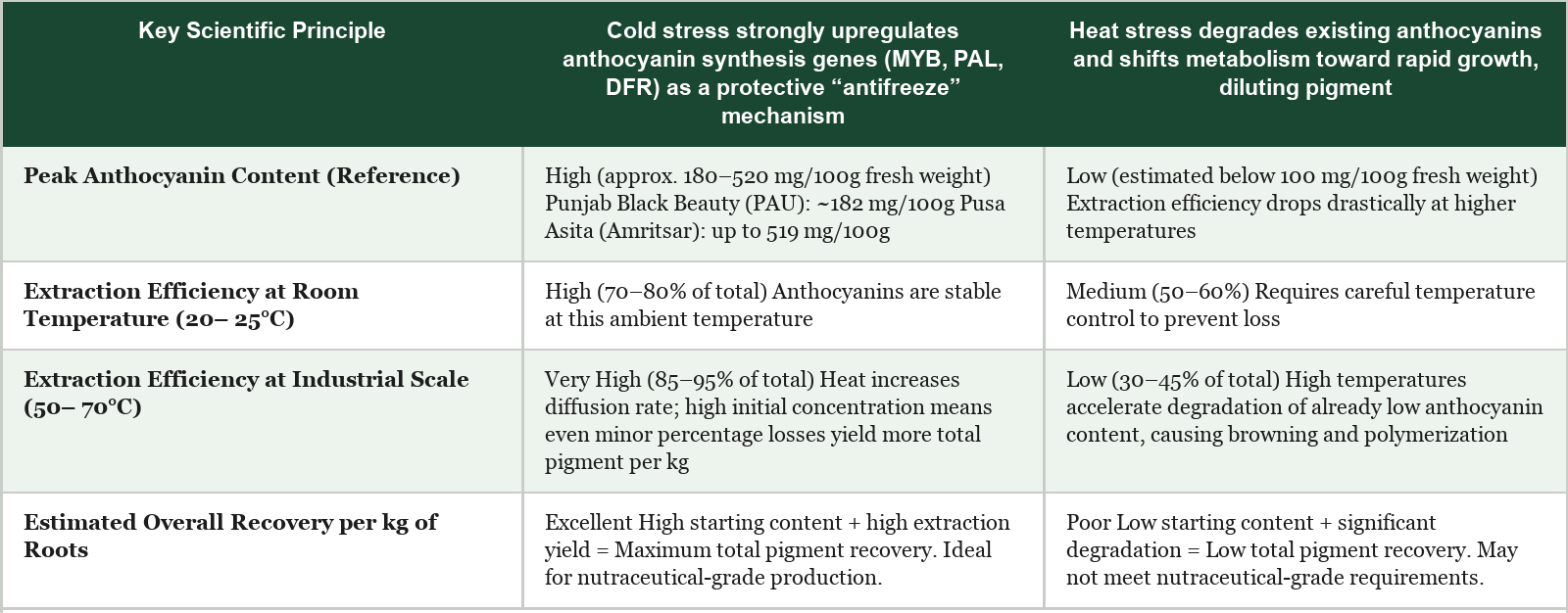
| Key Scientific Principle | Cold stress strongly upregulates anthocyanin synthesis genes (MYB, PAL, DFR) as a protective “antifreeze” mechanism | Heat stress degrades existing anthocyanins and shifts metabolism toward rapid growth, diluting pigment |
|---|---|---|
| Peak Anthocyanin Content (Reference) | High (approx. 180–520 mg/100g fresh weight) Punjab Black Beauty (PAU): ~182 mg/100g Pusa Asita (Amritsar): up to 519 mg/100g | Low (estimated below 100 mg/100g fresh weight) Extraction efficiency drops drastically at higher temperatures |
| Extraction Efficiency at Room Temperature (20– 25°C) | High (70–80% of total) Anthocyanins are stable at this ambient temperature | Medium (50–60%) Requires careful temperature control to prevent loss |
| Extraction Efficiency at Industrial Scale (50– 70°C) | Very High (85–95% of total) Heat increases diffusion rate; high initial concentration means even minor percentage losses yield more total pigment per kg | Low (30–45% of total) High temperatures accelerate degradation of already low anthocyanin content, causing browning and polymerization |
| Estimated Overall Recovery per kg of Roots | Excellent High starting content + high extraction yield = Maximum total pigment recovery. Ideal for nutraceutical-grade production. | Poor Low starting content + significant degradation = Low total pigment recovery. May not meet nutraceutical-grade requirements. |
Key Takeaways for Your Punjab PQNK Farm
1. Winter is for premium nutraceutical grade. Focus 70–80% of your contracted area on the winter window (Oct–Feb).
2. Summer crop is for food grade only (colorant, juice concentrate). If the buyer requires year-round supply, negotiate a lower price for summer harvests or blend across seasons for an annual average.
3. Your stable soil temperature (13–26°C) is a major advantage. Even when air is cold, roots remain active, allowing pigment accumulation without growth cessation.
PART FIVE: PRACTICAL SUMMARY – YOUR YEAR-ROUND PQNK MODEL
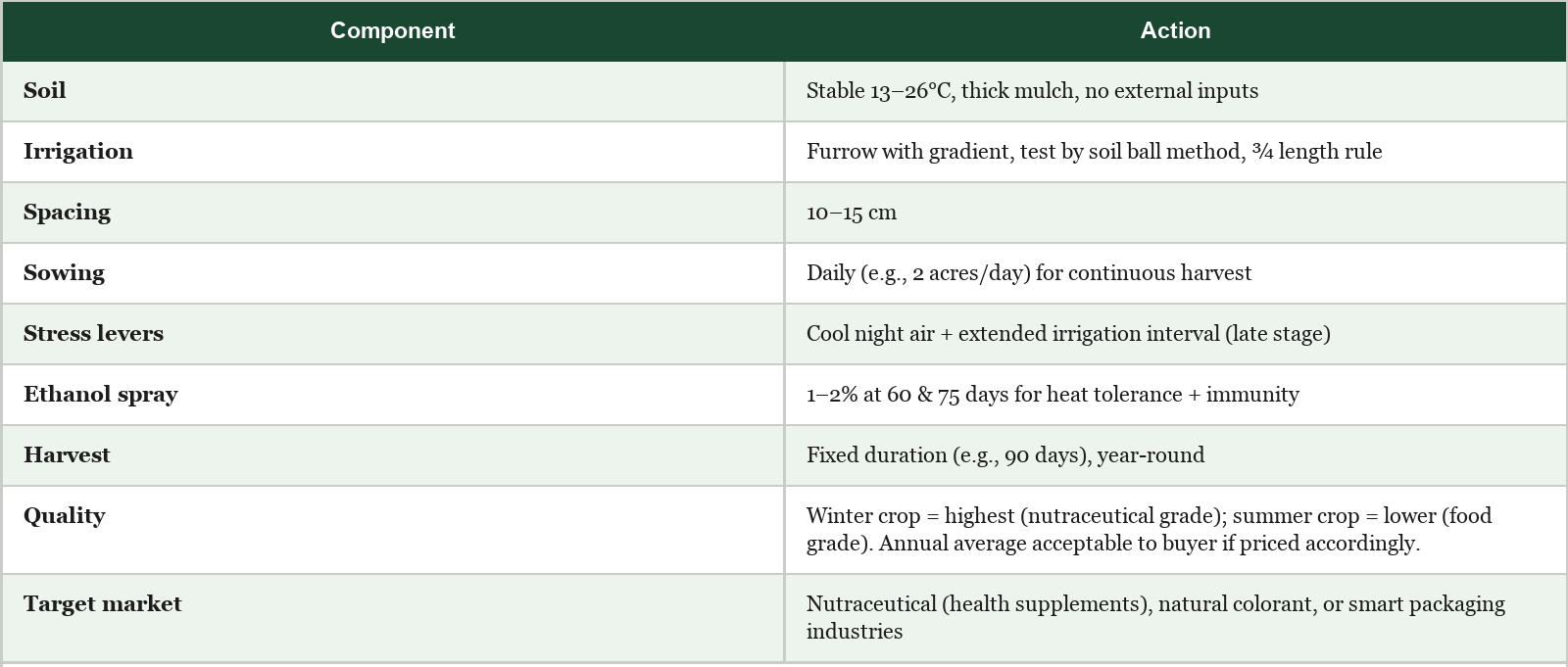
| Component | Action |
|---|---|
| Soil | Stable 13–26°C, thick mulch, no external inputs |
| Irrigation | Furrow with gradient, test by soil ball method, ¾ length rule |
| Spacing | 10–15 cm |
| Sowing | Daily (e.g., 2 acres/day) for continuous harvest |
| Stress levers | Cool night air + extended irrigation interval (late stage) |
| Ethanol spray | 1–2% at 60 & 75 days for heat tolerance + immunity |
| Harvest | Fixed duration (e.g., 90 days), year-round |
| Quality | Winter crop = highest (nutraceutical grade); summer crop = lower (food grade). Annual average acceptable to buyer if priced accordingly. |
| Target market | Nutraceutical (health supplements), natural colorant, or smart packaging industries |
FINAL NOTE FOR THE BUYER
The buyer must understand that anthocyanin concentration will vary seasonally even under perfect PQNK management. The solution is:
• Annual average pricing (not per-batch peaks)
• Factory designed for variable input concentration (blending across seasons)
• Premium pricing for winter crop (nutraceutical grade)
• Lower pricing for summer crop (food grade)
Your closed-loop PQNK system, with stable soil temperature, intelligent root gradients, daily staggered sowing, and ethanol spray for heat tolerance, is scientifically sound for year-round black carrot production. The winter crop will consistently deliver nutraceutical-grade anthocyanin levels suitable for the high-value health supplement market.
Applying PQNK without understanding nature’s operating system will not deliver abundance, stability, or nutrient density.
PQNK (pronounced “picnic”)—the regenerative & sustainable Pristine Organic Farming System—is grounded in Natural Ecosystem Science. This science employs perennial biodiversity, protects soil with organic mulch, and avoids practices such as water inundation, tillage disturbance, and leaving soil bare.
It is the process that matters most. PQNK is a pristine production system designed not merely for yield, but for optimal, balanced output—where quality, sustainability, and ecological harmony emerge from a self‑regulated, zero‑external‑input methodology.
About This Paper
- Crop
- Black Carrot
- Problem
- Weak Flavor / Aroma / Quality Sensory Markers · Price Volatility / Market Glut · Seasonal / Batch Quality Variability · Yield Stagnation / Decline
- Science
- Plants · Water · Nutrition · Food Quality · Economics
- Evidence
- Scientific Mechanism
- Authority
- Current / Approved PQNK Knowledge
Related PQNK Science
Key Takeaways
- Anthocyanin is the plant's own cold-stress response, upregulated through a MYB 'master switch' gene pathway triggered by cold nights, intense light, and mild drought.
- PQNK's stable 13-26°C root zone keeps roots active even when air temperature drops, allowing mild stress to be applied deliberately in the final 25-30 days without stalling growth.
- Winter-grown roots are smaller but dramatically more pigment-dense (roughly 182-519 mg/100g) than summer roots (under 100 mg/100g), which also degrade further during high-temperature extraction.
- A 1-2% ethanol foliar spray applied at 60 and 75 days after sowing primes heat-shock proteins and antioxidant pathways, boosting both stress tolerance and pigment synthesis.
- Because no external nitrogen is added, pigment concentration benefits directly, as low soil nitrogen favors anthocyanin production over vegetative growth.
- The guide recommends weighting 70-80% of contracted acreage to the October-February winter window and negotiating annual-average pricing so buyers absorb the seasonal quality swing.
Related Crops
Related Knowledge
same problem
Sugarcane: The Bamboo Principle
Sugarcane is conventionally treated like wheat, sown, harvested, and replanted every few years, but this paper uses bamboo as an analogy for a rhizome-forming perennial that can be harvested repeatedly from a protected living base. It lays out the wide-spacing planting geometry and selective-cut discipline behind PQNK field cases of eight harvest cycles from one planting, with recorded yields of over two thousand maunds per acre, with documented fields reaching 2,800 maunds (about 112 tonnes) (revised R1, per the PQNK book).
same problem
Sugarcane Cultivation on PQNK: A Perennial, Circular Production System
This companion knowledge paper turns the bamboo-principle reframe into an operating system: selective, year-round harvesting from overlapping generations of cane within the same clump, with rising density treated as a soil-health signal rather than a problem to be thinned.
same problem
What Science Delivered: The Documented Balance Sheet of a Century of Input-Funded Agricultural Research
Prompted by an online dismissal of scientific consensus, this paper turns the same skepticism on a century of input-industry-funded agricultural research and totals its documented balance sheet across soil, water, climate, cost, yield, food quality, and smallholder viability, using named published sources throughout and flagging PQNK's own field data separately wherever it appears.
same problem
PQNK Foundational Document, Topic 4: The Economics of Resilience — A Detailed Cost-Benefit Analysis over a 2-5 Year Horizon
This paper builds a two-pillar economic model, avoided conventional costs plus valued ecosystem services, to show PQNK generating a $300 to $865-plus per acre annual advantage over conventional farming by year four or five, arguing the transition should be understood as an investment in biological capital rather than an expense.