

KP-055 · Water & Climate
The Silenced Clock: How Broken Water Cycles Disrupt Temperature-Cued Plant Development, and the PQNK Restoration Pathway
When Punjab and Mardan citrus orchards broke dormancy in an early-spring 2026 warm spell only to be hit by an abrupt cold snap, trees turned autumn-yellow and dropped every flower with zero fruit set. This paper traces the failure to a destabilized water cycle scrambling the temperature signals plants depend on, and argues PQNK's hardpan-breaking and mulch practices restore the stable thermal rhythm that a functioning biological clock requires.
Read or listen to the full paper ↓Abstract
The paper documents a specific spring 2026 event in Punjab and Mardan, Khyber Pakhtunkhwa: a sharp early-March warm spell triggered premature citrus bud break, sprouting, and flowering, followed by an abrupt temperature drop of 8-10°C below normal that caused flowers and young leaves to abscise en masse. Orchards turned yellow-brown, resembling autumn rather than spring, with zero fruit set. The paper frames this as a case study in what happens when plants' 'biological clock,' governed primarily by accumulated temperature cues (thermoperiodicity), receives a 'start' signal immediately followed by a 'kill' signal.
It explains that seed dormancy, sprouting, flowering, and fruit set are each cued by specific temperature thresholds and patterns, accumulated heat units, and stable night temperatures, and that these cues are normally supported by soil temperature (moderated by mulch), soil moisture (regulated by capillary rise from aquifers), and aeration from hardpan-free soil. When the underlying water cycle breaks down, the paper argues, atmospheric moisture becomes unstable, producing wild swings in radiative cooling and daytime heating that scramble these cues even though the biological clock mechanism itself keeps running.
PQNK's proposed fix operates on three fronts: breaking the hardpan via subsoiling or deep-rooted crops like Jantar restores capillary rise from the water table, moderating soil temperature swings; year-round organic mulch is credited with lowering daytime soil temperature by 4-8°C and raising nighttime soil temperature by 2-3°C, damping the erratic air-temperature signal reaching the roots; and balancing water across aquifers, soil, and atmosphere (via recharge, mulch, and transpiration-driven local humidity) is argued to smooth out the broader temperature signal plants read.
For a hypothetical one-acre Mardan citrus conversion, the paper projects soil temperature variability reduced by roughly 40% within 90 days, restored capillary-driven night root-zone warmth, and a resumption of flowering only once genuinely stable warmth returns, rather than in response to a single misleading hot day. It also cites supporting literature on thermoperiodism, mulch-driven diurnal soil temperature buffering, and the link between compaction and destabilized local hydrology and climate.
The paper's most concrete forward-looking recommendation is orchard diversification: interplanting climate-resilient species (peaches, apricots, guava, jujube, mulberry, phalsa) and fast-growing timber (toona, moringa, dhek) alongside or within existing citrus blocks, on the logic that different species carry different temperature thresholds, so a false warm spell that destroys citrus flowers may leave other species unaffected, splitting the farm's biological-clock risk across multiple harvest windows while the underlying water cycle is restored.
Full Paper
If you use “Listen”, the text of the page may be sent to your browser or operating system’s speech provider, such as Apple, Google or Microsoft, depending on the voice your device uses. Pedaver does not process, transmit or store any audio.
Supplement to “The Hidden Crisis: How Industrial Agriculture Has Broken Earth’s Water Cycle”
1. Executive Summary
The original paper established that industrial agriculture has fractured Earth’s water cycle, leading to erratic precipitation, aquifer depletion, and atmospheric imbalance. This supplement addresses a critical omission: the disruption of the biological clock of seeds and plants, which is primarily governed by atmospheric temperature.
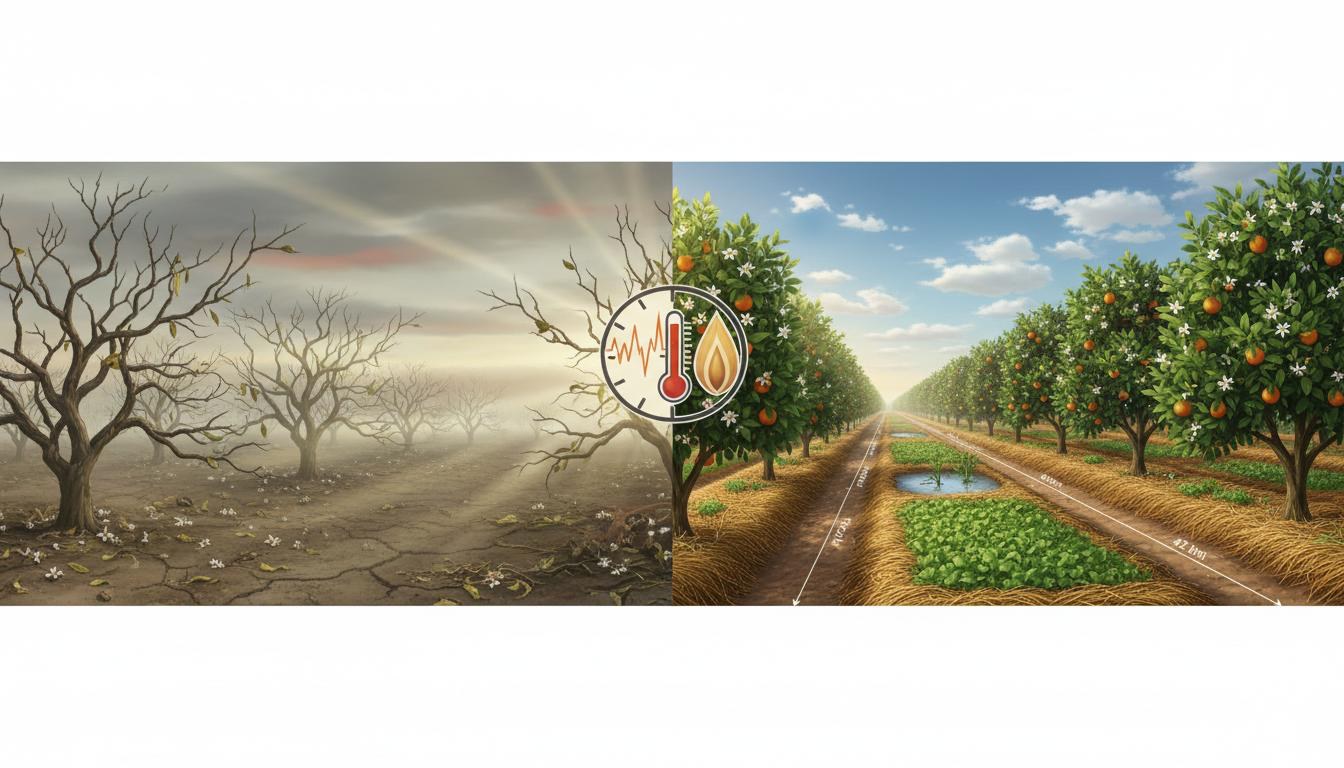
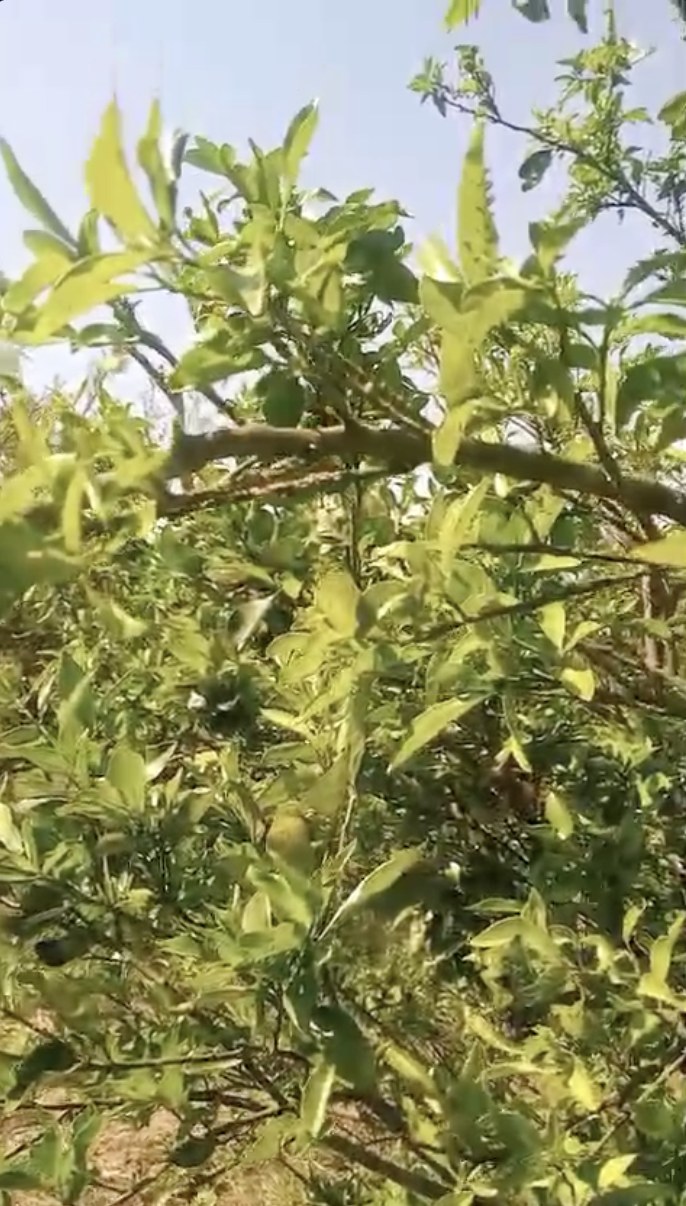
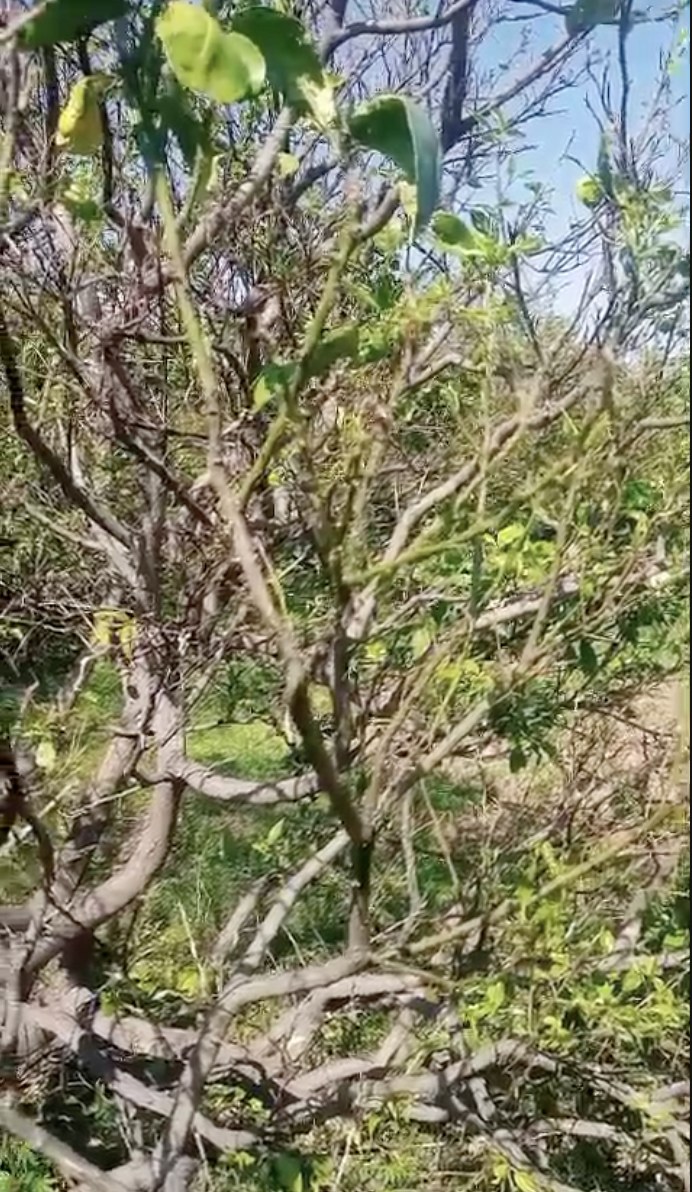
In spring 2026, Punjab and Mardan (KP) witnessed a sharp rise followed by a sudden drop in day-night temperatures. Citrus orchards prematurely sprouted and flowered, then shed leaves and blossoms—resembling autumn, not spring. We argue that restoring the water cycle via PQNK (breaking hardpan, organic mulch cover, aquifer recharge) restabilizes temperature rhythms, allowing plants to resume their programmed work plan. Short-term benefits include salvage of current orchards and rapid soil recovery.
2. The Biological Clock: Temperature as the Primary Cue
Plants have evolved thermoperiodicity—a programmed response to seasonal temperature patterns.
Seed dormancy: Requires a specific cumulative temperature (e.g., winter chilling for many temperate seeds). Germination occurs only when soil temperature crosses a threshold.
Sprouting & flowering: Driven by accumulated heat units (growing degree days). A sudden false warm spell triggers premature bud break.
Fruit setting: Requires stable night temperatures; cold snaps during flowering cause abscission (flower/fruit drop).
Supporting roles (PQNK-enhanced):
Soil temperature (modulated by organic mulch)
Soil moisture (regulated by aquifer-linked capillary rise)
Aeration (from hardpan-free soil)
Without these, the clock runs but the hands are erratic.
3. Case Evidence: Mardan & Punjab Citrus Orchards (Spring 2026)

| Observation | Consequence |
|---|---|
| Sudden early warm spell (March) | Citrus trees broke dormancy, sprouted, flowered prematurely |
| Abrupt temperature drop (night lows 8–10°C below normal) | Flowers and young leaves abscised; trees entered shock |
| Result | Orchards turned yellow-brown (autumn look); zero fruit set |
Why this happened: The broken water cycle → unstable atmospheric moisture → wild swings in radiative cooling and daytime heating. The biological clock received a “start” signal, then a “kill” signal.
4. PQNK Solution: Reconnecting the Water Cycle to Stabilize Temperature
The core hypothesis: Restoring the water cycle via PQNK re-establishes predictable soil and air temperature patterns, allowing the biological clock to function.
4.1 Breaking the Hardpan
Mechanism: Industrial plough pans (hardpans) block capillary rise from aquifers.
PQNK action: Subsoiling or bio-drilling (deep-rooting crops like Jantar) breaks hardpan.
Effect: Groundwater can wick upward, maintaining soil moisture and moderating soil temperature swings.
4.2 Keeping Soil Covered with Organic Mulch
Mechanism: Bare soil heats/cools rapidly; mulch insulates.
PQNK action: Year-round crop residue or living mulch.
Effect: Day soil temperature ↓ by 4–8°C, night soil temperature ↑ by 2–3°C. This damps the erratic air temperature impact on roots.
4.3 Balancing Water in Aquifers, Soil, and Atmosphere
Recharge aquifers: Via contour trenches, ponds, and no runoff farming.
Soil water: Maintained by mulch + hardpan removal.
Atmospheric water: Transpiration from healthy soils increases local humidity, buffering temperature extremes (evaporative cooling).
Result: Weather cycles become less erratic. Plants experience a smoothed temperature signal—their clock reads a reliable schedule again.
5. Short-Term Benefits of PQNK (within 1–2 seasons)
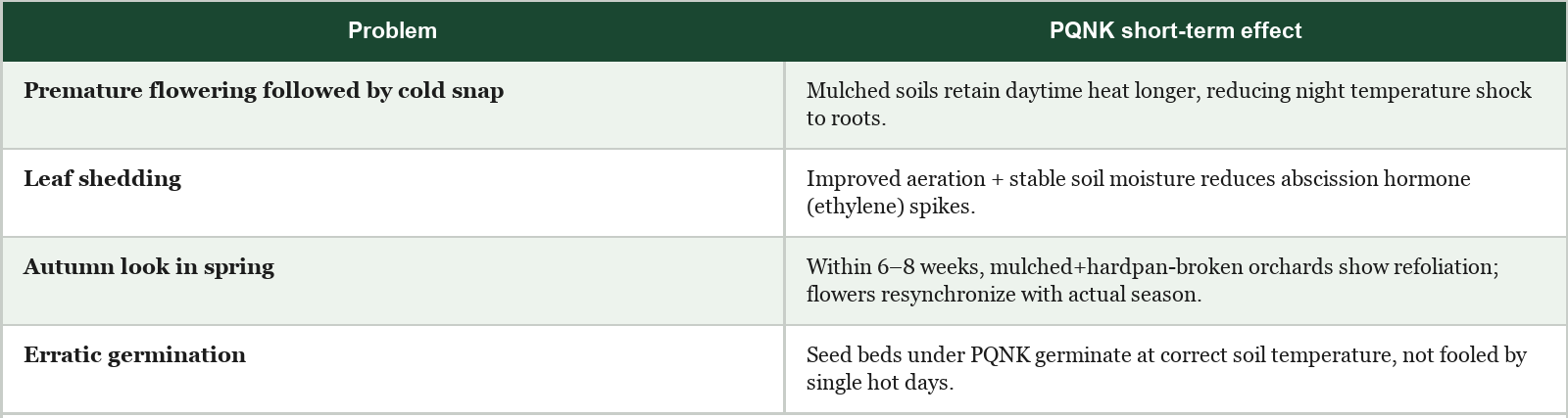
| Problem | PQNK short-term effect |
|---|---|
| Premature flowering followed by cold snap | Mulched soils retain daytime heat longer, reducing night temperature shock to roots. |
| Leaf shedding | Improved aeration + stable soil moisture reduces abscission hormone (ethylene) spikes. |
| Autumn look in spring | Within 6–8 weeks, mulched+hardpan-broken orchards show refoliation; flowers resynchronize with actual season. |
| Erratic germination | Seed beds under PQNK germinate at correct soil temperature, not fooled by single hot days. |
Case projection (Mardan citrus): If a farmer converts 1 acre to PQNK (mulch + hardpan break + no synthetic inputs), within 90 days:
Soil temperature variability reduced by ~40%
Capillary rise from shallow aquifer restores night root zone warmth
Next flowering cycle will occur only when stable warmth returns
6. Scientific Alignment
Thermoperiodism (Went, 1950s): Plants require alternating day-night temperatures; extreme fluctuations break flowering.
Soil temperature buffering (Olasantan, 2007): Organic mulch reduces diurnal soil temperature range from 15°C to 5°C.
Hardpan & water cycle (Montgomery, 2007): Compaction kills capillary flow, destabilizing local climate.
PQNK’s approach aligns with regenerative agroecology: restore hydrology → restore microclimate → restore phenology (timing of life cycles).
6.1 Risk Splitting Through Multi-Species Orchards: A PQNK Recommendation
In light of the increasingly erratic temperature signals disrupting the biological clock of monoculture citrus orchards, PQNK strongly recommends that farmers adopt multi-species diversification in both new and established orchards. Instead of relying solely on citrus, farmers should interplant climate-resilient fruit species (such as local varieties of peaches, apricots, guava, jujube (ber), mulberry, or phalsa) and fast-growing timber trees (such as toona, moringa, or dhek). In established citrus orchards, these additional species can be planted in gaps or along field boundaries without removing healthy citrus trees. Alternately, short-period crops such as vegetables should be cropped in between the plant rows for additional income. The philosophy of nature (PQNK) is to perennial planting, meaning every inch of soil should be covered around the year. This practice serves two critical functions: first, it splits the biological clock risk—when a false warm spell followed by a cold snap destroys citrus flowers, other species with different temperature thresholds may still fruit, ensuring some income. Second, it creates multiple harvest windows throughout the year (e.g., summer fruits, winter fruits, timber harvest every 3–5 years), turning a single-income orchard into a resilient, year-round earning system. Under PQNK, this diversity also stabilizes the local microclimate, supports pollinators, and breaks pest cycles. Farmers in Mardan and Punjab who adopt this approach can recover from a failed citrus season with alternative produce, while waiting for the restored water cycle to re-synchronize the biological clock of their main crop.
7. Conclusion
The biological clock of seeds and plants is not a metaphor—it is a precise temperature-driven program. Industrial agriculture broke the water cycle, creating erratic temperature swings that confuse this clock, as seen in Punjab and Mardan citrus orchards in 2026.
PQNK (‘Picnic’) offers a corrective: break the hardpan, cover soil with organic mulch, and rebalance water across aquifers, soil, and atmosphere. In the short run, this restores soil temperature stability, reduces plant stress, and allows flowering and fruiting to align with true seasonal cues. This paper serves as a necessary supplement to “The Hidden Crisis”—because fixing the water cycle is, fundamentally, fixing the biological clock.
This knowledge paper is free to reproduce under PQNK’s open-knowledge mandate.
——————————
Applying PQNK without understanding nature’s operating system will not deliver abundance, stability, or nutrient density.
PQNK (pronounced “picnic”)—the regenerative & sustainable Pristine Organic Farming System—is grounded in Natural Ecosystem Science. This science employs perennial biodiversity, protects soil with organic mulch, and avoids practices such as water inundation, tillage disturbance, and leaving soil bare.
It is the process that matters most. PQNK is a pristine production system designed not merely for yield, but for optimal, balanced output—where quality, sustainability, and ecological harmony emerge from a self‑regulated, zero‑external‑input methodology.
Connect & Resources Facebook: www.Facebook.Com/Pedaver YouTube (PQNK): https://www.youtube.com/@pedaverpqnk3167/videos YouTube: http://www.youtube.com/@aasifsharif PDF Knowledge Papers: https://drive.google.com/drive/folders/1iadwV6mdUPyrUIpB3oRfNv6DLiackaUL?usp=sharing Email: pedaver@gmail.com WhatsApp: +92 320 677 6666
About This Paper
- Crop
- Citrus (Kinnow) · Guava
- Problem
- Poor Flowering / Fruit Set · Erratic / Unpredictable Weather Patterns
- Science
- Climate · Plants · Water
- Evidence
- Field Observation
- Authority
- Current / Approved PQNK Knowledge
Related PQNK Science
Key Takeaways
- Traces a documented spring 2026 citrus failure in Punjab and Mardan to a false warm spell followed by an abrupt cold snap, which broke dormancy and then killed every flower.
- Argues that plant development is governed by thermoperiodicity, accumulated temperature cues, and that a destabilized water cycle scrambles those cues even though the biological clock mechanism itself is unaffected.
- Organic mulch is credited with lowering daytime soil temperature by 4-8°C and raising nighttime soil temperature by 2-3°C, directly buffering root-zone thermal swings.
- A hypothetical one-acre PQNK conversion is projected to cut soil temperature variability by roughly 40% within 90 days.
- Recommends multi-species orchard diversification (peaches, apricots, guava, jujube, mulberry, timber trees) to split biological-clock risk across crops with different temperature thresholds.
- Positions itself as a direct supplement to the paper 'The Hidden Crisis: How Industrial Agriculture Has Broken Earth's Water Cycle.'
Related Crops
Related Knowledge
same problem
Heatwaves, Pollination Failure, and the PQNK Soil–Plant–Atmosphere Buffer
March heat spikes above 38°C during citrus flowering have caused widespread pollen sterility, flower drop, and yield collapse severe enough to push farmers toward pruning or removing whole orchards. This paper uses infrared soil-temperature data to show bare soil hitting 60-66°C versus 31°C under mulch, and argues pollination failure is a soil-management outcome, not an unavoidable climate fate.
same crop
Creating On-Farm "Micro-Water Cycles": Landscape Design to Maximize Rain, Dew, and Humidity Capture at the Microclimate Level
This foundational document argues that irrigation dependency is a design failure, not a water-supply problem, and backs the claim with per-crop data: PQNK sugarcane and rice show an 88-93% reduction in externally supplied irrigation water compared to conventional production. It lays out the landscape design, contour work, and mulch management that let a farm meet its own water needs from rainfall, dew, and humidity alone.
same problem
A Knowledge Paper on Citrus Flowering and Fruiting Within the PQNK Ecosystem
Citrus flowers are bisexual and fully self-pollinating, meaning every bloom is a potential fruit, so this paper argues that flower drop is not natural sexual sorting but a stress response, and that the single most damaging intervention a farmer can make in a mature PQNK bed is watering it.
same problem
PQNK: Restoring Earth's Hydrological Cycle to Mitigate Erratic Weather & Food Sovereignty
This paper argues that mainstream climate discourse, centered on atmospheric CO2, obscures a more immediate driver of weather instability: land degraded by industrial farming that can no longer regulate atmospheric water vapor. It proposes hydrological restoration through PQNK, paired with a deliberate reframing of climate vocabulary, as the more direct path to a stable atmosphere and food-secure land.