

KP-052 · Water & Climate
Creating On-Farm "Micro-Water Cycles": Landscape Design to Maximize Rain, Dew, and Humidity Capture at the Microclimate Level
This foundational document argues that irrigation dependency is a design failure, not a water-supply problem, and backs the claim with per-crop data: PQNK sugarcane and rice show an 88-93% reduction in externally supplied irrigation water compared to conventional production. It lays out the landscape design, contour work, and mulch management that let a farm meet its own water needs from rainfall, dew, and humidity alone.
Read or listen to the full paper ↓Abstract
The paper frames millennia of tillage-based agriculture as a slow-motion fracturing of the local water cycle: disrupted soil structure, removed organic cover, and impaired natural moisture-capture mechanisms have produced a deep dependency on irrigation, aquifer depletion, and drought vulnerability. Its central claim is that nature already provides all the water resilient plant growth needs, through rainfall, daily dew, humidity held in soil-feeding organic mulch, and capillary and biological distribution networks, and that PQNK's job is simply to remove the obstacles (chiefly tillage and bare soil) that industrial farming has placed in front of these mechanisms.
On method, the paper is specific: hardpan must be completely broken so rain infiltrates instantly where it falls rather than running off, and beds, mulched zones, and plantings must follow the land's natural contour so the farm becomes a series of level water-harvesting terraces with zero field-scale water loss. Organic crop-residue mulch is identified as the single most important technology in the system, functioning simultaneously as an evaporation barrier and as a hygroscopic buffer that condenses and absorbs dew and atmospheric humidity overnight, releasing it gradually to soil and roots.
The paper's most striking claims are quantitative. It reports PQNK water use for sugarcane at 26 liters per kg of crop versus 206 liters conventionally (an 88% reduction), and 156 liters per kg of sugar produced versus 2,284 liters (a 93% reduction). For rice, it reports 321 liters per kg versus 4,699 liters conventionally, a 93% reduction, and argues rice's reputation as a water-guzzler is an artifact of flooding and evaporation on bare, poorly managed soil rather than an inherent crop requirement, since high monsoon-season humidity and narrow rice leaves are naturally water-efficient.
A rainwater calculator included in the paper estimates that one acre in Punjab, at a conservative 400 mm annual rainfall, receives over 2.5 million liters of water a year, roughly three times the maximum 850,000 liters per acre the paper calculates even its most demanding crops require under PQNK's Soil Moisture Management approach. On this basis, the paper concludes the challenge is water mismanagement, not water scarcity, and reports PQNK farmers producing citrus, peaches, mango, and guava with no irrigation at all, and banana, wheat, cotton, sugarcane, and rice with at least 80% less irrigation than conventional.
The paper closes by positioning irrigation not as something to make more efficient but as something to make obsolete for staple food production, through the combination of hardpan-breaking, contour alignment, permanent mulch cover, and crops grown in step with their natural seasonal humidity.
Full Paper
If you use “Listen”, the text of the page may be sent to your browser or operating system’s speech provider, such as Apple, Google or Microsoft, depending on the voice your device uses. Pedaver does not process, transmit or store any audio.
1. Introduction: Restoring the Cycle, the PQNK Way
For millennia, since the domestication of draft animals, tillage-based agriculture has progressively fractured the local water cycle by disrupting soil structure, removing organic cover, and impairing the natural mechanisms that capture and recycle atmospheric moisture. This long-standing practice has led to a deep and unsustainable dependency on irrigation, widespread aquifer depletion, and increased vulnerability to drought.
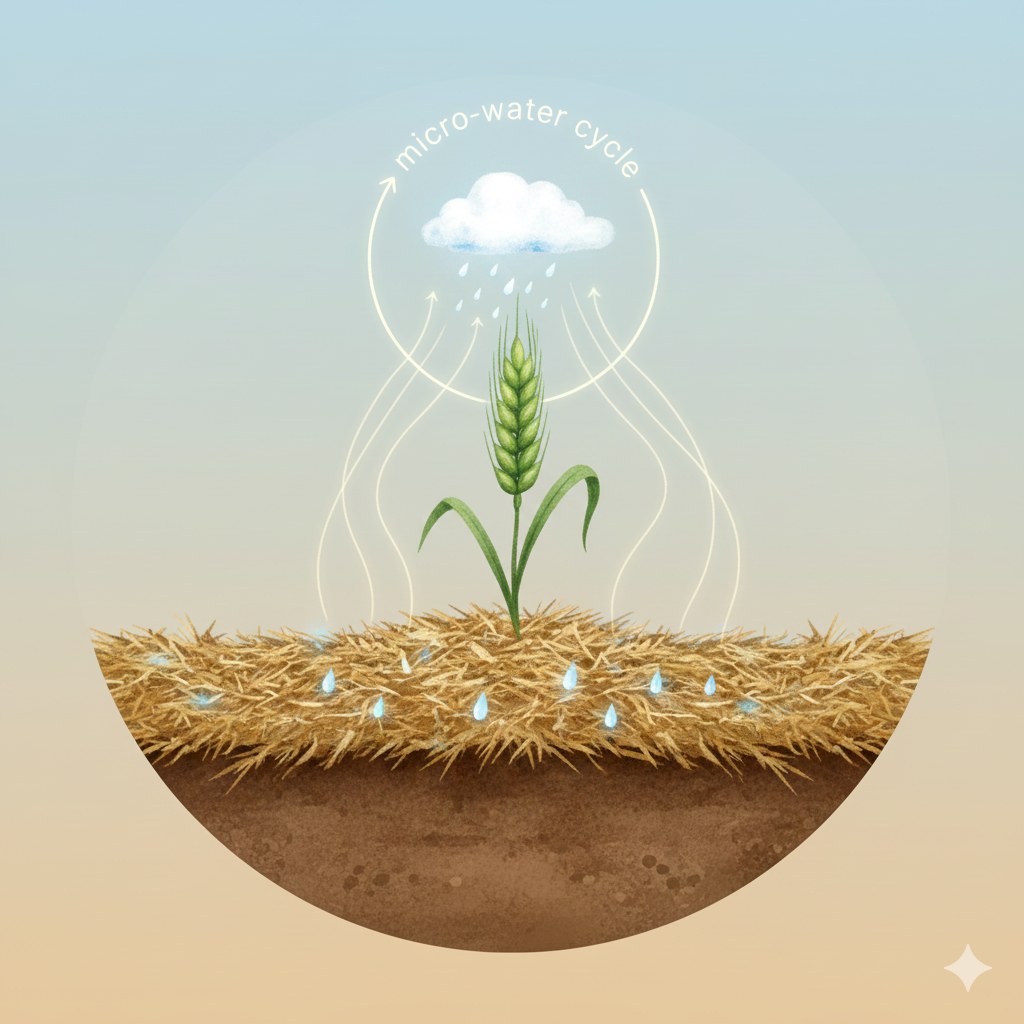
PQNK—Paedar Qudratti Nizam Kashtqari (pronounced “picnic”)—is the regenerative and sustainable pristine organic farming system. It is a closed-loop framework that restores nature’s hydrological intelligence at the field level. This paper details how, through proper landscape design and management, a PQNK farm creates a resilient on-farm micro-water cycle that meets crop water needs entirely from natural precipitation, dew, and humidity— eliminating the need for irrigation.
2. Core Principle: The Natural Water Buffer is Sufficient
As outlined in Uncovering the Secrets of Natural Water Supply Systems, nature provides all the water necessary for resilient plant growth through:
• Rainfall as the primary source.
• Dew as a daily supplementary source.
• Humidity as a reservoir that reduces plant transpiration and feeds organic mulch.
• Soil infiltration, capillary action, and biological networks for distribution and storage.
PQNK does not seek to add complex external technology to this system. Instead, it removes the obstacles imposed by industrial farming—especially tillage and bare soil—thereby allowing these natural mechanisms to function at their full capacity. The data proves that when this is done, rainfall alone is more than sufficient.
3. The PQNK Method: How the Micro-Water Cycle is Established
3.1. The Absolute Foundation: Breaking Hardpan & Contour Design
• Deep Soil Liberation: The first non-negotiable step is the complete breakdown of soil hardpan. This allows every drop of rainwater to infiltrate instantly where it falls, ending runoff and enabling deep recharge.
• Contour-Aligned Systems: All beds, mulched zones, and plantings follow the natural contour. This transforms the entire farm into a series of level, water-harvesting terraces, ensuring zero water loss from the field.
3.2. Organic Mulch: The Universal Moisture Engine
PQNK recognizes crop-residue-based organic mulch as the single most important technology for water cycling.
• Rain Capture: A thick mulch layer eliminates evaporation, ensuring 100% of infiltrated rain is preserved in the soil profile.
• Dew & Humidity Harvesting: The mulch acts as a hygroscopic buffer. During nights and periods of high humidity, moisture from the air condenses on and is absorbed by the mulch, which then releases it to the soil and plant roots. No special materials or surfaces are needed—the diverse organic matter provided by the system itself is perfectly designed for this function.
• The Result: As the attached tables demonstrate, this mulch-based Soil Moisture Management (SMM) system reduces crop water demand from conventional irrigation by 80-92% (see Table: Water use efficiency on PQNK).
3.3. Re-Evaluating "High-Water" Crops: The Data-Driven Reality
The attached comparative analyses reveal a paradigm-shifting truth:
For Sugarcane (PQNK vs. Conventional):
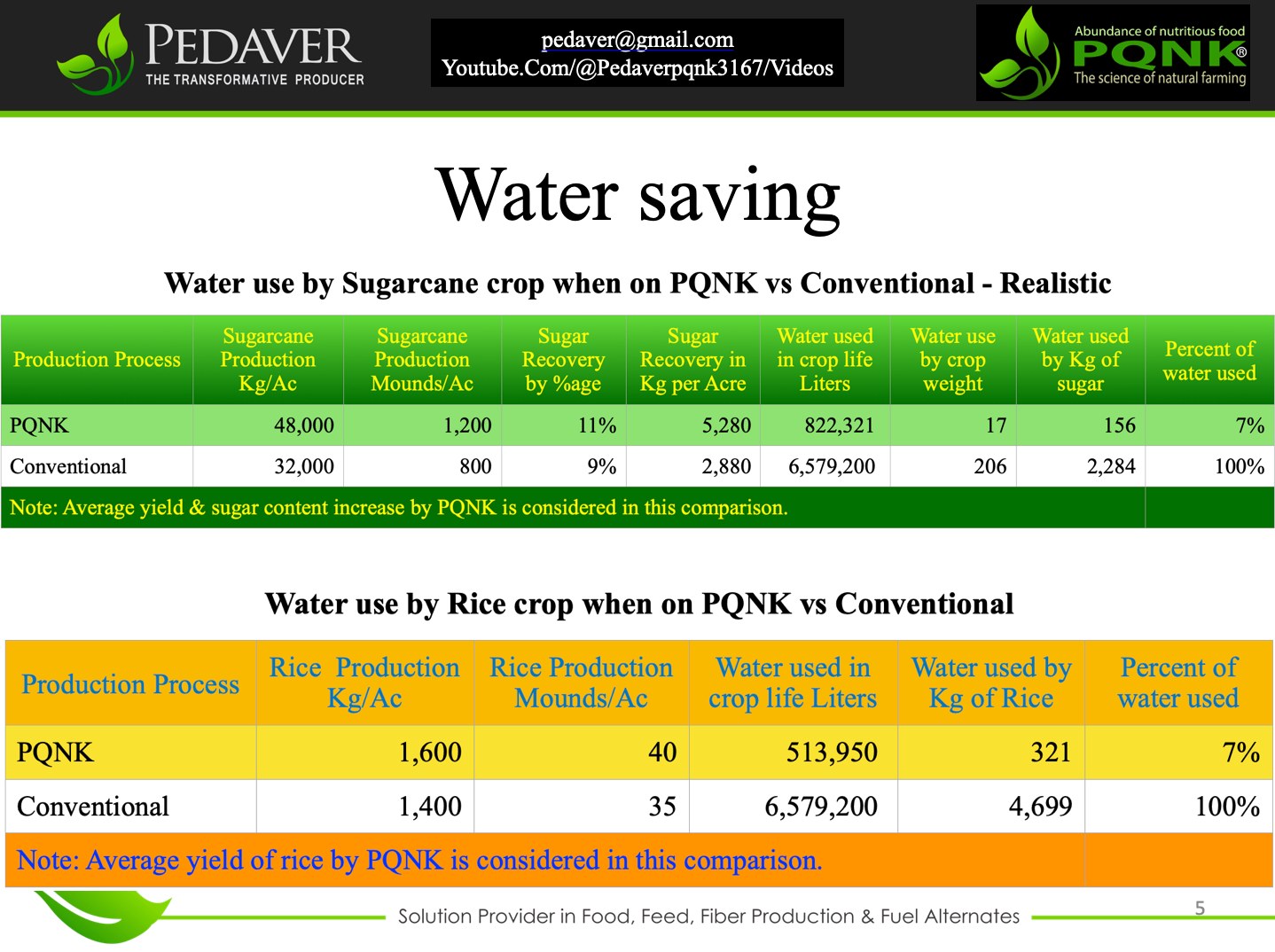
| Production Process | Sugarcane Production Kg/Ac | Sugarcane Production Mounds/Ac | Sugar Recovery by %age | Sugar Recovery in Kg per Acre | Water used in crop life Liters | Water use by crop weight | Water used by Kg of sugar | Percent of water used |
|---|---|---|---|---|---|---|---|---|
| PQNK | 48,000 | 1,200 | 11% | 5,280 | 822,321 | 17 | 156 | 7% |
| Conventional | 32,000 | 800 | 9% | 2,880 | 6,579,200 | 206 | 2,284 | 100% |
| Note: Average yield & sugar content increase by PQNK is considered in this comparison. | ||||||||
| Water use by Rice crop when on PQNK vs Conventional | Rice Production Kg/Ac | Rice Production Mounds/Ac | Water used in crop life Liters | Water used by Kg of Rice | Percent of water used | |||
| PQNK | 1,600 | 40 | 513,950 | 321 | 7% | |||
| Conventional | 1,400 | 35 | 6,579,200 | 4,699 | 100% | |||
| Note: Average yield of rice by PQNK is considered in this comparison. |
• Water use per kg of crop: 26 liters vs. 206 liters (88% reduction).
• Water use per kg of sugar produced: 156 liters vs. 2,284 liters (93% reduction).
For Rice (PQNK vs. Conventional):
• Water use per kg of crop: 321 liters vs. 4,699 liters (93% reduction).
Critical Insight: Rice, often maligned as a "water-guzzler," is naturally a low-water crop when grown within its correct ecological context—the monsoon season. High humidity drastically reduces transpiration, and its narrow leaves are inherently water-efficient. The extreme water use in conventional systems is an artifact of flooding and evaporation on bare, poorly managed soils, not a plant requirement.
3.4. The Rainfall Sufficiency Principle
The attached rainwater calculator shows that in the Punjab region (with a conservative annual average of 400 mm rainfall), one acre receives over 2.5 million liters of rainwater annually. The crop water requirement tables under PQNK's SMM system show that even the most water-demanding crops in the cycle use less than 850,000 liters per acre annually.
Therefore, 400 mm of rainfall provides approximately three times the water needed by every crop in the system. The challenge solved by PQNK is not water scarcity, but water
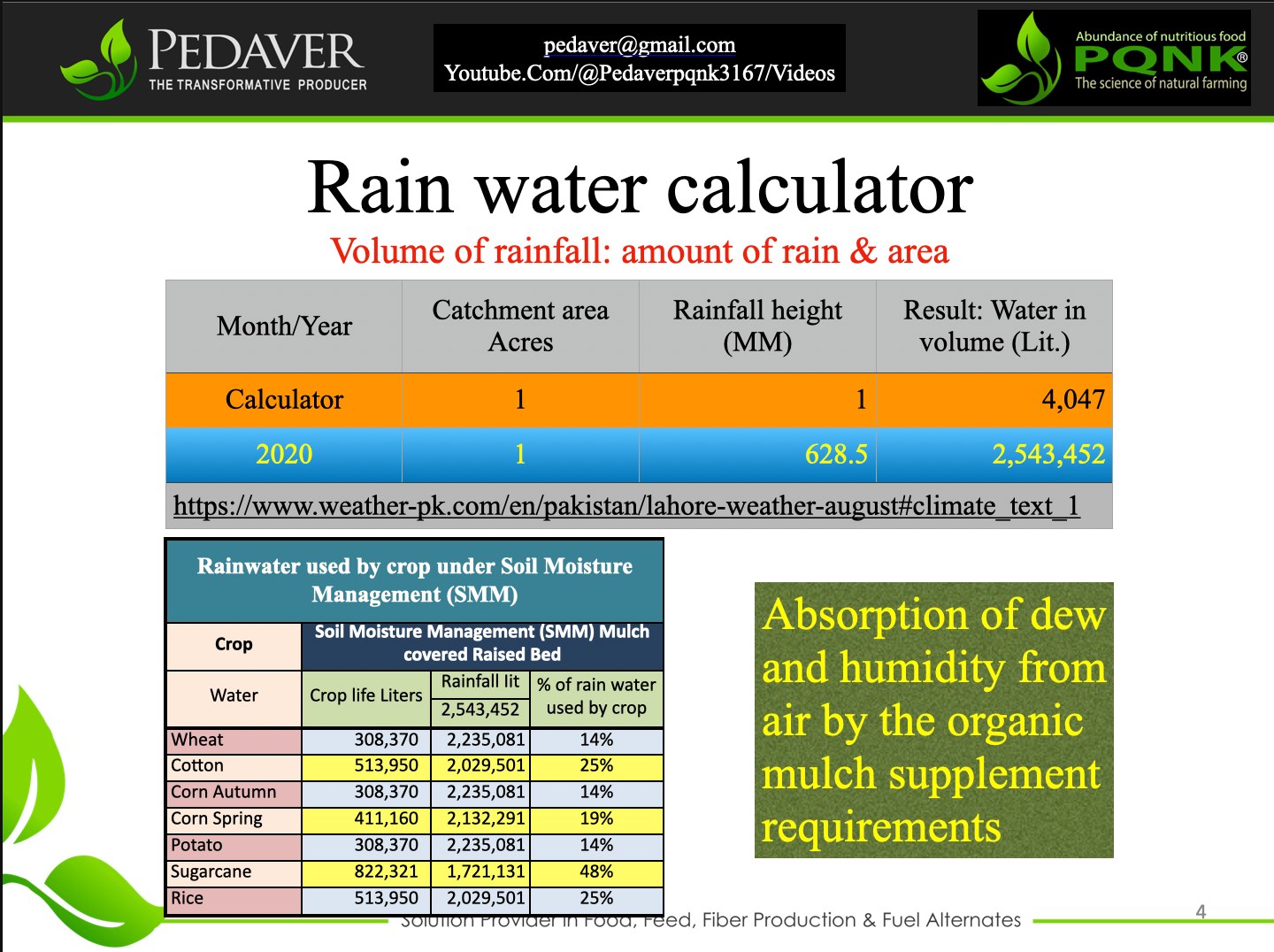
| Month/Year | Catchment area Acres | Rainfall height (MM) | Result: Water in volume (Lit.) |
|---|---|---|---|
| Calculator | 1 | 1 | 4,047 |
| 2020 | 1 | 628.5 | 2,543,452 |
| Source: https://www.weather-pk.com/en/pakistan/lahore-weather-august#climate_text_1 | |||
| Rainwater used by crop under Soil Moisture Management (SMM), mulch-covered raised bed: Crop | Crop life Liters | Rainfall lit 2,543,452 | % of rain water used by crop |
| Wheat | 308,370 | 2,235,081 | 14% |
| Cotton | 513,950 | 2,029,501 | 25% |
| Corn Autumn | 308,370 | 2,235,081 | 14% |
| Corn Spring | 411,160 | 2,132,291 | 19% |
| Potato | 308,370 | 2,235,081 | 14% |
| Sugarcane | 822,321 | 1,721,131 | 48% |
| Rice | 513,950 | 2,029,501 | 25% |
| Absorption of dew and humidity from air by the organic mulch supplement requirements. |
mismanagement. By capturing, infiltrating, and storing this rainfall via mulch and proper soil design, irrigation becomes redundant.
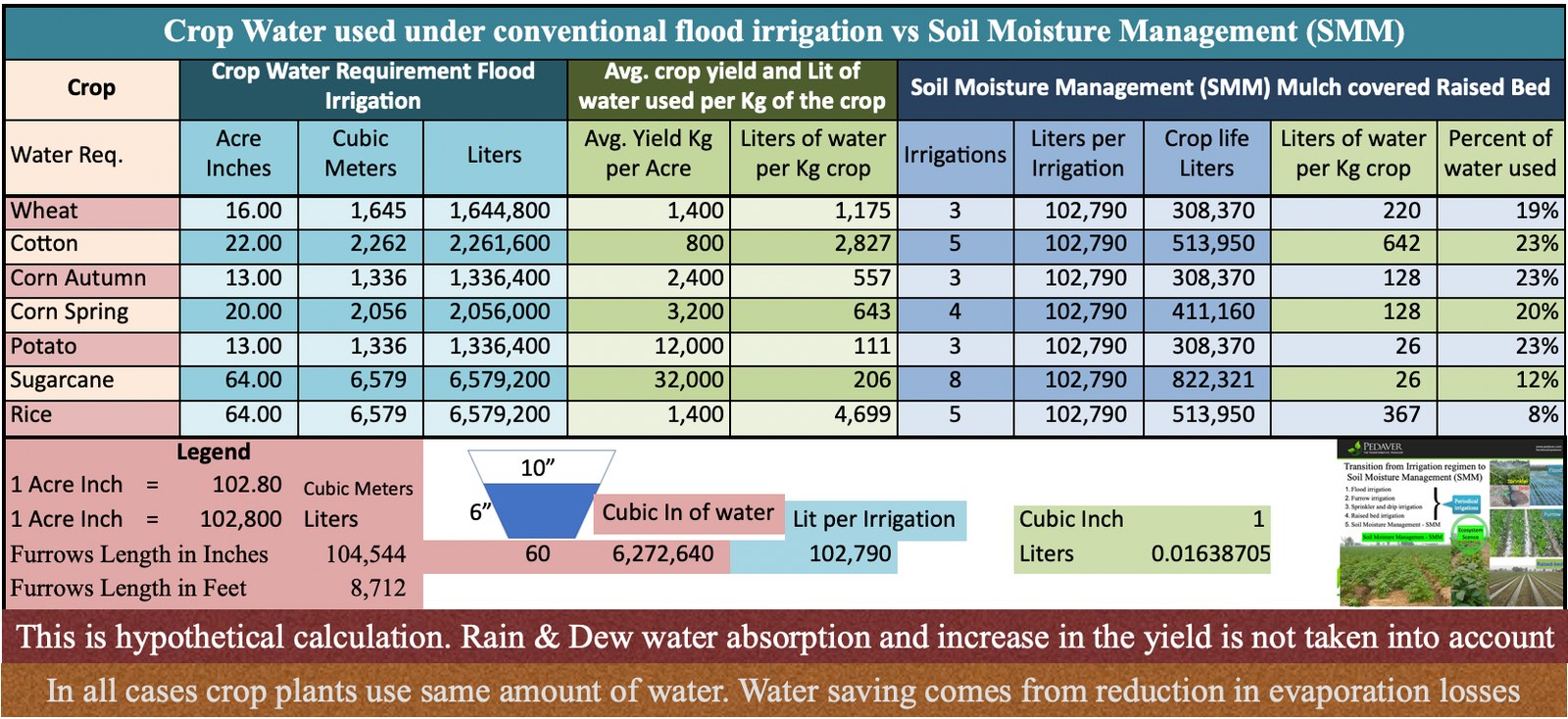
| Crop | Flood irrigation: Acre Inches | Flood irrigation: Cubic Meters | Flood irrigation: Liters | Avg. Yield Kg per Acre | Liters of water per Kg crop (flood) | SMM: Irrigations | SMM: Liters per Irrigation | SMM: Crop life Liters | SMM: Liters of water per Kg crop | SMM: Percent of water used |
|---|---|---|---|---|---|---|---|---|---|---|
| Wheat | 16.00 | 1,645 | 1,644,800 | 1,400 | 1,175 | 3 | 102,790 | 308,370 | 220 | 19% |
| Cotton | 22.00 | 2,262 | 2,261,600 | 800 | 2,827 | 5 | 102,790 | 513,950 | 642 | 23% |
| Corn Autumn | 13.00 | 1,336 | 1,336,400 | 2,400 | 557 | 3 | 102,790 | 308,370 | 128 | 23% |
| Corn Spring | 20.00 | 2,056 | 2,056,000 | 3,200 | 643 | 4 | 102,790 | 411,160 | 128 | 20% |
| Potato | 13.00 | 1,336 | 1,336,400 | 12,000 | 111 | 3 | 102,790 | 308,370 | 26 | 23% |
| Sugarcane | 64.00 | 6,579 | 6,579,200 | 32,000 | 206 | 8 | 102,790 | 822,321 | 26 | 12% |
| Rice | 64.00 | 6,579 | 6,579,200 | 1,400 | 4,699 | 5 | 102,790 | 513,950 | 367 | 8% |
| Legend: 1 Acre Inch = 102.80 Cubic Meters = 102,800 Liters; furrow length 104,544 inches (8,712 feet); a furrow 10 inches wide at the top, 6 inches deep, 60 cubic inches of water per inch of length, 6,272,640 cubic inches = 102,790 litres per irrigation; 1 cubic inch = 0.01638705 litres. | ||||||||||
| This is hypothetical calculation. Rain & Dew water absorption and increase in the yield is not taken into account. In all cases crop plants use same amount of water. Water saving comes from reduction in evaporation losses. |
4. System Integration: The Closed-Loop Water Economy in Practice
A functioning PQNK farm integrates these elements into a self-sustaining hydrological loop:
1. Rainfall is fully captured via contour design and infiltrated into hardpan-free soil.
2. Organic Mulch eliminates evaporation, harvests dew and humidity, and regulates soil temperature and moisture release.
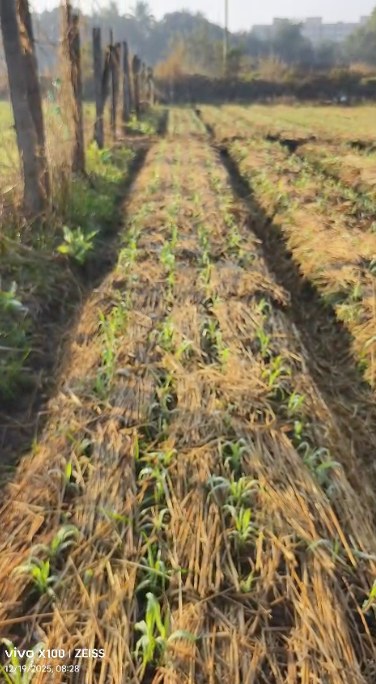
3. Soil Biology Autonomously Revitalizes: PQNK does not require artificial inoculation. By eliminating tillage and chemicals, and by providing constant organic matter, a pristine soil ecosystem re-establishes itself.
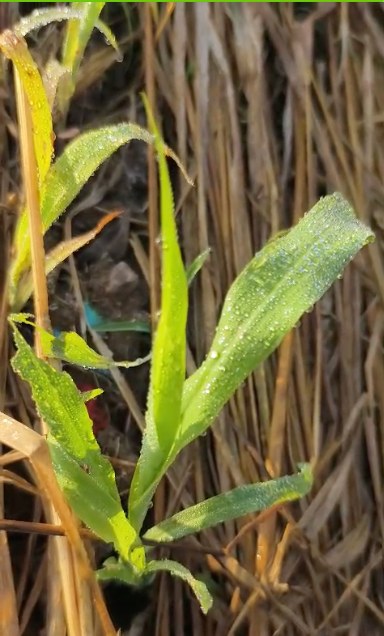
Mycorrhizal networks, bacteria, and fungi proliferate naturally, creating a "living water web" that distributes moisture and nutrients w i t h s u p r e m e efficiency.
4. The Microclimate
Shifts: The combined effect of vegetation layers and moist soil creates a cooler, more h u m i d f i e l d a t m o s p h e r e . T h i s further suppresses evaporation, enhances dew formation, and buffers plants against dry winds.
The outcome is a farm-scale water surplus, where the property meets all its needs from its own micro-water cycle.
5. The Empirical Proof: Beyond Theory
This document is not a proposal. It is a report from the field. We have a large and growing number of PQNK farmers who, for several years, have been producing abundant yields of citrus, peaches, mango, guava without irrigation, and banana, wheat, cotton, sugarcane, rice, and other crops with at least 80% reduced irrigation. It is well established that all crops can be grown without irrigation. Farmers are gradually coming out of the irrigation mindset. Their success is rooted in the exact principles and calculations presented here.
6. Conclusion: The End of Irrigation Dependency
Topic 10 establishes that the global water crisis in agriculture is a crisis of design and management, not of supply. The PQNK system demonstrates that by:
• Breaking hardpan,
• Farming on contour,
• Permanently covering soil with organic mulch from crop residues,
• And aligning crops with their natural seasonal humidity, a farm can become hydrologically self-sufficient. The data proves that natural precipitation,
enhanced by dew and humidity capture, is more than adequate for high-yield, high-quality production.
The goal of PQNK is not to make irrigation more efficient, but to make it obsolete for staple food production. By restoring the pristine, closed-loop water cycle of natural ecosystems, we create farms that are resilient, productive, and fundamentally in harmony with the climate.
References & Data Tables (Integrated from Attachments):
• Water Use Efficiency on PQNK: Comparison of Flood Irrigation vs. Soil Moisture Management (SMM)
• Comparative Water Use: PQNK vs. Conventional for Sugarcane and Rice
• Rainwater Calculator and Crop Utilization of Rainfall under SMM
• PQNK Foundational Documents: Topics 1-9 on Soil Liberation, Mulch, and Contour Design
PQNK – Farming in Harmony with Nature’s Logic. Proof in Practice.
Footnote: Any Production Process That Inundates Soil With Water, Disturbs Soil Through Tillage, Or Leaves Soil Bare Without Organic Mulch Cover Does Not Qualify As Natural Ecosystem Science For Production Agriculture.
PQNK, to be pronounced as 'picnic', which stands for Paedar Qudratti Nizam Kashatqari, and means: the regenerative & sustainable Pristine Organic Farming System.
About This Paper
- Crop
- Sugarcane · Rice · Citrus (Kinnow) · Peach · Mango · Guava · Banana · Wheat · Cotton
- Problem
- High Irrigation Cost / Dependency · Groundwater / Aquifer Depletion · Drought / Water Scarcity
- Science
- Water · Soil · Climate
- Evidence
- Measured Field Result
- Authority
- Current / Approved PQNK Knowledge
Related PQNK Science
Key Takeaways
- PQNK sugarcane shows an 88% reduction in externally supplied irrigation water per kg of crop and a 93% reduction per kg of sugar produced, compared to conventional cultivation.
- PQNK rice uses 321 liters of water per kg versus 4,699 liters conventionally, a 93% reduction, challenging rice's reputation as an inherently water-hungry crop.
- A conservative 400mm of annual Punjab rainfall delivers roughly three times the water even the most demanding crop in the PQNK rotation requires in a year.
- Organic mulch is identified as the system's single most important technology, functioning as both an evaporation barrier and a dew/humidity-harvesting hygroscopic buffer.
- PQNK farmers are reported growing citrus, peaches, mango, and guava with zero irrigation, and staple crops with at least 80% less irrigation than conventional.
- The paper's goal is explicitly to make irrigation obsolete for staple food production, not merely to make it more efficient.
Related Crops
Related Knowledge
same crop
Five Decades of Agricultural Innovation: Interventions and Achievements in Chronological Order, 1973–2023
Asif Sharif's own year-by-year record of fifty years of hands-on agricultural intervention in Pakistan, from early machinery and seed distribution through the 2008 development of PQNK and its crop-by-crop expansion since, presented as the primary evidentiary record behind PQNK: a ground-up, farmer-verified track record rather than a journal citation.
same problem
Rain Where It Falls: Restoring the Soil Before Building More Water Storage
Rajendra Singh’s Rajasthan story shows that slowing runoff lets water enter the ground and restore wells and rivers. PQNK moves that principle upstream into the field itself: correct the hardpan, stop disturbing the soil, keep the surface covered, and let every acre receive and hold the rain where it falls, so that agricultural water demand stays within what the landscape renews.
same problem
Knowledge Paper: The Looming Convergence of Oil and Food Crises — The Imperative for a Paradigm Shift toward PQNK
Written against the backdrop of an escalating Middle East conflict and its spillover into global oil markets, this paper maps how deeply Pakistan's and India's food systems are structurally dependent on fossil fuel, from Haber-Bosch fertilizer to diesel-pumped irrigation, and argues PQNK is the only de-risking strategy that breaks the link entirely rather than subsidizing around it.
same crop
Can High-TDS Water Be Used to Rehabilitate Saline Soils?
Conventional guidelines flag groundwater above 1,000-1,500 ppm TDS as unsuitable for irrigation, pushing farmers to abandon productive land. This paper argues the real determinant isn't the water's salt concentration but the soil's physical and biological capacity to keep those salts moving instead of accumulating in the root zone, backed by a crop-by-crop salt-load data table.