

KP-022 · Crop-Specific Guides
A Knowledge Paper on Citrus Flowering and Fruiting Within the PQNK Ecosystem
Citrus flowers are bisexual and fully self-pollinating, meaning every bloom is a potential fruit, so this paper argues that flower drop is not natural sexual sorting but a stress response, and that the single most damaging intervention a farmer can make in a mature PQNK bed is watering it.
Read or listen to the full paper ↓Abstract
The paper's central thesis is that consistent, high-quality flowering year after year is the primary indicator of a fully established PQNK ecosystem, and that in a mature setup the plant, soil, and microbial life reach a dynamic equilibrium governing water, aeration, nutrients, and protection. Building on prior PQNK work such as 'Returning Dairy Waste to the Land,' it argues that any external intervention, particularly watering, fundamentally disrupts the delicate balance of the soil solution the plant depends on.
A key corrective runs through the paper's floral biology section: citrus flowers are perfect and bisexual, containing both functional male stamens and female pistil in the same structure, and are capable of self-pollination. There is no separate male flower that naturally drops. This means every single bloom represents the tree's full potential yield, and observed flower drop is not a sexual separation but the plant's decision to abort its own potential offspring. The paper frames the flower as a sophisticated sensor assessing the plant's resource budget, deciding whether to proceed with or abort the costly process of fruit development based primarily on the stability of the soil solution, the water-and-nutrient mixture in the soil pores that is the root's only source of sustenance.
External interventions, even organic ones, are treated as disturbances to this equilibrium. Manure, though organic, creates a sudden nutrient spike that alters the soil solution, signals the plant toward vegetative growth at the expense of flowering, and produces lush, soft growth that attracts sucking and chewing insects, breaking the orchard's layered protection system. What looks like a beneficial input becomes a source of instability that compromises both current fruit set and long-term ecosystem stability.
Watering is identified as the most insidious and damaging intervention of all in a mature bed, one that has already built the capacity to draw and store water from deep subsoil through capillary action. Applying external water at the flowering stage dilutes the carefully balanced nutrient solution the roots depend on, causes a thermal shock where irrigation water differs in temperature from mulch-stabilized soil, and displaces air from soil pores by filling micropores that beneficial aerobic organisms need. The plant reads this combination as a major environmental crisis and triggers a mass drop of perfect, viable flowers, prioritizing survival over reproduction.
In contrast, an undisturbed, mature PQNK bed delivers a balanced water-nutrient solution, mulch-regulated stable temperature, optimal aeration, and layered biological protection as a single, unified signal of resource security, the precondition under which a citrus tree commits its self-sufficient flowers to fruit. The paper closes by reframing the farmer's highest form of stewardship as restraint: the wisdom of PQNK is understanding that in a truly natural system, the best intervention during flowering is often the one you do not make.
Full Paper
If you use “Listen”, the text of the page may be sent to your browser or operating system’s speech provider, such as Apple, Google or Microsoft, depending on the voice your device uses. Pedaver does not process, transmit or store any audio.
Abstract
The PQNK (Paedar Qudratti Nizam Kashatqari) system, or Pristine Organic Farming System, is founded on the principle of a self-regulating, closed-loop ecosystem. Within a mature PQNK setup, the plant, soil, and associated microbial life achieve a dynamic equilibrium that governs water, aeration, nutrients, and protection. This paper examines citrus flowering and fruit set through the lens of this ecological balance. It posits that consistent, high-quality flowering year after year is the primary indicator of a fully established PQNK ecosystem. Building upon foundational PQNK principles—such as those outlined in "Returning Dairy Waste to the Land"—this paper argues that any external intervention, particularly the application of water, fundamentally disrupts the delicate balance of the soil solution. Drawing upon the established reproductive biology of citrus, this paper clarifies that citrus flowers are bisexual and self-pollinating, dispelling the myth of male flower drop. The disruption caused by intervention is interpreted by the plant as an environmental stress signal, leading to the shedding of perfect, viable flowers and a consequent reduction in productivity. The paper details the ideal conditions within a mature PQNK bed—a balanced water-nutrients solution, regulated soil temperature via mulch, optimal aeration, and a layered biological protection system—that together signal to the plant that it has sufficient resources to successfully convert its self-pollinating flowers into fruit.
1. Introduction: The PQNK Ecosystem as the Foundation for Reproductive Success
PQNK is not merely a set of farming techniques; it is a philosophical and practical framework for regenerating and sustaining a natural ecosystem. As articulated by its founder, Asif Sharif, modern agricultural research has dismantled a natural provisioning system that sustained life for over 400 million years. PQNK seeks to restore this system by creating a closed-loop microenvironment where all inputs are internally generated and balanced. In this paradigm, the primary role of the farmer is to establish the system and then refrain from intervention, allowing the inherent intelligence of nature to guide plant health and productivity.
In the context of citrus, a mature PQNK ecosystem is defined by its ability to independently regulate the four core "provisions" required for plant life: water, aeration, nutrients, and protection. A well-matured bed, with its complex food web and stable physical structure, maintains these provisions in a precise, homeostatic balance. The plant, in constant communication with this system, perceives this stability as a signal of resource abundance and security. It is only under this condition of perceived stability that the plant will commit significant energy to a heavy fruit set. Any deviation from this equilibrium is interpreted as a potential threat, triggering a survival response: the plant will self-regulate by shedding flowers to reduce its reproductive load. This paper will explore how flowering and fruit set in citrus are therefore not just botanical processes, but profound indicators of the health and stability of the underlying PQNK ecosystem.
2. Floral Biology: The Self-Sufficient Citrus Flower
To understand why flower drop occurs, we must first understand the nature of the citrus flower itself. A common myth in traditional farming is that citrus trees produce separate male flowers that naturally fall off, leaving the female flowers to bear fruit. This is incorrect and obscures the true cause of flower shedding.
2.1. Bisexual and Self-Pollinating Flowers
Citrus flowers are perfect or bisexual, meaning each individual flower contains both functional male (stamens) and female (pistil) reproductive organs within the same structure. There are no separate male and female flowers on a citrus tree. Furthermore, citrus flowers are capable of self-pollination; pollen from the stamens of a flower can fertilize the ovules within the same flower. This means that, biologically, every single flower that blooms on a citrus tree has the inherent potential to develop into a fruit, provided the tree is healthy and resources are abundant.
2.2. The PQNK Interpretation of Floral Potential
From a PQNK perspective, this biological fact is critically important. It means that when a citrus tree enters its flowering stage, it is presenting the farmer with 100% potential yield. Every bloom is a potential fruit. Therefore, when we observe flowers falling to the ground, we are not witnessing a natural separation of sexes. We are witnessing a plant's decision to abort its own potential offspring.
The flower is not just a reproductive organ but a sophisticated sensor that assesses the plant's overall resource budget. It is the point where the plant decides to proceed with or abort the costly process of fruit development. The primary criterion for this decision is the stability and balance of the soil solution—the mixture of water and soluble nutrients within the soil pores. This solution is the plant's only source of sustenance. If this solution is diluted or its composition fluctuates, the plant's roots detect this as an unreliable food supply. The plant "calculates" that it cannot guarantee the nutrient uptake required to mature a full crop of fruit. Its evolutionary imperative is to conserve resources for survival and future reproduction. Therefore, it triggers a hormonal cascade that results in the abscission (shedding) of a significant portion of its perfect, self-pollinating flowers, retaining only what it judges it can support.
This understanding reframes the conventional explanation of flower drop. It is not a random event or a separation of male blooms, but a calculated, strategic response to perceived environmental instability.
3. External Interventions as Disturbances to the PQNK Equilibrium
The core tenet of PQNK is that any external input into a mature ecosystem constitutes a disturbance . This section examines the specific impact of such disturbances on flowering and fruit set.
3.1. The Fallacy of "Returning Dairy Waste to the Land"
Previous PQNK knowledge papers, such as "Returning Dairy Waste to the Land," have established that even seemingly beneficial organic inputs like manure can disrupt the natural equilibrium. In a mature system, the soil biology is precisely calibrated to cycle nutrients at a rate that matches the plant's needs. The addition of manure, even though organic, creates a nutrient spike. This sudden surge in soluble nitrogen, for example, can:
Alter the Soil Solution: It changes the delicate balance of the water-nutrients solution, shocking the system.
Trigger Vegetative Growth: The plant receives a signal of excess nitrogen, which it interprets as a cue for vegetative (leaf and stem) growth at the expense of reproductive (flower and fruit) growth.
Attract Pests: The resulting lush, soft growth is highly attractive to sucking and chewing insects, breaking the layered protection system.
Thus, the "beneficial" input becomes a disturbance that compromises both the current fruit set and the long-term stability of the ecosystem.
3.2. Watering: The Most Disruptive Intervention
While any external input is problematic, the application of water is considered the most insidious and damaging intervention in a mature PQNK bed. A fully established soil system, rich in organic matter from years of mulching, possesses a remarkable capacity to regulate its own moisture . It draws water from the deep subsoil through capillary action and stores it efficiently, making the plant resilient to dry spells.
Applying external water at the flowering stage has several catastrophic effects:
Dilution of the Nutrient Solution: This is the most immediate and critical impact. The plant's roots are immersed in a solution that has been carefully balanced by microbial activity. Adding water dilutes this "nutrient broth," lowering the concentration of essential elements. The plant's roots sense this dilution as a sudden drop in food availability.
Temperature Shock: In the PQNK system, organic mulch maintains a stable, cool soil temperature, which is vital for healthy root function and hormone signaling. Irrigation water, whether from a well or canal, is often at a different temperature. Applying it can cause a thermal shock to the root zone, further stressing the plant.
Aeration Imbalance: A well-aerated soil has a specific ratio of water to air in its pores. Over-watering fills the micropores, displacing air and creating anaerobic conditions. This suffocates beneficial aerobic organisms and can lead to root stress.
The Plant's Response: The plant perceives these combined signals—diluted food, temperature fluctuation, and reduced aeration—as a major environmental crisis. Its immediate response is to trigger a massive drop of its perfect, self-pollinating flowers. The plant concludes that the nutrient uptake system is compromised and that it lacks the resources to mature fruit. It prioritizes survival over reproduction, shedding flowers to reduce demand on its roots.
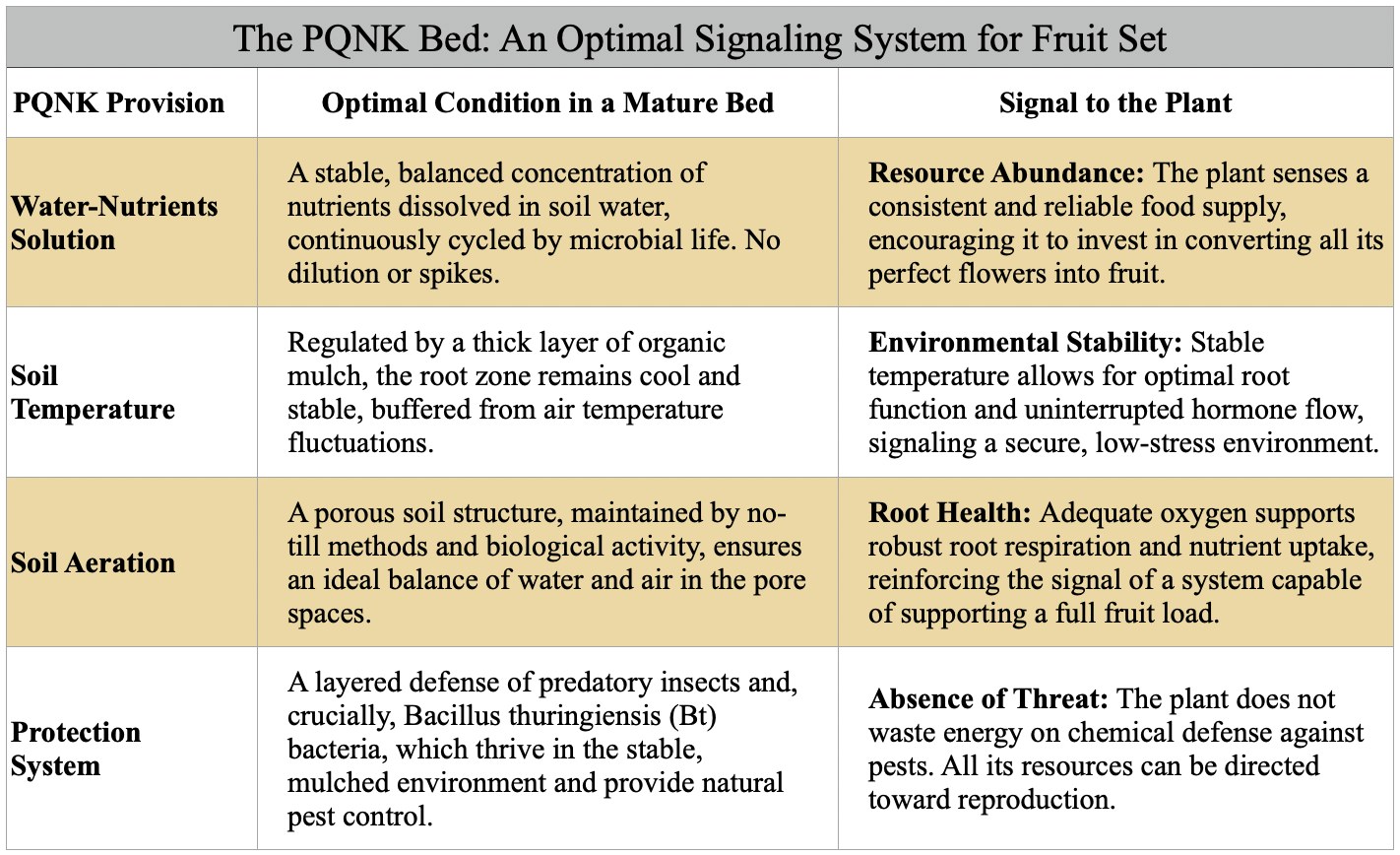
4. The PQNK Bed: An Optimal Signaling System for Fruit Set
| PQNK Provision | Optimal Condition in a Mature Bed | Signal to the Plant |
|---|---|---|
| Water-Nutrients Solution | A stable, balanced concentration of nutrients dissolved in soil water, continuously cycled by microbial life. No dilution or spikes. | Resource Abundance: The plant senses a consistent and reliable food supply, encouraging it to invest in converting all its perfect flowers into fruit. |
| Soil Temperature | Regulated by a thick layer of organic mulch, the root zone remains cool and stable, buffered from air temperature fluctuations. | Environmental Stability: Stable temperature allows for optimal root function and uninterrupted hormone flow, signaling a secure, low-stress environment. |
| Soil Aeration | A porous soil structure, maintained by no-till methods and biological activity, ensures an ideal balance of water and air in the pore spaces. | Root Health: Adequate oxygen supports robust root respiration and nutrient uptake, reinforcing the signal of a system capable of supporting a full fruit load. |
| Protection System | A layered defense of predatory insects and, crucially, Bacillus thuringiensis (Bt) bacteria, which thrive in the stable, mulched environment and provide natural pest control. | Absence of Threat: The plant does not waste energy on chemical defense against pests. All its resources can be directed toward reproduction. |
In contrast to the disturbance caused by intervention, a mature, untouched PQNK bed provides the perfect environment for the plant to perceive stability and security, thereby encouraging maximum fruit set. This environment is characterized by the following interdependent factors:
When all four of these provisions are in perfect, undisturbed balance, the plant receives a unified and powerful signal of "Optimal Conditions." It is in this state that a citrus tree, with its biologically self-sufficient flowers, will reward the farmer with abundant flowering and successful fruit set, year after year.
5. Conclusion: Non-Intervention as the Highest Form of Stewardship
The PQNK philosophy offers a profound reframing of agricultural productivity. In the context of citrus flowering, it teaches that the farmer's most critical task is not to do something to promote fruit set, but to refrain from doing anything that might disturb the natural balance. Good flowering is not a result of a single input or practice; it is a diagnostic indicator of a mature, healthy, and autonomous ecosystem below the ground.
The myth of male flower drop has for too long masked the true cause of low yields: human intervention. Every flower that falls is a perfect, self-pollinating fruit-bearing unit that the plant has chosen to sacrifice because it perceived a threat to its survival. The temptation to water a crop during flowering, or to add manure for a nutrient boost, must be resisted. These actions, born from a conventional mindset of intervention, are precisely the disturbances that shatter the plant's perception of security. By diluting the nutrient solution, shocking the soil temperature, and disrupting aeration, the farmer inadvertently sends a signal of scarcity and stress, triggering the very flower drop they hoped to prevent. The wisdom of PQNK lies in understanding that in a truly natural system, the best intervention is the one you do not make. The path to consistent, high-quality citrus yields is paved not with inputs, but with trust in the self-regulating intelligence of the pristine ecosystem.
——————————
Applying PQNK without understanding nature’s operating system will not deliver abundance, stability, or nutrient density.
PQNK (pronounced “picnic”)—the regenerative & sustainable Pristine Organic Farming System—is grounded in Natural Ecosystem Science. This science employs perennial biodiversity, protects soil with organic mulch, and avoids practices such as water inundation, tillage disturbance, and leaving soil bare.
It is the process that matters most. PQNK is a pristine production system designed not merely for yield, but for optimal, balanced output—where quality, sustainability, and ecological harmony emerge from a self‑regulated, zero‑external‑input methodology.
Connect & Resources Facebook: www.Facebook.Com/Pedaver YouTube (PQNK): https://www.youtube.com/@pedaverpqnk3167/videos YouTube: http://www.youtube.com/@aasifsharif PDF Knowledge Papers: https://drive.google.com/drive/folders/1iadwV6mdUPyrUIpB3oRfNv6DLiackaUL?usp=sharing Email: pedaver@gmail.com WhatsApp: +92 320 677 6666
About This Paper
- Crop
- Citrus (Kinnow)
- Problem
- Poor Flowering / Fruit Set · Over-Irrigation · General Pest Pressure
- Science
- Plants · Water · Soil
- Evidence
- Philosophical/Framework Argument
- Authority
- Current / Approved PQNK Knowledge
Related PQNK Science
Key Takeaways
- Citrus flowers are bisexual and self-pollinating; there is no separate 'male flower' that naturally drops, so every bloom represents 100% potential fruit.
- Flower drop is reframed as the plant's calculated decision to abort viable flowers when it perceives its nutrient and water supply as unstable, not a random biological event.
- Watering a mature PQNK citrus bed during flowering is identified as the single most damaging intervention, since it dilutes the soil's nutrient solution, shocks root-zone temperature, and displaces air from soil pores.
- Even organic inputs like manure can trigger a nutrient spike that shifts the tree's energy toward vegetative growth and pest vulnerability instead of fruit set.
- A mature, undisturbed PQNK bed delivers a balanced water-nutrient solution, stable mulch-regulated temperature, and optimal aeration as a unified signal of security that maximizes fruit set.
- The paper's central recommendation is radical restraint: the best intervention during flowering is often no intervention at all.
Related Crops
Related Knowledge
same problem
Soil Moisture Management in PQNK Organic Farming: The 30/70 Rule
Explains PQNK's core moisture condition, roughly 30% water-filled and 70% air-filled soil pore space, as the sustained balance of a healthy, functioning PQNK soil, and the yield, input-cost, and produce-quality consequences of over-irrigating past it.
same problem
The Pest-Free Revolution: Eliminating Agrochemicals by Unleashing Soil Biology with the PQNK System
A knowledge paper arguing that a properly implemented PQNK system leaves crops 98-99% free of pest and disease pressure through native Bt bacteria and a conserved predator population, and that the system's single greatest failure point is not input scarcity but over-irrigation.
same problem
PQNK Advisory: Understanding Nematode Damage in ACI Systems and the Path to Recovery with PQNK
A citrus grower on hot, sandy, drip-irrigated dunes was seeing classic nematode damage and assumed it meant waterlogged, anaerobic soil, the opposite of his actual conditions. This advisory explains how heat- and drought-stressed root tips create the same localized decay zone nematodes exploit, and prescribes live mulch as the direct, three-part fix.
same problem
Restoring Prosperity in Citrus and Mango Orchards Through the PQNK Regenerative System
Decades of industrial orchard management have driven a 60% decline in Kinnow nutrition density and widespread orchard abandonment. This paper presents field data from a Toba Tek Singh comparison and the Sujjahabad Mango Research Station showing how PQNK reverses that decline, lifting A-grade fruit yield by up to 80%.