

KP-092 · PQNK Philosophy, Framework & Economics
The PQNK Framework: From Degenerative Systems to Regenerative Process to Sustainable State
A short framework note that corrects what it calls a common misconception, that 'regenerative' and 'sustainable' are interchangeable or parallel labels, by defining them as sequential stages: a defined four-step Corrective Intervention that a degraded farm passes through once, followed by a Regenerative Phase of biological rebuilding and then a permanent Sustained Closed Loop State requiring only seed placement and harvesting.
Read or listen to the full paper ↓Abstract
The paper states its purpose plainly: PQNK is a closed-loop methodology that first regenerates degraded land through a defined four-step Corrective Intervention, after which it enters a Sustained Closed Loop State requiring minimal human intervention, explicitly designed to reverse degenerative practices and build a resilient, self-maintaining agro-ecosystem. Its core contribution is a sequencing claim rather than a new technical detail: degenerative, corrective intervention, regenerative, and sustained closed loop are not competing approaches to choose between, but sequential stages of a single system.
The Corrective Intervention is restated in its now-familiar four steps: breaking the hardpan to allow deep water and root infiltration; correcting soil chemistry using deep irrigation with sulfuric acid where pH exceeds 8, to leach salts and unlock minerals within the closed-loop system; building permanent raised beds and planting Jantar (Sesbania) as a deep-rooted cover crop to further fracture subsoil, create bio-channels, and mine nutrients; and retaining Jantar roots while chopping its biomass as mulch, then planting cash crops directly into that mulch with a no-till planter, preserving the restored soil structure.
Once Corrective Intervention is complete and the Regenerative Phase of biological rebuilding has taken hold, the paper states the system enters its Sustained Closed Loop State and no longer degrades over time, requiring only two ongoing human actions, vertical seed placement and harvesting, with no irrigation, fertilization, or tillage needed, since the system maintains itself through natural water cycles (rain, dew, humidity) and a buffered ecosystem supported by fungal networks.
The paper's summary section makes its sequencing argument explicit: degenerative is named the unsustainable starting point, Corrective Intervention (the PQNK process) is the intentional four-step rehabilitation that opens into a Regenerative Phase of biological rebuilding, and the Sustained Closed Loop State is the final, low-input, perpetual steady state that results, a framing intended to correct what it calls the common misconception of treating 'regenerative' and 'sustainable' as parallel, interchangeable choices rather than as process and outcome within a single system.
A closing footnote reinforces that PQNK's outcomes are conditional on process fidelity, warning that applying PQNK without understanding nature's operating system will not deliver abundance, stability, or nutrient density, and reiterating that PQNK is a pristine production system aimed at optimal, balanced output rather than yield alone.
Full Paper
If you use “Listen”, the text of the page may be sent to your browser or operating system’s speech provider, such as Apple, Google or Microsoft, depending on the voice your device uses. Pedaver does not process, transmit or store any audio.
The PQNK Regenerative Process (4 Steps):
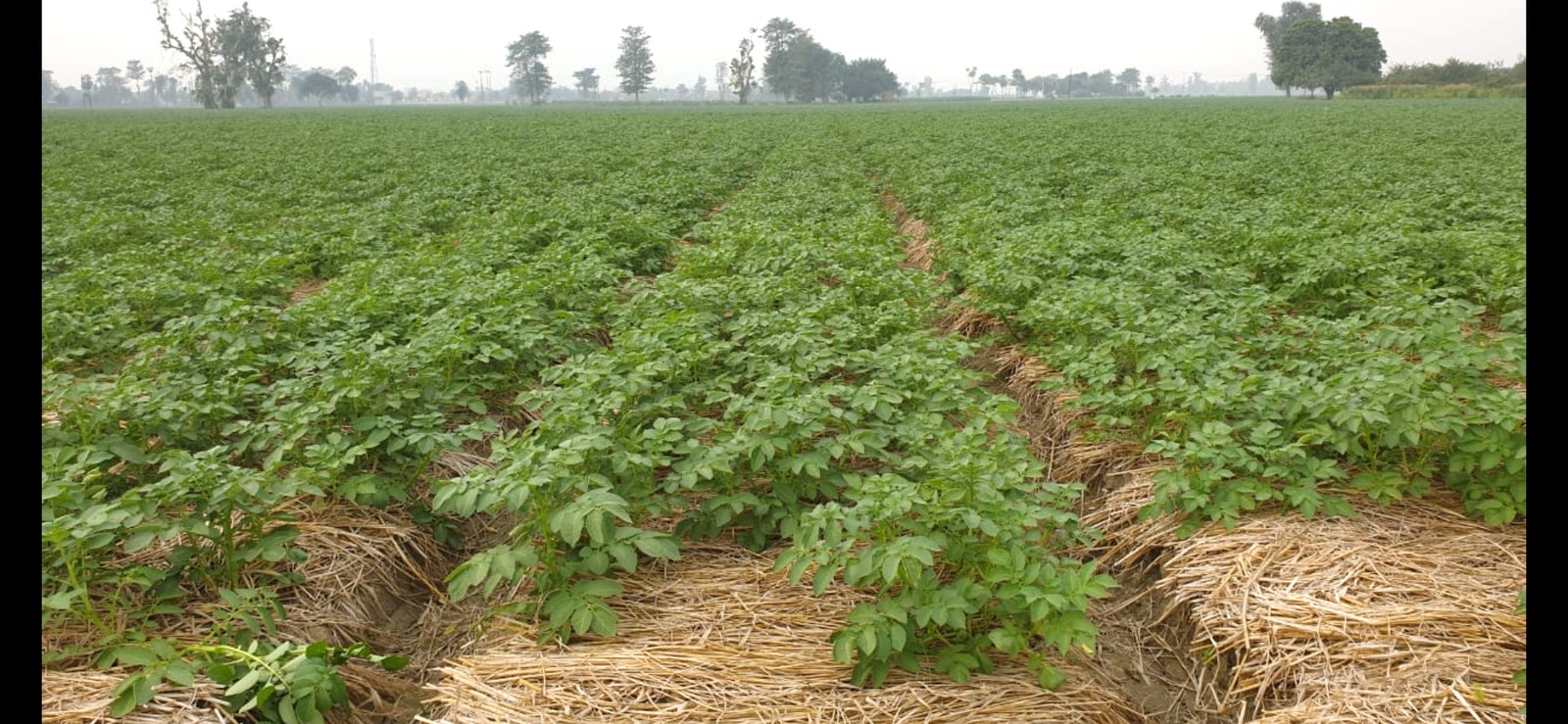
Break the Hardpan: Shatter the subsoil compaction to allow deep infiltration of water and air, and enable deep root growth.
Correct Soil Chemistry: Use deep irrigation with sulfuric acid (for pH >8) to leach salts and unlock minerals, rebalancing soil chemistry within the closed-loop system.
Build Beds & Plant Jantar: Form permanent raised beds for controlled traffic. Plant Jantar (Sesbania) as a deep-rooted cover crop to further fracture subsoil, create bio-channels, and mine nutrients.
Retain, Mulch, No-Till: Retain all Jantar roots. Chop and use its biomass as mulch on the same bed. Subsequently, plant cash crops directly into the mulch using a no-till planter, preserving the restored soil structure.
The PQNK Sustainable State:
After the regenerative process is complete, the system enters a sustainable state. It no longer degrades over time and requires only two human actions:
Placement of seed vertically into the soil.
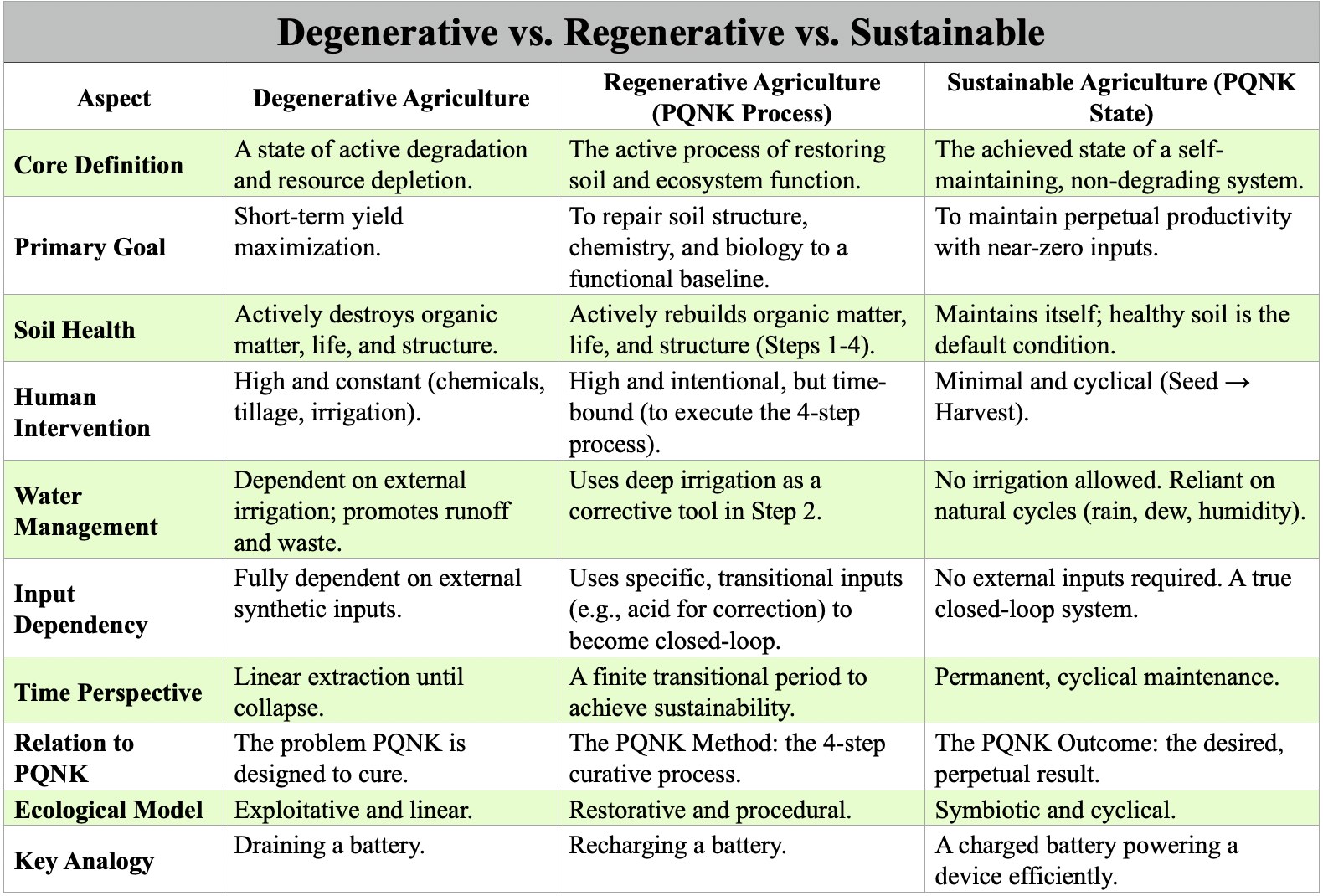
| Aspect | Degenerative Agriculture | Regenerative Agriculture (PQNK Process) | Sustainable Agriculture (PQNK State) |
|---|---|---|---|
| Core Definition | A state of active degradation and resource depletion. | The active process of restoring soil and ecosystem function. | The achieved state of a self-maintaining, non-degrading system. |
| Primary Goal | Short-term yield maximization. | To repair soil structure, chemistry, and biology to a functional baseline. | To maintain perpetual productivity with near-zero inputs. |
| Soil Health | Actively destroys organic matter, life, and structure. | Actively rebuilds organic matter, life, and structure (Steps 1-4). | Maintains itself; healthy soil is the default condition. |
| Human Intervention | High and constant (chemicals, tillage, irrigation). | High and intentional, but time-bound (to execute the 4-step process). | Minimal and cyclical (Seed → Harvest). |
| Water Management | Dependent on external irrigation; promotes runoff and waste. | Uses deep irrigation as a corrective tool in Step 2. | No irrigation allowed. Reliant on natural cycles (rain, dew, humidity). |
| Input Dependency | Fully dependent on external synthetic inputs. | Uses specific, transitional inputs (e.g., acid for correction) to become closed-loop. | No external inputs required. A true closed-loop system. |
| Time Perspective | Linear extraction until collapse. | A finite transitional period to achieve sustainability. | Permanent, cyclical maintenance. |
| Relation to PQNK | The problem PQNK is designed to cure. | The PQNK Method: the 4-step curative process. | The PQNK Outcome: the desired, perpetual result. |
| Ecological Model | Exploitative and linear. | Restorative and procedural. | Symbiotic and cyclical. |
| Key Analogy | Draining a battery. | Recharging a battery. | A charged battery powering a device efficiently. |
Harvesting. No irrigation, fertilization, or tillage is needed, as the system maintains itself through natural water cycles (rain, dew, humidity) and a buffered soil ecosystem supported by fungal networks.
Summary: Framework presents a clear, sequential model:
Degenerative is the unsustainable starting point.
Regenerative (PQNK Process) is the intentional, 4-step rehabilitation.
Sustainable (PQNK State) is the final, low-input, perpetual steady state.
This corrects the common misconception of "regenerative" and "sustainable" as parallel choices, instead positioning them as process and outcome within the same system.
Footnote:
Applying PQNK without understanding nature’s operating system will not deliver abundance, stability, or nutrient density.
PQNK (pronounced “picnic”)—the regenerative & sustainable Pristine Organic Farming System—is grounded in Natural Ecosystem Science. This science employs perennial biodiversity, protects soil with organic mulch, and avoids practices such as water inundation, tillage disturbance, and leaving soil bare.
It is the process that matters most. PQNK is a pristine production system designed not merely for yield, but for optimal, balanced output—where quality, sustainability, and ecological harmony emerge from a self‑regulated, zero‑external‑input methodology.
Connect & Resources Facebook: www.Facebook.Com/Pedaver YouTube (PQNK): https://www.youtube.com/@pedaverpqnk3167/videos YouTube: http://www.youtube.com/@aasifsharif PDF Knowledge Papers: https://drive.google.com/drive/folders/1iadwV6mdUPyrUIpB3oRfNv6DLiackaUL?usp=sharing Email: pedaver@gmail.com WhatsApp: +92 320 677 6666
About This Paper
- Problem
- Terminology / Framework Confusion · General Soil Fertility / Land Degradation · External Input Dependency
- Science
- Soil · Water · Plants · Production Architecture · Transition
- Evidence
- Philosophical/Framework Argument
- Authority
- Current / Approved PQNK Knowledge
Related PQNK Science
Key Takeaways
- Corrects a stated common misconception: 'regenerative' and 'sustainable' are not parallel or interchangeable labels but sequential stages, process then outcome, within one system.
- Restates the four-step Corrective Intervention: break the hardpan, correct soil chemistry with acid-assisted leaching, build permanent beds and plant Jantar, then retain, mulch, and no-till plant.
- Defines the resulting Sustained Closed Loop State as requiring only two human actions indefinitely: seed placement and harvesting, with no irrigation, fertilization, or tillage needed.
- Frames 'degenerative' as the unsustainable starting point, Corrective Intervention as the intentional four-step rehabilitation opening into a Regenerative Phase of biological rebuilding, and the Sustained Closed Loop State as the resulting low-input steady state.
- Attributes the Sustained Closed Loop State's self-maintenance to natural water cycles (rain, dew, humidity) and fungal-network-buffered soil ecology rather than ongoing management.
- Closes with an explicit warning that applying PQNK practices without understanding the underlying operating system will not deliver abundance or nutrient density.
Related Knowledge
same problem
Chemical Fertiliser Dependency Through the PQNK Lens
An evidence-qualified review of the article “Chemical Fertilizer Industry”. It keeps the article's warning about soil degradation, nutrient pollution and biological decline, disciplines its headline numbers, and argues that fertiliser dependency is a symptom of a damaged production system (tillage, flooding, bare soil and simplified biology) that PQNK removes by restoring aerated, covered, living soil, reaching zero purchased fertiliser and pesticide at maturity.
same problem
PQNK Foundational Document, Topic 13: The Autonomous Cycle — Planting and Harvesting in the Perfected System
This paper describes the end-state of a matured PQNK farm as a one-time ecological engineering project rather than an ongoing method, in which the only permitted human interventions become planting and harvesting, and lists the specific evidence, including a claimed zero yield response to added fertilizer, that proves a farm has reached this autonomous state.
same problem
PQNK — Nature's Algorithm for Abundant Food: From a Failing Industrial Model to a Permanent Natural System
A narrated overview asking why a century of tool and input innovation left agriculture in crisis, answering that the industry improved the wrong system, and describing how PQNK studies the operating principles nature has run for four hundred million years and translates them into a four-step transition farmers can implement directly.
same problem
Rethinking Agricultural Systems – The PQNK Framework (A1)
This framework document defines PQNK not as an addition of techniques to conventional farming but as a first-principles diagnostic standard, built on four non-negotiable axioms, for distinguishing genuine ecosystem agriculture from repackaged extraction dressed up as 'regenerative' or 'sustainable.'