

KP-117 · PQNK Philosophy, Framework & Economics
PQNK — Nature's Algorithm for Abundant Food: From a Failing Industrial Model to a Permanent Natural System
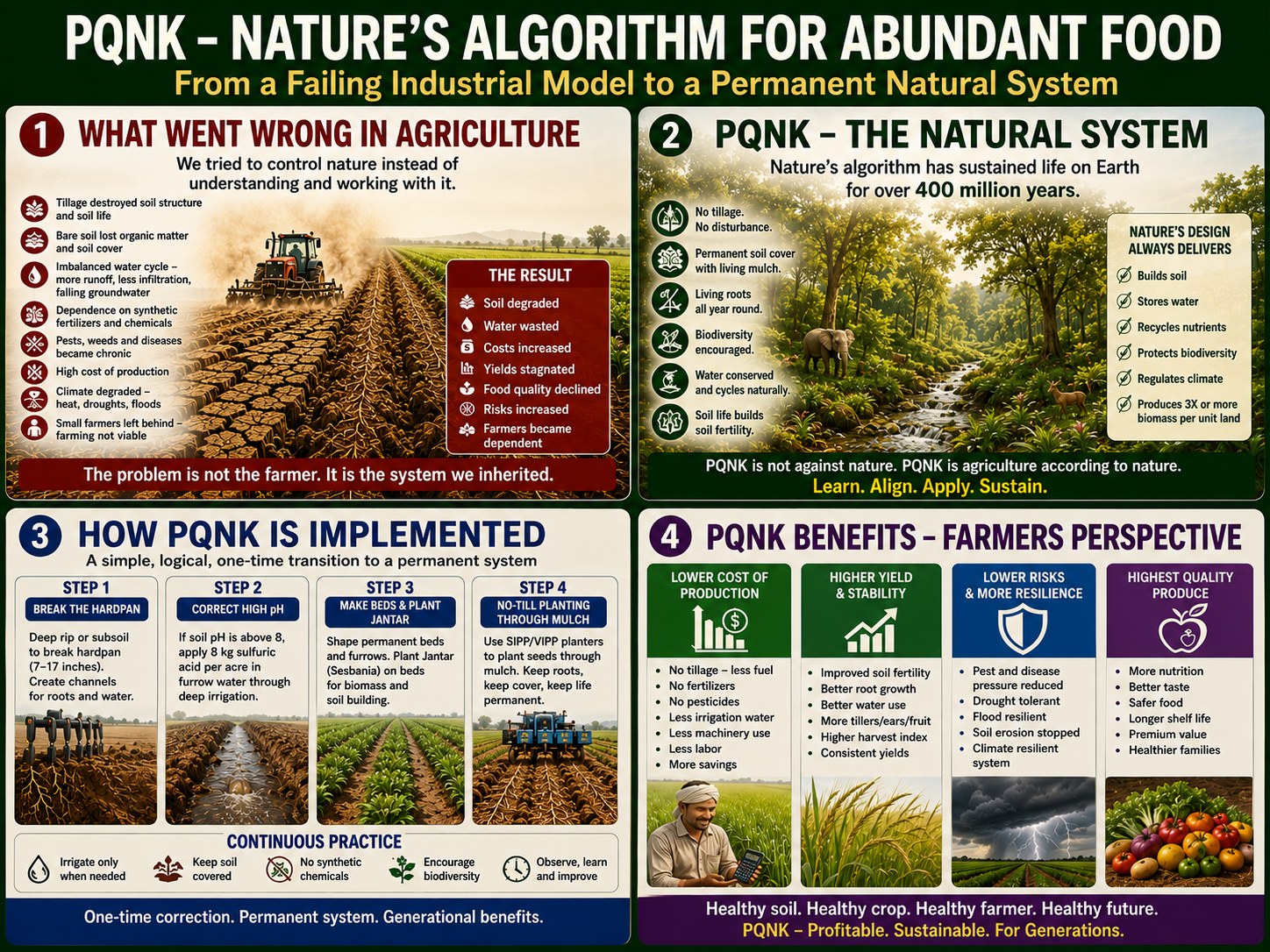
A narrated overview asking why a century of tool and input innovation left agriculture in crisis, answering that the industry improved the wrong system, and describing how PQNK studies the operating principles nature has run for four hundred million years and translates them into a four-step transition farmers can implement directly.
Read or listen to the full paper ↓Abstract
The presentation opens by naming what went wrong: repeated tillage destroys soil structure, bare soil overheats, organic matter disappears, rainwater runs off instead of infiltrating, groundwater falls deeper every year, and biological life declines, so that every new problem requires another purchased solution, squeezing small farmers first. It reframes the diagnostic question from whether industrial agriculture became more efficient to whether it remained biologically correct.
Nature is presented as the model to study rather than copy literally: forests, grasslands, and wetlands have produced enormous biomass while improving their surroundings for over four hundred million years, without ploughing, bare soil, manufactured fertilizer, or pesticide. PQNK is described as studying the operating principles that make natural ecosystems successful and translating those principles into modern food production, working with nature rather than against it.
Implementation is laid out as a short, largely one-time sequence: removing the hardpan that restricts roots, water, and underground air; correcting alkaline soils where required during the transition phase; establishing permanent raised beds and furrows that are never cultivated again; planting directly through surface mulch using precision no-till equipment, specifically the SIPP planter, with VIPP described as still under development for even greater placement precision; and applying irrigation only where and when plants actually require it, rather than by default schedule.
Farmer-facing benefits are presented in a deliberate order: lower production cost first (less cultivation, fuel, and irrigation, little or no dependence on fertilizer and pesticide), then greater production stability (healthier soil storing more water, deeper roots, better heat and drought tolerance), then lower production risk (fewer pest and disease problems, reduced erosion), then higher-quality food (better taste, shelf life, nutritional value), and finally independence from purchased inputs, framed as the greatest and most durable benefit as the farm becomes progressively more self-sustaining.
Full Paper
If you use “Listen”, the text of the page may be sent to your browser or operating system’s speech provider, such as Apple, Google or Microsoft, depending on the voice your device uses. Pedaver does not process, transmit or store any audio.
PQNK — Nature's Algorithm for Abundant Food
From a Failing Industrial Model to a Permanent Natural System
VoiceOver
For thousands of years, agriculture has evolved by improving the tools we use to grow crops. We developed better ploughs, larger tractors, synthetic fertilizers, pesticides, irrigation systems and increasingly sophisticated machinery. These innovations undoubtedly increased food production.
But today agriculture faces a crisis unlike any before. Production costs continue to rise. Soils are becoming less productive. Groundwater is disappearing. Weather is becoming increasingly unpredictable. Food quality is declining, and millions of small farmers are struggling to survive.
The question we must ask is not whether science failed. The question is whether we started with the wrong production model.
PQNK begins with a completely different question.
Instead of asking how to improve industrial agriculture, it asks:
How does nature continuously produce abundant vegetation while simultaneously improving soil, conserving water, protecting biodiversity and stabilizing climate?
Nature has successfully operated this system for over four hundred million years.
PQNK simply studies those natural algorithms and applies them to food production.
This presentation explains what went wrong, what nature has been doing successfully all along, how PQNK implements those principles, and what benefits farmers are already experiencing.
SLIDE 2
What Went Wrong in Agriculture
The problem is not the farmer.
The problem is the production system that humanity inherited thousands of years ago.
Early farmers cultivated the soil because they had no better alternative. Modern science inherited that same system and invested enormous effort in improving it rather than questioning it.
Repeated tillage destroys soil structure.
Bare soil overheats.
Organic matter disappears.
Rainwater runs away instead of entering the soil.
Groundwater falls deeper every year.
Biological life declines.
Farmers become increasingly dependent on fertilizers, pesticides, irrigation and expensive machinery.
Every new problem requires another purchased solution.
As production costs rise, profits shrink.
Small farmers suffer first.
Meanwhile, the natural ecosystem continues functioning without any of these external inputs.
The issue is therefore not whether industrial agriculture became more efficient.
The issue is whether it remained biologically correct.
PQNK proposes that instead of continuously correcting the symptoms, we should restore the natural processes that prevented these problems in the first place.
SLIDE 3
PQNK — The Natural System
Nature is the greatest agricultural scientist that has ever existed.
Long before humans appeared, forests, grasslands and wetlands were producing enormous quantities of biomass while simultaneously improving the environment around them.
Nature never ploughs.
Nature never leaves soil bare.
Nature never depends on manufactured fertilizers.
Nature never sprays pesticides.
Instead, it keeps the soil permanently covered.
Roots remain alive throughout the year.
Water infiltrates instead of running away.
Microorganisms continuously recycle nutrients.
Biodiversity regulates insects and diseases naturally.
Organic matter accumulates.
The soil becomes more fertile every year.
This system has sustained vegetation on Earth for more than four hundred million years.
PQNK does not attempt to copy forests literally.
It studies the operating principles that make natural ecosystems successful and translates those principles into modern food production.
Instead of fighting nature,
PQNK works with nature.
Nature is not the enemy of agriculture.
Nature is the original engineering blueprint for agriculture.
• SLIDE 4
How PQNK is Implemented
Transitioning to PQNK is remarkably straightforward.
The first step is to remove the hardpan that restricts roots, water movement and underground air.
This is normally done only once.
Where alkaline soils require correction, that is completed during the transition phase.
Permanent raised beds and permanent furrows are then established.
From this point onward, the beds remain undisturbed.
The soil is never cultivated again.
Crop residues remain on the surface as protective mulch.
Living roots continue feeding the underground biological community.
Seeds are planted directly through the mulch using precision no-till equipment such as the SIPP planter, while VIPP is being developed for even greater planting
precision.
Irrigation changes completely.
Instead of flooding the field, water is applied only where needed and only when plants actually require it.
The objective is not simply to grow crops.
The objective is to rebuild a permanent biological production system that becomes healthier every season.
As the soil recovers, farming becomes easier rather than more difficult.
SLIDE 5
PQNK Benefits — Farmers' Perspective
Farmers judge a production system by results, not by theories.
The first benefit they notice is lower production cost.
Less cultivation.
Less fuel.
Less irrigation.
Little or no dependence on fertilizers and pesticides.
Machinery operates less frequently.
The second benefit is greater production stability.
Healthier soil stores more water.
Roots grow deeper.
Plants tolerate heat and drought better.
Extreme weather causes less damage.
The third benefit is lower production risk.
Healthy biological systems naturally reduce many pest and disease problems while improving soil structure and reducing erosion.
Finally comes the benefit every farmer and every consumer values.
Higher quality food.
Crops grown in healthy living soil often have better taste, improved shelf life and greater nutritional value.
But perhaps the greatest benefit is independence.
Instead of becoming more dependent on purchased inputs every year, the farm gradually becomes more self-sustaining.
The soil improves.
The biology strengthens.
The production system becomes increasingly resilient.
That is why farmers are adopting PQNK.
Not because it is a theory.
Because it works in their fields.
The future of agriculture is not about using more inputs.
It is about understanding nature's algorithms and applying them intelligently to produce abundant food while restoring the resources upon which agriculture itself depends.
That is the science of PQNK.
About This Paper
- Problem
- Tillage Damage to Soil Biology / Structure · Runoff · Groundwater / Aquifer Depletion · External Input Dependency
- Science
- Soil · Water · Plants · Production Architecture · Transition
- Evidence
- Philosophical/Framework Argument
- Authority
- Current / Approved PQNK Knowledge
Related PQNK Science
Key Takeaways
- Reframes the central agricultural question from 'how do we improve industrial agriculture' to 'how does nature produce abundant vegetation while improving soil, conserving water, and stabilizing climate,' a system it says has run successfully for over 400 million years.
- Diagnoses the crisis as biological incorrectness, not inefficiency: every new problem in the industrial model requires another purchased input, deepening rather than resolving farmer dependency.
- Describes PQNK implementation as a largely one-time correction (hardpan removal, alkaline correction) followed by permanent, never-recultivated raised beds and furrows.
- Names SIPP as the precision no-till planter currently used for seeding directly through mulch, with VIPP described as still in development for even greater placement precision.
- Orders farmer-facing benefits deliberately: lower production cost first, then greater production stability, then lower production risk, then higher food quality, with input independence framed as the deepest, most durable benefit.
- Frames the future of agriculture as understanding nature's algorithms and applying them intelligently, rather than adding more inputs to compensate for a broken model.
Related Knowledge
same problem
Chemical Fertiliser Dependency Through the PQNK Lens
An evidence-qualified review of the article “Chemical Fertilizer Industry”. It keeps the article's warning about soil degradation, nutrient pollution and biological decline, disciplines its headline numbers, and argues that fertiliser dependency is a symptom of a damaged production system (tillage, flooding, bare soil and simplified biology) that PQNK removes by restoring aerated, covered, living soil, reaching zero purchased fertiliser and pesticide at maturity.
same problem
PQNK Foundational Document, Topic 13: The Autonomous Cycle — Planting and Harvesting in the Perfected System
This paper describes the end-state of a matured PQNK farm as a one-time ecological engineering project rather than an ongoing method, in which the only permitted human interventions become planting and harvesting, and lists the specific evidence, including a claimed zero yield response to added fertilizer, that proves a farm has reached this autonomous state.
same problem
The PQNK Framework: From Degenerative Systems to Regenerative Process to Sustainable State
A short framework note that corrects what it calls a common misconception, that 'regenerative' and 'sustainable' are interchangeable or parallel labels, by defining them as sequential stages: a defined four-step Corrective Intervention that a degraded farm passes through once, followed by a Regenerative Phase of biological rebuilding and then a permanent Sustained Closed Loop State requiring only seed placement and harvesting.
same problem
The Hidden Crisis: How Industrial Agriculture Has Broken Earth's Water Cycle
A quantified case that industrial agriculture has driven global groundwater tables from 20-30 feet to over 300 feet deep, creating a roughly $200 billion annual crisis addressable through a costed $15 billion, 24-month PQNK rollout plan.