

KP-090 · PQNK Philosophy, Framework & Economics
PQNK Foundational Document, Topic 13: The Autonomous Cycle — Planting and Harvesting in the Perfected System
This paper describes the end-state of a matured PQNK farm as a one-time ecological engineering project rather than an ongoing method, in which the only permitted human interventions become planting and harvesting, and lists the specific evidence, including a claimed zero yield response to added fertilizer, that proves a farm has reached this autonomous state.
Read or listen to the full paper ↓Abstract
The paper's central claim is structural: PQNK is not a method requiring ongoing management but a one-time ecological engineering project resulting in a self-executing production ecosystem. After the four foundational PQNK steps are correctly executed, the paper argues the system enters an operational state where the only required human interventions, indefinitely, are planting seed and harvesting the crop.
It grounds this claim in four established conditions carried over from the core PQNK protocol, a shattered hardpan enabling vertical root, water, and air movement, a corrected soil pH of 6.5-7.0, permanent raised beds with Jantar-created bio-drilled channels, and a no-till, full-residue mulch layer, describing these together as the farm's installed 'operating system.'
Three self-sustaining processes are described as running automatically once these conditions are in place: a water cycle in which shattered-hardpan infiltration and mulch-prevented evaporation make irrigation redundant except in extreme conditions; a mineral cycle in which crop roots follow decaying Jantar channels to access deep mineral reserves while root exudates continuously feed a self-regulating microbial supply chain, rendering soil and tissue testing 'irrelevant' because nutrient access is described as perfect; and a biological cycle in which balanced plant nutrition suppresses pest and pathogen pressure, weeds lose their ecological function once soil structure is perfected, and fungal hyphae and soil fauna continuously maintain soil aggregation.
The paper is explicit about what disappears from the farmer's task list in this state, no fertilizing, tilling, weeding, spraying, amending, or testing and balancing, and offers observable proof points that a system has reached genuine autonomy: consistent high yields with minimal season-to-season fluctuation, increasing earthworm and fungal activity, superior resilience to drought, flood, or temperature extremes relative to conventional neighbors, and, presented as the definitive proof, a documented zero crop response if external fertilizer is applied to an already-established system, taken as evidence the farm is operating at its ecological carrying capacity and closed to external fertility.
It closes by reframing the fourth PQNK step, retain, mulch, and plant with no-till, not as the final step of construction but as the first step of an infinite cycle, describing the Pristine Organic system as a permanent, entered-into state of agricultural grace rather than a set of techniques to be repeatedly reapplied, with the farmer's role reduced to precision planting, harvesting, and keen observation.
Full Paper
If you use “Listen”, the text of the page may be sent to your browser or operating system’s speech provider, such as Apple, Google or Microsoft, depending on the voice your device uses. Pedaver does not process, transmit or store any audio.
1.0 The Pristine Organic End-State: A Self-Executing System
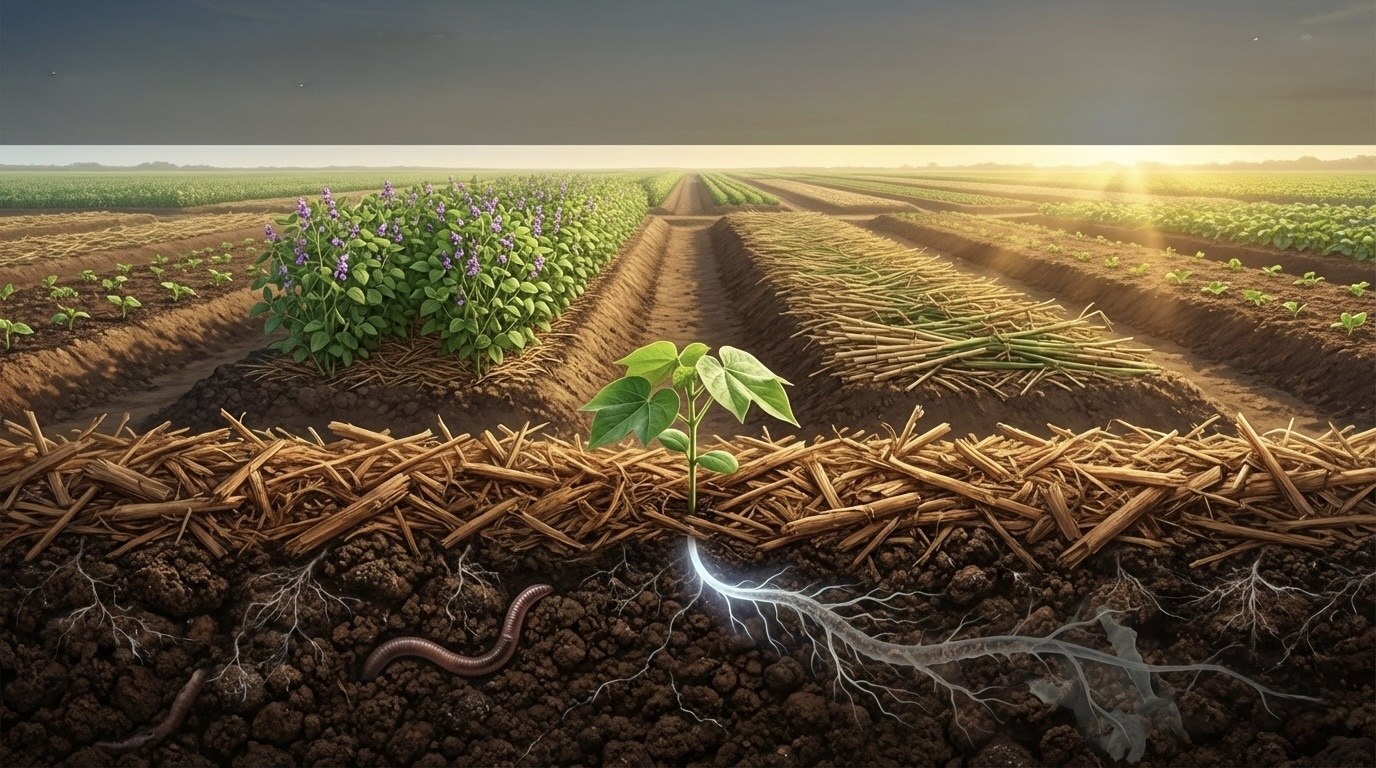
The Pristine Organic (PQNK) system is not a method of agriculture that requires ongoing management. It is a one-time ecological engineering project that results in a perfected, autonomous production ecosystem. After the four foundational steps are correctly executed, the system enters its operational state. In this state, the only required human interventions are: Planting seeds, and harvesting crops. Season after season, year after year, the system sustains and regenerates itself. This document describes the science and function of this end-state, explaining why further intervention is unnecessary and counterproductive.
2.0 The Pillars of Autonomy: A Review of the Established Conditions
The four PQNK steps create four immutable conditions that make the autonomous cycle possible:
A Shattered Hardpan: Creates an unobstructed vertical connection for roots, water, and air.
Corrected Soil Chemistry: A balanced pH (6.5-7.0) ensures all minerals are plant-available and the soil biology is optimized.
Permanent Raised Beds with Jantar Bio-Drills: Establishes the permanent infrastructure and the initial deep, organic pathways that become the main mineral and water conduits.
A No-Till, Full-Residue Protocol: Creates a permanent mulch layer and leaves all root systems in place, eliminating disturbance.
These four conditions act as the "operating system" for the farm. Once installed, they run the program.
3.0 The Self-Sustaining Processes of the Operational System
3.1 The Water Cycle: Automatic Regulation
Infiltration & Storage: The shattered hardpan and Jantar root channels allow instantaneous water infiltration, preventing runoff. Water is stored deep in the subsoil, creating a resilient reservoir.
Capillary Rise & Redistribution: During dry periods, water moves upward through the soil matrix and the continuous pore spaces created by biology, making itself available to roots. The permanent mulch layer eliminates evaporation.
Outcome: The system is drought-proof and flood-resilient. Irrigation becomes redundant except in the most extreme climatic circumstances.
3.2 The Mineral Cycle: The Permanent Biological Pump
Deep Access: Crop roots follow the decaying Jantar root channels deep into the subsoil, accessing the parent material's mineral reservoir.
Continuous Exchange: Root exudates from every crop feed rhizosphere microbes, which continuously weather minerals in a slow, balanced release. This is not a human-managed process; it is a constant, low-level function of the living soil.
Surface Recycling: 100% of crop residues are returned as mulch. Minerals are cycled at the surface by decomposer organisms and integrated into stable soil organic matter.
Outcome: A constant, balanced flow of all macro and trace minerals. Soil tests become irrelevant because the plant's access to minerals is perfect. Tissue tests will show optimal nutrient levels year after year.
3.3 The Biological Cycle: A Balanced, Self-Regulating Community
Pest & Pathogen Suppression: Balanced mineral nutrition produces plants with full genetic expression of defense compounds (phytoalexins). Robust, healthy plants are not recognized as prey by insects or pathogens. The diverse, stable microbial community outcompetes and antagonizes pathogenic organisms.
Weed Dynamics: In a collapsed soil, pioneer plants ("weeds") serve a vital ecological function: opening soil pores for aeration and infiltration, and providing food for microbial life. In the PQNK system, this remediation function is made obsolete. The permanent soil cover (by cash crop canopy and/or mulch) and the perfected soil structure leave no ecological mandate for weeds to establish. Where they occasionally appear, they do not compete with the cash crop for nutrients, as the soil system provides for all plants. The only potential competition is for sunlight, which can be managed in the initial years by simply chopping them and dropping the biomass as additional mulch.
Soil Structure Maintenance: Fungal hyphae, root exudates, and the activity of earthworms and arthropods continuously create and stabilize soil aggregates. No-till prevents its destruction.
Outcome: No pesticides, herbicides, or fungicides are needed. The system's internal ecology maintains balance.
4.0 The Human Role: Planter and Harvester
In the perfected PQNK system, the farmer's role shifts from active manager to beneficial participant and harvester.
Precision Planting: Planting in PQNK requires precise seed placement at optimal, predetermined spacing (both row-to-row and plant-to-plant) to achieve perfect plant populations. This is not achieved with random-drop drills. It requires a precision seed-singulation mechanism capable of handling diverse seed shapes, sizes, and weights, and a specialized mulching mechanism capable of consistently cutting through and placing seed into the highly variable residue left by different crops (e.g., rice straw, corn stalks, sugarcane trash). The development of purpose-built planters like the SIPP (Slit Insertion Precision Planter) and VIPP (Vertical Insertion Precision Planter) represents a critical, decade-long engineering investment to solve this final interface between human intention and the autonomous soil system.
Harvesting: Removing the edible portion of the crop. The remaining biomass (stalks, leaves) is immediately returned to the bed as mulch.
Observation: The primary task becomes keen observation—monitoring plant health, biodiversity, and yield—which confirms the system is functioning autonomously.
Crucially, there is no:
Fertilizing
Tilling
Weeding
Spraying
Applying amendments
Testing and balancing
These actions are rendered obsolete by the system's design.
5.0 Evidence of Perfection: How to Know the System is Autonomous
Consistent, High Yields: Yields stabilize at a high level, with minimal fluctuation between seasons.
Zero Input Dependency: No decline in yield or plant health is observed without the addition of any inputs. Critically, if external inputs (e.g., fertilizer) are applied to an established PQNK system, the crop plants will show no response. This is the definitive proof that the system is operating at its ecological carrying capacity and is closed to external fertility.
Increasing Biological Activity: Earthworm populations burgeon, fungal mycelium is visible, bird and insect diversity increases.
Resilience to Stress: The field shows superior performance during drought, heavy rain, or temperature extremes compared to neighboring conventional systems.
The "Feel" of the Soil: The soil remains soft, crumbly, and moist, with a rich, earthy smell year-round.
6.0 Conclusion: The Final Step is a New Beginning
The fourth PQNK step—"Retain, Mulch, and Plant with No-Till"—is not the last step of construction; it is the first step of the infinite cycle. It initiates the autonomous state. Each harvest and subsequent planting reinforces the cycle, deepening the pathways, enriching the biology, and solidifying the system's independence.
The Pristine Organic system is, therefore, a permanent solution. It is not a set of techniques to be repeatedly applied, but a state of agricultural grace to be entered into. Once established, the work of fertility, pest control, and water management is handed back to the natural world, which executes it with flawless efficiency. The farmer is freed to plant, to harvest, and to steward the perfected ecosystem.
—————————
Footnote: PQNK (pronounced 'picnic')—the regenerative & sustainable Pristine Organic Farming System—is grounded in Natural Ecosystem Science. This science employs perennial biodiversity, protects soil with organic mulch, and avoids practices like water inundation, tillage disturbance, and leaving soil bare.
www.Facebook.Com/Pedaver
https://www.youtube.com/@pedaverpqnk3167/videos
pedaver@gmail.com
WhatsApp +92 320 677 6666
About This Paper
- Problem
- External Input Dependency · Labor Scarcity / Cost · Yield Stagnation / Decline · Drought / Water Scarcity
- Science
- Soil · Water · Plants · Biodiversity · Production Architecture · Transition
- Evidence
- Philosophical/Framework Argument
- Authority
- Current / Approved PQNK Knowledge
Related PQNK Science
Key Takeaways
- Argues a matured PQNK farm becomes fully autonomous: after the four foundational steps are complete, the only required human interventions, indefinitely, are planting and harvesting.
- Describes three self-sustaining automatic cycles once established, water (infiltration/mulch), mineral (Jantar channels/microbial supply chain), and biological (pest suppression, weed function loss, soil aggregation).
- States that in this end-state, fertilizing, tilling, weeding, spraying, and soil testing all become unnecessary and are explicitly excluded from ongoing farm work.
- Cites a documented zero yield response to added fertilizer on an established PQNK system as the definitive proof the farm has reached its ecological carrying capacity.
- Frames precision planting technology (SIPP/VIPP planters) as the critical engineering interface solving seed placement through variable mulch, described as a decade-long development effort.
- Reframes the final PQNK construction step (retain/mulch/no-till) as the beginning of a permanent, self-renewing cycle rather than the end of a project.
Related Knowledge
same problem
Chilli Production Under PQNK (PICNIC)
Chilli is biologically perennial and can remain productive for over a decade, but conventional short-cycle, urea-dependent management collapses that potential into a pest-prone annual grind. This paper shows how PQNK's soil-conversion framework and a single apical-pinching intervention restore chilli to a low-cost, high-density perennial crop, validated on a Hafizabad farm.
same problem
PQNK — Nature's Algorithm for Abundant Food: From a Failing Industrial Model to a Permanent Natural System
A narrated overview asking why a century of tool and input innovation left agriculture in crisis, answering that the industry improved the wrong system, and describing how PQNK studies the operating principles nature has run for four hundred million years and translates them into a four-step transition farmers can implement directly.
same problem
The PQNK Framework: From Degenerative Systems to Regenerative Process to Sustainable State
A short framework note that corrects what it calls a common misconception, that 'regenerative' and 'sustainable' are interchangeable or parallel labels, by defining them as sequential stages: a defined four-step Corrective Intervention that a degraded farm passes through once, followed by a Regenerative Phase of biological rebuilding and then a permanent Sustained Closed Loop State requiring only seed placement and harvesting.
same problem
Technical Adaptations for Mechanized SRI Production to Achieve Water Saving and Increased Profitability in Punjab, Pakistan
The founding 2009-2010 field trial behind PQNK's rice work, peer-reviewed and published in Paddy and Water Environment (Springer, 2011). Asif Sharif's original technical report on mechanizing the System of Rice Intensification (SRI) for large-scale Punjab farms, years before the fuller PQNK protocol described elsewhere on this site was developed.