

KP-111 · PQNK Philosophy, Framework & Economics
The Missing Synthesis: Positioning PQNK Among a Century of Fragmented Regenerative Science
A literature-positioning paper that credits seven independent research traditions, from Fukuoka and Gliessman to the Loess Plateau project and the Bionutrient Food Association, for establishing separate pieces of the ecosystem-agriculture case, then argues PQNK's distinct contribution is assembling those pieces into one operationally complete, field-ready protocol developed independently through direct production practice.
Read or listen to the full paper ↓Abstract
The paper opens by naming a pattern of fragmentation: decades of rigorous work exist on ecosystem-based agriculture, water-cycle restoration, mineral-based fertility, and the farming-health link, but none of it assembled into a single, comprehensive, operationally specific process a farmer could implement across varied conditions. Its central claim is precise: every body of work credited here supplied an ingredient, a principle, a philosophy, a measurement standard, but none supplied a recipe, specific quantities, sequence, timing, and reasoning, that turns a principle into a repeatable field action, and that completeness is what the paper argues distinguishes PQNK.
It is equally careful about its own origin: PQNK was developed independently, over five decades of direct field practice and machinery engineering beginning in 1973, through years of institutional resistance along the way, and confirmed through a 2008 field trip into the Amazon, not by studying the literature reviewed in this paper. The convergence documented here, a hands-on production background reaching the same conclusions as separate academic traditions, is presented as independent corroboration, not derivation.
Seven threads are credited by name and organized into a table: ecosystem-based design (Fukuoka, Gliessman, Mollison and Holmgren), ecosystem provisions and protection (the Millennium Ecosystem Assessment, 2005), water cycle and climate (Yeomans' Keyline design, Kravčík, Jehne, the Loess Plateau project), geological minerals (Hamaker and Weaver, Remineralize the Earth), degradation remediation (the Loess Plateau project, Sawadogo's zaï pits), nutrition-density economics (Davis 2004, the Bionutrient Food Association), and public health (Montgomery and Biklé, ultra-processed food epidemiology).
A dedicated section compares PQNK against six contemporary reform programmes at similar ambition, Conservation Agriculture, the System of Rice Intensification, Andhra Pradesh's Community Managed Natural Farming, the Savory Institute, Gabe Brown's ranching model, and syntropic agroforestry, crediting each as a real improvement worked from inside the existing paradigm while arguing PQNK begins from a different question: what does nature do when left to govern soil, water, and vegetation without human interference. SRI receives an extended, candid case study: credited for pioneering careful young-seedling transplantation, but marked down for retained partial flooding, topsoil-working mechanical weeding, and a published record of yield claims that drew methodological scrutiny. The section also introduces 'ACI' (Ancient-Conventional-Industrial) as one continuous soil-disturbing paradigm expressed through three successive historical stages, naming plough-driven soil inversion, not disturbance in general, as the actual mechanism of ecological disconnection.
The paper closes by describing PQNK's specific contribution as carrying all seven threads forward into one integrated, sequenced, tool-equipped process, its Four-Step Transition Protocol, raised-bed geometry, and Water:Air framework, precise enough to serve a single acre as faithfully as a large commercial holding, and claims the protocol takes a field from degraded to regenerative within two crop cycles, reaching a closed-loop, self-sustaining state.
Full Paper
If you use “Listen”, the text of the page may be sent to your browser or operating system’s speech provider, such as Apple, Google or Microsoft, depending on the voice your device uses. Pedaver does not process, transmit or store any audio.
PQNK Knowledge Paper
ABSTRACT
For more than seventy years, a series of independent researchers and practitioners have each contributed a piece of the same underlying case: that production agriculture built on ecosystem principles, restored water cycles, natural mineral abundance, and biological self-regulation outperforms, and can repair the damage of, industrial chemical agriculture. Each of these bodies of work is real, well evidenced, and, in most cases, decades old. This paper credits seven such contributions accurately, alongside six further programmes, Conservation Agriculture, Andhra Pradesh’s Community Managed Natural Farming, the Savory Institute, Gabe Brown’s regenerative ranching model, Zero Budget Natural Farming, and Ernst Götsch’s syntropic agroforestry, that built comprehensive efforts of their own at real scale. It then shows where PQNK’s Four-Step Transition Protocol, raised-bed geometry, and Water : Air framework, developed independently through direct field practice rather than through study of the literature reviewed here, carry that shared work forward: a system precise enough to serve a single acre as faithfully as a large commercial holding. The protocol carries a further, more specific claim: it takes a field from a degraded starting condition to a regenerative one, and within two crop cycles to a closed-loop, self-sustaining state in which the farmer’s only remaining interventions are to plant and to harvest.
1. INTRODUCTION: THE PATTERN OF FRAGMENTATION
Ask whether anyone has studied ecosystem-based production agriculture, natural water cycle restoration, mineral-based soil fertility, or the link between farming practice and human health, and the honest answer is yes, repeatedly, and often rigorously. Ask whether any of that work assembled into a single, comprehensive, operationally specific process that a farmer could implement with defined tools across varied production conditions, and the answer changes. What follows is not a claim that PQNK invented these ideas. It is an account of who did establish each piece, why each piece stayed a piece, and what changes when they are assembled into one system.
There is a simpler way to state what changes. Every body of work credited in this paper supplied an ingredient: a principle, a philosophy, a single input, a measurement standard. None of them supplied a recipe, the specific quantities, sequence, timing, and reasoning that turn a principle into a repeatable action in a field. PQNK's contribution is the recipe itself: not just what to do, but how much, in what order, for how long, and why, spelled out in enough operational detail that two different farmers following it arrive at the same result. That completeness, the full recipe rather than a list of ingredients, is what distinguishes PQNK from the prior and contemporary work reviewed below.
It is equally important to be precise about how PQNK itself arrived at these conclusions. PQNK was not developed by studying the literature reviewed in this paper. It was developed independently, over fifty-three years of direct field practice, machinery engineering, and agronomic work spanning 1973 to 1994, and confirmed through direct, unmediated observation of an intact ecosystem rather than through a review of prior literature, a 2008 field trip into the Amazon. Neither period of work drew on, nor was informed by, the researchers and projects discussed below; both are recounted in full in the author's companion full-length manuscript on PQNK, referenced only in summary here since this paper's purpose is the literature comparison, not the field history itself. The convergence documented in this paper, a hands-on production background reaching the same conclusions as separate academic and research traditions, is presented as independent corroboration: evidence that these conclusions are reachable directly from production experience and unmediated ecological observation, not evidence that PQNK was built on, or derived from, any of the work reviewed here.
2. NATURAL ECOSYSTEM SCIENCE OF PRODUCTION AGRICULTURE
The academic field closest to this question is agroecology, formalised by Stephen Gliessman, whose textbook Agroecology: The Ecology of Sustainable Food Systems has gone through four editions since its first publication and is built on the premise that farming should be designed as an ecosystem rather than an industrial input-output process. Gliessman treats agroecology as simultaneously a science, a set of practices, and a social movement, spanning ecological, economic, social, and political dimensions of food systems.
A decade before either, the Japanese farmer and philosopher Masanobu Fukuoka had already reached a related conclusion from a different direction entirely. His account of do-nothing farming, no tillage, no chemical fertiliser, no weeding, no pesticides, developed over several decades on his own family's citrus and grain fields in Shikoku, was published in Japanese in 1975 and in English in 1978 as The One-Straw Revolution. Fukuoka's claim was that natural farming worked precisely because it worked with the self-sustaining order already present in an undisturbed field rather than against it, a position that directly shaped Mollison and Holmgren's early thinking on permaculture.
Alongside agroecology, Bill Mollison and David Holmgren coined permaculture in 1978, defining it as the conscious design of agriculturally productive systems with the diversity, stability, and resilience of natural ecosystems, organised around the ethics of earth care, people care, and future care, and later formalised by Holmgren into twelve design principles.
All three bodies of work are serious, decades old, and remain what they were designed to be: philosophies, design principles, and an academic framework, taught and adapted case by case rather than delivered as a single specified production process with matching implements. A permaculture designer, an agroecologist, and a practitioner of Fukuoka's method working the same hectare would each produce a different farm, because each describes a way of thinking about the field, not a specified, repeatable protocol.
3. NATURAL PROVISIONS AND PROTECTION SYSTEMS
The idea that ecosystems provide services, not just products, was formalised at global scale by the Millennium Ecosystem Assessment in 2005, which classified nature’s contributions into provisioning services (food, fibre, timber, water), regulating services (climate, flood, disease, and water quality regulation), supporting services, and cultural services. This framework has since become the standard vocabulary for discussing what an intact ecosystem does for the people living within it, and it directly supports the argument that a farm should be designed to supply and protect itself, rather than relying on external replacement of functions nature would otherwise perform for free.
The Millennium Ecosystem Assessment operates at the scale of global policy and landscape accounting. It tells a government or a research body how to categorise what an ecosystem provides. It does not tell a farmer how to build a farm that supplies its own provisioning and regulating services at the field level, in the specific sense of an operational bed design, water management schedule, or biological input sequence.
4. NATURAL WATER SUPPLY SYSTEMS AND THE CLIMATE CONNECTION
This is the thread with the deepest and most specific precedent. P.A. Yeomans, an Australian mining engineer turned land developer, published the first Keyline design book in 1954 after rehabilitating degraded rangeland in New South Wales. Keyline design lays out contour-following channels and strategically placed dams to slow, spread, and sink water into the landscape rather than letting it run off, with the explicit goal of building soil depth and fertility through water management rather than chemical inputs. Mollison and Holmgren studied Keyline directly and folded its water-harvesting logic into permaculture.
Decades later, the Slovak hydrologist Michał Kravčík formalised the New Water Paradigm, arguing that the small water cycle, the local loop of evaporation, plant transpiration, and rainfall, is disrupted by land degradation in ways that measurably worsen both flooding and drought, and that restoring this small water cycle through landscape rehydration is a more direct lever on regional and even global climate stability than is generally credited. Australian soil microbiologist Walter Jehne makes closely related arguments about the soil carbon sponge, the water-holding capacity created by soil carbon and biology, contending that rebuilding this sponge, not carbon accounting alone, is what re-establishes a stable hydrological and thermal cycle.
The clearest large-scale proof that this thesis works at landscape scale is the Loess Plateau Watershed Rehabilitation Project, a 1994 collaboration between China and the World Bank that rehabilitated severely eroded land across four of China’s poorest provinces. Vegetation cover rose from 17 to 34 percent in the project’s core phase, soil erosion fell sharply, and more than 2.5 million people were lifted out of poverty as farm incomes doubled through the introduction of terracing, water harvesting, and revegetation.
So the water cycle thesis has serious theoretical founders (Yeomans, Kravčík, Jehne) and a landscape-scale proof of concept (Loess Plateau). What none of this delivers is a field-level, farm-scale specification: a defined bed geometry, a measurable air-to-water ratio, and a named protocol a smallholder can apply on a single field without a World Bank-scale watershed intervention. This is precisely the gap PQNK’s raised-bed geometry and Water : Air ratio are built to close, translating the same water-cycle logic that moved millions of hectares in China into a specification that operates at the scale of a single bed, and the Four-Step Transition Protocol’s Soil Moisture Management component is the explicit mechanism for doing so.
5. GEOLOGICAL MINERALS IN ABUNDANCE
The case that soil fertility can be rebuilt from locally abundant rock minerals rather than manufactured fertiliser was made most forcefully by John Hamaker, whose 1982 book The Survival of Civilization, co-written with Don Weaver, argued that soils are naturally remineralised by glacial and volcanic activity during ice ages and gradually depleted between them, and that spreading rock dust could substitute for that lost geological process. Hamaker’s own demonstration plot in Michigan reportedly produced 65 bushels of corn per acre against a local average under 25, with higher mineral content in the harvest. Joanna Campe read Hamaker’s work in the early 1980s and founded Remineralize the Earth in 1995 to build a worldwide network and evidence base around the practice, a body of work now described under the broader heading of agrogeology.
This is real, decades-old, evidenced work, and it remains what its founders built it to be: an advocacy and research network promoting a single input category, rock dust, rather than a full production system that positions mineral abundance within a wider sequence of soil recovery steps. It also stayed a niche movement relative to mainstream soil science, in part because it was framed around one input rather than an integrated protocol. Where PQNK differs is treating the local abundance of geological minerals not as a standalone amendment but as one input among several, sequenced within the broader recovery protocol described in Section 6, rather than as a substitute fertiliser sold and applied in isolation.
6. REMEDIATING THE DAMAGE OF INDUSTRIAL AND ANCIENT CONVENTIONAL AGRICULTURE
Two case studies show that severely degraded land, whether by modern industrial practice or by millennia of conventional cultivation, can be brought back, and both are instructive for what a remediation-focused system needs to contain.
The Loess Plateau project, already described in Section 4, is the clearest large-scale demonstration: nearly four million acres of over-grazed, over-harvested land recovered through a combination of terracing, grazing bans, and revegetation, funded and coordinated at government and World Bank scale.
At the smallholder scale, the Burkinabé farmer Yacouba Sawadogo revived and modified an ancient technique called zaï, digging and enlarging pits in hardpan soil, filling them with organic matter, and using termite activity to break up the compacted layer beneath, concentrating scarce rainfall directly at the root zone. His method, refined over four decades, has been credited with reversing degradation across some six million hectares of the Sahel, improving food security for roughly three million people, and raising household incomes by eighteen to twenty-four percent, and it is now practised across a six-thousand-kilometre stretch of Africa. Sawadogo received the Right Livelihood Award, often described as the alternative Nobel Prize, in 2018.
Both cases prove that degradation caused by centuries of conventional or decades of industrial practice is reversible, and both did it without a single named, transferable process: Loess Plateau succeeded through a large, well-funded, site-specific government engineering programme, and Sawadogo’s zaï pits succeeded through one farmer’s own decades of hands-on trial, refined for hardpan-breaking in a specific hydrological and soil context, spread farmer to farmer rather than published as a specified protocol with accompanying tools. Neither produced a general-purpose, four-step, tool-equipped sequence designed to be picked up directly by a farmer working degraded land anywhere, which is the specific role PQNK’s Four-Step Transition Protocol, hardpan-breaking, mulch, root retention, no-till, and Soil Moisture Management, is built to fill.
7. COST OF PRODUCTION VERSUS NUTRITION DENSITY
Donald Davis and colleagues published the landmark study on this question in 2004, comparing USDA nutrient composition data for forty-three garden crops between 1950 and 1999. Six of thirteen nutrients tracked showed statistically reliable declines over that period, ranging from six percent for protein to thirty-eight percent for riboflavin, a pattern Davis attributed chiefly to decades of breeding selected for yield rather than nutritional content.
Dan Kittredge founded the Bionutrient Food Association in 2010 specifically to act on this finding, building a testing infrastructure, including a handheld nutrient-density meter developed from 2017 onward, and documenting that nutrient variation within a single crop type is far larger than typically assumed, tied measurably to soil health and management practice rather than genetics alone.
Both bodies of work establish, with real data, that modern production systems have been optimised for yield and shelf life at nutrient density’s expense, and that soil management practice measurably affects that outcome. Neither, however, produced a farm-level production protocol that treats nutrient density as a designed output of a specific system, the way yield per hectare is treated in conventional agronomy. PQNK’s framework treats nutrient density as a direct, expected consequence of an intact biological system, the same nitrogen-fixation, mineral-cycling, and mycorrhizal pathways this paper and its companion Knowledge Papers describe mechanistically, rather than as a separate metric to be measured after the fact and marketed as a premium.
It is worth being precise about what the Davis benchmark actually measures, and what it does not. Davis compared USDA crop data from 1950 against 1999, both dates already deep inside the industrial-chemical era. What that comparison captures is the erosion caused by fifty further years of yield-first breeding on top of an already depleted baseline, not the full distance between industrial produce and food grown the way an intact ecosystem grows it. Two further bodies of evidence suggest that full distance is considerably larger. Wild and wild-relative plants, measured against their cultivated counterparts, repeatedly show higher concentrations of minerals, antioxidants, and phytochemicals, including in wild wheat relatives compared with modern wheat cultivars, a gap plant breeding widened long before 1950. And a 2022 field comparison by Montgomery and colleagues found that crops grown on regenerative farms, soil managed for biology rather than chemistry, carried sixty to a hundred and twenty-five percent more iron, zinc, calcium, phosphorus, magnesium, and potassium than conventionally grown crops from the same region, along with two to four times the phenolic content in vegetables such as cabbage and spinach. Neither comparison is against food grown in a wholly undisturbed natural habitat, and neither is a direct test of mature PQNK production; both remain the logical next benchmark, one this paper flags rather than claims to have already measured. But together they indicate that the true gap in nutrition density and phytochemical diversity, industrial produce against food grown by an intact or restored biological system, is substantially wider than the Davis figures alone suggest.
8. PUBLIC HEALTH CONSEQUENCES OF THE DISCONNECT
David Montgomery and Anne Biklé’s books, The Hidden Half of Nature and What Your Food Ate, trace the connective tissue from soil microbiology through crop chemistry, livestock health, and ultimately human health, arguing that the same tillage, synthetic nitrogen, and pesticide regime that degrades soil biology also degrades the beneficial compounds, phytochemicals among them, that end up in the food supply.
The epidemiological evidence for the downstream human cost is substantial and current. A 2024 umbrella review pooling forty-five meta-analyses across nearly ten million participants found convincing evidence that diets high in ultra-processed foods raise cardiovascular death risk by roughly fifty percent, with highly suggestive links to a sixty-six percent increase in heart disease mortality, a fifty-five percent increase in obesity risk, and a forty percent increase in type 2 diabetes risk.
This body of work makes the health case with real rigor. What it does not do, because it is not designed to, is specify the production system a farmer would need to adopt to change the inputs at the root of that chain. Montgomery and Biklé describe the connective tissue; the epidemiology quantifies the downstream cost; neither is an agronomic protocol. PQNK’s argument closes that loop at the point of production: a system built to restore soil biology, mineral cycling, and nutrient density is, by the mechanism these authors describe, a public health intervention delivered through the farm rather than the clinic.
9. STANDING ON SHARED GROUND: WHAT CA, CMNF, SAVORY, GABE BROWN, ZBNF, AND SYNTROPIC AGROFORESTRY EACH BUILT
The programmes closest to PQNK in ambition deserve to be named for what they achieved, not measured against what they left undone. Each is a serious act of stewardship in its own right, and PQNK’s independent path takes nothing away from any of them.
There is, though, a more fundamental distinction worth stating plainly before naming them individually. Conservation Agriculture, the System of Rice Intensification, Andhra Pradesh's Community Managed Natural Farming, the Savory Institute, Gabe Brown's ranching model, Zero Budget Natural Farming, syntropic agroforestry, and other serious reform efforts each work by navigating the existing, degraded paradigm more intelligently than the industrial baseline: reducing tillage, reducing external inputs, restoring grazing patterns, refining planting geometry, each a real improvement worked from inside the system industrial agriculture built. PQNK begins from a different question entirely: what does nature do when left to govern soil fertility, water, and vegetation without human interference? That question was not seriously asked by the commercial science that shaped modern agronomy, because commercial interests had little reason to ask it. Answering it directly, through unmediated field observation rather than through refinement of existing practice, is the starting point PQNK's Four-Step Transition Protocol, raised-bed geometry, and Water : Air framework are built from, and it is why PQNK's own path, described in the Introduction above, did not pass through any of the frameworks named in this paper.
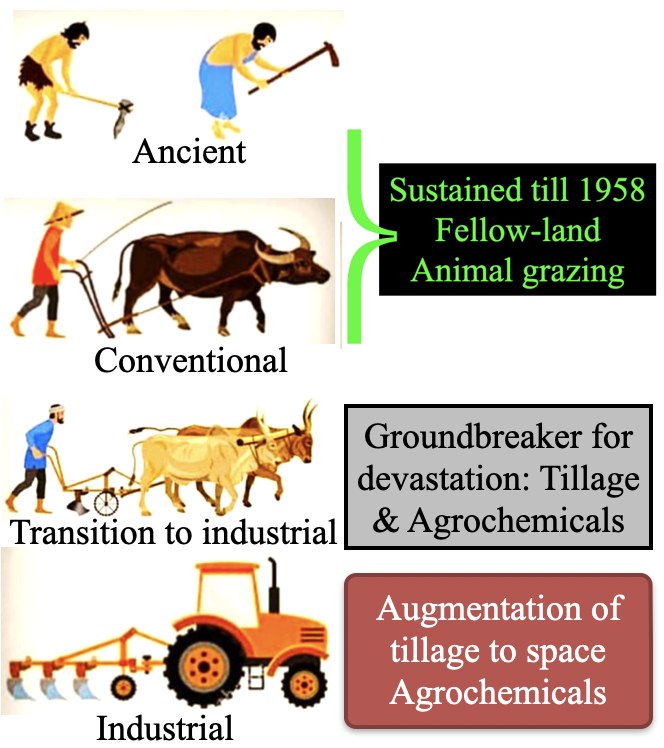
One further term is worth defining before turning to each programme individually, since it appears throughout the process-level chart later in this section. ACI, Ancient-Conventional-Industrial, is this paper's shorthand for a single continuous paradigm rather than three separate ones. Its ancient phase, hand tools used to bury seed, sustained cultivation for thousands of years with little measurable damage to soil structure. The break came with the conventional phase: the introduction of the animal-drawn plough, the actual point of disconnection from the soil's own provisioning and protective functions, the root channels, biopores, and biological structure this paper returns to repeatedly. The specific mechanism is inversion, not disturbance in general: a mouldboard or disc plough does not merely loosen soil, it turns the profile over, burying surface organic matter and biology at depth while exposing subsoil to air and light. That inversion accelerates the oxidation of stored soil carbon, measurably reduces the arbuscular mycorrhizal fungi that stabilise soil aggregates, and, repeated season after season at the same working depth, shears a compacted plough pan into the profile just beneath the blade, the same hardpan this paper's first process step, hardpan breaking, exists to reverse. It is a mechanism serious enough that PQNK's own field materials label mouldboard and disc ploughs Weapons of Mass Destruction for soil systems, a characterisation this paper does not adopt as its own register but does not think is overstated either. The industrial phase carried that same inversion forward at mechanised scale and layered synthetic agrochemicals on top of it. Section 6 already treats ancient, conventional, and industrial practice as one continuous paradigm rather than separate stages, since each deepens the same underlying disturbance rather than introducing a new one; the chart simply gives that baseline a name and a column of its own.
The System of Rice Intensification, named above, deserves its own account rather than a passing mention. Father Henri de Laulanié, a French agronomist, developed it working alongside Malagasy farmers from the 1960s onward, formalising the method in the early 1980s so smallholders could raise yields without depending on inputs they could not afford. Its departures from conventional flooded rice are specific: transplanting single seedlings at eight to twelve days old rather than clumps of older ones, spacing them widely enough for roots and tillers to develop fully, alternating wetting and drying instead of continuous flooding, and mechanically weeding in ways that also aerate the soil, paired with organic matter rather than synthetic fertiliser. Early results were striking, farmers working with the NGO Association Tefy Saina saw average yields rise from two to eight tonnes per hectare, and Cornell researcher Norman Uphoff carried the method to international attention from the mid-1990s onward, helping it spread to smallholders across more than fifty countries.
The chart below is candid about how far this goes: SRI earns a single checkmark among the sixteen process steps, for precisely the technique that made it famous, careful, minimally disturbing transplantation of young seedlings. Its alternate wetting and drying meaningfully reduces how often the field stands flooded compared with continuous-flood rice, but does not eliminate inundation outright, so the chart still marks it, like ACI, against the no-inundation criterion; only OSR and PQNK avoid standing water altogether. Mechanical weeding still works the topsoil each cycle, no lasting biodiversity or organic-matter-buildup practice is built in, and the method remains specific to rice rather than a general protocol a farmer could carry across crops. The record since the earliest results has been more mixed too: claims of yields above fifteen tonnes per hectare drew justified scrutiny for weak methodology, controlled comparisons have generally found real but far more modest gains, and SRI's knowledge- and labour-intensity, particularly the manual transplanting and weeding, has driven high rates of abandonment even among farmers reporting higher yields and lower water use. Where SRI raised yields chiefly by intensifying the farmer's own labour around one refined technique, PQNK's Four-Step Transition Protocol changes the whole sixteen-step system at once.
FAO’s Conservation Agriculture framework carried three enduring principles, minimal soil disturbance, permanent soil cover, and crop rotation, into national policy and international development practice across dozens of countries, giving an entire generation of agronomists a shared vocabulary for soil-first farming.
Of these three, the first two track an undisturbed natural system directly: an intact forest or grassland floor is neither tilled nor left bare. The third does not have the same standing. In an undisturbed plant community, the same set of species persists on the same ground indefinitely, centuries in a mature forest, without any rotation of what grows there; rotation is not a mechanism nature uses to sustain a stand of vegetation. Crop rotation earns its place in CA for a different reason: it is a workaround for the pest and weed pressure that builds up when a field is planted, season after season, to a single species in isolation, a vulnerability monoculture creates rather than one natural systems ever face. A natural plant community avoids that pressure not by rotating one species out for another in sequence, but by holding many species on the same ground at once, a standing diversity that keeps any single pest or weed from dominating. PQNK’s raised-bed design follows that natural template: simultaneous, deliberate plant diversity within a bed, rather than sequential rotation across seasons, achieving by co-occurrence what CA’s rotation clause attempts by sequence.
The Andhra Pradesh Community Managed Natural Farming programme built something rarer still: a government-backed, women-led movement that carried natural farming from forty thousand farmers in 2016 to roughly 1.8 million by 2024, proving that ecological farming can scale through community leadership and public commitment at the level of an entire state, an achievement recognised by the 2024 Gulbenkian Prize for Humanity.
The Savory Institute gave the regenerative movement something it had lacked: a rigorous, measurable way to verify ecological outcomes. Ecological Outcome Verification, now applied across more than six million acres of grassland worldwide, turned holistic grazing management from a philosophy into a monitored, accountable practice.
Gabe Brown showed, on his own ranch and then through three decades of teaching other operators, that a single farm’s soil could be rebuilt from under two percent organic matter to seven or eight percent, and that the principles behind that recovery could be taught, farm by farm, to anyone willing to learn them.
Subhash Palekar developed Zero Budget Natural Farming in India beginning in the 1990s, publishing The Philosophy of Spiritual Farming in 2005 and building a training movement that has since spread across several Indian states, seeding much of what became Andhra Pradesh's own programme. Palekar's system rests on four pillars, Jiwamrita, a fermented microbial culture, Bijamrita, a seed treatment, mulching, and Waaphasa, a term Palekar defines as the condition in which soil pore space holds roughly equal parts air and water vapour, moisture without waterlogging, which he argues is the actual mechanism by which roots draw water, through vapour absorption rather than direct uptake of standing water. That specific claim, an approximately fifty-fifty air-to-water balance in the root zone as the condition a healthy root system is built to work in, is strikingly close to PQNK's own Water : Air framework, arrived at independently and grounded differently, in nitrogenase's sensitivity to oxygen rather than in a theory of vapour uptake, but converging on the same underlying ratio as the target condition for a living soil. Where two independent lines of field-tested practice converge on the same number, that convergence deserves to be stated plainly rather than passed over.
That convergence, though, is a convergence of target, not of mechanism reliability. Palekar's method still tills between crops and pursues Waaphasa through alternate-furrow, reduced-frequency irrigation and microbial inputs rather than through retained root channels. Soil science is clear that persistent root channels, and especially the biopores that remain after a root decays, are what carry water efficiently into a soil profile and let air back in behind it, accounting for as much as seventy percent of soil macropore structure; irrigation timing alone cannot substitute for that channel network. Tillage severs it every cycle, so Waaphasa has to be rebuilt from a shallower foundation each time, where PQNK's no-till, no-uprooting practice keeps the channel network intact and self-reinforcing. Like the System of Rice Intensification and the other reform efforts named above, Zero Budget Natural Farming is navigating a production paradigm already degraded by industrial practice, doing so more intelligently than most, but navigating it rather than replacing it with the nature-designed alternative PQNK's different starting question produced.
That gap between target and mechanism is not the only one worth naming. Palekar's own published writing states a fuller theory than the version that reached the field: his books call for working toward as little irrigation as possible, no tillage, permanent organic mulch, biodiversity, and no purchased inputs, principles that, on paper, sit considerably closer to how an undisturbed ecosystem actually behaves than the practiced shorthand most farmers encounter. What spread and scaled under the ZBNF name, though, narrowed to four techniques, jivamrita, bijamrita, waaphasa, and mulch, an input-and-amendment regimen a newcomer can adopt in full without ever taking up the no-till, no-purchased-input, or biodiversity principles the theory itself calls for. The distance, in other words, is not between Palekar and nature; it is between what Palekar wrote and what his own movement carried into practice. That is the same distance this paper names in its Introduction as separating an ingredient from a recipe: a sound principle stated in a book is not yet a specification a farmer can execute faithfully at scale, and it is very likely that same untranslated gap, not any flaw in the underlying theory, that limits several of the other reform efforts named in this section as well, not only Zero Budget Natural Farming.
The distinction sharpens further at the level of institutional evidence and support infrastructure. ZBNF has not gone unstudied: ICAR ran multi-year field trials at four locations, and NITI Aayog commissioned an independent evaluation across Andhra Pradesh, Karnataka, and Maharashtra. What those studies actually found were yields comparable to, or in several crops such as wheat and basmati rice somewhat lower than, conventional practice, and a real scalability constraint tied to the system's dependence on native-cow dung and urine, since most farmers do not have access to anywhere near the number of desi cows the practice assumes. Palekar's own explanatory mechanism for Waaphasa, that roots absorb water as vapour rather than through direct uptake, has not been validated by soil or plant science and has been characterised by researchers studying Indian natural farming as sitting closer to a populist restatement of tradition than a tested mechanism. Beyond the science, ZBNF also never built a transition-support infrastructure: no sequenced, checkpointed pathway from a degraded field to a self-sustaining one, and no continuously updated channel for the field-specific questions, an unexpected pest, an unusually dry season, a soil behaving outside the manual, that arise during any real transition. It scaled through Palekar's own training camps and farmer-to-farmer word of mouth rather than through a standing support system. PQNK's Four-Step Transition Protocol pairs its sequence with exactly that missing piece: a live, continuously growing record of real farmer questions answered and real outcomes documented across its own practitioner network, catching the edge cases a written protocol alone cannot anticipate and turning each resolved case into evidence the next farmer can build on.
The Swiss-Brazilian farmer Ernst Götsch has spent more than four decades developing syntropic agroforestry on his own farm, Olhos D'Água, in Bahia, Brazil, planting at four to ten times conventional density across twenty to fifty species and four to six canopy layers per hectare, deliberately accelerating the successional stages a forest would otherwise take decades to pass through. Since acquiring the property in 1982, his methods have regenerated some 480 hectares of degraded pasture into productive forest and are credited with reviving fourteen of the seventeen springs on the property that had previously run dry. Götsch's method, like PQNK, treats vegetation density and structure as the mechanism for rebuilding a self-sustaining water and mineral cycle, rather than as an outcome pursued separately from soil recovery.
PQNK did not draw on any of these six, for the reasons set out in the Introduction above: it emerged independently, from direct field practice and unmediated observation of an intact ecosystem. What distinguishes it from each of these six is not superiority but reach: an engineered, self-contained specification, the raised bed, the Water : Air ratio, the Four-Step Transition Protocol, precise enough to travel from a large commercial holding down to a single acre farmed by hand, without requiring the government infrastructure, the training network, or the consultant each of these six programmes was built around. That reach is PQNK’s specific contribution to a shared project every one of these six helped build.
None of the six carries a comparable claim about where its own transition ends. PQNK’s does: the Four-Step Transition Protocol carries a field from a degraded starting condition to a regenerative one, and within two crop cycles carries it further, to a closed-loop, self-sustaining state in which soil biology, mulch-based moisture retention, and the Water : Air ratio maintain themselves without further correction. Once that state is reached, the farmer’s required interventions reduce to two: go planting, and go harvesting. Everything the six other programmes ask a farmer to sustain indefinitely, mulching schedules, grazing rotations, external input decisions, PQNK is built to hand back to the field itself after the second crop.
There is a further, structural reason none of the six ever reached PQNK's completeness, worth naming plainly rather than leaving implicit. Agricultural research funding has been documented, not merely accused of, favouring input-intensive, patentable technology over systems-level alternatives: the 2008 International Assessment of Agricultural Knowledge, Science and Technology for Development, approved by dozens of governments and co-sponsored by the FAO, the World Bank, and the WHO among others, found this bias directly in how agricultural science had been funded and directed, and called for redirected investment toward agroecological research. CA, CMNF, Savory, Gabe Brown, ZBNF, SRI, and syntropic agroforestry each achieved what they achieved without the sustained, well-funded research infrastructure input-intensive agriculture has drawn on for a century; several, CMNF and SRI among them, only reached their present scale once government or university backing eventually arrived. PQNK took the opposite path: self-funded from the outset, answerable to no funding body's priorities, free to ask the different question this paper describes throughout. That independence is very likely why the question got asked and answered completely rather than incrementally. It carries a real cost in the other direction: without institutional backing, the same completeness that lets PQNK reach a single acre as readily as a large holding now has to scale the harder way, farm to farm, without the funding infrastructure the other six programmes eventually drew on.
A Process-Level Comparison Across Six Systems
The programmes named above operate at the level of institutions, movements, and philosophies. A second, complementary comparison is useful at the level of the field itself: sixteen specific process steps and three outcome measures, set side by side. It also carries forward ACI and OSR, defined above and in Section 2, so the full span from the most degraded starting point to PQNK itself sits on one scale. This comparison, developed independently through the author's own field practice, is reproduced here in full.
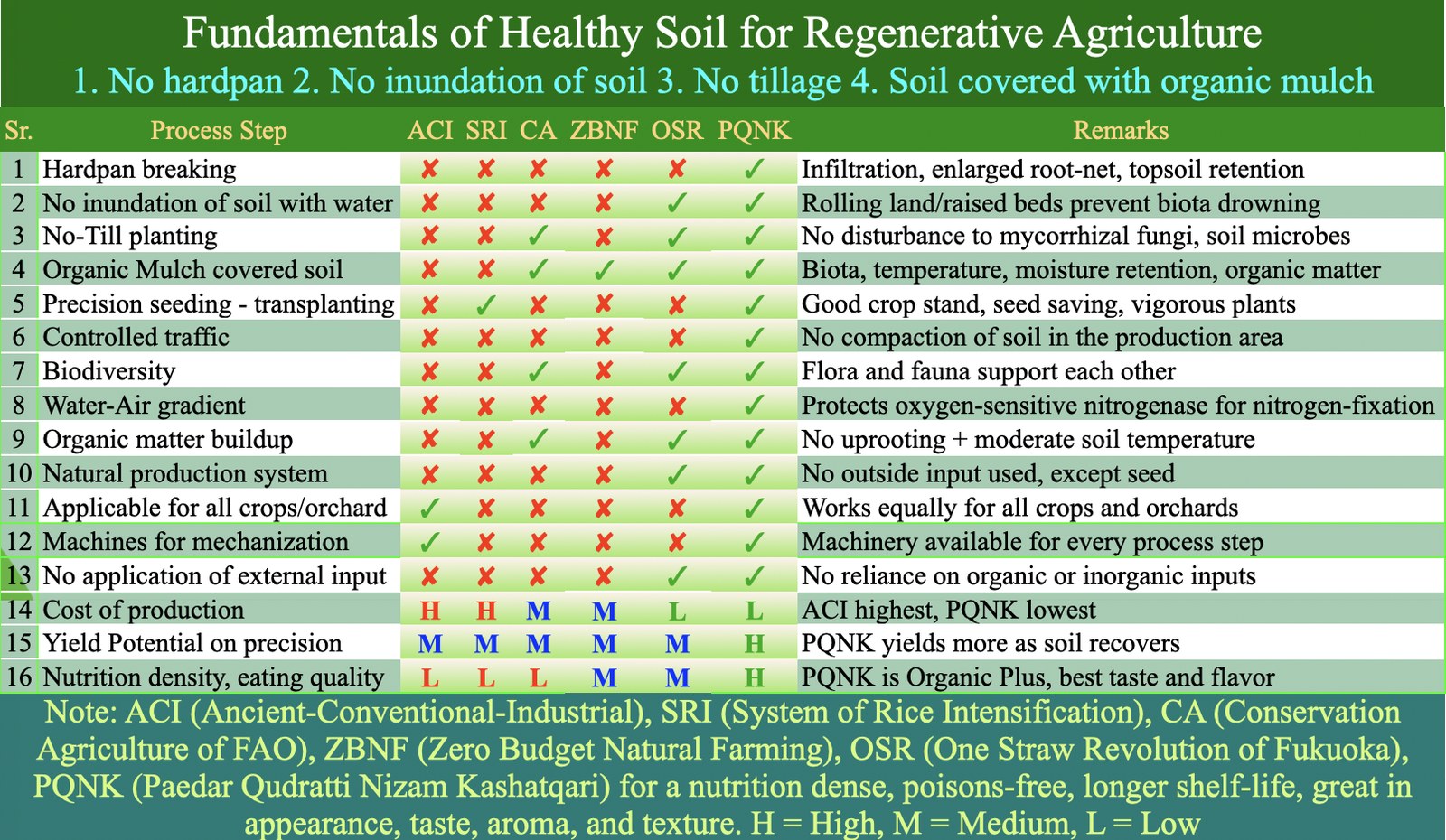
| Sr. | Process Step | ACI | SRI | CA | ZBNF | OSR | PQNK | Remarks |
|---|---|---|---|---|---|---|---|---|
| 1 | Hardpan breaking | No | No | No | No | No | Yes | Infiltration, enlarged root-net, topsoil retention |
| 2 | No inundation of soil with water | No | No | No | No | Yes | Yes | Rolling land/raised beds prevent biota drowning |
| 3 | No-Till planting | No | No | Yes | No | Yes | Yes | No disturbance to mycorrhizal fungi, soil microbes |
| 4 | Organic Mulch covered soil | No | No | Yes | Yes | Yes | Yes | Biota, temperature, moisture retention, organic matter |
| 5 | Precision seeding - transplanting | No | Yes | No | No | No | Yes | Good crop stand, seed saving, vigorous plants |
| 6 | Controlled traffic | No | No | No | No | No | Yes | No compaction of soil in the production area |
| 7 | Biodiversity | No | No | Yes | No | Yes | Yes | Flora and fauna support each other |
| 8 | Water-Air gradient | No | No | No | No | No | Yes | Protects oxygen-sensitive nitrogenase for nitrogen-fixation |
| 9 | Organic matter buildup | No | No | Yes | No | Yes | Yes | No uprooting + moderate soil temperature |
| 10 | Natural production system | No | No | No | No | Yes | Yes | No outside input used, except seed |
| 11 | Applicable for all crops/orchard | Yes | No | No | No | No | Yes | Works equally for all crops and orchards |
| 12 | Machines for mechanization | Yes | No | No | No | No | Yes | Machinery available for every process step |
| 13 | No application of external input | No | No | No | No | Yes | Yes | No reliance on organic or inorganic inputs |
| 14 | Cost of production | High | High | Medium | Medium | Low | Low | ACI highest, PQNK lowest |
| 15 | Yield Potential on precision | Medium | Medium | Medium | Medium | Medium | High | PQNK yields more as soil recovers |
| 16 | Nutrition density, eating quality | Low | Low | Low | Medium | Medium | High | PQNK is Organic Plus, best taste and flavor |
10. WHAT PQNK ADDS
Laid side by side, a pattern emerges: seven serious, independent, hard-won contributions, each building part of the case for ecological, self-regulating agriculture.
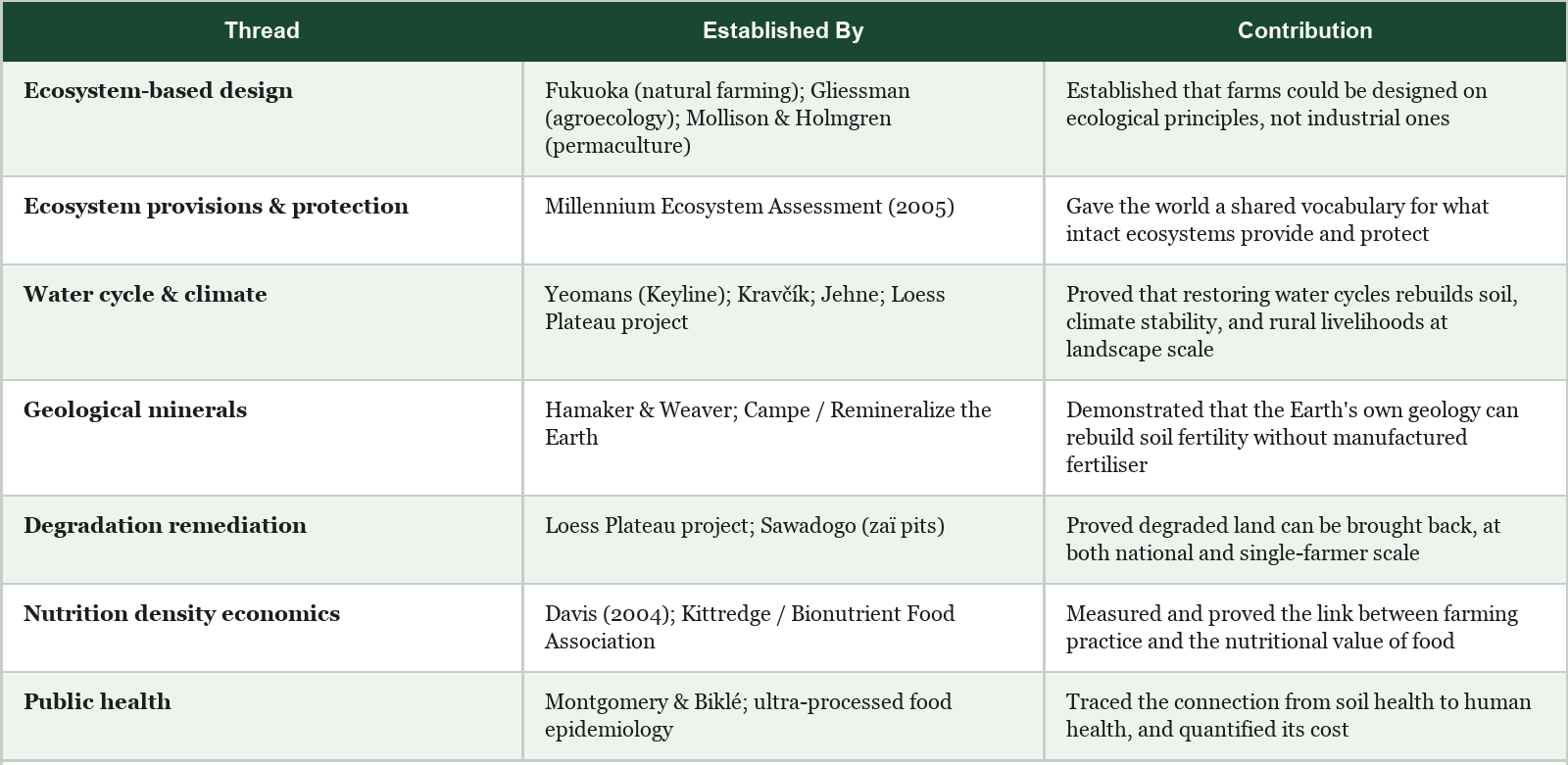
| Thread | Established By | Contribution |
|---|---|---|
| Ecosystem-based design | Fukuoka (natural farming); Gliessman (agroecology); Mollison & Holmgren (permaculture) | Established that farms could be designed on ecological principles, not industrial ones |
| Ecosystem provisions & protection | Millennium Ecosystem Assessment (2005) | Gave the world a shared vocabulary for what intact ecosystems provide and protect |
| Water cycle & climate | Yeomans (Keyline); Kravčík; Jehne; Loess Plateau project | Proved that restoring water cycles rebuilds soil, climate stability, and rural livelihoods at landscape scale |
| Geological minerals | Hamaker & Weaver; Campe / Remineralize the Earth | Demonstrated that the Earth's own geology can rebuild soil fertility without manufactured fertiliser |
| Degradation remediation | Loess Plateau project; Sawadogo (zaï pits) | Proved degraded land can be brought back, at both national and single-farmer scale |
| Nutrition density economics | Davis (2004); Kittredge / Bionutrient Food Association | Measured and proved the link between farming practice and the nutritional value of food |
| Public health | Montgomery & Biklé; ultra-processed food epidemiology | Traced the connection from soil health to human health, and quantified its cost |
PQNK's own independent path arrives at the same conclusions from direct field practice, and its specific role is to carry all seven forward into one integrated, sequenced, tool-equipped process, ecosystem design, water cycle restoration, mineral abundance, degradation reversal, and nutrient density, with the public health benefit following as a natural consequence, precise enough to reach a single acre as readily as a large holding. That assembly, offered in the same spirit of stewardship as the work it builds on, is what this paper describes.
It is worth restating plainly that PQNK reached this assembly on its own path, through the fifty-three years of field practice and the direct 2008 Amazon observation described in the Introduction above, not by drawing on the researchers named in the table above. Their work is cited here as independent corroboration arrived at from a different direction, academic and institutional research on one side, hands-on production and unmediated ecological observation on the other, converging on the same conclusion. That two separate routes arrive at the same destination, one built to serve institutions and policy, the other built from the beginning to serve the smallest farmer as faithfully as the largest, is a stronger form of evidence than either route could provide alone.
11. CONCLUSION
The right response to “has anyone studied this before” is not to claim a vacuum. It is to name the researchers and practitioners who built each piece, credit them accurately, and show precisely what changes when their separate contributions are assembled into one applied system with defined steps and tools. That is a stronger claim than uniqueness by assertion, because it is falsifiable: it can be checked against the literature, and it holds.
What makes that assembly worth building at all is not scale for its own sake. It is that a specification precise enough to be written down, measured, and repeated is also precise enough to reach the last farmer as fully as the first, the single acre as fully as the large holding. It is also precise enough to end: within two crop cycles, the same protocol that repairs a degraded field hands its maintenance back to the field itself, reducing the farmer’s ongoing task to two decisions, when to plant and when to harvest. That reach, carrying forward work that a century of researchers, institutions, and practitioners each helped build, is what this paper has tried to honour.
REFERENCES
Believe Earth. (2019). Ernst Götsch: The creator of the real green revolution. Believe Earth.
Brown, G. (2018). Dirt to soil: One family’s journey into regenerative agriculture. Chelsea Green Publishing.
Campe, J., Goreau, T. J., & Larson, R. W. (2015). Geotherapy: Innovative methods of soil fertility restoration, carbon sequestration, and reversing CO2 increase. CRC Press.
Council on Energy, Environment and Water. (2024). How Andhra Pradesh scaled up community-managed natural farming. CEEW Case Study.
Davis, D. R., Epp, M. D., & Riordan, H. D. (2004). Changes in USDA food composition data for 43 garden crops, 1950 to 1999. Journal of the American College of Nutrition, 23(6), 669–682.
Fukuoka, M. (1978). The one-straw revolution: An introduction to natural farming (C. Pearce, T. Kurosawa, & L. Korn, Trans.). Rodale Press. (Original work published 1975).
Giller, K. E., Witter, E., Corbeels, M., & Tittonell, P. (2009). Conservation agriculture and smallholder farming in Africa: The heretics’ view. Field Crops Research, 114(1), 23–34.
Gliessman, S. R. (2014). Agroecology: The ecology of sustainable food systems (3rd ed.). CRC Press.
Hamaker, J. D., & Weaver, D. (1982). The survival of civilization. Hamaker-Weaver Publishers.
International Assessment of Agricultural Knowledge, Science and Technology for Development (IAASTD). (2009). Agriculture at a crossroads: Global report. Island Press.
Kravčík, M., Pokorný, J., Kohutiar, J., Kováč, M., & Tóth, E. (2007). Water for the recovery of the climate: A new water paradigm. Krupa Print.
Lane, M. M., Gamage, E., Du, S., Ashtree, D. N., McGuinness, A. J., Gauci, S., et al. (2024). Ultra-processed food exposure and adverse health outcomes: umbrella review of epidemiological meta-analyses. BMJ, 384, e077310.
Laulanie, H. de. (1993). Le systeme de riziculture intensive malgache. Tropicultura, 11(3), 110-114.
Millennium Ecosystem Assessment. (2005). Ecosystems and human well-being: Synthesis. Island Press.
Mollison, B. (1988). Permaculture: A designer’s manual. Tagari Publications.
Moser, C. M., & Barrett, C. B. (2003). The disappointing adoption dynamics of a yield-increasing, low-external-input technology: The case of SRI in Madagascar. Agricultural Systems, 76(3), 1085–1100.
Montgomery, D. R., & Biklé, A. (2016). The hidden half of nature: The microbial roots of life and health. W.W. Norton & Company.
Montgomery, D. R., & Biklé, A. (2022). What your food ate: How to heal our land and reclaim our health. W.W. Norton & Company.
Montgomery, D. R., Biklé, A., Archuleta, R., Brown, P., & Jordan, J. (2022). Soil health and nutrient density: Preliminary comparison of regenerative and conventional farming. PeerJ, 10, e12848.
NITI Aayog, ICAR-NAARM, & CRIDA. (2021). Adoption of natural farming and its effect on crop yield, economics and soil fertility: Case study in Andhra Pradesh. NITI Aayog.
Palekar, S. (2005). The philosophy of spiritual farming (2nd ed.). Zero Budget Natural Farming Research, Development & Extension Movement.
Pandey, P., & Cabral, L. (2025). Transformational agroecology: The making and unmaking of Zero Budget Natural Farming in India. Journal of Development Policy and Practice.
Right Livelihood Foundation. (2018). Yacouba Sawadogo, Burkina Faso: Laureate profile. Right Livelihood.
Savory Institute. (2018). Ecological Outcome Verification (EOV) summary. Savory Institute.
United Nations Environment Programme. (2020). Yacouba Sawadogo: Champions of the Earth laureate profile. UNEP.
Wang, S., Wu, J., et al. (2022). Response of net primary productivity to vegetation restoration in Chinese Loess Plateau during 1986–2015. Frontiers in Environmental Science.
Wilkes, T. I., Warner, D. J., Edmonds-Brown, V., Davies, K. G., & Denholm, I. (2021). Zero tillage systems conserve arbuscular mycorrhizal fungi, enhancing soil glomalin and water stable aggregates with implications for soil stability. Soil Systems, 5(1), 4.
World Bank. (2007). Restoring China’s Loess Plateau. World Bank Feature Story.
Yeomans, P. A. (1954). The Keyline plan. Yeomans.
PQNK — Paedar Qudratti Nizam Kashatqari
Connect & Resources
Facebook: www.Facebook.Com/Pedaver
YouTube (PQNK): https://www.youtube.com/@pedaverpqnk3167/videos
YouTube: http://www.youtube.com/@aasifsharif
PDF Knowledge Papers: https://drive.google.com/drive/folders/1iadwV6mdUPyrUIpB3oRfNv6DLiackaUL?usp=sharing
Email: pedaver@gmail.com
WhatsApp: +92 320 677 6666
About This Paper
- Crop
- Rice
- Problem
- Terminology / Framework Confusion · Untrained Labor / Management
- Science
- Soil · Water · Biodiversity · Nutrition · Food Quality · Economics
- Evidence
- Philosophical/Framework Argument
- Authority
- Current / Approved PQNK Knowledge
Related PQNK Science
Key Takeaways
- Credits seven independent traditions, Fukuoka/Gliessman/permaculture, the Millennium Ecosystem Assessment, Yeomans/Kravčík/Jehne/Loess Plateau water-cycle work, Hamaker & Weaver's geological remineralization, Loess Plateau/Sawadogo degradation reversal, Davis 2004/Bionutrient Food Association nutrient-density research, and Montgomery & Biklé's soil-to-public-health work, for establishing separate pieces of the regenerative case.
- States plainly that PQNK was developed independently over five decades of field practice beginning in 1973, through years of institutional resistance along the way, and a 2008 Amazon field observation, not by studying the literature it credits, presenting the convergence as corroboration rather than derivation.
- Frames its distinct contribution as 'the recipe, not the ingredients': specific quantities, sequence, and timing precise enough that two farmers following it reach the same result.
- Compares PQNK against six contemporary reform programmes (SRI, Conservation Agriculture, CMNF, the Savory Institute, Gabe Brown's model, syntropic agroforestry), crediting each while arguing they refine the existing degraded paradigm rather than starting from nature's own governing question.
- Introduces 'ACI' (Ancient-Conventional-Industrial) as one continuous paradigm expressed through three successive historical stages, naming plough-driven soil inversion, not disturbance in general, as the actual point of ecological disconnection.
- Gives the System of Rice Intensification an extended, candid case study: credited for pioneering careful seedling transplantation, but marked down for retained flooding, topsoil-working weeding, and a mixed record on its most ambitious yield claims.
Related Crops
Related Knowledge
same problem
Every Seed Is a Promise to the Next Generation: Why PQNK Selects Open-Pollinated Genetics Over GMO, Hybrid, and Seedless Seed
PQNK's seed philosophy separates three routinely conflated categories, GMO, F1 hybrid, and induced seedlessness, and argues open-pollinated seed was never agriculture's weak link; degraded, tillage-hollowed soil was. This knowledge paper works from the biology of pollination through the Green Revolution's real achievement to a full crop-by-crop protocol for saving, isolating, and hand-pollinating open genetics on a PQNK farm.
same problem
Rethinking Agricultural Systems – The PQNK Framework (A1)
This framework document defines PQNK not as an addition of techniques to conventional farming but as a first-principles diagnostic standard, built on four non-negotiable axioms, for distinguishing genuine ecosystem agriculture from repackaged extraction dressed up as 'regenerative' or 'sustainable.'
same problem
The PQNK Framework: From Degenerative Systems to Regenerative Process to Sustainable State
A short framework note that corrects what it calls a common misconception, that 'regenerative' and 'sustainable' are interchangeable or parallel labels, by defining them as sequential stages: a defined four-step Corrective Intervention that a degraded farm passes through once, followed by a Regenerative Phase of biological rebuilding and then a permanent Sustained Closed Loop State requiring only seed placement and harvesting.
same problem
From Chemistry to Biology: What PQNK Really Means
Answers a practicing farmer's question, why does PQNK say agriculture is moving "from chemistry to biology" when chemical reactions clearly continue in every living soil, by distinguishing externally managed chemistry (chemistry imposed from outside through purchased inputs) from biologically regulated chemistry (chemistry organized by living roots, microorganisms and fungi), and explaining why PQNK's four principles must work together to restore that biological regulation.