

KP-109 · Plant Physiology & Production Systems
Every Seed Is a Promise to the Next Generation: Why PQNK Selects Open-Pollinated Genetics Over GMO, Hybrid, and Seedless Seed
PQNK's seed philosophy separates three routinely conflated categories, GMO, F1 hybrid, and induced seedlessness, and argues open-pollinated seed was never agriculture's weak link; degraded, tillage-hollowed soil was. This knowledge paper works from the biology of pollination through the Green Revolution's real achievement to a full crop-by-crop protocol for saving, isolating, and hand-pollinating open genetics on a PQNK farm.
Read or listen to the full paper ↓External Knowledge — this paper is sourced from outside Pedaver/PQNK. It is presented as supporting evidence, not as PQNK's own approved doctrine.
Abstract
The paper opens by defining what a seed actually is: the product of a reproductive event that functions, across generations of open pollination, as a running experiment re-run every season, in which the plants best suited to a specific field, climate, and pest pressure survive to pass their genetics forward. A landrace built this way becomes something close to a live, field-tested record of what has actually worked on that soil, under that sky, and it is this real biological mechanism, not sentiment, that the paper's title refers to. Against that backdrop, it sets out to separate three modern seed categories that public discussion routinely blurs into one undifferentiated worry, GMO, F1 hybrid, and induced seedlessness, and argues that treating them identically weakens the case against each.
Genetically modified seed is distinguished as the only category that crosses a reproductive barrier no pollination event could ever cross on its own. Pakistan's own Bt cotton history is used to sharpen the point: unlike India, where Bt cotton is grown almost exclusively as hybrid seed requiring annual repurchase, Pakistan's approved lines (IUB-13, MNH-886, BS-15, NIAB-878, FH-142) are released as open-pollinated varieties, so PQNK's objection is to the transgenic trait itself, not to seed-saving as such; a technology-use agreement backed by patent litigation, not the seed's own biology, is what actually stops a farmer from replanting it. F1 hybrid seed is treated as a different problem entirely: real, well-documented hybrid vigour that is a one-generation event, so a farmer who replants F2 seed gets an unpredictable, segregated population, the specific genetic mechanism behind a commercial seed industry now valued at roughly $50-60 billion and 60-70% controlled by a handful of multinational firms. Induced seedlessness is shown to have two distinct mechanisms, chromosomal sterility (triploid watermelon) and parthenocarpy/stenospermocarpy (seedless grapes), with banana carved out as a genuine exception: its sterility traces to a spontaneous mutation farmers found and vegetatively propagated some seven thousand years ago, not a trait engineered against the plant's own reproductive interest.
The paper's historical core argues the Green Revolution solved a soil problem with a seed problem's solution: Borlaug's shuttle-bred, open-pollinated, semi-dwarf wheat carried a shorter stalk and higher harvest index that let it absorb far heavier synthetic nitrogen doses without lodging, nearly doubling Pakistani wheat yields between 1965 and 1970, but at a documented cost of roughly 75% of global agricultural genetic diversity by one FAO estimate, with India's rice landraces the starkest case, more than 90% of an estimated 110,000 distinct landraces disappearing from farmers' fields within decades. The paper argues this was agronomic compensation for degraded soil, not genetic repair, and that genotype is a ceiling, not a guarantee, of what a crop can express.
A dedicated section contrasts the priority list a commercial breeder works from, uniform yield, display appeal, mechanical-harvest compatibility, shelf life, against the priority list open selection runs on: whether a household wanted to eat the crop again. Because flavour correlates with the sugars, oils, and secondary compounds that also carry nutritional density, taste-based selection is argued to pull nutrition and eating quality forward together as a package, illustrated by the contrast between a dense, satisfying desi cucumber and a mostly-water hybrid bred for shelf appearance.
The paper closes with an extensive practical section: a crop-by-crop table of dominant commercial seed types against what PQNK selects instead, separate treatment of clonally propagated crops like garlic and potato, and detailed field technique covering isolation by distance, time, and physical barrier; manual hand-pollination of cucurbits (squash, melon, cucumber, watermelon); harvesting, drying, and moisture-testing seed without a laboratory meter; and a PQNK method for stabilizing a new open-pollinated line, including a technique for selectively re-deriving an open line from GMO stock by saving seed specifically from the minority of plants that do not express the introduced trait.
Full Paper
If you use “Listen”, the text of the page may be sent to your browser or operating system’s speech provider, such as Apple, Google or Microsoft, depending on the voice your device uses. Pedaver does not process, transmit or store any audio.
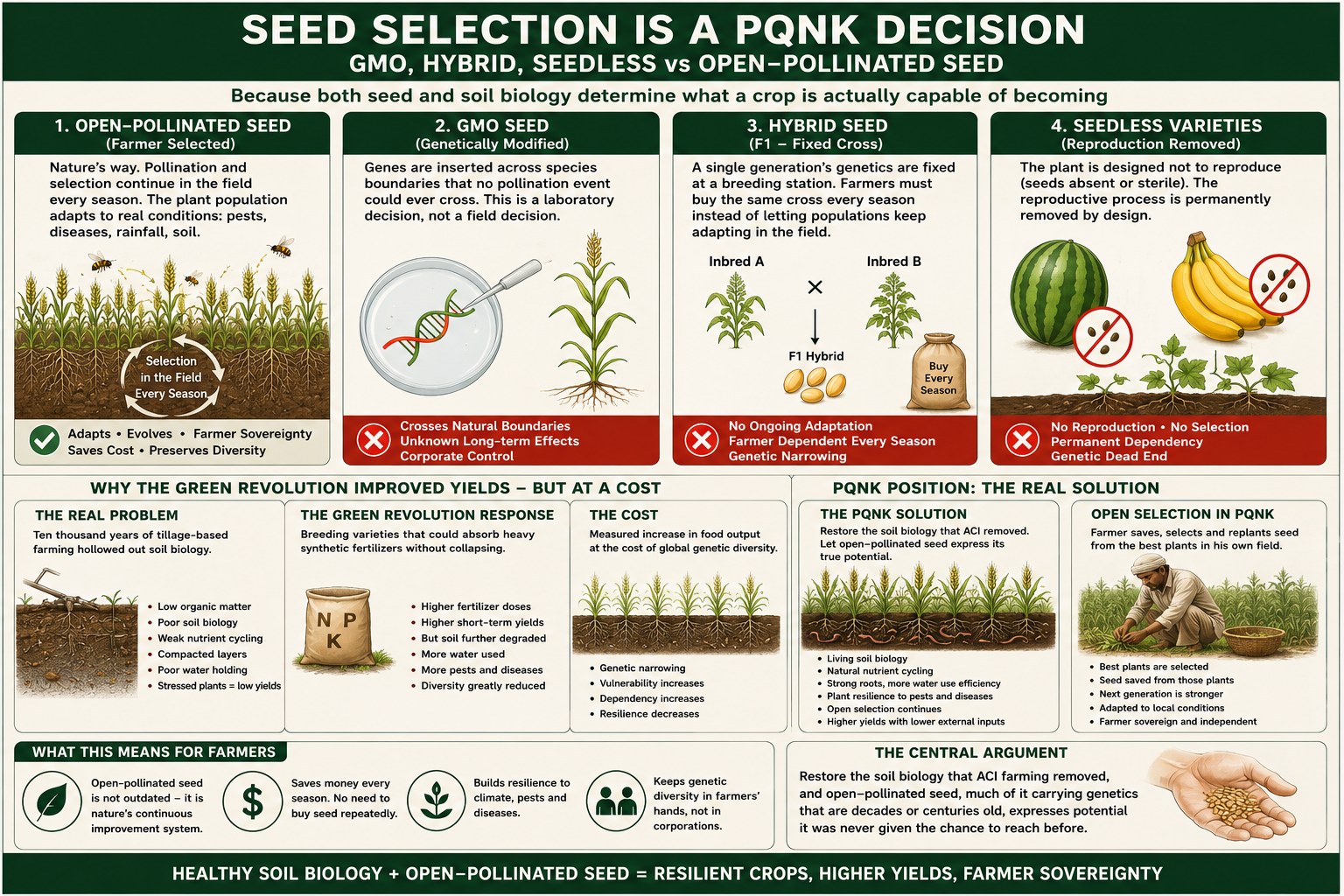
Why PQNK Selects Open-Pollinated Genetics Over GMO, Hybrid, and Seedless Seed
ABSTRACT
Seed selection is a PQNK decision with the same weight as soil biology, and for the same reason: both determine what a crop is actually capable of becoming. In nature, pollination, whether carried by wind, insect, or the plant's own pollen onto itself, is not incidental to reproduction. It is the mechanism by which every generation of a species is tested against, and adjusted for, the conditions it actually has to survive: the pests present that year, the disease pressure, the rainfall, the soil. Three categories of modern seed interrupt that process in three different ways, and public discussion routinely blurs them into one undifferentiated worry. Genetically modified seed introduces genes across boundaries no pollination event could ever cross. Hybrid seed fixes a single generation's genetics centrally, at a breeding station, then asks the farmer to buy that same fixed cross again every season rather than let the plant population continue adjusting itself in the field. Seedless varieties remove the plant from the reproductive process altogether, by design, as a permanent condition.
PQNK's position is that open-pollinated seed, saved, selected, and replanted by the farmer who grows it, was never the deficient half of the yield equation. Before the Green Revolution, farmers grew open-pollinated landraces that carried, in most of the traits that matter, everything a modern breeder would later try to fix. What actually limited those crops was ten thousand years of tillage-based, biologically hollowed-out soil, the same Ancient-Conventional-Industrial (ACI) condition this book documents throughout. The Green Revolution answered a soil problem with a seed problem's solution: it bred varieties that could absorb far heavier doses of synthetic fertiliser without collapsing, and in doing so, it measurably improved food output at the cost of a large share of the world's cultivated genetic diversity.
This paper sets out, precisely, what distinguishes GMO, hybrid, and seedless seed from open-pollinated genetics; traces why the Green Revolution's real achievement was agronomic compensation rather than genetic repair; and works through what open selection means, crop by crop, across the field crops, vegetables, and orchard plants that make up a working PQNK farm. The central argument is simple and testable: restore the soil biology that ACI farming removed, and open-pollinated seed, much of it carrying genetics that are decades or centuries old, expresses potential it was never given the chance to reach before.
1. WHAT A SEED ACTUALLY IS: POLLINATION AS NATURE'S IMPROVEMENT ENGINE
A seed is the product of a reproductive event, and in the overwhelming majority of cultivated plant species, that event involves the union of genetic material from two parents rather than one. Even in self-pollinating crops such as wheat, rice, and most legumes, where a flower typically fertilises itself, a small but persistent rate of natural cross-pollination continues to introduce new genetic combinations into the population every generation. Sexual reproduction exists, evolutionarily, because genetic recombination generates variation, and variation is the raw material natural selection acts on. A population of open-pollinated plants growing in a particular field, under a particular climate, against a particular set of local pests and diseases, is not a static genetic asset. It is a running experiment, re-run every season, in which the individuals best suited to that specific environment are more likely to survive, set seed, and pass their genetics forward. Over generations of this process, and of the parallel process of farmers themselves selecting the best-performing plants to save seed from, a landrace becomes something close to a live, field-tested record of what has actually worked, on that soil, under that sky.
This is the sense in which every seed genuinely does carry forward an improvement to the next generation, not as sentiment but as a description of a real biological mechanism. It is also the sense in which three modern categories of seed depart from that mechanism in three distinct ways, examined in turn below.
2. THREE DIFFERENT PROBLEMS, OFTEN TREATED AS ONE
Public conversation about seed regularly collapses genetically modified, hybrid, and seedless varieties into a single undifferentiated category of concern. They are not the same problem, they do not raise the same objections, and treating them identically weakens the case against each. PQNK separates them deliberately.
2.1 Genetically Modified Seed
A genetically modified organism is one whose genetic material has been altered directly, in a laboratory, using techniques that can move a gene across a reproductive barrier no pollination event, wind-borne, insect-carried, or otherwise, could ever cross on its own: a bacterial gene into a cotton plant, for instance. This is the categorical difference between genetic modification and every other form of plant breeding discussed in this paper, hybridisation included. Hybridisation recombines genes already present within a species, or between species close enough to cross naturally. Genetic modification does not carry that constraint.
Pakistan's own recent agricultural history makes this concrete. Bt cotton, engineered to express an insecticidal protein from the soil bacterium Bacillus thuringiensis, was formally approved for commercial release in Pakistan in 2010, after several years in which farmers had already begun planting unregistered Bt seed ahead of regulatory approval. Adoption has since become near-total: Bt varieties now cover more than ninety percent of Pakistan's cotton area. One precise distinction is worth making here, because it is commonly missed: unlike India, where Bt cotton is grown almost exclusively as hybrid seed requiring annual repurchase, Pakistan's approved Bt cotton lines, including IUB-13, MNH-886, BS-15, NIAB-878, and FH-142, are released as open-pollinated varieties. Pakistani farmers can, in principle, save Bt cotton seed from one season to the next without the genetic segregation problem that affects hybrids. PQNK's objection to Bt cotton is therefore specifically to the transgenic trait itself, not to a seed-saving mechanic: the insertion bypasses the pollination-and-selection process this paper treats as the seed's real value, it places a patented, licensed trait permanently inside Pakistan's cotton genetics, and it commits the crop to a pest-resistance arms race, since insect populations under sustained Bt exposure are already showing resistance in several growing regions worldwide.
The purpose behind a genetic modification is worth stating plainly, because it is not always visible from the seed itself. Commercial seed licensing shows the primary objective clearly: a farmer who buys patented GMO seed generally signs a technology use agreement contractually prohibiting the saving and replanting of seed from the resulting crop, an agreement backed by patent litigation rather than by the seed's own biology, one major seed company alone filed well over a hundred such suits against farmers in the decade after its first transgenic crops reached the market. The restriction is legal, not biological: a GMO seed germinates and reproduces normally if saved and replanted, and it is the licence, not the seed's own fertility, that stands between a farmer and a second generation. A genuinely biological version of this restriction, capable of rendering a plant's second-generation seed sterile by design, was developed and patented in the 1990s under the name Genetic Use Restriction Technology, popularly known as Terminator technology. It was never commercialised. The Convention on Biological Diversity recommended a de facto global moratorium on field-testing or selling it in 2000, the moratorium was reaffirmed and strengthened in 2006, and every major seed company, including the technology's original developer, has since pledged not to bring it to market. The underlying concern was real and well founded; the specific engineered mechanism, in practice, was stopped before it reached a single farmer's field, and the seed-saving barrier that does exist today runs through contract law rather than through the seed's own chemistry.
PQNK's own field experience adds one further, practical observation here, offered as a documented field practice rather than a claim drawn from the published genetics literature: a genetic modification rarely expresses with complete uniformity across every plant grown from a modified seed lot. In PQNK's own on-farm observation, roughly nine in ten plants grown from a given GMO seed source carry the introduced trait as expected, while a smaller fraction, on the order of one in ten, shows visibly different, unmodified characteristics. Selecting and saving seed specifically from that resilient minority, generation after generation, using the same stabilising-selection method set out in Section 9, is a practical route by which a farmer can work back toward an open, saveable line even starting from GMO stock, a technique consistent with, rather than a substitute for, this paper's broader recommendation to source open-pollinated seed directly wherever it is already available.
2.2 F1 Hybrid Seed
A hybrid, in the F1 sense used throughout the commercial seed trade, is the first-generation offspring of a deliberate cross between two distinct, genetically stable parent lines, each maintained separately by the breeder and never sold to the farmer. The cross itself is not unnatural; controlled cross-pollination is one of the oldest plant-breeding tools there is. What makes F1 hybrid seed a different proposition from open pollination is what happens next. The F1 generation typically displays heterosis, or hybrid vigour, a real and well-documented phenomenon in which the offspring outperforms both parents on traits such as yield uniformity, but that vigour is a one-generation event tied to a specific, precise genetic combination. If a farmer saves seed from an F1 plant and replants it, the second generation, F2, does not repeat the cross. It segregates: the genes inherited from each grandparent re-sort themselves according to ordinary Mendelian inheritance, producing a mixed, unpredictable population in which yield, disease resistance, and uniformity can all fall well below the F1 parent's performance. This is not a defect that can be bred away. It is the direct genetic consequence of what a hybrid cross is, and it is the reason the global seed trade is structured around the farmer purchasing F1 seed fresh, every season, from the company that controls both parent lines.
The scale of this is worth stating plainly. The commercial seed industry is now valued at roughly fifty to sixty billion dollars globally, more than three and a half times its size in the mid-1990s, and a small number of multinational companies, formed through a wave of mergers since the 1990s, now control sixty to seventy percent of proprietary seed sales worldwide. Maize is the crop where hybrid vigour first became commercially decisive, because maize is naturally wind-pollinated and cross-breeds easily; hybrid maize has dominated global cultivation since the 1930s and 1940s. Vegetable seed, particularly tomato, chilli, and okra sold for commercial rather than subsistence production, is now overwhelmingly F1 hybrid, chosen less for yield than for the uniformity in fruit size, ripening date, and shelf life that mechanised harvest and long-distance transport require, traits that matter to a supply chain far more than they matter to a plant or the farmer who grows it. Rice hybridisation followed a different route: Chinese scientist Yuan Longping's discovery of cytoplasmic male sterility in the early 1970s made large-scale hybrid rice seed production possible for the first time, and hybrid rice now covers roughly half of China's rice area and has been introduced in more than seventy countries, with a documented yield advantage over inbred varieties in the range of fifteen to thirty percent under matched conditions.
Wheat offers the clearest natural counter-example to the idea that hybridisation is simply what modern breeding does. Wheat is stubbornly self-pollinating: its pollen is heavy, short-lived, and produced in small quantities, and the crop lacks a natural, efficient sterility system that would block self-fertilisation long enough for a controlled cross to reliably occur at commercial scale. Despite sustained investment by several of the world's largest seed companies, hybrid wheat remains commercially marginal, covering under one percent of the world's wheat area. Wheat's biology has, in effect, resisted exactly the kind of centralised genetic control that maize, rice, and vegetable seed were converted to decades ago, and the world's wheat supply, Green Revolution varieties included, remains almost entirely open-pollinated as a direct result. This is not a coincidence PQNK treats lightly: it is evidence that hybridisation is a commercial choice available wherever a crop's reproductive biology permits it, not an agronomic necessity every crop eventually requires.
2.3 Induced Seedlessness
Seedlessness is not one phenomenon. It arises through at least two distinct mechanisms, and one crop on every PQNK farm's plate arrived at seedlessness by a route that predates modern breeding science entirely, a distinction worth making before treating all seedless produce as a single modern problem.
Chromosomal seedlessness is the mechanism behind seedless watermelon. A tetraploid parent line, its chromosome number artificially doubled using the chemical colchicine, is crossed with an ordinary diploid parent to produce a triploid offspring. A triploid cannot divide its three sets of chromosomes evenly during the cell division that produces pollen and egg cells, so its gametes are non-functional even though its flowers appear entirely normal; the plant is, in the most direct sense, sterile by design. Because the triploid produces no viable pollen of its own, commercial seedless watermelon fields must still interplant a normal, seeded diploid variety, typically at a ratio of roughly one diploid plant to every two or three triploids, purely to supply the pollen that triggers fruit set, even though that pollen never actually fertilises a seed inside the fruit it stimulates.
Parthenocarpy and its close relative, stenospermocarpy, are the mechanisms behind most seedless grapes and some seedless citrus. In true parthenocarpy, fruit develops without fertilisation ever taking place, and the resulting fruit tends to be visibly smaller, since the hormonal signal that normally drives fruit growth originates in the developing seed. In stenospermocarpy, the more common mechanism in commercial table grapes such as Thompson Seedless and Flame Seedless, pollination and fertilisation both occur normally, but the embryo aborts shortly afterward, leaving only the trace, soft seed remnants familiar from a seedless grape. Both routes are the product of deliberate, targeted breeding for a single trait: the elimination of the plant's own reproductive outcome, for the consumer's convenience at the point of eating.
Banana is the important exception, and PQNK treats it as a genuinely different case rather than folding it into the same objection. Cultivated banana's seedlessness traces to a spontaneous, naturally occurring sterile mutation in wild Musa acuminata, first noticed and propagated by farmers roughly seven thousand years ago, long before any formal plant science existed. Early cultivators found the rare seedless fruit easier to eat, and kept the plant alive the only way a sterile plant can be kept alive: vegetatively, by replanting the suckers that grow from its base, rather than by seed. Continued crossing between wild diploid Musa species eventually produced the sterile triploid genetics, including the AAA-genome Cavendish, now grown almost everywhere in the world; nearly half of all commercially traded bananas descend from cuttings of a single plant collection assembled in an English greenhouse in 1834. This is a natural genetic accident that farmers found, kept, and propagated forward for millennia, not a trait engineered into the plant against its own reproductive interest. PQNK's objection to modern induced seedlessness, whether triploid watermelon or stenospermocarpic grape, is precisely that it is the opposite process: a deliberate breeding programme aimed at permanently disabling a plant's capacity to complete the reproductive cycle this entire paper treats as the seed's real value, in a crop that was never naturally headed in that direction.
3. EVERY POLLINATION EVENT IS A TRIAL NATURE RUNS ON THE NEXT GENERATION
Section 1 described pollination as an improvement mechanism in outline. It is worth stating precisely what that mechanism does, and does not, permit each of the three categories above to do. In an open-pollinated population, every flowering event recombines genetics that are already present, tests the resulting seedlings against the actual conditions of that field and that season, and lets differential survival and farmer selection decide which plants contribute most to next year's seed. Repeated over many generations, this produces a population, a landrace, that is a genuine, running record of local fitness: which plants tolerated last year's drought, which resisted the fungus that moved through the district, which produced grain the household actually wanted to eat again.
F1 hybrid seed interrupts this at the point of distribution. The genetics are fixed once, centrally, at a breeding station, then reproduced identically and distributed everywhere the seed is sold, with no mechanism for the population to continue adjusting itself to any one farm's actual conditions season to season; the same F1 cross performs identically, for better or worse, whether it lands on a farm in Multan or a farm a thousand kilometres away, because it was never permitted to be tested against either one specifically before being sold to both. Genetically modified seed goes a step further: the trait was never produced by, or testable through, sexual reproduction and selection at all, and remains fixed and identical regardless of local conditions until the licence holder chooses to release a new version. Induced seedless varieties remove the plant from this trial altogether, in the most literal sense possible, since a plant that cannot complete fertilisation cannot participate in the generational testing process this section describes, no matter how many seasons it is grown.
4. TWO DIFFERENT PRIORITY LISTS: WHAT A BREEDER SELECTS FOR, AND WHAT NATURE SELECTS FOR
A hybrid or GMO seed's traits are not arbitrary. They are the direct output of a priority list, and that list belongs to whoever is selling the seed, not to the plant, the soil, or the person eating the crop. A breeder supplying a commercial seed company works from a brief set largely by what moves product at scale: high, uniform yield; a fruit or grain shape and colour that displays well; skins and rinds that peel, slice, or process with minimal labour; a shelf life long enough to survive distribution; and, in a growing number of fruit crops, the absence of seed altogether, marketed as a consumer convenience. Every one of these traits serves a link in a supply chain. None of them is a trait the plant itself, left to its own reproductive devices, would ever select for.
Open selection runs on an entirely different list, and the mechanism that enforces it is simple: a plant's fruit is only eaten, and only re-selected for next year's seed, if it tastes good enough to be eaten again. Taste is not a cosmetic afterthought in this system; it is the actual selection pressure. A landrace or heirloom line saved and replanted by farmers for generations has been filtered, every single year, through the one trait that is functionally impossible to fake: whether the household that grew it wanted to eat it again. Because flavour in most crops correlates with the sugars, oils, and secondary compounds that also carry nutritional density and aroma, taste-based selection tends to pull nutrition, aroma, and genuine eating quality forward together, as a package, even though no breeder was ever specifically selecting for nutrient content.
The difference is visible directly at the table. A desi, open-pollinated cucumber, grown to genuine maturity, is dense, firm, and satisfying; a hybrid-seeded cucumber bred chiefly for size, uniform colour, and shelf appearance is, by comparison, mostly water, with markedly less food density behind its skin. A person eating the hybrid variety typically feels hungry again within twenty or thirty minutes, not because they ate too little, but because what they ate carried too little actual nutrition to satisfy the body's real requirement. This is not a difference in quantity. It is a difference in what each seed's own selection history was actually optimising for.
5. THE GREEN REVOLUTION SOLVED A SOIL PROBLEM WITH A SEED SOLUTION
The historical record on this point is precise enough to be stated without exaggeration in either direction. Norman Borlaug and his colleagues at the Mexico-based predecessor to CIMMYT spent the 1950s and 1960s breeding short-strawed, disease-resistant wheat varieties using conventional cross-pollination and selection, a technique called shuttle breeding that alternated selection across two distinct growing environments each year. None of this involved genetic modification, and almost none of it involved F1 hybridisation; the resulting varieties, and the parallel semi-dwarf rice varieties released around the same period, were open-pollinated, true-breeding lines that farmers could, in principle, save seed from indefinitely. The results were dramatic and well documented: wheat yields in Pakistan nearly doubled between 1965 and 1970, from 4.6 to 7.3 million tonnes, and comparable gains followed across South Asia.
What made these varieties high-yielding was not superior genetics in the abstract. It was a specific, deliberately bred trait: a shorter stalk with a higher harvest index, meaning the plant directed more of its energy into grain and less into stem and leaf, which allowed it to carry a much heavier grain head without collapsing under its own weight. That trait mattered specifically because it let the plant absorb and convert far larger doses of synthetic nitrogen fertiliser than a traditional, taller landrace ever could without lodging. The Green Revolution, in other words, bred a plant capable of exploiting an input package, heavy fertiliser and controlled irrigation, that Ancient-Conventional-Industrial soil could no longer supply biologically after millennia of tillage. It compensated for degraded soil with a seed engineered to tolerate, and profit from, the chemical substitute for that soil's lost biology, rather than restoring the biology itself.
The displacement this caused is measured, not estimated loosely. An FAO assessment from the early 1990s put the loss of global agricultural genetic diversity since the start of the twentieth century at roughly seventy-five percent, with the Green Revolution accelerating that decline sharply through the second half of the century. India's rice landraces are the starkest documented case: of an estimated one hundred and ten thousand distinct rice landraces cultivated across India before the Green Revolution, more than ninety percent had disappeared from farmers' fields within a few decades, replaced by a small number of high-yielding varieties selected for uniformity and fertiliser responsiveness rather than for the specific local pest, disease, and drought tolerance each landrace had accumulated over centuries. Locally adapted landraces, the kind PQNK asks farmers to return to, are not a nostalgic preference. Indigenous crop varieties tolerate a far wider range of climatic and soil conditions than the narrow set of modern varieties that replaced them, precisely because that tolerance was the product the generational trial described in Section 3 had been running, and selecting for, the whole time.
6. GENOTYPE IS A CEILING, NOT A GUARANTEE
Plant breeding science has a settled term for the relationship this paper's central argument depends on: genotype-by-environment interaction, or G×E. The observed performance of any variety, its actual yield, grain quality, or disease outcome in a real field, is not a direct readout of its genetics. It is the product of genetics and environment interacting, and the same genotype can rank near the top of a trial in one environment and near the bottom in another. A variety's genetic potential functions as a ceiling on what is possible; the growing environment determines how close to that ceiling the plant is actually able to get.
This is the precise mechanism behind PQNK's claim that pre-Green-Revolution seed was never the deficient half of the equation. A landrace wheat or rice population carrying genetics refined by centuries of local selection was, and is, capable of far more than it visibly produced under Ancient-Conventional-Industrial management, because ACI's compacted, biologically hollowed soil suppressed the environmental half of the G×E equation regardless of how strong the genetic half was. The evidence that soil biology, not genetics, is frequently the binding constraint is direct: controlled studies of arbuscular mycorrhizal fungi inoculation, the fungal partnership PQNK deliberately rebuilds through undisturbed, permanently covered soil, show growth responses ranging from a twelve percent reduction to a forty percent increase in the same crop depending entirely on the existing soil microbiome the fungi are working with, a range wide enough to move an unchanged genotype from underperformance to a forty-percent gain purely as a function of what is, or is not, biologically alive in the ground beneath it. Restoring that biology does not change a single gene in the seed. It changes how much of the seed's existing genetic ceiling the plant is actually able to reach, which is the entire basis for PQNK's position that a landrace variety, planted into a mature PQNK bed, is not the same crop it was on the ACI field its ancestors were confined to.
7. CROP BY CROP: WHAT CHOOSING OPEN GENETICS ACTUALLY MEANS
The practical meaning of choosing open-pollinated genetics differs by how a crop actually reproduces or propagates. Field and row crops grown from true botanical seed each season are the clearest case, and the one most directly addressed by Sections 1 through 5. Orchard and other vegetatively propagated crops raise a related but distinct question, since a mango, a citrus tree, or a stand of sugarcane is not replanted from seed at all in ordinary commercial practice, and the open-genetics question there is about the source of the planting material, not about pollination directly. Both are covered below.
7.1 Field, Row, and Vegetable Crops Grown From True Seed
The table below summarises the dominant commercial seed type for the field and vegetable crops most common on PQNK farms, and what open selection means in practice for each.
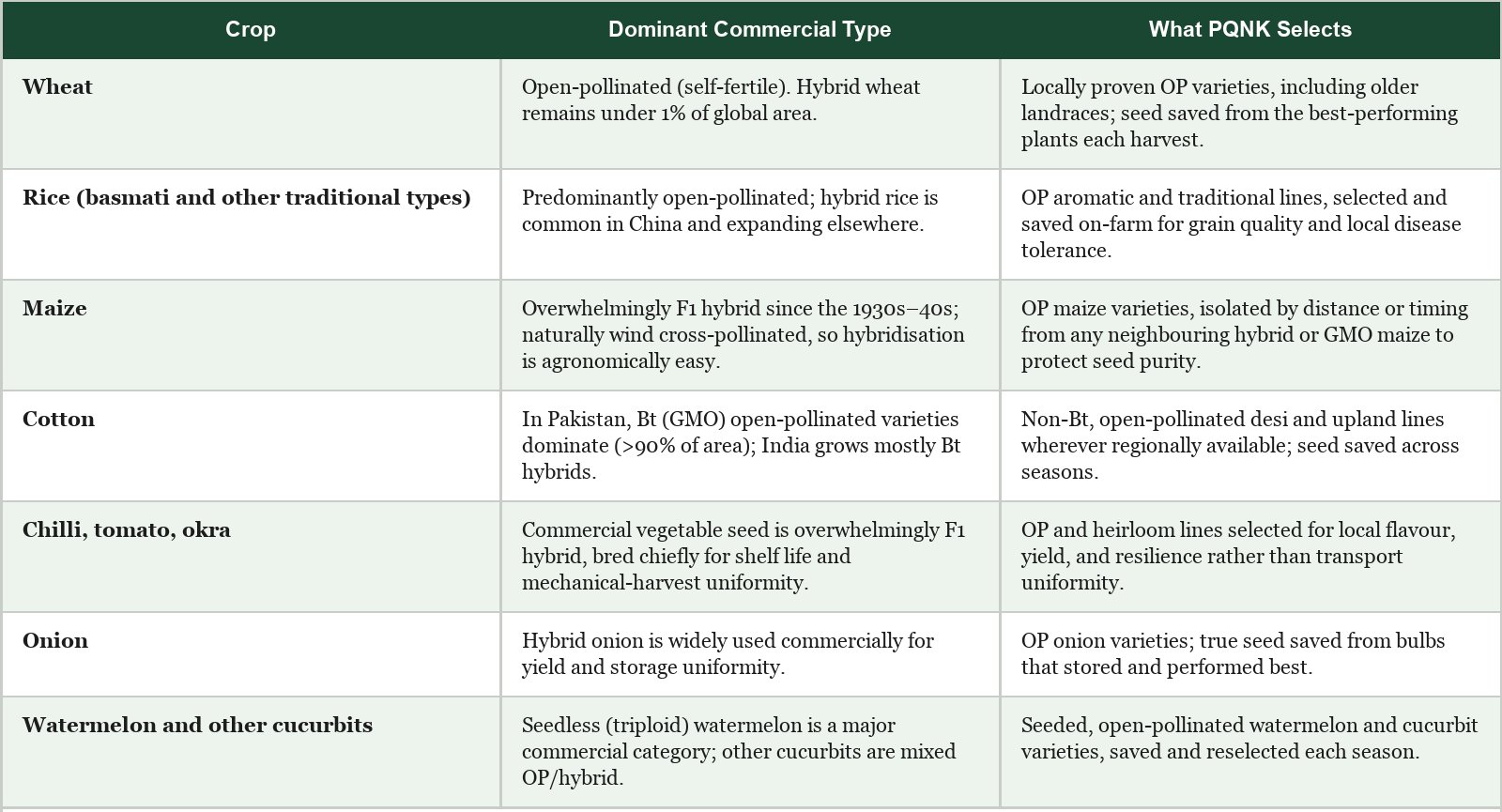
| Crop | Dominant Commercial Type | What PQNK Selects |
|---|---|---|
| Wheat | Open-pollinated (self-fertile). Hybrid wheat remains under 1% of global area. | Locally proven OP varieties, including older landraces; seed saved from the best-performing plants each harvest. |
| Rice (basmati and other traditional types) | Predominantly open-pollinated; hybrid rice is common in China and expanding elsewhere. | OP aromatic and traditional lines, selected and saved on-farm for grain quality and local disease tolerance. |
| Maize | Overwhelmingly F1 hybrid since the 1930s–40s; naturally wind cross-pollinated, so hybridisation is agronomically easy. | OP maize varieties, isolated by distance or timing from any neighbouring hybrid or GMO maize to protect seed purity. |
| Cotton | In Pakistan, Bt (GMO) open-pollinated varieties dominate (>90% of area); India grows mostly Bt hybrids. | Non-Bt, open-pollinated desi and upland lines wherever regionally available; seed saved across seasons. |
| Chilli, tomato, okra | Commercial vegetable seed is overwhelmingly F1 hybrid, bred chiefly for shelf life and mechanical-harvest uniformity. | OP and heirloom lines selected for local flavour, yield, and resilience rather than transport uniformity. |
| Onion | Hybrid onion is widely used commercially for yield and storage uniformity. | OP onion varieties; true seed saved from bulbs that stored and performed best. |
| Watermelon and other cucurbits | Seedless (triploid) watermelon is a major commercial category; other cucurbits are mixed OP/hybrid. | Seeded, open-pollinated watermelon and cucurbit varieties, saved and reselected each season. |
Two crops in this table deserve a further practical note, because their commercial planting material is not conventional true seed at all. Garlic is naturally close to functionally sterile: its flowers are largely or completely non-fertile, and true botanical garlic seed is rare enough that it went unrecognised in cultivated garlic until the 1870s, when a wild flowering population was first identified. Commercial garlic, in PQNK as everywhere else, is propagated by planting individual cloves, a clonal, vegetative method rather than a seed-based one; the open-genetics question for garlic is therefore about maintaining a diverse, locally proven set of clove lines rather than about pollination as such. Potato follows the same pattern: while true potato seed exists and is used by breeders to develop new varieties, essentially all commercial and PQNK potato planting is done from tubers, a clonal propagation method, for the same reason as garlic, uniform, true-to-type reproduction of a proven line without the genetic reshuffling true seed would introduce.
7.2 Orchard and Vegetatively Propagated Crops
Most tree and perennial crops on a PQNK farm are not grown from seed in ordinary practice, for a biological reason worth stating plainly: many fruit tree species are highly heterozygous, meaning a seedling grown from a named variety's seed will typically not resemble its parent at all, since the seed itself is the product of a cross whose exact genetic outcome cannot be predicted. Grafting, joining a cutting or bud of a proven variety onto a separately grown rootstock, exists precisely to sidestep this problem: it propagates a proven tree's exact genetics vegetatively, without passing them through a reproductive event that would scramble them. The open-genetics question for these crops, accordingly, is not about pollination but about the source of the scion wood or budwood a grower grafts from, and about the rootstock it is grafted onto.
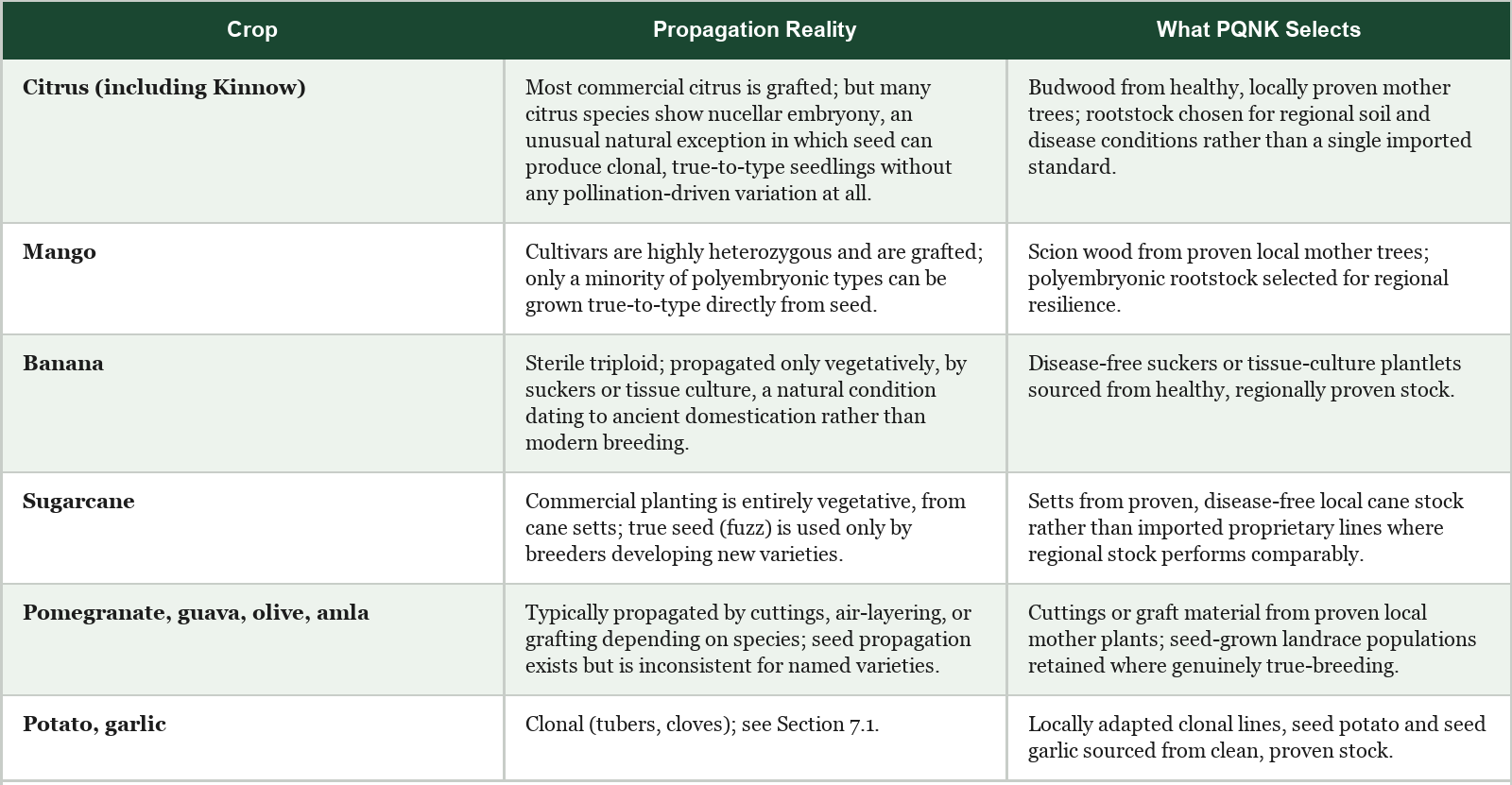
| Crop | Propagation Reality | What PQNK Selects |
|---|---|---|
| Citrus (including Kinnow) | Most commercial citrus is grafted; but many citrus species show nucellar embryony, an unusual natural exception in which seed can produce clonal, true-to-type seedlings without any pollination-driven variation at all. | Budwood from healthy, locally proven mother trees; rootstock chosen for regional soil and disease conditions rather than a single imported standard. |
| Mango | Cultivars are highly heterozygous and are grafted; only a minority of polyembryonic types can be grown true-to-type directly from seed. | Scion wood from proven local mother trees; polyembryonic rootstock selected for regional resilience. |
| Banana | Sterile triploid; propagated only vegetatively, by suckers or tissue culture, a natural condition dating to ancient domestication rather than modern breeding. | Disease-free suckers or tissue-culture plantlets sourced from healthy, regionally proven stock. |
| Sugarcane | Commercial planting is entirely vegetative, from cane setts; true seed (fuzz) is used only by breeders developing new varieties. | Setts from proven, disease-free local cane stock rather than imported proprietary lines where regional stock performs comparably. |
| Pomegranate, guava, olive, amla | Typically propagated by cuttings, air-layering, or grafting depending on species; seed propagation exists but is inconsistent for named varieties. | Cuttings or graft material from proven local mother plants; seed-grown landrace populations retained where genuinely true-breeding. |
| Potato, garlic | Clonal (tubers, cloves); see Section 7.1. | Locally adapted clonal lines, seed potato and seed garlic sourced from clean, proven stock. |
The underlying principle is the same across every row of both tables, whether the crop reproduces by true seed or by vegetative propagation: the planting material a PQNK farm starts from should trace back to a population, or a mother plant, that has already proven itself under real, local, biologically restored conditions, rather than to a centrally fixed genetic package distributed identically to every farm regardless of where it will actually grow.
8. HARVESTING, DRYING, AND TESTING SEED: THE STEP EVERY OTHER STEP DEPENDS ON
Everything argued so far assumes a farmer already has sound seed in hand to select from, save, and replant. That assumption skips over the step that actually determines whether saved seed survives to be planted at all: harvesting it at the right moment, drying it the right way, and confirming it has actually reached a moisture level low enough to store, rather than one that merely looks dry. This step is not uniform across crops, and treating it as one generic instruction, harvest it, dry it, is precisely where a general seed-saving guide is least useful to the farmer holding a specific plant. A dry-seeded grain such as wheat, a wet-seeded fruit such as tomato, and a vegetatively propagated crop such as sugarcane each reach ready to save by a different route, and each is confirmed dry by a different practical field test, since no PQNK farm can be expected to own, or need, a laboratory moisture meter. This section sets out that route, crop type by crop type, together with the tests farmers have long used in a meter's place.
8.1 Dry-Seeded Field Crops: Grains, Pulses, Cotton, and Dry-Pod Vegetables
Dry-seeded crops signal readiness through the plant itself: pods, hulls, bolls, and heads change colour from green to brown, tan, or straw, the plant senesces and dries around the seed, and the seed inside hardens well before it is removed from the plant. Wheat and rice are harvested at the hard dough to physiological maturity stage, when the grain has stopped accumulating starch but still carries field moisture well above safe storage levels; both are then threshed and sun-dried further before storage, not stored directly off the plant. Maize gives a visible, specific signal that most other grains do not: a black abscission layer forms at the tip of each kernel once the plant has stopped feeding it, called black layer or physiological maturity, typically at a kernel moisture of roughly thirty to thirty-five percent. Drying from that point is governed almost entirely by field weather, moving from about thirty percent moisture down to twenty-five percent over roughly thirty accumulated growing-degree units per percentage point, and from twenty-five percent to twenty percent over roughly forty-five; maize is usually mechanically harvested around twenty-five percent moisture, when losses and kernel damage are lowest, and dried further afterward rather than left to field-dry all the way down, which risks stalk lodging and ear drop. Beans, lentils, chickpea, pea, broad bean, and other pulses are left on the plant until the pods themselves turn brown and papery and rattle audibly when shaken, the seed inside having hardened enough that a fingernail can no longer dent it, at which point pods are pulled, spread on a drying screen in a ventilated spot for a further two weeks or so, and then threshed.
Cotton is harvested for seed the same way it is harvested for fibre, since the two are not separated until after picking: bolls are left on the plant until they split fully open and the fibre inside has fluffed out and dried in the open air, the picked seed cotton is spread and sun-dried further if any damp remains, and the seed is then separated from the lint by ginning, mechanically on most farms, or by hand on a small saved-seed lot, before the seed itself is stored. Chilli is left on the plant until the pods have changed fully from green to their ripe red (or other mature) colour and begun to shrivel and dry at the tip; fully dried pods are then split open by hand and the flat seed shaken or scraped free. Okra is left well past its tender, edible picking stage until the pods turn brown, woody, and begin to crack along their seams; at that point the pods are pulled, dried a few more days in open air if needed, then split or twisted open by hand to release the seed. Onion does not set seed on the bulb at all; a bulb kept through a cold period sends up a tall flowering stalk topped with a spherical seed head, or umbel, and the seed is only ready once that umbel has dried and browned over several weeks, its papery capsules splitting to expose small black seeds. Because ripe onion seed shatters out of a fully dried umbel on its own, the umbel is best cut, seed head still attached, once the first capsules begin to split, and slipped into a paper bag or cloth sack before cutting so the shattering seed is caught rather than lost in the field; the bagged umbels are then left to finish drying for one to two weeks before the seed is threshed out by rubbing or shaking. Leek, onion's close relative, is handled exactly the same way, its own umbel cut and bagged the moment the first black seed capsules begin to split.
8.2 Wet-Seeded Fruiting Vegetables: Tomato, Cucumber, Melon, Watermelon, Squash, Pepper, and Eggplant
These crops carry their seed embedded in pulp or gel inside a fruit, so both the harvest cue and the extraction method differ entirely from a dry-seeded grain. The fruit is left on the plant well past the point of peak eating ripeness: a seed tomato is fully coloured and beginning to soften, a seed cucumber is left until its skin turns yellow and its shape swells past the slender green stage sold for eating, sometimes described as the yellow blimp stage, a seed pepper is left until the fruit has changed fully to its ripe colour rather than picked green, and a seed eggplant is left on the plant well past its glossy, edible stage until the skin dulls and turns yellow-brown and the fruit feels noticeably lighter and softer. Watermelon gives three separate, stackable cues rather than one: the pale patch on its underside where it rests on the soil, the field or ground spot, turns from white to a buttery or deep yellow as the fruit ripens; the curly tendril on the vine nearest the fruit's stem dries and browns fully once the fruit is ready, staying green only while the fruit is still immature; and a ripe fruit gives back a deep, hollow sound when thumped rather than the higher, tighter note of an unripe one, though the thump alone is the least reliable of the three and is best used to confirm, not replace, the ground-spot and tendril checks. Melons such as cantaloupe behave differently again: a ripe melon separates from the vine on its own with a gentle tug, the true slip a watermelon never gives, since a watermelon must always be cut free with a knife regardless of ripeness. Whichever fruit, once judged ripe it is cut open and the pulp and seed scooped out together.
Tomato seed specifically requires an extra step that cucumber does not: the scooped pulp and seed are left to ferment in a jar of water at roughly room temperature, about twenty-two degrees Celsius, for two to three days. Fermentation breaks down the gel coating around each tomato seed that would otherwise inhibit germination, and the same short fermentation kills off some of the seed-borne pathogens carried on the fruit's surface. A layer of mould on top after a day or two is expected and is skimmed off rather than treated as spoilage; viable seed sinks, empty seed and pulp float, and the sunk seed is rinsed clean. Cucumber, melon, watermelon, and squash seed do not need this step, since their coating does not carry the same germination-inhibiting gel, though a brief soak still helps separate seed from pulp cleanly; pepper and eggplant seed need neither fermentation nor soaking and can simply be scraped or picked from the ripe fruit's flesh and dried directly. Once separated, wet-extracted seed of any of these crops is spread in a single thin layer on a plate, a sheet of glass, or a fine mesh screen, never on paper towelling or cloth, which the seed coat sticks to as it dries and can tear when peeled away, and left in a warm, shaded, well-ventilated spot for two to three days, stirred or turned occasionally so seeds do not clump or mould as they dry.
8.3 Clonal and Vegetatively Propagated Planting Material: Curing and Selection, Not Drying
For the grafted and vegetatively propagated crops set out in Section 7.2, citrus, mango, banana, sugarcane, potato, and garlic among them, there is ordinarily no seed-drying step at all, because there is no seed: the planting material is a living cutting, tuber, bulb, sucker, or sett, and the goal is the near opposite of drying it, protecting it from desiccation while it is prepared and held for planting. Each still has its own readiness window and its own confirming check, just as true seed does. Garlic is pulled once the lower leaves have browned and only five or six green leaves remain at the top, then cured, not dried, out of direct sun in a warm, well-ventilated spot for three to six weeks depending on local humidity; curing is complete once the outer wrappers feel dry and papery between the fingers and the neck above the bulb has gone fully hard, with no give at all when squeezed, at which point the bulb can be broken into cloves for replanting or stored whole. Seed potato is handled almost the same way in reverse order: freshly dug tubers are cured in a dark, cool, well-ventilated space for one to two weeks before storage, which toughens the skin and closes small wounds from digging and meaningfully cuts storage rot, and the cured tubers are then held in a cool, dark place until the following planting window rather than left anywhere warm enough to sprout early. Sugarcane setts are cut from the middle portion of mature stalks roughly eight to ten months old, avoiding both the immature top and the driest basal section, with each sett carrying two to three healthy, undamaged buds and no sign of disease in the cut cross-section; setts are best cut close to planting time rather than stored long, since a cut cane sett dries and loses viability quickly once exposed. Banana is propagated from suckers, and the sword sucker, a young shoot with narrow, upright, sword-shaped leaves rather than the broad leaves of an older, already-fruiting sucker, is the one selected, taken from a healthy mother plant showing no yellowing or wilting symptoms consistent with Panama wilt or other vascular disease, and separated with a portion of the parent rhizome intact. Citrus and mango planting material is neither dried nor cured but collected as budwood or scion wood at a specific seasonal window: citrus budwood is best cut when the bark still separates cleanly from the wood beneath it, typically during the tree's active growth months, while mango budwood is best gathered after one fruiting season has finished and before the next flush of new growth, in both cases taken only from healthy, disease-free mother trees and used promptly or wrapped to prevent the cut wood drying out before grafting. The two exceptions noted in Section 7.2, nucellar citrus and polyembryonic mango, do produce true seed inside the fruit, and where that seed is used it is handled by the ordinary wet-extraction route in Section 8.2, since it sits inside a fleshy fruit rather than a dry pod.
8.4 Root and Umbellifer Seed Crops: Carrot, Celery, Fennel, and Parsnip
Carrot, celery, fennel, and parsnip belong to the same family, the Apiaceae, and share the same basic reproductive timetable, one that catches many first-time seed savers by surprise: none of them sets seed in its first season. Each is biennial, spending its first year building the root or stalk a household actually eats, and only flowering, and setting seed, in a second season after passing through a winter cold period, vernalisation, that the plant needs before it will bolt and flower at all. In practice this means selected roots, carrot and parsnip especially, must be either left in the ground over winter where the climate allows, or lifted, trimmed, and stored cool through the winter and replanted the following spring, rather than harvested and eaten at the end of year one. Once vernalised and replanted, the plant sends up a tall flowering stalk topped with the same umbrella-shaped flower cluster, or umbel, described for onion in Section 8.1; as the seed matures the umbel dries from green to a tan, crisp brown, and the ripe seed can shatter out on its own in a stiff wind, so the umbel is best slipped into a mesh or paper bag before that point and cut once the majority of the head has browned, then left to finish drying in the bag for a further one to two weeks before the seed is threshed out.
8.5 Brassica (Cole Crop) Seed Saving: Cabbage, Cauliflower, Broccoli, Brussels Sprout, Kale, Kohlrabi, Turnip, Radish, and Savoy Cabbage
Cabbage, cauliflower, broccoli, Brussels sprout, kale (with the exception of Siberian kale), kohlrabi, and savoy cabbage are not merely related crops; they are, botanically, a single species, Brassica oleracea, bred over centuries into forms that look nothing alike but that flower with the same structure and cross with each other freely whenever two of them are allowed to bloom near one another at the same time. Documented cross-pollination rates between these types, where flowering overlaps, run from roughly seventy percent up into the nineties, which makes isolation, covered in Section 8.9, essential rather than optional wherever more than one type or variety is kept for seed. Most of this group is biennial in the same sense as the root crops in Section 8.4, needing a cold period before they will bolt and flower the following season; radish is the group's exception, commonly flowering and setting seed within a single season without a cold requirement, and turnip falls between the two depending on variety and climate. Once flowering, all of them produce narrow seed pods along an upright stalk, in the same general pattern as mustard, and the pods are left on the plant until they turn from green to tan or light brown and papery; harvest is timed for the point just before the lowest pods begin to split open on their own, since waiting for every pod on the stalk to reach that point risks losing the earliest ones to shattering. Cut stalks are dried further, hung or laid out in a ventilated spot, until fully brittle, then threshed by rubbing, treading, or beating the dried stalks over a sheet or tarp to release the seed.
8.6 Chenopod Seed Saving: Beetroot, Chard, and Spinach
Beetroot, chard (in practice the same species as beetroot, grown for leaf rather than root), and spinach are wind-pollinated rather than insect-pollinated, which changes the isolation calculation covered in Section 8.9, since wind carries pollen far further than most insects travel. Beetroot and chard are biennial, following the same root-crop pattern as Section 8.4, flowering only in a plant's second season after a cold period; spinach is a fast annual and can flower and set seed within a single season, and is naturally dioecious, meaning individual plants are either male or female, so a viable seed-saving population needs enough of both sexes growing together. All three produce seed not in a single head but scattered in small clusters along a tall central flowering stalk; the stalk is left until these seed clusters have dried and turned from green to brown or tan and feel hard rather than fleshy, at which point the whole stalk is cut, hung to finish drying in a ventilated spot for a further one to two weeks, and then stripped by hand or rubbed between gloved hands over a container to release the small, hard seed clusters.
8.7 Fluffy-Seeded Crops: Lettuce, Chicory, Artichoke, Cardoon, Sunflower, and Corn Salad
Lettuce, chicory, artichoke, and cardoon belong to the daisy family, the Asteraceae, and sunflower belongs to the same family; corn salad is unrelated botanically but shares a similar small, light seed and is grouped here for that practical reason. What this group shares, and what catches out anyone expecting a dry pod, is that the seed itself is typically attached to a light, downy tuft, a pappus, built for wind dispersal, in exactly the way a garden dandelion's seed head goes fluffy and blows apart; a seed saver's task is to intercept that seed after it matures but before the wind does. Lettuce and chicory are left until their small flower heads, opened one at a time up a tall central stalk over several weeks, dry out and turn fluffy and white, at which point the whole stalk, or the individual heads as they turn, are shaken directly into a paper bag to catch the seed before it disperses; corn salad is treated the same way at a smaller scale, its tiny seed heads drying and loosening along low, branching stems. Artichoke and cardoon are left until their large, thistle-like flower heads dry and begin to open on the plant, exposing the fluffy pappus and the seed beneath it, which is then pulled or combed out by hand, wearing gloves against the spines. Sunflower is harvested differently again: the large flower head is often protected with a paper bag, mesh sack, or cloth tied loosely over it as the seed fills out, since birds will strip a ripening head bare well before a farmer judges it ready; the head is left until its back turns from green to yellow and then brown and the individual seeds have hardened and their hulls have taken on a mature, often striped, colour, at which point the whole head is cut, dried further indoors for a week or two, and the seed rubbed free by hand.
8.8 Cleaning and Sorting Threshed Seed
Threshing, whatever the crop, leaves seed mixed with broken pod, hull, chaff, and stem fragments that need to be removed before storage, both because that debris can carry moisture and mould into the seed lot and because it makes germination testing and sowing rates harder to judge accurately. Three simple methods cover nearly every crop in this section. Screening passes the threshed mixture through a sieve or mesh sized to let the seed through while holding back larger debris, or the reverse, sized to hold the seed back while finer dust and chaff falls through; two screens of different mesh sizes used in sequence clean most seed lots well on their own. Winnowing uses moving air, a steady breeze, an electric fan, or seed poured slowly from one container to another in front of either, to carry away light chaff and empty husks while the heavier, viable seed falls straight down into a collecting tray beneath. Water-sorting, the same sink-or-float logic already described for tomato in Section 8.2, works for many dry seeds too: a seed lot stirred into a bowl of water lets shrivelled, insect-damaged, or hollow seed float to the top for skimming off, while sound, viable seed settles to the bottom, though any seed sorted this way must then be dried again fully, using the same methods in Section 8.1 or 8.2, before it goes into storage.
8.9 Isolation Techniques: Distance, Time, and Physical Barriers
Every crop in Sections 8.1 through 8.7 that reproduces by true seed carries the same underlying risk described in Section 3: an open-pollinated population stays true to type only if its flowers are fertilised by pollen from the same variety, and any neighbouring planting of a cross-compatible variety threatens that. Knowing which plantings are actually cross-compatible starts with the same basic botanical classification the crop tables in Section 7 already group crops by: distinct species, or distinct varieties within one species such as the Brassica oleracea group in Section 8.5, can cross with each other, while genuinely distinct species, tomato and eggplant for instance, cannot, no matter how close together they grow. Three practical isolation strategies exist once a real cross-pollination risk is identified. Distance isolation simply grows only one variety of a cross-compatible crop within the distance its pollen, or its pollinating insects, can realistically travel; that distance varies enormously by crop and by pollinator, from a few tens of metres for a self-pollinating, insect-visited crop grown in modest quantity, to several hundred metres for most insect-pollinated vegetables, up to a mile or more for a wind-pollinated crop like maize, spinach, or the beet family, or for a crop such as broccoli where reliable isolation has been shown to require roughly a mile of separation from any other Brassica oleracea type. Time isolation grows only one cross-compatible variety flowering at a time, staggering sowing dates so a second variety's flowering begins only once the first has finished setting seed, a workable substitute wherever land is too limited for full distance isolation. Physical isolation, the most reliable and the most labour-intensive option, covers a variety's flowers, or the whole plant, with row cover fabric, fine mesh netting, or individual bags, keeping pollinating insects out entirely; a crop protected this way while flowering either self-pollinates on its own inside the cover, or, where it cannot, is hand-pollinated using the technique in Section 8.10 before being re-covered to keep out any further, unwanted pollen.
8.10 Manual Hand-Pollination of Cucurbits: Squash, Melon, Cucumber, and Watermelon
Squash, melon, cucumber, and watermelon all carry separate male and female flowers on the same plant rather than a single flower containing both, which makes hand-pollination unusually practical for this family and lets a farmer grow several varieties of the same species side by side, without any distance isolation at all, simply by controlling exactly which pollen reaches which flower. A male flower has a plain, unswollen stem; a female flower carries a small, immature fruit already visibly swollen just behind the petals. The evening before a chosen male and female flower are due to open, both still closed, each is taped shut with a small piece of masking tape, or clipped with a clothes peg, to keep insects out overnight while leaving the flower free to open naturally against the seal. The following morning, once both flowers have opened under their covering, the male flower is picked and its petals stripped away to expose the pollen-laden anther at its centre; that anther is then pressed or rubbed directly against the sticky stigma in the middle of the female flower, turning it gently to transfer pollen across the stigma's full surface. The female flower is immediately re-taped or re-clipped shut for a further two to three days, until it naturally withers, by which point fertilisation is secure and no further pollen can reach it. The pollinated fruit is marked, a loop of coloured string or a ribbon tied loosely to its stem works well, so it is not confused at harvest with any open-pollinated fruit nearby; it is this marked fruit's seed, and only this fruit's seed, that is guaranteed to breed true to the variety used for pollination.
8.11 Confirming Seed Is Dry Enough to Store, Without a Laboratory Meter
The general target for long-term storage of most orthodox seed is a moisture content of roughly ten to twelve percent; grains specifically are more commonly dried to about thirteen to thirteen and a half percent, with up to fourteen percent treated as acceptable only for short-term summer storage rather than multi-year holding. The reason this last percentage point or two is worth the extra drying effort, rather than a fussy technicality, is a well-established relationship in seed science known as Harrington's Rule: within normal ranges, a seed lot's storage life roughly doubles for every one percentage point drop in moisture content, and separately roughly doubles again for every ten degree Fahrenheit, or 5.6 degree Celsius, drop in storage temperature. Drying seed those last couple of points, or storing it somewhere a few degrees cooler, buys disproportionate extra shelf life rather than a marginal improvement.
Because most PQNK farms will not have a moisture meter to hand, the following field tests, developed and used by farmers for exactly this reason long before such meters existed, serve the same purpose using only the seed itself and materials already on hand.
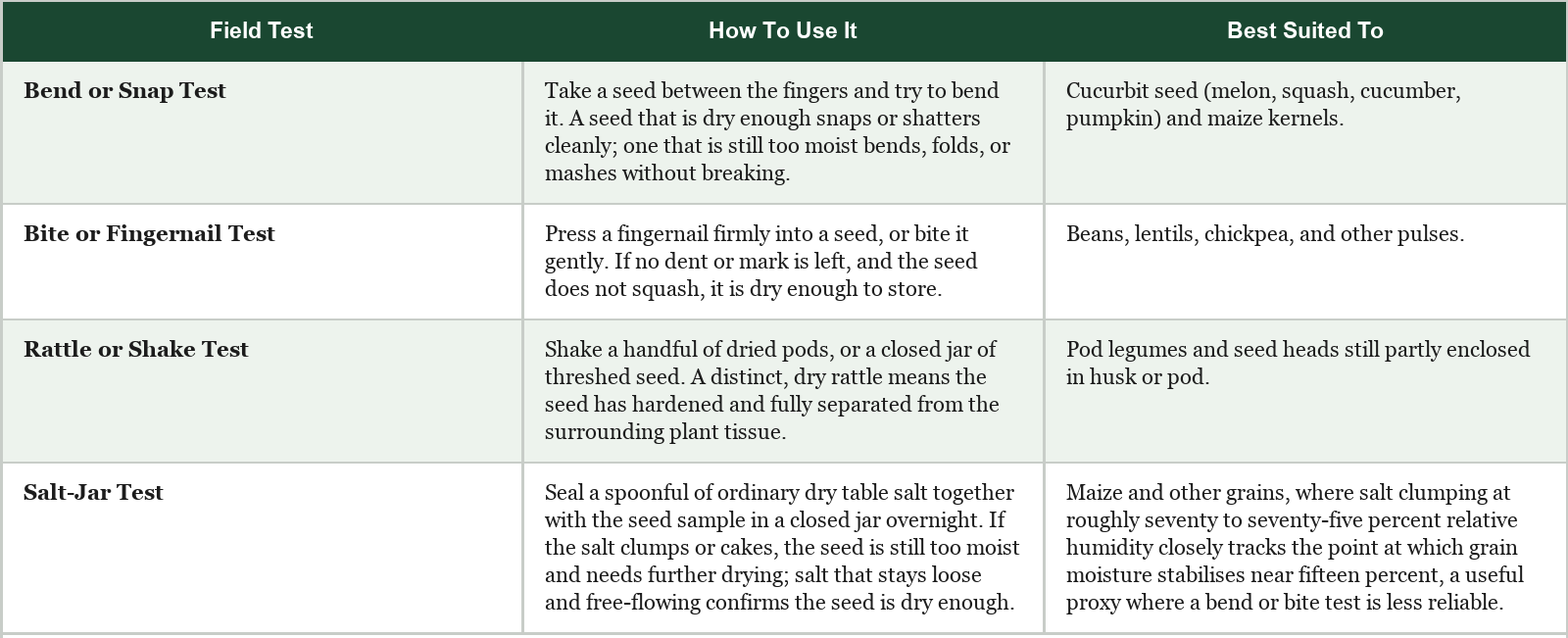
| Field Test | How To Use It | Best Suited To |
|---|---|---|
| Bend or Snap Test | Take a seed between the fingers and try to bend it. A seed that is dry enough snaps or shatters cleanly; one that is still too moist bends, folds, or mashes without breaking. | Cucurbit seed (melon, squash, cucumber, pumpkin) and maize kernels. |
| Bite or Fingernail Test | Press a fingernail firmly into a seed, or bite it gently. If no dent or mark is left, and the seed does not squash, it is dry enough to store. | Beans, lentils, chickpea, and other pulses. |
| Rattle or Shake Test | Shake a handful of dried pods, or a closed jar of threshed seed. A distinct, dry rattle means the seed has hardened and fully separated from the surrounding plant tissue. | Pod legumes and seed heads still partly enclosed in husk or pod. |
| Salt-Jar Test | Seal a spoonful of ordinary dry table salt together with the seed sample in a closed jar overnight. If the salt clumps or cakes, the seed is still too moist and needs further drying; salt that stays loose and free-flowing confirms the seed is dry enough. | Maize and other grains, where salt clumping at roughly seventy to seventy-five percent relative humidity closely tracks the point at which grain moisture stabilises near fifteen percent, a useful proxy where a bend or bite test is less reliable. |
Everything in Sections 8.1 through 8.11 is written to stand on its own, deliberately, because a farmer's ability to save the coming season's seed should never depend on a machine, a laboratory, or a website remaining reachable. Between them, these subsections now cover every one of the thirty-seven individual vegetables documented by the DIY Seeds project (diyseeds.org), an educational film series, plus the grain, fibre, and orchard crops that project does not cover at all and that a PQNK farm actually grows. Readers who want to see any of this filmed rather than described may still find it useful to look up that project directly; it is offered here only as a further, optional viewing aid, not as a source this section's own instructions rely on or a body of information this paper has left incomplete.
8.12 Why This Cannot Wait
Everything above is written as practical instruction because it is meant to be used, not filed away. A farm without its own seed is not, in the full sense, a farm; it is a tenant of whoever currently controls the seed supply, for however long that supplier chooses to keep supplying it. Open-pollinated, heirloom seed is already difficult to find in Pakistan today, well before any further tightening of seed law, seed certification requirements, or corporate consolidation of the seed trade narrows what is commercially available still further. None of this happens by public announcement. No seed company, and no government seed authority, is under any obligation to declare in advance that a given heirloom line will no longer be registered, licensed, or stocked from a certain date forward; a variety simply becomes unavailable, quietly, the season after farmers stop being able to buy it, and by the time its scarcity is widely noticed, the seed itself, and the genetics it carried, may already be gone beyond recovery. A hungry population is also, as history has repeatedly shown, a controllable one, willing to accept terms it would otherwise refuse; a farmer's own saved seed, replanted year after year from that farmer's own land, is one of the few forms of food security that cannot be revoked, rationed, delisted, or priced out of reach by any outside party. PQNK's position on this is accordingly direct rather than cautious: do not wait for a better season, a bigger harvest, or more certainty before starting to save seed from what is already growing. Begin this year, with whatever open-pollinated seed is already on the farm, using the methods set out in this section, and treat every saved handful as insurance against a shortage that will not send a warning before it arrives. You may find this website helpful: diyseeds.org.
9. THE PQNK METHOD FOR STABILIZING A NEW OPEN-POLLINATED LINE
Section 4 argued that nature's own selection criterion runs through taste and continued field performance. This section sets out the concrete, season-by-season method PQNK uses to convert a genetically mixed or segregating population, including, per Section 2.1, a population recovered from GMO stock, into a stable, true-breeding open-pollinated line a farmer can save and replant indefinitely.
Assess uniformity first. If every plant in the current crop already looks alike in growth, tillering, and general vigour, no selection work is needed yet; the line may already be stable.
If plants visibly differ, physically mark the standout individuals in the field, traditionally by tying a ribbon to each one, based on visible traits such as tillering, stem strength, and overall vigour.
Harvest the marked plants separately from the rest of the field, keeping their seed apart from the general harvest at every step.
Dry the harvested seed using the crop-appropriate harvest and drying method set out in Section 8, and confirm moisture content using the field tests in Section 8.11, no higher than roughly twelve percent for most crops and thirteen to thirteen and a half percent for grains, before storing it in a well-ventilated space.
Replant this seed the following season on a deliberately small scale relative to the overall operation, commonly just one or two kanals to begin with, rather than across the whole farm.
Monitor this second generation closely; this is where the real selection work happens. Again mark the plants with more tillers, stronger stems, and the other traits being selected for, and again harvest and save their seed separately.
Expand the planted area with each successive generation, for example doubling the trial plot size season to season, while repeating the same mark-harvest-select cycle at each stage.
Continue until plant-to-plant variation in the field has effectively disappeared, with height, vigour, and tillering consistent across the planting rather than showing a spread of stronger and weaker individuals.
Once that uniformity is reached, the line is considered stable. It can be planted at full scale and reused season after season without repeating the selection process, unless new variation reappears.
This is not a laboratory technique. It is a disciplined version of exactly what farmers have always done to develop a locally adapted variety, applied consistently enough, generation after generation, to convert an uneven population into a dependable, farm-owned line.
10. THE PQNK SEED AND PLANTING-MATERIAL PROTOCOL
Source open-pollinated seed, or locally proven vegetative planting material, in preference to GMO, F1 hybrid, or induced-seedless alternatives wherever a comparable option exists for that crop.
Save seed only from the healthiest, best-performing plants each season, not from an average or convenient sample; this positive mass selection is exactly the farmer-directed half of the natural improvement process described in Section 3.
For cross-pollinated crops such as maize, maintain isolation distance or staggered flowering time from any neighbouring hybrid or GMO planting of the same species, to protect the open-pollinated population's genetic integrity.
Maintain a broad enough population of seed-source plants, rather than saving from one or two individuals only, to avoid inbreeding depression in naturally cross-pollinated species.
Avoid seed pre-treated with systemic chemical coatings, which are most often paired with hybrid and GMO seed lines and are unnecessary on seed grown and saved within a biologically active PQNK system.
For grafted and vegetatively propagated orchard crops, select scion wood, budwood, cuttings, or setts from healthy, disease-free, regionally proven mother plants rather than imported, patented nursery clones bred for a different climate and soil.
Where a genuinely superior local variety does not yet exist, breed toward one through conventional cross-pollination followed by the stabilising-selection method set out in Section 9, rather than defaulting to a purchased hybrid; this is ordinary plant breeding, fully compatible with open-pollinated principles.
11. WHAT THIS IS NOT
None of the argument above is a rejection of plant breeding, or of scientific seed improvement as such. Farmers have selected, crossed, and stabilised new varieties for as long as agriculture has existed, and open-pollinated seed-saving is itself an active, ongoing act of selection, not a passive default. Borlaug's own wheat-breeding programme, described in Section 5, used deliberate cross-pollination and rigorous selection across multiple environments, exactly the tools PQNK's own protocol in Sections 9 and 10 recommends; the objection this paper raises is not to that method. It is specifically to three later developments that changed what the farmer's relationship to the resulting seed looks like: genetic modification, which introduces genes no breeding programme could reach through pollination and selection at all; F1 hybridisation deployed specifically to prevent the farmer from saving seed, rather than as a step toward a new, stable, open-pollinated line; and induced seedlessness, which removes the plant's reproductive capacity permanently. A new, true-breeding open-pollinated variety, arrived at through years of deliberate crossing and selection and then released for farmers to save and continue improving themselves, is precisely the kind of seed innovation this paper argues for.
CONCLUSION
Every act of pollination in nature recombines genetics, tests the result against real local conditions, and lets survival and farmer selection decide what carries forward, a mechanism that has been quietly improving cultivated plant populations for as long as agriculture has existed. Genetically modified seed bypasses that mechanism by crossing reproductive barriers no pollination event could cross. F1 hybrid seed interrupts it by fixing one generation's genetics centrally and asking the farmer to buy that fixed cross again every season rather than let the population keep adjusting itself. Induced seedlessness ends it altogether, by design, in varieties bred specifically to remove the plant's own reproductive outcome. None of these three developments repaired a genetic deficiency in the world's open-pollinated landraces, because no such deficiency was ever the actual constraint. The constraint was soil biology that ten thousand years of tillage-based agriculture, ACI farming, had already hollowed out well before the Green Revolution offered a chemically compatible seed as its answer.
PQNK's restoration of that biology does not require new genetics to succeed. It requires the soil to finally deliver on genetics that, in many cases, were already more than capable, waiting only for a growing environment able to let them express what they had always carried.
Every seed carries forward a trial nature has already run. PQNK's task is not to replace that trial with a lab-fixed genetic package, but to give the seed's own genetics, and the soil beneath it, back the conditions to finally answer it.
KEY TAKEAWAYS
Three Distinct Problems, Not One: GMO seed crosses reproductive barriers pollination cannot; F1 hybrid seed fixes genetics centrally and blocks farmer seed-saving through genetic segregation; induced seedlessness removes reproduction altogether. Each deserves a separate argument.
Pollination Is a Live Trial, Not a One-Time Event: open-pollinated populations continue adjusting to local pests, disease, and climate every generation; centrally fixed hybrid and GMO genetics do not.
Green Revolution Wheat Was Open-Pollinated, Not Hybrid or GMO: Borlaug's semi-dwarf varieties were conventionally bred, true-breeding OP lines, engineered for fertiliser responsiveness, not laboratory-modified genetics (CIMMYT; Britannica).
The Real Cost Was Diversity, Not Ownership of the Breeding Method: an estimated 75% of global agricultural genetic diversity has been lost since 1900, and India alone lost over 90% of its 110,000 rice landraces to Green Revolution replacement varieties.
Genotype Is a Ceiling, the Environment Decides How Close a Plant Gets To It: documented mycorrhizal-inoculation trials show the same genotype ranging from a 12% growth reduction to a 40% gain depending purely on existing soil biology, the exact lever PQNK restoration pulls.
Pakistan's Bt Cotton Is GMO but Not Hybrid: unlike India's Bt hybrid model, Pakistan's approved Bt cotton varieties are open-pollinated and seed-saveable; the objection to them is specifically the transgenic trait, not a seed-purchase mechanic.
Banana's Seedlessness Is Ancient and Natural, Watermelon's Is Modern and Engineered: the distinction matters, because one is a domestication accident farmers found and kept seven thousand years ago, and the other is a deliberately bred, permanent reproductive dead end.
Choosing Open Genetics Is Not Anti-Breeding: PQNK actively supports deliberate crossing and generational selection toward new, true-breeding, farmer-saveable varieties; the objection is to methods that end the farmer's relationship with the seed's own improvement process, not to improvement itself.
Nature Selects for Taste, Breeders Select for the Supply Chain: yield uniformity, cosmetic appearance, peelability, and seedlessness serve distribution; taste is the one trait a plant can only pass forward if it is genuinely good to eat, and it tends to carry nutrition and aroma forward with it.
GMO Seed-Saving Restrictions Are Contractual, Not Biological: engineered sterility (Terminator/GURT technology) was patented in the 1990s but never commercialised, blocked by a global moratorium since 2000; the actual barrier today is a signed technology-use agreement backed by patent litigation.
A Genetic Modification Rarely Expresses With Total Uniformity: PQNK's own field observation finds a resilient minority of unmodified plants within GMO seed lots, offering a practical, if unconventional, route back toward open, saveable genetics through the same stabilising-selection method used to fix any new OP line.
Stabilising a New OP Line Is a Concrete, Repeatable Field Method: mark the best plants, harvest and dry their seed separately to 12% moisture, trial at small scale, keep re-selecting the top performers each generation, and expand the planted area until variation disappears.
Harvest and Drying Are Crop-Specific, Not One Instruction: dry-seeded grains and pulses are read off the plant itself (colour change, pod rattle, maize's black-layer signal), while wet-seeded fruit such as tomato and cucumber must be extracted from pulp, and tomato specifically requires 2–3 days of fermentation to break down its germination-inhibiting gel coat.
Dryness Can Be Confirmed Without a Moisture Meter: the bend/snap test, the bite/fingernail test, the rattle test, and the salt-jar test each let a farmer confirm seed has reached a safe storage moisture (roughly 10–12% generally, 13–13.5% for grains) using nothing but the seed and materials already on hand.
Harrington's Rule Explains Why the Last Percentage Point Matters: seed storage life roughly doubles for every 1% drop in moisture content, and separately doubles for every 10°F (5.6°C) drop in storage temperature, within normal ranges — the reason thorough drying and cool storage pay off disproportionately.
Vegetative Planting Material Is Cured and Selected, Not Dried: garlic and seed potato are cured, not dried, to a hard neck or toughened skin over one to six weeks; sugarcane setts, banana sword suckers, and citrus/mango budwood are each selected from healthy mother stock within their own specific seasonal window.
This Section Does Not Depend on Any Outside Website: every harvest, drying, curing, and moisture-testing instruction above is self-contained in this paper, now covering all thirty-seven vegetables documented by an external film series (diyseeds.org) plus PQNK's own grain, fibre, and orchard crops; that site is mentioned only as an optional further viewing aid, not as a source these instructions rely on.
Biennial Root, Leaf, and Stalk Crops Need a Season the Farmer Must Plan For: carrot, celery, fennel, parsnip, beetroot, chard, and most cabbage-family crops flower and set seed only in their second year, after a winter cold period; the selected plant must be carried through that winter rather than harvested at the end of year one.
A Single Species Can Hide Behind a Dozen Vegetable Names: cabbage, cauliflower, broccoli, Brussels sprout, kale, kohlrabi, and savoy cabbage are all Brassica oleracea and cross-pollinate at documented rates of roughly 70–95% when flowering overlaps, making isolation essential rather than optional within this group.
Hand-Pollination Lets Several Cucurbit Varieties Share One Field: taping male and female squash, melon, cucumber, or watermelon flowers shut before they open, then hand-transferring pollen the next morning and re-sealing the flower, lets a farmer keep a variety pure without any distance isolation at all.
A Farm Without Its Own Seed Is Not a Farm: heirloom, open-pollinated seed is already scarce in Pakistan; its disappearance from the market would not come with advance public announcement, and PQNK's advice is to begin saving from whatever open-pollinated seed is already on the farm this season, not a future one.
REFERENCES
CIMMYT. From east Asia to south Asia, via Mexico: how one gene changed the course of history.
Encyclopaedia Britannica. Green revolution: Definition, Agriculture, Environment, Impact.
FAS (Foundation for Agrarian Studies). Cotton cultivation: Bt varieties and hybrids.
Journal of Cotton Research (2024). In-depth analysis of Bt cotton adoption: farmers' opinions, genetic landscape, and varied perspectives — a case study from Pakistan. Springer Nature.
Khoury, C. K., et al. (2022). Crop genetic erosion: understanding and responding to loss of crop diversity. New Phytologist.
PMC. Domestication, Genomics and the Future for Banana.
PMC (2023). Promoter insertion leads to polyembryony in mango — a case of convergent evolution with citrus. Horticulture Research, Oxford Academic.
PMC. Nucellar embryony in Citrus genetics, breeding and biotechnology (CABI).
PMC (2022). Yuan Longping and Hybrid Rice Research.
PMC. Symbiotic synergy: How Arbuscular Mycorrhizal Fungi enhance nutrient uptake, stress tolerance, and soil health.
PMC. Comparative physiological and biochemical mechanisms in diploid, triploid, and tetraploid watermelon.
Plant Breeding (2025). Dhall, R. K., et al. Reproductive Biology, Sterility and Fertility Restoration, Breeding and Biotechnological Advances in Garlic: A Comprehensive Review. Wiley Online Library.
Scientific American. The Struggle to Save Heirloom Rice in India.
ScienceDirect Topics. Genotype-Environment Interaction.
Wikipedia. Stenospermocarpy.
DIY Seeds (diyseeds.org). From Seed to Seed: crop-specific and technical seed-saving film series (optional further viewing, not a source relied upon in this paper).
Seed Savers Exchange; Grow a Good Life; Epic Gardening. Seed harvest and drying guidance for beans, okra, tomatoes, and cucurbits.
University/extension agronomy sources (Bayer Crop Science, Pioneer, Dairyland Seed, Clemson Extension). Corn physiological maturity, black layer formation, and post-maturity dry-down rates.
Harrington, J. F. Principles of seed storage: the effect of seed moisture content and storage temperature on seed longevity ("Harrington's Rule").
University of Georgia Extension; MasterClass; Fruit and Garden. Watermelon and melon ripeness indicators: ground spot, tendril, and slip tests.
Keene Organics; Garden Betty; UMass Amherst Center for Agriculture, Food, and the Environment. Garlic curing and seed-potato curing practices.
University of Florida IFAS; California Rare Fruit Growers; Graft A Mango. Citrus budwood and mango scion-wood collection timing and selection standards.
Seed Savers Connect; Learn Seed Saving. Brassica oleracea cross-pollination rates and isolation distance requirements across cabbage, broccoli, cauliflower, kale, kohlrabi, and Brussels sprout.
Seed Savers Exchange; various extension sources. Vernalisation and biennial seed-to-seed cycles in carrot, celery, beetroot, and related root and stalk crops.
DIY Seeds (diyseeds.org). Isolation techniques; manual pollination of Cucurbitaceae (technical ABC films, consulted for general method description only).
Alliance of Bioversity International and CIAT. Seeds of resilience: novel strategies for using crop diversity in climate change adaptation.
Earlham Institute. Hybrid Wheat Initiative: the 'holy grail' of wheat breeding.
Convention on Biological Diversity (2000; reaffirmed 2006). Decisions on genetic use restriction technologies (Terminator technology moratorium).
Genetic Literacy Project. Seed patent primer: Is the use of GMOs preventing farmers from reusing their seeds?
American Farm Bureau Foundation for Agriculture. Can farmers save and replant GMO seeds?
PQNK — Paedar Qudratti Nizam Kashatqari
Connect & Resources
Facebook: www.Facebook.Com/Pedaver
YouTube (PQNK): https://www.youtube.com/@pedaverpqnk3167/videos
YouTube: http://www.youtube.com/@aasifsharif
PDF Knowledge Papers: https://drive.google.com/drive/folders/1iadwV6mdUPyrUIpB3oRfNv6DLiackaUL?usp=sharing
Email: pedaver@gmail.com
WhatsApp: +92 320 677 6666
About This Paper
- Crop
- Wheat · Cotton · Rice · Watermelon · Grapes · Banana · Cucumber · Garlic · Potato
- Problem
- External Input Dependency · Macro / Policy-Level Externalities · Terminology / Framework Confusion · Seed Sourcing / Genetic Vulnerability
- Science
- Biodiversity · Food Quality · Transition
- Evidence
- External Scientific Evidence
- Authority
- External Knowledge / Evidence
Related PQNK Science
Key Takeaways
- Separates GMO, F1 hybrid, and induced seedlessness into three distinct problems with three distinct objections, rather than one undifferentiated worry about 'modern seed.'
- Frames Green Revolution semi-dwarf wheat as agronomic compensation for degraded soil, not genetic repair, quantified against roughly 75% global crop genetic diversity loss and India's collapse from an estimated 110,000 rice landraces to a small remaining fraction.
- Explains F1 hybrid seed's core mechanism, unpredictable F2 segregation, as the reason the $50-60 billion commercial seed industry is structured around annual repurchase from firms controlling 60-70% of proprietary sales.
- Distinguishes chromosomal seedlessness (triploid watermelon) and parthenocarpy/stenospermocarpy (seedless grapes) from banana's naturally occurring, millennia-old sterile mutation, treating banana as a genuine exception rather than folding it into the same objection.
- Argues taste, not shelf life or uniformity, is open-pollinated seed's real selection pressure, and that it pulls nutrition and flavor forward together as a package.
- Provides a detailed crop-by-crop seed-saving protocol: isolation distances, manual hand-pollination technique for cucurbits, moisture testing without a lab meter, and a method for re-deriving an open line even from GMO stock by selecting the non-expressing minority.
Related Knowledge
same problem
Five Decades of Agricultural Innovation: Interventions and Achievements in Chronological Order, 1973–2023
Asif Sharif's own year-by-year record of fifty years of hands-on agricultural intervention in Pakistan, from early machinery and seed distribution through the 2008 development of PQNK and its crop-by-crop expansion since, presented as the primary evidentiary record behind PQNK: a ground-up, farmer-verified track record rather than a journal citation.
same problem
Wheat Hybrid and Organic Wheat Through the PQNK Lens
A PQNK response to a widely circulated review comparing hybrid and organic wheat, arguing that hybrid describes genetics while organic describes a production standard, so the two are not opposite categories that can be compared directly. Applies PQNK's seed-is-potential, soil-is-the-production-system framework to modern wheat breeding, chemical dependence, organic certification, water management and the health claims made against modern wheat.
same crop
Channeling Plant Energy: A PQNK Guide to Managing Vegetative Growth for Regenerative Production
With no grazing animals left to signal plants that their surplus foliage is being used, PQNK farmers must manually replicate that missing pressure. This guide sets out four directives, stamping, grazing, pruning and pinching, and bruising, with a crop-by-crop protocol for redirecting a plant's vegetative surplus into reproductive yield.
same problem
The Seed Is Potential, the Soil Is the Production System: Rethinking High-Yielding Varieties, Heirloom Seeds, Hybrids and GM Crops Through the PQNK Lens
Why are Green Revolution varieties called 'fertiliser-responsive' — does that mean they require synthetic fertiliser? This paper argues genetics is potential, not the production system: a seed's inherited instructions, like a soil's inherited texture, determine what is possible, while the living environment around each, root ecology for the seed, biological structure for the soil, determines what is actually expressed. Extending that logic across open-pollinated, heirloom, hybrid, high-yielding and genetically modified seed alike, it separates three questions usually confused, the genetics of the seed, who controls its reproduction, and the production system it is grown in, and adds a distinct concern for cross-pollinated crops: in maize, pollen-mediated gene flow can carry an engineered trait into a farmer's own saved seed, generation after generation, which is why seed sovereignty requires not only access to seed but the practical ability to reproduce it with genetic purity.