

KP-071 · Nutrition & Food Quality
The Inherent Shelf-Life Advantage of PQNK Produce: A Scientific Analysis from Root Zone to Market
Farmers kept reporting that PQNK produce simply lasts longer in storage, and this paper traces that observation to a specific, measurable cause: mulch holding root-zone temperature in a stable 13-26°C band. It follows that stability through fruit cell-wall development, ripening physiology, harvest timing, and field-heat removal to explain why the shelf-life advantage shows up well before any cold storage is involved.
Read or listen to the full paper ↓Abstract
The paper formalizes a specific farmer hypothesis: that PQNK produce's longer shelf life traces directly to root-zone temperature moderated by thick organic mulch, rather than simply to the absence of chemical residues. It builds the case around five interlocking restoration conditions produced by PQNK's governing principles, thick mulch insulation, a moderated 13-26°C root-zone temperature range, thriving microbial life acting as a 'microbial kitchen,' no-till structure preservation, and mulch-balanced moisture, arguing temperature stability is the mechanism that ties the rest together.
A stable root zone is described as a master regulator of plant metabolism: consistent temperature keeps roots and their mycorrhizal partners functioning continuously, avoiding the metabolic shocks conventional (ACI) plants suffer from soil temperature extremes, which in turn allows steady hormonal balance between growth hormones (auxins, cytokinins) and defense compounds (jasmonic acid). The paper contrasts resulting fruit characteristics directly: PQNK fruit develops strong cell walls from consistent calcium availability, higher dry matter and nutrient density, high levels of natural antioxidants that function as internal preservatives, and firm, bruise-resistant structure, against ACI fruit's thin cell walls, water-loaded tissue from excess nitrogen, depleted defensive compounds, and soft, bruise-prone structure.
On ripening physiology, the paper explains that PQNK fruit's slower, more measured respiration rate and higher antioxidant content delay oxidative decay under post-harvest stress, while weakened ACI fruit burns through its limited sugar and acid reserves quickly, accelerating flavor loss and texture breakdown. It extends this into a specific evolutionary explanation for why tropical fruits like mango and banana over-ripen faster than temperate fruits like apples, tropical fruits evolved for rapid animal-mediated seed dispersal without a cold season to survive, giving them high respiration rates, high ethylene sensitivity, and softer cell walls by design, meaning PQNK's cellular-integrity gains matter most precisely for the fruits most prone to fast collapse.
The paper is specific about harvest timing (distinguishing physiological from horticultural maturity and recommending Brix/refractometer readings, firmness/penetrometer testing, and visual cues together rather than any single indicator) and about field heat removal, noting that harvested fruit can carry field heat 5-10°C above ambient and that every 10°C increase roughly doubles to triples the rate of deterioration, making prompt shade, forced-air cooling, room cooling, or hydro-cooling within an hour of harvest a critical, non-optional step.
It closes by arguing the shelf-life advantage is built in the field, not created in storage: PQNK produce in basic, uncooled storage resists spoilage far longer than ACI produce under the same conditions, and controlled-atmosphere storage, when available, functions as a complement that extends an already-slow metabolism rather than as a corrective measure attempting to fix quality problems that were built in at harvest.
Full Paper
If you use “Listen”, the text of the page may be sent to your browser or operating system’s speech provider, such as Apple, Google or Microsoft, depending on the voice your device uses. Pedaver does not process, transmit or store any audio.
1 Introduction: From Farmer Observation to Scien-tific Principle
A perceptive observation from the field often precedes formal scientific inquiry. A prac-ticing farmer recently posed a compelling hypothesis: the extended shelf-life of fruits and vegetables under the PQNK system is directly linked to the moderated root zone temperature achieved through its core practice of applying thick organic mulch. This paper formalizes this insight, providing the scientific rationale that validates the observa-tion and positions PQNK not merely as an alternative farming method, but as a holistic ecosystem-based science for producing inherently superior and durable food.
2 Core PQNK Principles: Engineering the Root Zone Environment
PQNK - Natural Ecosystem Science for Production Agriculture is predicated on repli-cating and enhancing natural forest floor conditions to create a perfectly functioning soil system. The principles critical to this discussion are:
• Thick Organic Mulch: Acts as an insulating layer, protecting the soil from extreme temperature fluctuations.
• Moderated Root Zone Temperature: Maintained within an optimal biological range of 13 °C to 26 °C.
• Thriving Microbial Life: A diverse soil food web acts as a “microbial kitchen,” unlocking and blending nutrients from the soil organic matter as per plant demand.
• No-Tillage: Preserves soil structure, pore spaces for aeration, and fungal networks.
• Balanced Soil Moisture: The mulch layer prevents evaporation and waterlog-ging, maintaining ideal humidity.
It is the synergy of these principles, with temperature stability at the heart, that creates the foundation for quality.
3 The Mechanism: How a Stable Root Zone Builds a Better Fruit
3.1 The Plant’s “Inner Environment”
A stable root zone temperature is a master regulator of plant health.
• Root Function: Consistent temperature ensures uninterrupted activity of roots and their symbiotic mycorrhizal fungi. This allows for a steady, balanced uptake of water and the perfectly blended nutrient solution prepared by soil microbes.
• Plant Metabolism: Unlike in ACI systems where plants suffer metabolic shocks from soil temperature extremes, PQNK plants experience a steady, stress-free rate of photosynthesis and resource allocation. Energy is directed towards growth and defense, not survival.
• Hormonal Balance: Uninterrupted metabolic function allows for optimal syn-thesis and balance of growth (auxins, cytokinins) and defense (jasmonic acid) hor-mones, programming the plant for vitality and longevity.
3.2 Fruit Development & Structural Integrity: PQNK vs. ACI
The quality of a fruit is determined at the cellular level during its development.
4 The Ripening Process and Response to Post-Harvest Stress
Ripening is a form of senescence. The inherent quality of the fruit at harvest dictates the trajectory of this process.
• PQNK Produce: Enters the ripening phase with a robust structure and a full complement of antioxidants. Its respiration rate is slower and more measured, leading to a gradual, predictable ripening process. Its high antioxidant content scavenges free radicals, delaying oxidative decay. When subjected to post-harvest
Table 1: PQNK vs. ACI Fruit Characteristics
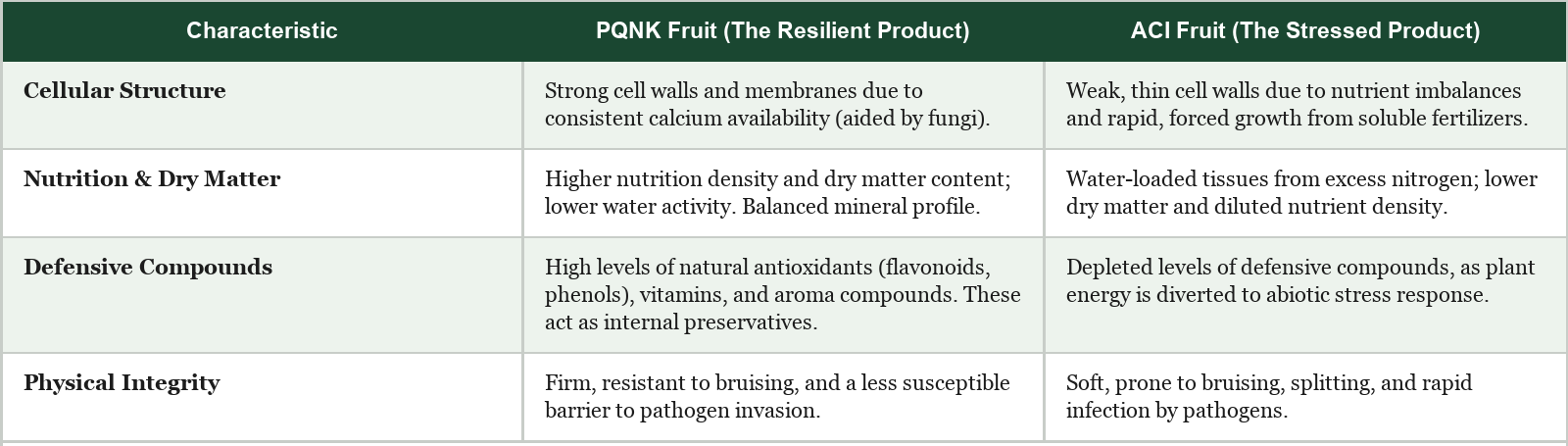
| Characteristic | PQNK Fruit (The Resilient Product) | ACI Fruit (The Stressed Product) |
|---|---|---|
| Cellular Structure | Strong cell walls and membranes due to consistent calcium availability (aided by fungi). | Weak, thin cell walls due to nutrient imbalances and rapid, forced growth from soluble fertilizers. |
| Nutrition & Dry Matter | Higher nutrition density and dry matter content; lower water activity. Balanced mineral profile. | Water-loaded tissues from excess nitrogen; lower dry matter and diluted nutrient density. |
| Defensive Compounds | High levels of natural antioxidants (flavonoids, phenols), vitamins, and aroma compounds. These act as internal preservatives. | Depleted levels of defensive compounds, as plant energy is diverted to abiotic stress response. |
| Physical Integrity | Firm, resistant to bruising, and a less susceptible barrier to pathogen invasion. | Soft, prone to bruising, splitting, and rapid infection by pathogens. |
temperature fluctuations, this resilient structure can withstand the stress far more effectively.
• ACI Produce: Already weakened, it has a high respiration rate, quickly burn-ing through its limited sugars and acids, leading to rapid flavour loss and texture breakdown. It has minimal defense against oxidative stress and is highly vulnerable to post-harvest temperature swings, which accelerate its deterioration.
4.1 The Climatic Context: Tropical vs. Temperate Fruit Ripen-ing
The farmers observation regarding the rapid over-ripening of tropical fruits like mangoes and bananas compared to the longer shelf-life of temperate fruits like apples is astute and rooted in plant physiology and evolutionary biology.
• Evolutionary Strategy (Tropical Fruits): Evolved in climates without a cold winter. Their survival strategy is to be rapidly eaten by animals for seed dispersal. To achieve this, they developed:
– High Respiration Rates: Metabolically very active, quickly converting starches to sugars.
– High Sensitivity to Ethylene: Produce and respond to large amounts of this ripening hormone, triggering a rapid, irreversible cascade.
– Softer Cell Walls: Adapted for easy consumption.
• Evolutionary Strategy (Temperate Fruits): Evolved with distinct seasons. They need to persist longer for fall/winter dispersal, leading to:
– Lower Respiration Rates: A slower, more measured metabolism.
– Firmer Cellular Structure: Thicker cell walls and waxy cuticles for protection.
– Different Ethylene Dynamics: A generally less dramatic production and re-sponse.
This contrast underscores the paramount importance of the PQNK system for tropi-cal fruits. While their nature is to ripen quickly, the superior cellular integrity, higher dry matter, and antioxidant content bestowed by PQNK practices provide them with the greatest possible resilience against their own rapid metabolic destiny, significantly extending their commercial shelf-life.
4.2 Determining the Optimal Harvest Stage
Harvesting at the correct stage of maturity is the first and most critical step in post-harvest management. Harvesting either too early or too late negates the inherent quality built by the PQNK system.
• Physiological vs. Horticultural Maturity: Physiological maturity is when the fruit can ripen offthe plant. Horticultural maturity is the optimal stage for its intended use. For climacteric fruits (e.g., mango, banana), harvest must occur at physiological maturity but before horticultural maturity.
• PQNK Harvest Indicators: Reliance on visual cues alone is insufficient. PQNK advocates for a combination of scientifically backed, practical indicators:
– Total Soluble Solids (TSS)/Brix: Using a refractometer to ensure sugar levels meet a variety-specific minimum.
– Firmness: Using a penetrometer to ensure the fruit has developed fully but is not yet soft.
– Visual Cues: Fullness of shoulders, skin colour change, disappearance of bloom.
– Experience: The “snap” of the peduncle or a specific hollow sound when tapped.
Harvesting at the right stage ensures the fruit has accumulated its maximum potential of dry matter, vitamins, and antioxidantsthe very compounds that PQNK enhancesand possesses the vitality to withstand the post-harvest chain.
5 The Criticality of Field Heat Removal
A fruit respires, generating heat. After harvest, it carries “field heat,” which can be 5–10 °C above ambient temperature. This heat is a massive catalyst for deterioration.
• Why its Necessary: For every 10 °C increase, the rate of deterioration (respira-tion, microbial growth) increases 2 to 3-fold. Leaving field heat is like allowing the fruit to “cook” itself from the inside out, rapidly destroying flavours, textures, and nutrients.
• The PQNK Method for Field Heat Removal:
1. Harvest During Cooler Hours: Schedule operations for early morning or late evening.
2. Prompt Precooling: Move produce to shade immediately. Begin cooling within one hour of harvest.
3. Forced-Air Cooling (Ideal): For larger operations, use fans to pull cold air through packages.
4. Room Cooling (Good Practice): For smaller holdings, use a well-ventilated, shaded cooling shed. Spread produce in a single layer.
5. Hydro-cooling (For Suitable Produce): Immerse sturdy produce (e.g., carrots, some mango varieties) in cold water.
The superior cellular structure of PQNK produce allows it to withstand these cooling processes without damage (e.g., splitting). Removing field heat “stops the clock” on deterioration, allowing the fruits innate PQNK resilience to define its shelf-life.
6 Implications for Storage and Marketability
The principle is clear: superior shelf-life is built in the field, not created in the storage facility. The advantage of PQNK produce is most profoundly evident in basic storage conditions.
6.1 The Farm-Level Storage Advantage: Inherent Quality Trumps Basic Infrastructure
• PQNK Produce in Basic Storage: Its foundational robustnessstronger cells, lower water activity, high antioxidantsallows it to resist spoilage longer. Its slower respiration means it generates less heat and deteriorates more slowly even at am-bient temperatures, reducing losses and extending selling windows.
• ACI Produce in Basic Storage: Its vulnerabilities are exposed. High water content and rapid respiration lead to quick wilting, shriveling, and microbial rot. Without constant cooling, it deteriorates rapidly, leading to significant financial losses.
6.2 CA Storage: Maximizing an Already Superior Product
• PQNK Produce: Is inherently “CA-ready.” CA technology acts as a complement, further slowing its already-slow metabolism to preserve its excellence for extended periods.
• ACI Produce: CA storage is often a necessary corrective measure to mitigate inherent weaknesses and prevent rapid spoilage. It attempts to “fix” in storage what was broken in the field.
7 Conclusion
The farmers hypothesis is scientifically robust and correct. The extended shelf-life of PQNK produce is a direct outcome of its foundational practices. The thick organic mulch moderates root zone temperature, which facilitates a bloom of microbial life and stress-free plant physiology. This results in the development of fruit that is structurally and biochemically superior.
PQNK - Natural Ecosystem Science for Production Agriculture, under the leadership of Mr. Asif Sharif, moves beyond simply replacing chemical inputs. It represents a paradigm shift towards managing the entire agro-ecosystem to produce food that is not only more nutritious and flavorful but also inherently durable, echoing the resilience found in natural ecosystems.
8 About PQNK
PQNK - Natural Ecosystem Science for Production Agriculture is a knowledge system developed and propagated by Mr. Asif Sharif. It is based on the principle of mimicking the natural forest ecosystem to create a self-sustaining, highly productive, and regenerative agricultural model. PQNK emphasizes the role of soil microbes as the “chefs” preparing perfect meals for plants, leading to the production of food with superior aroma, flavour, taste, and nutrition density.
About This Paper
- Crop
- Mango · Banana · Apple
- Problem
- Post-Harvest Loss / Spoilage · Short Shelf Life · Soil Temperature Extremes · Harvest Timing Problems (Premature or Delayed)
- Science
- Soil · Plants · Food Quality · Climate
- Evidence
- Scientific Mechanism
- Authority
- Current / Approved PQNK Knowledge
Related PQNK Science
Key Takeaways
- Traces PQNK produce's longer shelf life to root-zone temperature held in a stable 13-26°C band by thick organic mulch, not merely to the absence of chemical residues.
- PQNK fruit is described developing stronger cell walls, higher dry matter and nutrient density, and higher natural antioxidant content that functions as an internal preservative slowing oxidative decay.
- Explains why tropical fruits like mango and banana over-ripen faster than temperate fruits like apples through evolutionary seed-dispersal strategy, and argues PQNK's cellular-integrity gains matter most for exactly these fast-collapsing fruits.
- Recommends combining Brix (refractometer), firmness (penetrometer), and visual cues to judge harvest timing, since physiological and horticultural maturity are not the same moment.
- Field heat can leave harvested produce 5-10°C above ambient, and every 10°C increase roughly doubles to triples the rate of deterioration, making cooling within an hour of harvest critical.
- Argues the shelf-life advantage is built in the field: PQNK produce outperforms in basic uncooled storage, while cold/CA storage for ACI produce functions as a corrective measure rather than an enhancement.
Related Knowledge
same problem
The PQNK Strawberry Production System: Achieving Commercial Abundance Through Ecosystem Logic
A full production system for open-field commercial strawberries under PQNK, covering ultra-high-density planting (19,600 plants/acre, nearly double the conventional standard), a mulch-hydration system that eliminates irrigation, a three-layer pest defense, and a post-harvest cold-chain protocol, plus a winter-crop rotation that keeps the same permanent bed productive year-round.
same problem
Watermelon Cultivation Under the Paedar Qudratti Nizam Kashatqari (PQNK): A Guideline Based on Practical Field Observations
PQNK watermelon takes 90-100 days to mature instead of 70 under chemical systems, not a delay but evidence of the plant building a real root-microbiome partnership first. This guideline works through frost protection, vine training, tip-cutting after fruit set, shade-based shrinkage prevention, and a cold-water field-heat removal protocol that holds fruit quality for 10-14 days.
same problem
PQNK Advisory Paper: Tomato (Solanum lycopersicum)
Tomato is naturally perennial in its tropical highland origin, and this advisory shows how PQNK's stable microclimate, mulch, living companion canopy, and a low-dose ethanol spray, can restore that perennial behavior in open-field cultivation, alongside a full sucker-pruning and harvest protocol.
same crop
The Plant Does Not Produce for Humans Alone: Carbon, Biological Production, Harvest and the Real Meaning of Agricultural Productivity
Modern agriculture measures success by harvested mass, tonnes per hectare or maunds per acre, but that is only the fraction of a plant's biological production that people remove from the field. This paper reframes the harvest as one output of a much larger plant carbon economy that also feeds roots, soil biology, residues and the wider ecosystem, and argues production should ultimately be judged by the useful nutrition delivered per hectare while the biological capacity to produce again is maintained.