

KP-195 · Plant Physiology & Production Systems
The Plant Does Not Produce for Humans Alone: Carbon, Biological Production, Harvest and the Real Meaning of Agricultural Productivity
Modern agriculture measures success by harvested mass, tonnes per hectare or maunds per acre, but that is only the fraction of a plant's biological production that people remove from the field. This paper reframes the harvest as one output of a much larger plant carbon economy that also feeds roots, soil biology, residues and the wider ecosystem, and argues production should ultimately be judged by the useful nutrition delivered per hectare while the biological capacity to produce again is maintained.
Read or listen to the full paper ↓Abstract
Modern production agriculture measures success mainly by harvested quantity: tonnes per hectare, maunds per acre, kilograms per tree, grains per plant. Those measures are essential for farm management and economics, but they describe only the fraction of a plant's biological production that people remove from the field. A plant does not fix carbon solely to make food for humans. The same photosynthesis builds and maintains roots, stems and leaves, funds the plant's defensive chemistry, supports the microorganisms, fungi, insects and animals of the community it evolved in, and passes a large share of its output into the soil. Carbon reaches the soil by several routes at once, through roots, rhizodeposition and root exudates below ground, and through fallen leaves, dead roots, pruned and broken branches and crop residues above ground, so the carbon dioxide taken in at the leaf is not the only source of the carbon deposited in soil.
The paper draws a scientific distinction that PQNK material has sometimes blurred: total below-ground carbon allocation is not the same as root exudation alone. Reviews that trace plant-derived carbon into the soil put the below-ground share at roughly 20 to 40 percent of fixed carbon depending on the crop and its growth stage, with about 20 to 30 percent reported for wheat and barley, while root exudation specifically accounts for a smaller fraction, on the order of 5 to 21 percent. That carbon is distributed among root tissue, respiration, microorganisms and stable soil organic matter. PQNK does not need the overstatement; the accurate statement, that a plant invests a large and variable share of its carbon in roots, microbial relationships and the machinery that obtains water and nutrients, is the stronger one.
Carbon sent below ground is treated as production, not as carbon subtracted from the harvest. Because photosynthesis can outpace immediate growth when water, nutrients, temperature or developmental stage limit how fast a plant builds tissue, a plant can hold and invest more carbon than its reproductive output alone would suggest. Roots that explore new soil, reach deeper water, engage fungi and bacteria and build structure enlarge the resource base available to the whole plant, so below-ground investment and above-ground yield need not be competitors. A heavily bearing PQNK mango orchard is used as a field example: before harvest the trees carry an exceptionally heavy fruit load on a full canopy; after harvest, enough vegetative biomass remains that substantial pruning is still required, visible evidence that the mango crop was one part of the tree's total biological production, and that pruned and fallen material is a second pathway feeding soil carbon alongside the roots.
The paper then extends the argument beyond carbon to what agriculture is for. Consumers do not need kilograms; they need energy and nutrients, protein and amino acids, fats, minerals, vitamins and fibre, and two fields producing the same physical mass need not deliver the same nutritional value. It proposes a three-level framework, physical yield, nutritional yield, and biological food value (what survives digestion, absorption and metabolism), and a metric of nutritional productivity: how much useful, diverse nutrition a hectare produced, eventually assessed per unit of irrigation water and per unit of production cost. It closes on an evidence discipline: PQNK reached these conclusions from the field first and investigated the mechanisms afterwards, so established science and PQNK field evidence should each be labelled as such, and neither used to silence the other. Its summary line: we do not grow kilograms, we grow nutrition.
Full Paper
If you use “Listen”, the text of the page may be sent to your browser or operating system’s speech provider, such as Apple, Google or Microsoft, depending on the voice your device uses. Pedaver does not process, transmit or store any audio.
1. Production is larger than the harvest
Agriculture has become very good at measuring what leaves the field. We know how many tonnes of wheat a hectare produced, how many maunds of cotton came off an acre, how many kilograms of mangoes a tree carried and how many tonnes of cane went to the mill. These measures are necessary. A production manager cannot work intelligently without knowing physical yield, cost, water use, labour and economic return.
Yet measuring only what is removed can narrow our understanding of what took place biologically. It records the material taken by humans. It does not tell us how much total photosynthetic production occurred, how much carbon was invested in roots, how much passed through the rhizosphere, how much vegetative biomass remained after harvest, how much organic material returned to the soil, or how much of the biological infrastructure needed for the next cycle was kept intact.
The question is therefore larger than how much produce was harvested. We must also ask what the plant itself was producing, and how that production was distributed through the living system.
Plants existed long before agriculture. Their leaves, roots and reproductive systems did not evolve to satisfy the diet or the commerce of a single species that appeared very late in their history. Plants developed within communities of life in which many organisms interact with them continuously. A grazing animal removes foliage. An insect chews a leaf or drinks sap. Birds eat fruit or seed, rest in the canopy or nest in the branches. Leaves fall, branches break, roots grow and die, fungi engage living roots, and microorganisms consume the carbon compounds released into the soil.
None of this means the purpose of a plant is to be eaten or damaged. It means that the biological production of a plant has always operated within a larger ecological community, and that its captured carbon has many destinations, of which the part harvested by humans is only one.
2. The plant carbon economy
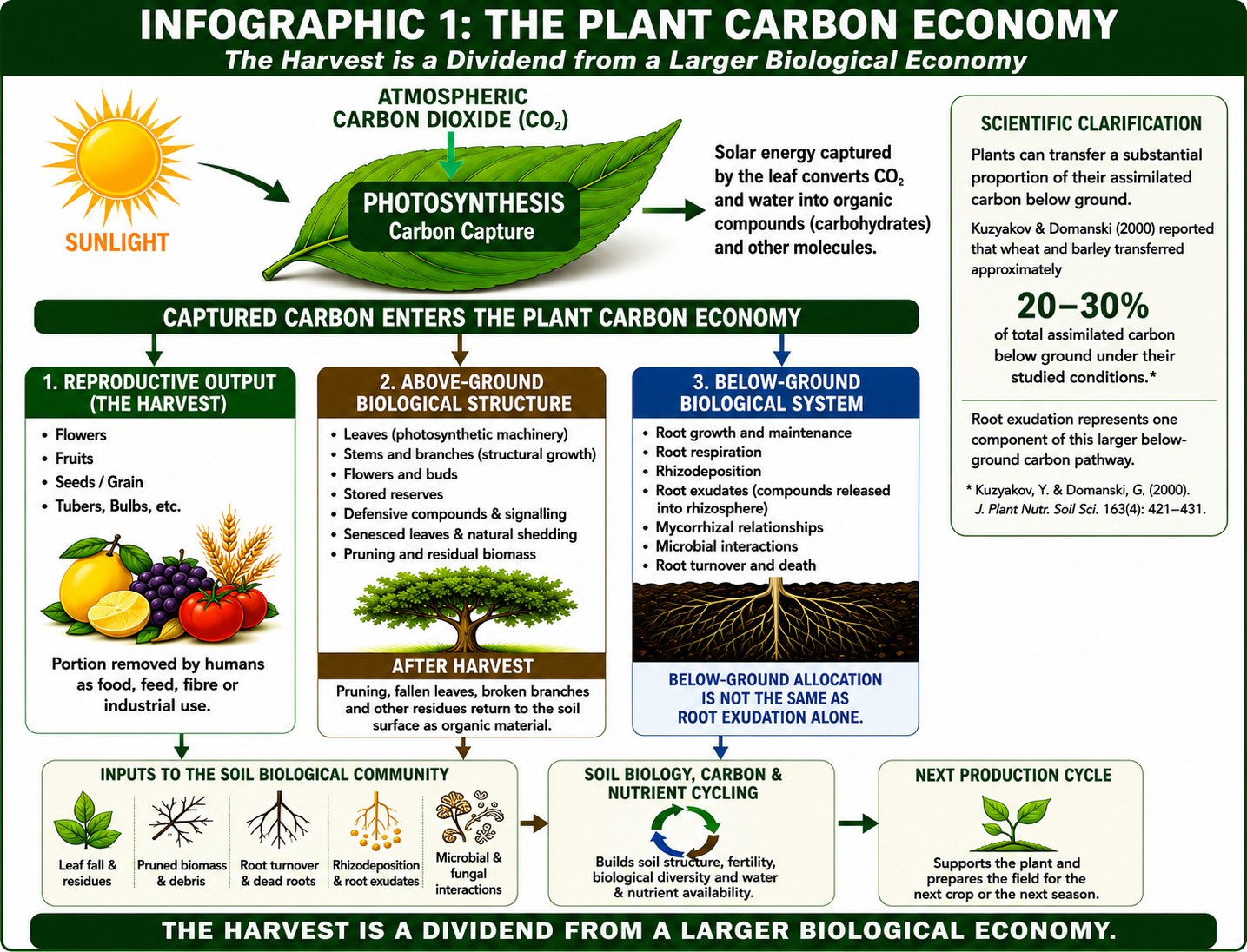
A plant begins production by intercepting solar energy at its leaves. Through photosynthesis, atmospheric carbon dioxide is built into organic compounds. Those compounds then enter a dynamic, whole-plant economy rather than travelling along a single route toward grain or fruit.
Some captured carbon builds new leaves, stems and branches. Some builds and maintains roots. Some is spent in root respiration and metabolism. Some goes to flowers, fruit and seed. Some enters storage compounds. Some becomes defensive chemistry and signalling. Some passes below ground through roots and rhizosphere processes. Some ends up in dead roots, fallen leaves, branches, prunings and other residues. Some returns to the atmosphere through normal respiration.
The commodity that humans harvest is one output of this whole process, not the process itself.
This is consistent with modern crop physiology. Yield is governed by interactions between photosynthetic sources and the sinks that receive carbon and nutrients, and these source and sink relationships influence not only yield but nutritional quality (Smith et al., 2018). Photosynthesis, total plant growth and harvested yield must therefore not be treated as interchangeable quantities. The productive capacity of a plant cannot be understood merely by asking how much leaf area is needed to make the grain or fruit we intend to harvest: the canopy supports a whole organism, and that organism takes part in a larger biological system.
3. Photosynthesis can exceed immediate growth demand
A relevant idea in current plant science is that carbon fixation and immediate growth demand are not always equal. Growth can be limited by water, nutrients, temperature or developmental stage even while photosynthesis keeps capturing carbon. Under such conditions the plant may hold more assimilated carbon than it needs for immediate structural growth.
Prescott and colleagues describe this as surplus carbon and note that it can be stored, put into secondary compounds, transferred below ground, released through roots or supplied to root-associated organisms (Prescott et al., 2020). The amount of carbon captured by the photosynthetic system need not equal the amount immediately built into harvestable growth.
The implication for production agriculture is significant. The photosynthetic apparatus of the plant should not be read as a factory built only around the volume humans eventually harvest. The plant runs many physiological and ecological functions at once, and its carbon economy can be substantially larger than its reproductive output. This does not by itself prove every explanation that may be offered for a PQNK field result, but it shows the basic proposition is biologically reasonable: photosynthetic carbon capture can exceed the immediate carbon requirement of the harvestable portion of the plant.
4. Below-ground carbon and root exudation are not the same thing
An important scientific distinction is needed here. Total below-ground carbon allocation should not be confused with root exudation alone.
Below-ground allocation is a broad category. It includes carbon built into root biomass, root growth and maintenance, root respiration, root turnover, relationships with mycorrhizal fungi, rhizodeposition, and the compounds released directly from roots into the surrounding soil. Root exudates are one component of this larger pathway.
Reviews that trace plant-derived carbon into the soil report that a substantial share of photosynthetically fixed carbon, on the order of 20 to 40 percent depending on the plant type and its growth stage, is allocated below ground. For wheat and barley specifically, Kuzyakov and Domanski reported approximately 20 to 30 percent of assimilated carbon moving below ground under the conditions studied (Kuzyakov and Domanski, 2000). That carbon did not all become root exudate; it was distributed among root tissue, respiration, microorganisms and soil organic matter. Wen and colleagues, examining exudation specifically, describe it as a substantial carbon investment tied to resource acquisition, with roughly 5 to 21 percent of fixed carbon entering the rhizosphere through exudation-related processes, depending on the plant, its growth stage and its environment (Wen et al., 2022).
The distinction matters because a statement such as “20 to 40 percent of photosynthate is exuded by roots” silently merges several biological processes into one. PQNK does not need that overstatement. The accurate and still powerful statement is that a plant can allocate a large share of its captured carbon below ground, that this share varies with species and growth stage, and that root exudation is one important part of a broader investment in roots, microbial relationships and the biological machinery that obtains water and nutrients and keeps the soil functioning.
5. Carbon sent below ground is part of production
Conventional production thinking can treat carbon allocated to roots as carbon that failed to become grain or fruit. That assumes the plant holds a fixed amount of carbon and that every unit sent below ground is taken away from the harvest. This simple zero-sum reading is incomplete.
Roots are not merely consumers of photosynthate. They enlarge the plant’s access to water and nutrients. They explore new soil volume, engage microorganisms and fungi, open channels, add organic material to the soil and shape the rhizosphere around them. Root-derived compounds can stimulate or regulate microbial processes that affect nutrient acquisition. Root investment can therefore create the conditions that let the plant capture still more resources and sustain greater above-ground production.
Work on biological approaches to soil systems is relevant here. Its synthesis places strong emphasis on vigorous root systems and on the biological relationships that let roots enlarge access to water and nutrients (Uphoff et al., 2006; Uphoff and Thies, 2024). In this view, greater root development is not a simple sacrifice of harvestable production. Better root function enlarges the effective resource base available to the whole plant. This changes the idea of efficiency: carbon allocated to the root system or the rhizosphere is not necessarily carbon lost from production. Much of it is biological investment in the productive infrastructure on which both the present and the future crop depend.
6. What ACI changed
Ancient Conventional Industrial agriculture progressively changed the environment in which crop plants operate. Animals are kept out of growing crops. Insects judged economically harmful are suppressed with pesticides. Diseases are controlled chemically. Competing plants are removed. Soil is frequently disturbed. Crop residues are burned, removed or turned in by tillage. Root systems are repeatedly cut off when the soil is worked for the next crop.
At the same time, irrigation, synthetic fertiliser and other interventions alter the plant’s growth environment. Nitrogen in particular can strongly push vegetative growth. The crop therefore operates in conditions very different from those in which plant and soil biological relationships evolved.
This raises a PQNK question. If management reduces many forms of above-ground ecological consumption while also stimulating vegetative growth, what happens to the whole plant carbon economy? We should not claim prematurely that carbon which would have been eaten by an insect or a grazing animal is automatically redirected below ground. Carbon allocation is governed by complex source and sink relationships, and the response depends on species, growth stage, nutrient supply, water status and other factors.
The more basic production observation still holds. The carbon captured by the plant is not represented only by the commodity humans remove. There can be substantial vegetative production above ground and substantial biological investment below ground in addition to the harvested portion. This is exactly what becomes visible in a perennial crop such as mango.
7. The mango orchard before harvest
The PQNK mango orchard in Figure 2 is a useful field example. The trees carried an exceptionally heavy fruit load through a large part of the canopy while still holding substantial leaf area and vegetative structure. The trees were not producing foliage instead of fruit. They were expressing strong vegetative capacity and heavy reproductive production at the same time.
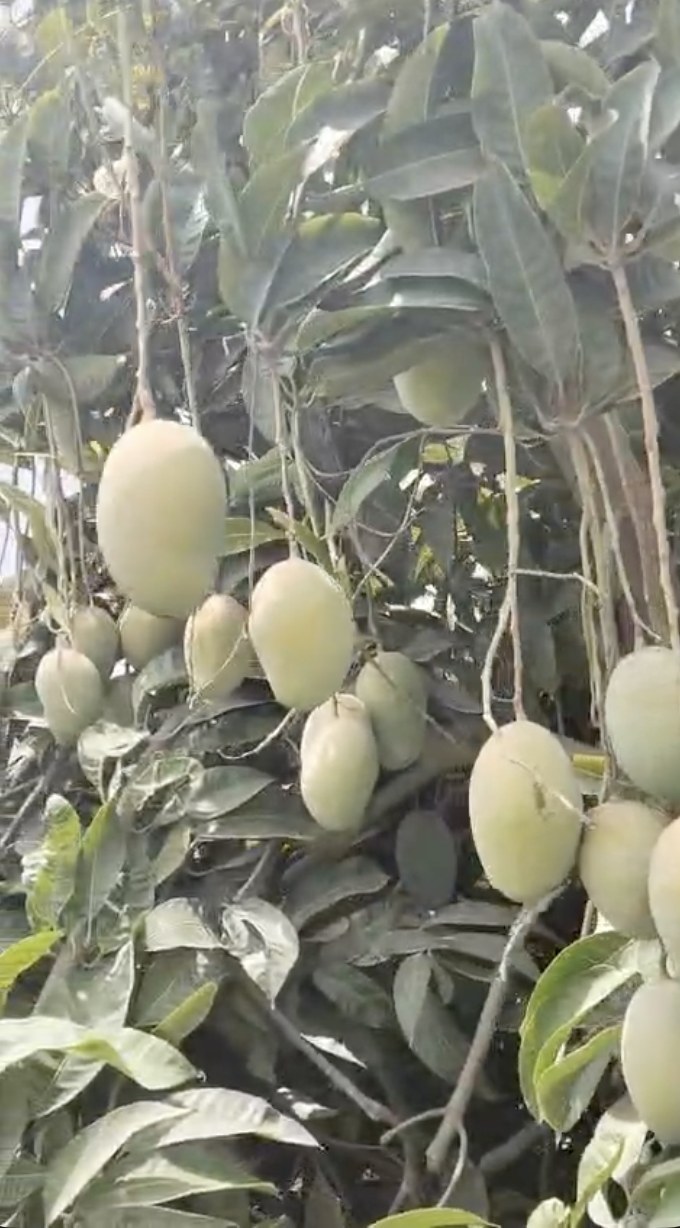
Figure 2. A PQNK mango tree before harvest. A very heavy fruit load is carried on a full, vigorous canopy. Still frame from a field video.
The observation should not be turned straight into a universal physiological law. But the visual evidence is clear: a large photosynthetic canopy supported a very substantial reproductive load. That becomes more informative when read together with the same orchard after harvest.
8. The same orchard after harvest
After the mango crop was removed, the orchard was heavily pruned. Large quantities of green foliage and branches were cut from the trees and left on the orchard floor.
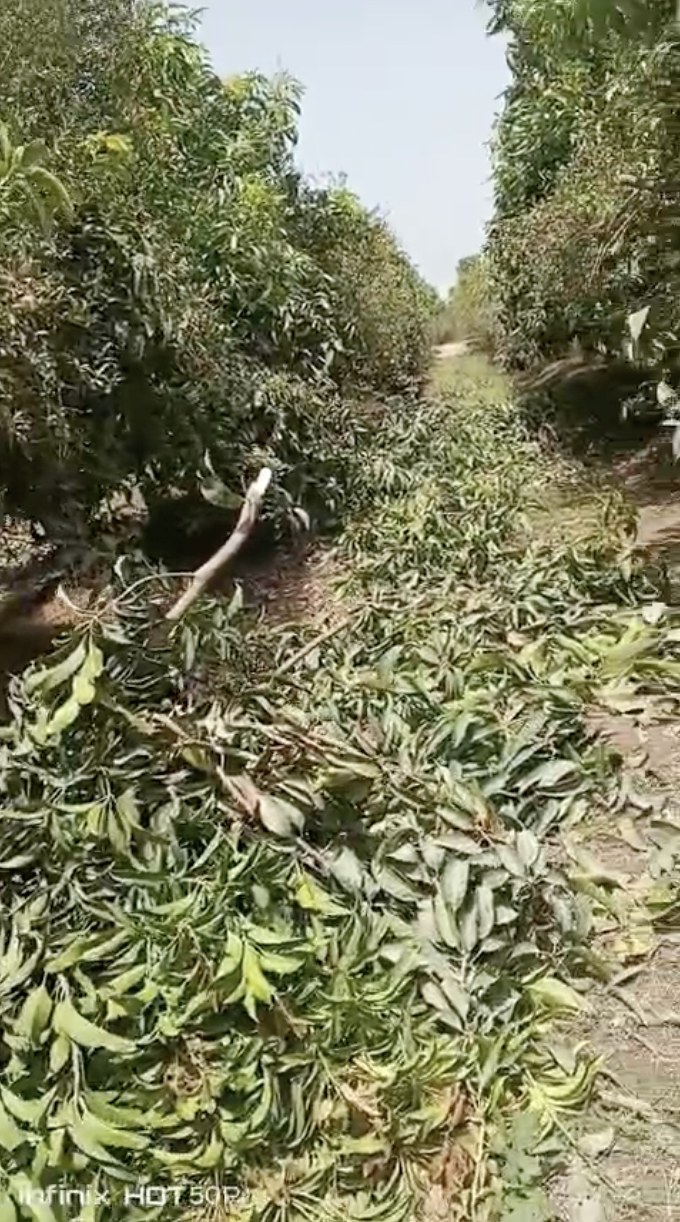
Figure 3. The same orchard after harvest. Green foliage and branches removed in post-harvest pruning lie across the orchard floor. Still frame from a field video.
This creates a visible biological sequence. The trees first built a large photosynthetic canopy, carried a heavy reproductive load and produced a substantial harvest. After that harvest was removed, enough vegetative biomass remained that substantial pruning was still needed.
The point is not that this biomass was useless, or that every pruned branch is carbon that should have become fruit. Pruning serves several production purposes: regulating canopy architecture, improving light and airflow, controlling vegetative growth, keeping the tree accessible and preparing it for future fruiting. What the two images show directly is that the harvested mango crop was only one part of the total biological production of the tree. Even after supporting the observed fruit load, a substantial quantity of captured carbon remained in living vegetative tissue. Conventional yield accounting records the mangoes but not the complete biological production required to create and sustain them.
9. Pruning reveals another carbon pathway
The post-harvest pruning also raises the question of what happens to captured carbon after the harvest leaves the farm. A pruned branch began as atmospheric carbon dioxide. Solar energy let the tree turn that carbon into living tissue. Once the branch is removed, the carbon has not disappeared. Its next destination depends on management. If the biomass is burned or carried off, much of its potential contribution to the production ecosystem is lost or quickly returned to the atmosphere. If it is kept on the soil surface, mulched or otherwise biologically recycled, it becomes food for decomposer organisms and part of the continuing cycling of carbon and nutrients.
The soil therefore receives plant-derived carbon by at least two broad routes. One route runs below ground: carbon moves from photosynthesis into roots, root metabolism, rhizodeposition, root exudates, microbial interactions and root turnover. The second route runs from above: leaves fall, branches break or are pruned, crop residues remain, and organic material returns to the soil surface where biological decomposition begins. A living production system is fed with plant-derived carbon from both directions. Roots feed it from below; plant residues feed it from above. This is one reason PQNK does not treat roots, residues or suitable pruning material as agricultural waste. They are biological capital already captured through photosynthesis.
10. Harvest is not the end of production
Once this broader carbon economy is recognised, harvest takes on a different meaning. Humans remove the portion needed for food, feed, fibre or industry, but the biological production cycle does not end at that moment. Roots can stay in the soil. Crop residues can stay on the surface. Pruned material can become mulch. Microorganisms keep decomposing organic compounds. Nutrients keep cycling. Carbon keeps moving through living and non-living pools. Soil structure keeps developing, and the next crop enters an environment shaped by the biological activity of the crops before it. The crop need not begin from biological zero after every harvest.
This difference matters most when comparing ACI with a mature PQNK sustained state. In many ACI systems the production cycle is followed by soil disturbance, root destruction, residue removal or incorporation, chemical intervention and renewed dependence on external inputs. In PQNK the aim is to keep biological continuity so that the productive infrastructure survives the harvest and carries into the next crop.
Carbon is not permanently locked away, nor should it be. Respiration and decomposition are essential functions of a living system, and carbon must circulate. The production aim is to ensure that enough captured carbon is continually reinvested, biologically processed and held in useful pools to keep the production system functional. The two carbon economies can be described in these terms: ACI progressively consumes or disrupts biological carbon capital, while PQNK seeks to earn, circulate, reinvest and retain enough carbon to keep the production system biologically functional.
11. PQNK began with production, not theory
This carbon discussion also clarifies how PQNK developed. PQNK was not created by reading a set of biological theories and then asking how to apply them to farming. Its development began inside production agriculture. The operating conditions of conventional fields were compared with those of natural ecosystems, and the question became simple: what are we doing in agriculture that the natural production system does not do?
The differences were then addressed operationally. Soil disturbance was removed. Inundation was removed. Permanent biological cover was established. Biodiversity was encouraged. The soil water and air relationship was managed differently. Roots and residues were retained as components of the production system. The field responses were observed. Only after those responses became repeatedly evident did the work turn toward understanding the biological and physical mechanisms behind them.
The sequence matters: from observation to operational change, from operational change to field result, from repeated field result to investigation of the governing mechanisms, and from that investigation toward documentation for replication. This is the reverse of an approach in which theory is developed first and field application follows. The purpose of studying photosynthesis, carbon allocation, microbes, fungi, roots and nutrient cycling is not to invent PQNK or to justify it after the fact. It is to understand why an already functioning production system behaves as it does, so that farmers and future generations can manage it intelligently.
12. Why the governing mechanisms still matter
Field results alone can show that something works, but production managers also need to understand why it works. A farmer who copies a practice can reproduce it under identical conditions. A farmer who understands the governing processes can make better decisions when soil, weather, crop or water availability change. For this reason PQNK must document the biological mechanisms operating behind the field observations. The next generation should not inherit PQNK as another package of instructions; it should understand the relationships among soil aeration, water, roots, carbon, microorganisms, biodiversity and production.
Published science is valuable in this role. It helps explain mechanisms that the field has already revealed through production responses. Conventional scientific knowledge should neither be rejected nor allowed to define the limits of what field evidence may show. Published science can explain what is known. PQNK field records can document what is observed.
13. Plant protection carries the same lesson
The same reasoning applies to plant protection. A functioning biological protection system cannot reasonably be reduced to one organism. Bacillus thuringiensis may contribute. Predators and parasitoids contribute. Microbial antagonists contribute. Fungi contribute. The plant’s own defences contribute. Soil biological conditions affect plant health. Biodiversity shapes the relationships among pests, predators, hosts and microorganisms.
The production question is therefore not whether one beneficial organism can replace one pesticide. The larger question is whether a sufficiently restored biological production system can maintain crop health without routine dependence on chemical plant protection. If PQNK fields repeatedly show that outcome, it is a production result worth documenting, and science can continue identifying the organisms and interactions responsible. There is no need to make Bacillus thuringiensis carry the whole explanation, and incomplete knowledge of every organism involved does not invalidate the field result. A production observation and the mechanism proposed to explain it must not be confused. The mechanism explains the result; it does not create it.
14. The larger question: what are we producing?
The discussion of plant carbon leads to a more fundamental question. What is the purpose of production agriculture? If the purpose is only to make marketable commodities, kilograms and tonnes may be enough. If the purpose is to nourish living organisms, they are not.
Consumers do not physically need kilograms. They need the useful energy and nutrients contained in food: protein and essential amino acids, carbohydrates, fats and essential fatty acids, minerals, vitamins, fibre and many other compounds required for metabolism, growth, maintenance and health. Two fields can produce the same physical mass without producing the same nutritional value. Crop science already recognises this in part, since source and sink relationships influence both yield and nutritional quality (Smith et al., 2018). The question should not end with how many tonnes a hectare produced. We should also ask how much useful nutrition that hectare delivered.
15. Physical yield, nutritional yield and biological food value
A more complete production framework can distinguish three levels of output.
The first is physical yield: the conventional measure of kilograms, tonnes, fruit or grain. It remains essential and should never be dismissed. Farmers must know how much they produced.
The second is nutritional yield: what quantity and diversity of useful nutrients the harvested mass contains. Depending on the crop, this may include energy, protein and amino-acid composition, fats, minerals, vitamins, fibre and other relevant compounds.
The third is biological food value: the extent to which the harvested product can actually meet physiological requirements after digestion, absorption and metabolism, since nutrients present in food are not always equally digestible or bioavailable, and consumer needs differ.
These three levels should not be collapsed prematurely into one number. Calories alone are not an adequate measure of nutrition. Mineral concentration alone is not an adequate measure of food quality. Kilograms alone are not an adequate measure of biological food value. Together they point to a PQNK concept: nutritional productivity.
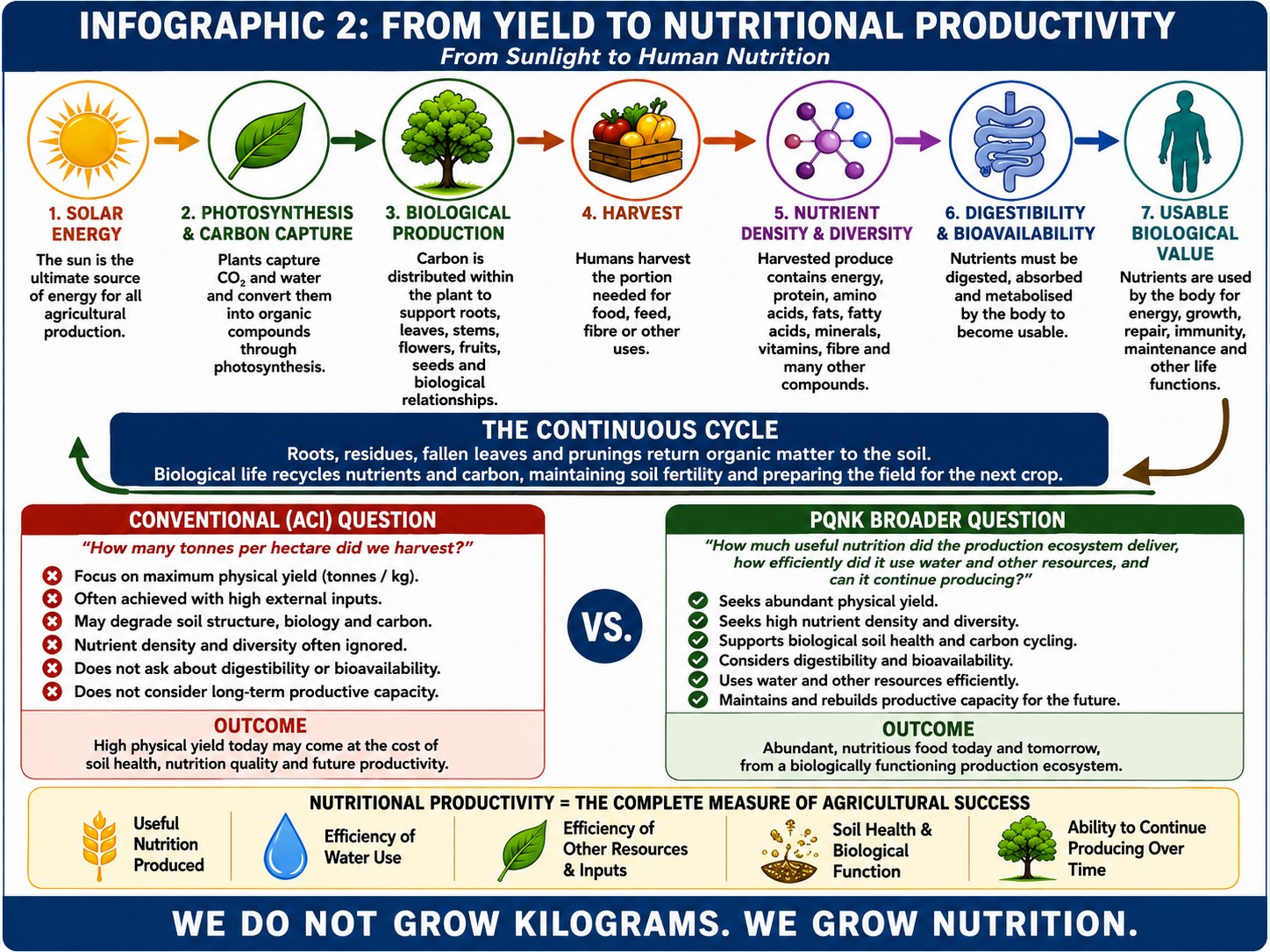
Figure 4. From yield to nutritional productivity. Solar energy and captured carbon pass through biological production and harvest to nutrient density, digestibility and usable biological value, while roots and residues return organic matter to the soil for the next cycle.
16. Nutritional productivity
Conventional productivity asks how many tonnes were produced per hectare. Nutritional productivity asks how much useful and diverse nutrition that hectare produced. The distinction matters when two fields produce the same physical yield: if both produce ten tonnes but one harvest has materially different nutritional density or composition, the fields produced the same physical mass but not the same quantity of useful food.
Representative samples from PQNK and ACI production should be analysed by recognised laboratories. Nutritional composition should be compared crop by crop and, where relevant, variety by variety. If PQNK produce proves measurably more nutrient dense or diverse, the data should show it. The food itself should provide the evidence. In time, nutritional productivity could be examined per hectare, per cubic metre of irrigation water, per production cycle and against cost of production, so that agricultural efficiency is measured not simply by mass extracted from land but by the useful food value produced from the resources consumed.
17. From solar energy to human nutrition
Seen from this wider perspective, agriculture is part of a continuous biological transformation. Solar energy is intercepted by leaves. Photosynthesis captures atmospheric carbon. That carbon enters whole-plant biological production. Part is reinvested into roots, soil biology, vegetative structure and future productive capacity. Another part enters grain, fruit, seed or other harvestable material. Humans remove that harvest. Its nutritional composition then determines how much energy and how many essential nutrients are available to the consumer, and digestibility and bioavailability determine how much of those nutrients the body can use.
At the same time, another part of biological production returns through roots, residues, fallen leaves and pruning material to the soil biological community, helping prepare the ecosystem for another cycle. Agriculture is therefore not a linear chain in which inputs enter one end of a field and commodities leave the other. It can work as a biological cycle in which part of the production is harvested and another part is reinvested into the capacity to produce again.
18. Abundance, resilience and continuity
This also gives more precision to the PQNK use of the word abundance. Abundance does not mean infinite production. It does not imply that biological resources have no limits, nor that every natural ecosystem produces maximum agricultural yield under every condition. Abundance is the productive expression that becomes possible when unnecessary constraints imposed on the natural production system are removed and biological functioning is restored.
Agricultural abundance should not be measured only as physical volume. A genuinely abundant production system should provide adequate or high physical yield, strong nutritional value and the biological capacity to keep producing. Resilience and abundance are not opposites: resilience is one of the conditions that makes sustained abundance possible. A system that creates one exceptional crop while destroying its future productive capacity cannot reasonably be called abundant over time. A system that produces well while continuously rebuilding the biological foundation of production comes much closer to that meaning.
19. The mango orchard as a complete production account
The two mango images express the argument of this paper in a single view. Before harvest, the trees hold substantial leaf area, an extensive canopy and a very heavy fruit load; the crop is not carried by a weak vegetative structure. Humans then remove the mango harvest. After harvest, substantial living vegetative biomass still remains and is cut away in pruning, showing that the cycle generated far more biological material than the fruit alone. Below ground, roots and the rhizosphere functioned throughout the same period, though this is not visible in the images.
The conventional account records kilograms of mangoes harvested. The biological account is much larger: solar energy was intercepted, atmospheric carbon was fixed, roots and canopy were maintained, biological relationships operated, fruit was produced, humans removed nutritious food, substantial vegetative carbon remained after harvest, pruning produced recyclable biomass, and the tree and soil system continued toward the next cycle. Neither account is wrong. The second is simply more complete.
20. From commodity efficiency to biological efficiency
ACI has largely trained agriculture to optimise the extraction of a marketable commodity. That aim has produced real improvements in certain forms of output, but it can hide the biological costs through which the output is achieved. PQNK asks a broader question: can the production ecosystem generate high levels of harvestable food while also maintaining the roots, soil biology, carbon cycling, water and air relationships and other infrastructure needed to keep producing? If that is possible, investment in the biological system and the human harvest need not be competitors.
The mango example matters because it shows that very heavy reproductive production can coexist with substantial vegetative capacity. Similar questions arise in annual crops when vigorous roots, large tillering capacity or improved canopy expression appear alongside high harvestable production. The appropriate scientific response is not to assume that every such observation must conform to established expectations. It is to measure it.
21. The proper relationship between field evidence and science
PQNK should use a clear evidence discipline as this work develops. Established mechanisms supported by scientific literature should be identified as such: photosynthesis, source and sink relationships, below-ground carbon allocation, root exudation, rhizosphere activity and other well-documented processes. PQNK field evidence should be identified separately: measured or repeatedly documented production observations occurring under PQNK management.
This distinction allows both confidence and discipline. The absence of a published mechanism does not invalidate a reproducible field observation. Equally, an observation should not be treated as proof of whatever mechanism first appears to explain it. In production agriculture, results frequently come before complete explanation, and science then helps reveal the governing mechanisms.
22. Conclusion
Plants do not produce for humans alone. Their photosynthetic machinery developed within biological communities that existed hundreds of millions of years before agriculture. Carbon captured from the atmosphere supports the whole plant, its reproductive structures, its roots, its biological relationships and the continuing cycling of organic material through the ecosystem. Humans harvest one portion of this production. That portion is essential, but it is not the whole system.
The carbon economy of the plant reaches the soil from more than one direction: below ground through roots and the rhizosphere, and above ground through stems, leaves, residues, branches and pruning material. Some carbon is respired, some is consumed, some is harvested, some is recycled and some contributes to soil organic matter and continuing biological function. The carbon dioxide taken in at the leaf is one entry point, not the only source of the carbon that ends up in the soil.
PQNK reached this understanding through production agriculture. The operating differences between ACI and natural production systems were observed. Practices absent from the natural system were progressively removed or changed. Biological operating conditions were restored within managed fields, and the production responses were observed. Only afterwards did the investigation turn toward the mechanisms governing those results.
The mango orchard is a visible example. Before harvest, a substantial canopy supports an exceptionally heavy fruit load. After harvest, large quantities of vegetative biomass still remain and are removed through pruning. The mangoes are only one part of the biological production created by the tree during that cycle.
The larger lesson extends beyond carbon. Agriculture should not judge itself solely by physical volume harvested. The true objective is food, and food must ultimately be evaluated by the useful nutrition it provides, so physical yield needs to be complemented by nutritional yield and, in time, by a better understanding of biological food value. The system must also retain the biological capacity to produce again. The ultimate PQNK proposition is therefore broader than maximum yield: it is the production of abundant, nutritionally dense and diverse food from a biologically functioning production ecosystem that continually rebuilds the natural infrastructure on which future production depends. The field should provide the evidence. Science should help us understand the governing mechanisms. Neither should be used to silence the other.
We do not grow kilograms. We grow nutrition.
References
Kuzyakov, Y., and Domanski, G. (2000). Carbon input by plants into the soil. Journal of Plant Nutrition and Soil Science, 163(4), 421–431. doi:10.1002/1522-2624(200008)163:4<421::AID-JPLN421>3.0.CO;2-R
Prescott, C. E., Grayston, S. J., Helmisaari, H.-S., Kaštovská, E., Körner, C., Lambers, H., Meier, I. C., Millard, P., and Ostonen, I. (2020). Surplus carbon drives allocation and plant–soil interactions. Trends in Ecology and Evolution, 35(12), 1110–1118. doi:10.1016/j.tree.2020.08.007
Smith, M. R., Rao, I. M., and Merchant, A. (2018). Source-sink relationships in crop plants and their influence on yield development and nutritional quality. Frontiers in Plant Science, 9, 1889. doi:10.3389/fpls.2018.01889
Uphoff, N., Ball, A. S., Fernandes, E. C. M., Herren, H., Husson, O., Palm, C. A., Pretty, J., Sanginga, N., and Thies, J. (2006). Understanding the functioning and management of soil systems. In Biological Approaches to Sustainable Soil Systems (Chapter 1). Boca Raton, FL: CRC Press.
Uphoff, N., and Thies, J. E. (eds.) (2024). Biological Approaches to Regenerative Soil Systems, 2nd ed. Boca Raton, FL: CRC Press / Taylor and Francis.
Wen, Z., White, P. J., Shen, J., and Lambers, H. (2022). Linking root exudation to below-ground economic traits for resource acquisition. New Phytologist, 233(4), 1620–1635. doi:10.1111/nph.17854
• • •
Applying PQNK without understanding nature’s operating system will not deliver abundance, stability, or nutrient density.
PQNK (pronounced “picnic”), the regenerative and sustainable Pristine Organic Farming System, is grounded in Natural Ecosystem Science. It employs perennial biodiversity, protects soil with organic mulch, and avoids practices such as water inundation, tillage disturbance and leaving soil bare.
It is the process that matters most. PQNK is a pristine production system designed not merely for yield, but for optimal, balanced output, where quality, sustainability and ecological harmony emerge from a self-regulated, zero-external-input methodology.
Connect and Resources
Pedaver.com | Facebook: facebook.com/Pedaver | YouTube (PQNK): youtube.com/@pedaverpqnk3167/videos | YouTube: youtube.com/@aasifsharif | PDF Knowledge Papers: drive.google.com/drive/folders/1iadwV6mdUPyrUIpB3oRfNv6DLiackaUL | Email: pedaver@gmail.com | WhatsApp: +92 320 677 6666
About This Paper
- Crop
- Mango
- Problem
- Declining Nutrient Density in Food · Soil Organic Matter / Carbon Loss · Residue Mismanagement · Terminology / Framework Confusion
- Science
- Plants · Soil · Nutrition · Food Quality · Production Architecture · Climate
- Evidence
- Philosophical/Framework Argument
- Authority
- Current / Approved PQNK Knowledge
Related PQNK Science
Key Takeaways
- The harvested crop is one destination of a plant's fixed carbon, not the whole of it; the same photosynthesis also builds roots and canopy, funds defensive chemistry, supports the surrounding community of organisms, and passes a large share into the soil.
- Carbon reaches the soil by two broad routes at once: below ground through roots, rhizodeposition, exudates and root turnover, and above ground through fallen leaves, crop residues and pruned or broken branches. The carbon dioxide taken in at the leaf is one entry point, not the only source of soil carbon.
- Total below-ground carbon allocation, roughly 20 to 40 percent of fixed carbon and varying with crop and growth stage, is not the same as root exudation alone, a smaller fraction of about 5 to 21 percent; conflating the two overstates the claim without strengthening it.
- Photosynthesis can exceed a plant's immediate growth demand when water, nutrients, temperature or growth stage are limiting, so a plant's carbon economy, and what it can invest below ground, can be substantially larger than its reproductive output.
- Carbon allocated to roots is biological investment, not yield forgone: better root function enlarges the plant's access to water and nutrients, so below-ground investment and above-ground harvest are not a zero-sum trade in a restored soil.
- A heavily bearing PQNK mango orchard shows heavy fruiting and strong vegetative capacity together; the substantial post-harvest pruning is visible proof that the harvest was one part of the tree's total production, and that pruned biomass is a second carbon pathway into the soil.
- Production should ultimately be measured as nutritional productivity, the useful and diverse nutrition delivered per hectare and per unit of water and cost, distinguishing physical yield, nutritional yield and biological food value: we do not grow kilograms, we grow nutrition.
Related Crops
Related Knowledge
same problem
The Earth Has Not Stopped Working: A Production-Agriculture Response to Environmental Fatalism, and What PQNK Restores
A widely shared social-media message, built on Lovelock's Gaia Hypothesis, ends in resignation: the planet will correct a stressed system with floods and extinctions, and all we can do is await nature's revenge. This paper accepts that we are not separate from nature but rejects the fatalism. Drawing on more than fifty years in production agriculture, it argues the core error was redesigning natural systems before understanding them, that agriculture is the clearest case, and that a degraded field is a suppressed system rather than an extinguished one, so the answer is not to fear nature's revenge but to stop fighting nature and learn again to produce with it.
same problem
Chemical Fertiliser Dependency Through the PQNK Lens
An evidence-qualified review of the article “Chemical Fertilizer Industry”. It keeps the article's warning about soil degradation, nutrient pollution and biological decline, disciplines its headline numbers, and argues that fertiliser dependency is a symptom of a damaged production system (tillage, flooding, bare soil and simplified biology) that PQNK removes by restoring aerated, covered, living soil, reaching zero purchased fertiliser and pesticide at maturity.
same problem
What Science Delivered: The Documented Balance Sheet of a Century of Input-Funded Agricultural Research
Prompted by an online dismissal of scientific consensus, this paper turns the same skepticism on a century of input-industry-funded agricultural research and totals its documented balance sheet across soil, water, climate, cost, yield, food quality, and smallholder viability, using named published sources throughout and flagging PQNK's own field data separately wherever it appears.
same problem
Wheat Hybrid and Organic Wheat Through the PQNK Lens
A PQNK response to a widely circulated review comparing hybrid and organic wheat, arguing that hybrid describes genetics while organic describes a production standard, so the two are not opposite categories that can be compared directly. Applies PQNK's seed-is-potential, soil-is-the-production-system framework to modern wheat breeding, chemical dependence, organic certification, water management and the health claims made against modern wheat.