

KP-023 · Crop-Specific Guides
PQNK Advisory Paper: Tomato (Solanum lycopersicum)
Tomato is naturally perennial in its tropical highland origin, and this advisory shows how PQNK's stable microclimate, mulch, living companion canopy, and a low-dose ethanol spray, can restore that perennial behavior in open-field cultivation, alongside a full sucker-pruning and harvest protocol.
Read or listen to the full paper ↓Abstract
The advisory opens by noting that tomato is a perennial plant by nature, originating in the mild, year-round climate of South America's tropical highlands, where it can live and fruit continuously for years. It is grown as an annual in most regions not because of its biology but due to temperature extremes, pest buildup, and management convenience, and the paper's premise is that PQNK's carefully engineered soil health and microclimate can restore that perennial potential, especially for indeterminate types.
Within PQNK's diversified, layered vegetation system, tomato's deep root system and symbiotic associations support rhizosphere activity, nutrient cycling through decaying leaves and root exudates, and pest balance through habitat for beneficial arthropods. Perennial behavior becomes achievable under the raised-bed, mulch, living-soil system provided temperature extremes are moderated, soil stays biologically active year-round, and pruning and nutrient recycling are handled by soil organisms rather than synthetic inputs; determinate varieties can be managed perennially across 2-3 cycles, while indeterminate types express the fullest perennial potential and suit staking, trellising, or natural climbing on companion plants.
Because tomato is highly sensitive to both heat above 35°C and cold below 10°C, PQNK's protection strategy is biophysical rather than synthetic: permanent organic mulch regulates root-zone temperature and buffers spikes, living canopy layers from companion crops like maize, sunflower, or pigeon pea filter sun, deep biologically structured soil buffers transpiration stress through retained moisture, staking or trellising lifts vines off hot soil and improves airflow, and mulch plus living canopy conserve radiant warmth against cool-night chilling stress. Layered on top is a low-concentration (1-2%) food-grade ethanol foliar spray, applied every 7-10 days during high-stress periods (never at flowering peak), which acts as a mild physiological stress signal that triggers heat-shock protein formation and antioxidant pathways, helping the plant maintain membrane integrity and osmotic balance under temperature extremes.
Integration into the wider cropping system treats tomato as one member of a mutually reinforcing planting matrix: basil is co-located for its synergistic effect on flavor and vitality, and the vertical growth of indeterminate varieties creates a living trellis offering microclimate for shade-loving plants like lettuce. Pruning follows a defined sucker protocol, removing the secondary shoots that emerge between main stem and leaf branch while small, using a clean snapping motion; all suckers below the first fruit cluster are removed to establish a strong central leader, while one or two suckers above that point may be allowed to develop into additional main stems as the plant's abundance allows.
Harvest is treated as a deliberate act: fruit is picked at the 'Full Colour' stage, when it yields slightly to a gentle squeeze, using a sharp cut that leaves the calyx attached, followed immediately by removal of field heat in a shaded, cool area to extend shelf life. Post-harvest, tomatoes should never be refrigerated, since storage below 10°C disrupts flavor and texture; instead they are kept at ambient temperature, stem-end up, with any fruit past fresh consumption returned directly to the soil surface rather than formally composted.
Full Paper
If you use “Listen”, the text of the page may be sent to your browser or operating system’s speech provider, such as Apple, Google or Microsoft, depending on the voice your device uses. Pedaver does not process, transmit or store any audio.
The Natural Ecosystem Science for Production Agriculture
Published by: PQNK team lead by Mr. Asif Sharif
PQNK - The Regenerative & Sustainable Pristine Organic Farming System Date: Monday, 13 October 2025
1. Biological Nature of Tomato
Tomato is a perennial plant by nature, originating from tropical highlands of South America where environmental conditions remain mild year-round. Under such climates, a tomato plant can live and produce fruit continuously for several years. However, in most agricultural regions, tomato is grown as an annual crop - not because of its biology, but due to temperature extremes, pest buildup, and management convenience. Under the PQNK system, where soil health, microclimate, and biological equilibrium are carefully engineered, it is possible to restore tomato’s perennial potential, especially for indeterminate types.
2. Tomato under PQNK Framework a. Ecological Role
Tomato fits naturally in PQNK’s diversified, layered vegetation system. With its deep root system and symbiotic associations, it supports:
• Rhizosphere activity - promoting microbial diversity and soil respiration.
• Nutrient cycling - via decaying leaves and root exudates.
• Pest balance - through habitat for beneficial arthropods and microbial control.
b. Suitability as a Perennial
Under PQNK’s raised bed–mulch–living soil system, tomato plants can be maintained beyond a single season if:
• Temperature extremes are moderated (see section 4).
• Soil remains biologically active year-round through continuous mulch or live cover.
• Natural pruning and nutrient recycling are maintained by soil organisms, not synthetic inputs.
This allows perennial fruiting for indeterminate cultivars and at least semi-perennial behavior for determinate types.
PQNK principles are applicable to both determinate and indeterminate tomatoes, but indeterminate varieties express the full perennial potential when grown in balanced ecological conditions.
Determinate vs. Indeterminate Varieties of Tomatoes

| Type | Growth Habit | PQNK Suitability | Remarks |
|---|---|---|---|
| Determinate | Compact, limited height, flowers and fruits once | Can be managed perennially for 2–3 cycles | Retains bush form; ideal for rotational systems |
| Indeterminate | Continuous vine growth, flowers successively | Most suitable for perennial PQNK setup | Long-lived; compatible with staking, trellising, or natural climbing on companion plants |
4. Protection from Extreme Temperatures (Open Field)
Tomato is highly sensitive to both heat (>35 °C) and cold (<10 °C) stress. PQNK’s regenerative design mitigates these extremes through biophysical and biochemical moderation rather than synthetic protection.
a. Physical & Ecological Strategies
1. Permanent Organic Mulch: Regulates root-zone temperature, maintains moisture, and buffers heat and cold spikes.
2. Living Canopy Layers: Companion crops (e.g., maize, sunflower, or pigeon pea) act as sun filters.
3. Soil Moisture Buffering: Deep, biologically structured soil under PQNK retains cool moisture, reducing transpiration stress.
4. Staking or Trellising: Keeps vines off hot soil surface, improving airflow and reducing radiant heat impact.
5. Night Temperature Conservation: Mulch and living canopy conserve radiant warmth during cool nights, reducing chilling stress.
5. Use of Ethanol Spray for Temperature Protection a. Concept
Ethanol (ethyl alcohol) acts as a physiological stress modulator in plants. When applied in very low concentrations, it triggers heat-shock protein (HSP) formation and antioxidant pathways, enhancing resistance to both heat and cold stress.
b. Mechanism
• Ethanol acts as a mild stress signal, preparing cells for upcoming temperature fluctuations.
• It helps maintain membrane integrity, reduces oxidative damage, and promotes osmotic balance under heat or cold.
c. Application Under PQNK
• Use 1–2% ethanol spray (prepared from food-grade ethanol, diluted in clean water).
• Apply early morning or late evening before predicted temperature extremes.
• Avoid during flowering peak to prevent disturbance to pollination.
• Frequency: Once every 7–10 days during high-stress periods.
d. Precautions
• Over-concentration (>2%) can cause leaf burn.
• Always test on a few plants first.
• Prefer natural ethanol (fermented from molasses, fruits, or grain waste) for PQNK consistency.
6. Integration into the PQNK Cropping System
Within the PQNK paradigm, the tomato plant is a sovereign and synergistic component of the ecosystem. Its integration is a natural alignment with the system's inherent and complete provision, where it contributes to and benefits from the totality of the environment.
6.1. The Sovereign Planting Matrix
In the PQNK system, all plants exist in a state of natural harmony and mutual reinforcement. The tomato, as a respected member of this community, is placed within a matrix that exemplifies this equilibrium.
• Harmonious Co-location: Basil and tomatoes are planted together, not for protection, but because their synergistic coexistence enhances the flavour profile and vitality of both.
• Structural Synergy: The vertical growth of indeterminate tomato varieties creates a living trellis, offering a micro-climate for shade-appreciating plants like lettuce, thus optimizing the light and spatial resources of the system without competition.
6.2. Pruning for Systemic Energy Flow (The Sucker Mechanism) Pruning in PQNK is the art of guiding the plant's inherent energy towards its most expressive and productive form.
• Identification: A "sucker" is the secondary shoot that develops in the axil between the main stem and a leaf branch.
• The PQNK Pruning Protocol:
1. Objective: To direct the plant's abundant life force into the development of primary stems and robust fruit, in alignment with the system's principle of optimized growth.
2. Method: Using clean, sharp fingers or sterilized snips, remove suckers when they are small (2-4 inches long). This is done with a precise, snapping motion to create a clean wound that heals rapidly.
3. The "Lower Sucker" Rule: Remove all suckers up to the one immediately below the first fruit cluster to establish a strong central leader. Above this, the system's abundance may allow for one or two suckers to develop into additional main stems, increasing yield without depleting the plant's vitality.
4. System Reintegration: The removed plant matter is released onto the soil surface, where it is seamlessly reassimilated. It is not recycled matter but an immediate offering of organic substance that is transmuted by the soil's biological activity, a natural process of return within the continuous cycle of provision.
6.3. Harvesting as a Ritual of Receiving Provision
Harvesting is the conscious act of receiving the system's yield.
• For Peak Flavour and Vitality: Tomatoes are harvested at the "Full Colour" stage, when they have developed their complete colour and yield slightly to a gentle squeeze. This indicates a perfect balance of sugars and acids, a signature of the system's perfect provision.
• Technique: Use a sharp knife or pruners to cleanly sever the fruit from the stem, leaving a small calyx attached. This honours the plant's structure and prevents damage.
• Critical Post-Harvest Step: Removal of Field Heat. Harvest in the morning when the temperature of the fruit is not warm. Immediately upon harvest, the fruits must be moved to a shaded, cool area to allow the rapid dissipation of "field heat." This residual heat, if retained, accelerates deterioration. Its prompt removal is essential for initiating an extended shelf life, allowing the fruit to transition from a state of growth to one of perfect storage.
6.4. Optimizing Conditions for Shelf Life
The longevity of the tomato is a direct expression of the vitality it derives from the PQNK system.
• Inherent Resilience: Fruits developed within the complete mineral and biological provision of PQNK naturally possess thicker, more resilient skins and denser flesh, granting them structural integrity for extended shelf life.
• Post-Harvest Protocol:
• Ambient Storage: Never refrigerate. Storage below 10°C (50°F) disrupts the flavour and texture that the system has perfected. PQNK's ambient conditions are ideal.
• Storage Position: Store harvested tomatoes at room temperature, stem-end up. This protects the integrity of the fruit and minimizes moisture loss.
• Natural Reintegration: Any fruit that reaches a state of maturity beyond fresh consumption is not "composted" in a man-driven cycle. It is simply returned to the soil surface, where it is naturally and seamlessly reassimilated into the system's boundless cycle of provision, contributing its essence back to the whole.
Summary
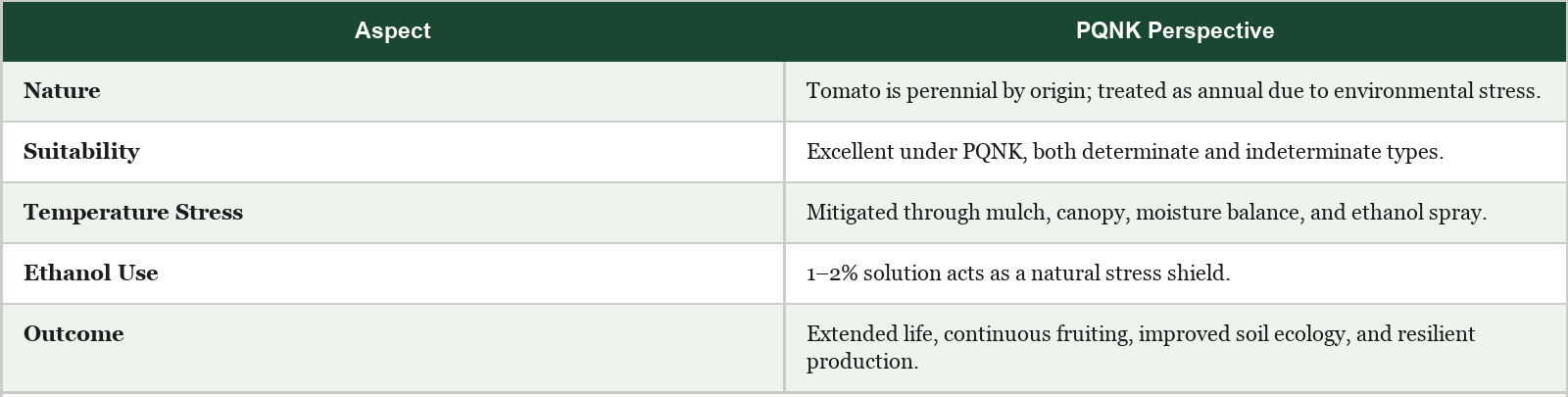
| Aspect | PQNK Perspective |
|---|---|
| Nature | Tomato is perennial by origin; treated as annual due to environmental stress. |
| Suitability | Excellent under PQNK, both determinate and indeterminate types. |
| Temperature Stress | Mitigated through mulch, canopy, moisture balance, and ethanol spray. |
| Ethanol Use | 1–2% solution acts as a natural stress shield. |
| Outcome | Extended life, continuous fruiting, improved soil ecology, and resilient production. |
In essence, the PQNK system reclaims tomato’s natural perennial behavior by restoring the original ecological conditions under which it evolved — living soil, stable microclimate, and natural biochemical protection rather than synthetic inputs. Footnote: Any Production Process That Inundates Soil With Water, Disturbs Soil Through Tillage, Or Leaves Soil Bare Without Organic Mulch Cover Does Not Qualify As Natural Ecosystem Science For Production Agriculture.
PQNK, to be pronounced as 'picnic', which stands for Paedar Qudratti Nizam Kashatqari, and means: the regenerative & sustainable Pristine Organic Farming System
About This Paper
- Crop
- Tomato · Basil · Lettuce · Maize (Corn) · Sunflower · Pigeon Pea
- Problem
- Heat Stress on Crop · Cold / Frost Damage · Long Time-to-Production / Multi-Year Maintenance · Post-Harvest Loss / Spoilage
- Science
- Plants · Climate · Production Architecture · Food Quality
- Evidence
- Scientific Mechanism
- Authority
- Current / Approved PQNK Knowledge
Related PQNK Science
Key Takeaways
- Tomato is biologically perennial, originating in the mild tropical highlands of South America; it is only grown as an annual elsewhere due to temperature extremes and pest buildup.
- Under PQNK's raised-bed, mulch, and living-soil system, indeterminate varieties can express genuine multi-year perennial fruiting, with determinate types manageable across 2-3 cycles.
- A 1-2% food-grade ethanol foliar spray, applied every 7-10 days during stress periods, triggers heat-shock proteins that help the plant tolerate both heat above 35°C and cold below 10°C.
- The sucker-pruning protocol removes shoots below the first fruit cluster to establish a strong central leader, while allowing select suckers above it to become additional main stems.
- Companion planting with basil and using indeterminate tomato as a living trellis for shade-loving lettuce are treated as synergistic, not merely space-saving.
- Post-harvest, tomatoes should never be refrigerated below 10°C; ambient, stem-end-up storage after prompt field-heat removal preserves flavor and extends shelf life.
Related Knowledge
same problem
Watermelon Cultivation Under the Paedar Qudratti Nizam Kashatqari (PQNK): A Guideline Based on Practical Field Observations
PQNK watermelon takes 90-100 days to mature instead of 70 under chemical systems, not a delay but evidence of the plant building a real root-microbiome partnership first. This guideline works through frost protection, vine training, tip-cutting after fruit set, shade-based shrinkage prevention, and a cold-water field-heat removal protocol that holds fruit quality for 10-14 days.
same problem
Advisory for One Acre Prosperity (OAP) in Vegetable Production: A PQNK Guide for the Smallholder
A hands-on smallholder guide built around one core discipline, using every square inch of soil for every passing minute of the year, that details a specific 36-block nursery system for raising transplants without seed waste or transplant shock, alongside a homemade 'dribble board' tool for direct seeding through mulch.
same problem
Watermelon Cultivation: Pruning, Irrigation, and Trellis Q&A
A farmer's detailed field questions on watermelon pruning ratios, shading with corn, trellis design, plant spacing, and irrigation timing, answered against PQNK's water-mineral and moisture-gradient principles.
same problem
PQNK (Pristine Organic Farming) Guide to Wheat Cultivation
A practical farmer Q&A covering seed preparation, an intercropped bed layout combining wheat with corn (for shade), peas, and radish, a three-stage pruning schedule tracked by tiller counts, and irrigation and harvest timing, distinct from PQNK's economics- and lifespan-focused wheat papers in that it is a field-operations manual for bed design and day-to-day management.