

KP-141 · Crop-Specific Guides
The PQNK Strawberry Production System: Achieving Commercial Abundance Through Ecosystem Logic
A full production system for open-field commercial strawberries under PQNK, covering ultra-high-density planting (19,600 plants/acre, nearly double the conventional standard), a mulch-hydration system that eliminates irrigation, a three-layer pest defense, and a post-harvest cold-chain protocol, plus a winter-crop rotation that keeps the same permanent bed productive year-round.
Read or listen to the full paper ↓Abstract
The paper frames conventional strawberry farming, plastic mulch, tillage, and chemical dependency, as creating an 'electrically positive' root zone: tillage burns off the soil organic matter that gives soil its negative-charge cation exchange capacity (CEC), while plastic mulch's anaerobic conditions force microbes to strip oxygen from soil minerals, flooding the soil with positively charged ions that displace the nutrient cations plants actually need. The result is a dead, imbalanced soil that forces continuous chemical intervention and caps conventional density around 10,000 plants/acre.
PQNK's alternative is a permanent raised bed built from layered carbon residues and soil, capped with thick organic mulch that functions as a moisture-trapping vault, capturing rainwater, harvesting atmospheric dew, and eliminating evaporative loss, providing full year-round hydration without irrigation (with a strict furrow-flood limit of 50% furrow height applied only during extreme heat). On this foundation, the bed is planted at ultra-high density: a 42-inch bed top carries 3 rows (1 center, 2 side rows 16 inches out, leaving a 5-inch buffer from the furrow edge) at 16-inch in-row spacing, giving roughly 19,600 plants per acre, nearly double the conventional standard, with 18-inch furrows left for picking access.
Managed as perennials rather than annuals, day-neutral varieties planted in early autumn begin flowering in February and fruit continuously through the end of October, targeting 6,000-10,000 kg/acre and consistently reaching 12-14° Brix against a 10° premium benchmark, aided by a stable 13-26°C root zone and 30:70 moisture-to-air soil ratio maintained by the mulch. After the strawberry season ends, fast-maturing winter crops (radish, baby carrots, green beans, spinach, green onions, garlic greens) are sown directly into the mulch between dormant plants, generating additional income, keeping the soil ecosystem active, and eliminating the cost of annual replanting entirely.
Pest and disease resistance operates in three layers: soil moisture management that keeps the bed aerated enough to exclude anaerobic pathogens like blight and fungus; internal biological defense via Bacillus thuringiensis absorbed from the soil into plant tissue; and external predator defense from the undisturbed mulched habitat, which supports ants, spiders, ladybugs, and ground beetles. Post-harvest protocol is equally specific: pick only fully red berries in the cool morning or evening by snapping the stem a quarter-inch above the cap (never pulling the fruit), then forced-air cool to 1-2°C immediately, grade by size and color, package in vented containers, and hold the cold chain at 1-2°C and 90-95% relative humidity through transport.
An included farmer Q&A annex reframes plant management around this same abundance logic: strategic removal of older, less-efficient lower leaves redirects energy into fruiting rather than maintenance; runners are consistently removed on production plants so all energy converts to marketable fruit; and after several years, crowded colonies are divided rather than replanted, since a PQNK strawberry bed has no fixed plantation lifespan and is treated as a permanent, self-renewing feature of the farm.
Revision R1 (28 September 2026): the ethanol foliar-spray strength has been standardised across Pedaver material at 1-2% food-grade ethanol in clean water (about 10-20 ml per litre), used against ambient heat or cold stress and sprayed in the cooler part of the day; stronger solutions can scorch leaves. The PDF opens with a revision note; the original text follows unchanged.
Full Paper
If you use “Listen”, the text of the page may be sent to your browser or operating system’s speech provider, such as Apple, Google or Microsoft, depending on the voice your device uses. Pedaver does not process, transmit or store any audio.
The PQNK Knowledge Paper: A Regenerative System for Open Field Commercial Strawberry Production
The PQNK Strawberry Production System: Achieving Commercial Abundance Through Ecosystem Logic
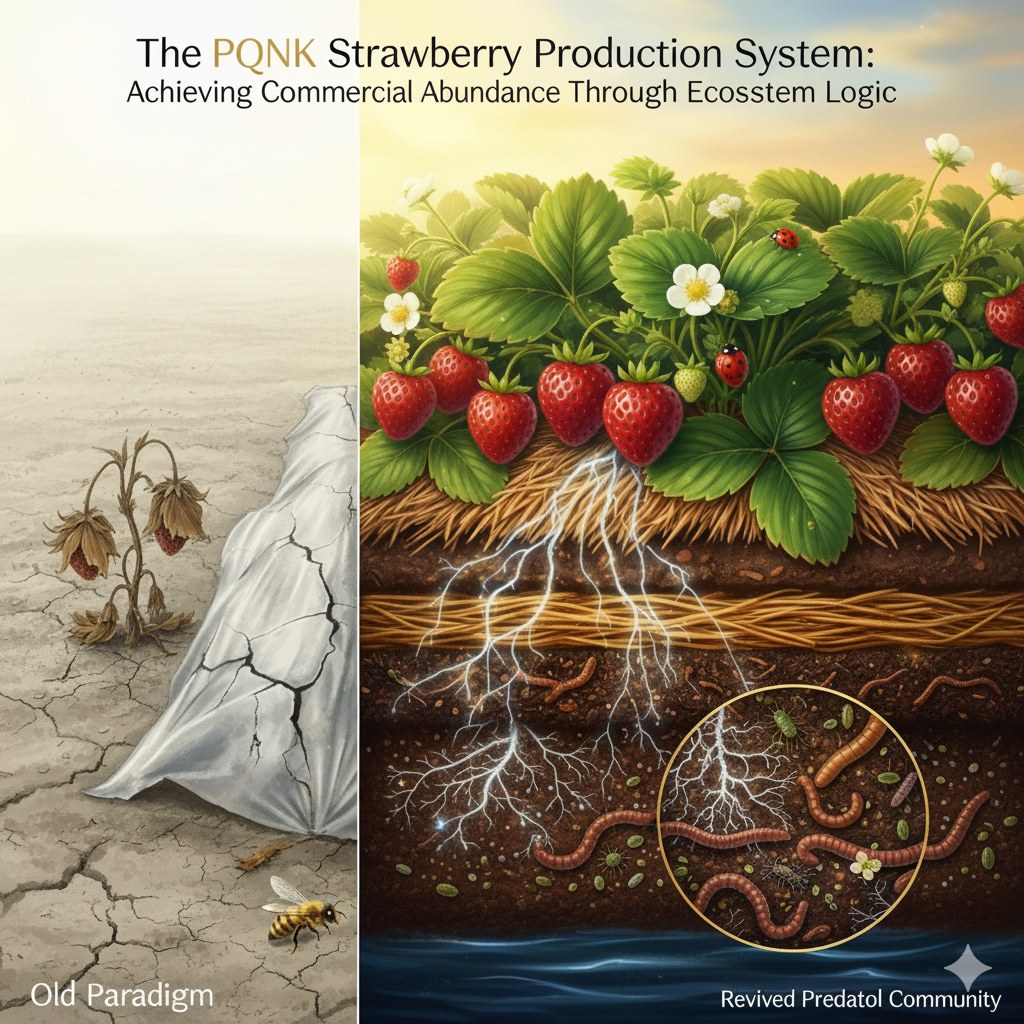
Executive Summary: This paper presents a definitive break from the Ancient Conventional Industrial (ACI) model of strawberry farming, which is degenerative and reliant on external inputs. The Paedar Qudratti Nizam Kashatqari (PQNK) System provides a regenerative framework based on ecosystem principles. By creating a self-sustaining raised bed environment, we enable ultra-high-density planting (19,600 plants/acre) of perennial strawberries that thrive without irrigation, fertilizer, or pesticides. This results in an extended harvest of premium-quality berries from February through October. The system is further enhanced by integrating valuable winter crops on the same beds, creating a continuous, highly profitable production cycle that eliminates annual replanting and establishes a truly sustainable farming enterprise.
1. The Critical Failure of the Ancient Conventional Industrial Model
The conventional method is fundamentally flawed and anti-life. Its core practices create a cycle of destruction:
Plastic Mulch & Tillage: Creates a compacted, anaerobic, and electrically positive root zone, locking up soil minerals and suffocating microbial life. Scientific Explanation: The "Electrically Positive Root Zone"
Healthy soil acts like a magnet with a negative charge, known as the Cation Exchange Capacity (CEC). This negative charge holds onto essential, positively charged nutrient ions (cations) like Potassium (K⁺), Calcium (Ca²⁺), and Magnesium (Mg²⁺), making them available to plants.
Tillage burns up soil organic matter, which is the primary source of this negative charge, effectively weakening the soil's "magnet."
Plastic Mulch creates anaerobic (oxygen-free) conditions. In this environment, soil microbes are forced to strip oxygen from soil minerals like Iron and Manganese, releasing a flood of their positively charged ions (Fe²⁺, Mn²⁺) into the soil.
The result is a double disaster: the soil's ability to hold nutrients (CEC) is reduced, while it is simultaneously flooded with "junk" positive charges. These junk cations overwhelm the system, kicking the essential nutrient cations off the exchange sites and locking them up in forms plants cannot use. This is the "electrically positive" state—a soil that has lost its ability to feed plants.
Chemical Dependency: The dead and imbalanced soil forces the farmer to act as a constant intervenor, using inundation (flood, furrow or drip irrigation), force-feeding (synthetic fertilizers), and poisoning (pesticides/fungicides).
The Result: Stressed plants, low yields (~10,000 plants/acre), and poor-quality fruit that is often sour and chemically contaminated.
2. The PQNK Foundation: Engineering the Living Production System
The cornerstone is the PQNK Raised Bed, a meticulously constructed biological engine.
Construction: Built with layers of carbon (crop residues), and soil, capped with a thick, permanent organic mulch.
The Mulch-Hydration System: The mulch layer is the primary technology. It acts as a "moisture-trapping vault" by:
Capturing and retaining rainwater.
Harvesting atmospheric dew.
Eliminating evaporative loss.
This provides complete hydration for year-round production without irrigation.
Protocol for Extreme Heat: If required, water is applied slowly through the furrows, with a strict limit that the water level must not rise above 50% of the furrow's height. This prevents root zone inundation and saturation.
3. Ultra-High-Density Planting & Bed Architecture
PQNK optimizes space and root zone aeration for maximum yield.
Bed Specifications: 42-inch wide bed top.
Planting Configuration: Three rows per bed.
One center row.
Two side rows, 16 inches from the center row.
This leaves a 5-inch buffer from the bed's edge, protecting roots from saturated furrow soil.
Spacing & Population:
In-Row Spacing: 16 inches between plants.
Plant Density: Each plant occupies a 16" x 16" area (256 sq. inches).
Total Population: Approximately 19,600 plants per acre (nearly double the conventional standard).
Operational Advantage: 18-inch furrows provide ample space for labour to pick fruit without damaging plants or compacting soil.
4. The Self-Feeding System: Microbes as the Miner and Chef
In the aerated, moist, carbon-rich PQNK bed, a thriving microbial network emerges.
Function: These microbes digest the organic mulch and unlock the abundant minerals from the soil's geological matrix.
Result: They produce a perfectly balanced, liquid "soil gut juice" that is the plant's sole nutrients source. The plant, through root exudates, requests specific nutrients. The concept of external fertilization is obsolete.
5. Circular Production, Seasonality, and Climate Resilience
PQNK creates a stable below-ground environment that buffers plants against climate extremes.
Ideal Root Zone: The mulch maintains soil temperature between 13°C to 26°C (55°F to 79°F) and an optimal soil moisture-air ratio of 30% water to 70% air.
Planting & Perennial Cycle: Plant in early autumn to establish strong roots. Strawberries are managed as perennials, producing for multiple years.
Extended Fruiting: Day-neutral varieties begin flowering in February and continue fruiting until the end of October.
Heat Stress Management: A foliar spray of a 2% ethanol-water mixture can be used during extreme heat to boost plant resistance.
International Benchmarks:
Yield: Target 6,000 to 10,000 kg per per acre for day-neutral varieties.
Quality (Brix): PQNK berries consistently achieve 12°-14° Brix, far exceeding the premium benchmark of 10°.
6. The Perennial Cycle & Integrated Winter Cropping
This is a key economic innovation, maximizing land use and income.
Winter Crop Integration: After the strawberry season ends in late October, sow winter crops directly into the mulch between the dormant strawberry plants.
Crop Selection: Choose fast-maturing crops that can be harvested by late January.
Examples: Radishes (multiple harvests), baby carrots, green beans, spinach, green onions, and garlic for green bunches.
Benefits:
Generates additional winter income.
Keeps the soil ecosystem active and fed.
Eliminates the cost and labour of annual strawberry replanting.
7. Achieving Total Plant Health and Pest Immunity
Pests and diseases are symptoms of ecosystem imbalance. PQNK creates a resilient system through a three-layered defense:
Layer 1: Soil Moisture Management (SMM): The bed's design maintains perfect aeration, creating an environment where anaerobic pathogens like blight and fungus cannot survive.
Layer 2: Internal Biological Defense: Beneficial bacteria (e.g., Bacillus thuringiensis) from the soil are absorbed by the roots. When pests chew the leaves, these bacterial proteins act as an internal, non-toxic insecticide.
Layer 3: External Predator Defense: The mulched, undisturbed habitat revives a robust community of predators (ants, spiders, ladybugs, ground beetles) that naturally control pest populations. Natural habitat also provides an environment that invites insects eating flies and birds.
8. Harvest and Post-Harvest Protocol for Premium Quality
Field quality must be preserved to capture maximum value.
Training Labour for Picking:
When: Harvest during the coolest parts of the day (early morning/late evening).
How: Train pickers to:
Pick only fully red berries.
Use the thumbnail to snap the stem ¼ inch from the cap; never pull the fruit.
Handle berries only by the stem and cap.
Pick directly into final containers to minimize handling.
Removing Field Heat (Critical):
Forced-Air Cooling: Immediately move fruit to a packhouse and use forced-air cooling to rapidly bring the core temperature down to 1-2°C (34-36°F). This is essential for preserving shelf-life.
Sorting, Grading, and Packaging:
Remove damaged fruit.
Grade by size and color for premium pricing.
Package in shallow, vented containers (e.g., 250g/500g clamshells).
Cold Chain:
Store and transport berries at 1-2°C (34-36°F) and 90-95% relative humidity.
9. Expected Outcomes and Economic Rationale
The PQNK model transforms farm economics.
Higher Revenue: Nearly double the plant population, an extended harvest season, premium-quality fruit, and additional winter crop income.
Drastically Lower Costs: Near-zero expenditure on irrigation, fertilizer, and pesticides after initial bed establishment.
Net Result: Unparalleled profitability and a farm that becomes an appreciating, self-renewing biological asset.
Conclusion: The Paradigm Shift
The PQNK System is the logical future of agriculture. It moves the farmer from the role of a combatant against nature to the empowered role of an ecosystem architect. By implementing this system, you are not just growing strawberries; you are cultivating a pristine, productive ecosystem where continuous abundance is the inherent, automatic outcome.
—————————
Footnote: Any Production Process That Inundates Soil With Water, Disturbs Soil Through Tillage, Or Leaves Soil Bare Without Organic Mulch Cover Does Not Qualify As Natural Ecosystem Science For Production Agriculture.
PQNK, to be pronounced as 'picnic', which stands for Paedar Qudratti Nizam Kashatqari, and means: the regenerative & sustainable Pristine Organic Farming System.
www.Facebook.Com/Pedaver
https://www.youtube.com/@pedaverpqnk3167/videos
pedaver@gmail.com
WhatsApp +92 320 677 6666
Annex A: Farmer Q&A – Practical Implementation of the PQNK Strawberry System
This document provides the definitive operational logic for strawberry production within the Paedar Qudratti Nizam Kashatqari. It describes the management of a self-sustaining perennial ecosystem.
Question 1: What is the yield paradigm in the PQNK system?
PQNK Answer: The conventional model measures yield as a short-term, weight-based output from a chemically forced plant in a dead medium. This is a metric of extraction and exploitation.
The PQNK system redefines yield as the continuous, high-quality fruiting expression of a perennial ecosystem. We measure success in premium quality and perpetual harvests, not grams per season.
The Process:
A runner planted in a mature PQNK bed in Oct-Nov is immediately integrated into a living soil food web. It does not "establish"; it inherits a fully functional root system via mycorrhizal and bacterial networks.
By February, the plant is a robust, mature component of the ecosystem, ready for its reproductive cycle.
The constant, balanced nutrient stream from microbial activity and ideal soil moisture means the plant is never "exhausted" by fruiting. It exists in a state of continuous, balanced energy intake and output.
Yield is therefore not an event, but a permanent state of the system. The farmer's role is to maintain the conditions for this state.
Question 2: What is the PQNK logic for pruning and plant management?
PQNK Answer: PQNK management is the intelligent channeling of the ecosystem's abundant energy flow.
Strategic Leaf Pruning: Optimizing the Energy Sink.
The living soil provides a constant, abundant stream of nutrients and water. The limiting factor is not energy availability, but its efficient use by the plant.
Older, lower leaves become less efficient and act as energy sinks for maintenance.
By strategically removing these older leaves, we reduce vegetative maintenance costs. This forces the abundant energy from the root system to be directed with greater intensity into flowering, fruit development, and increasing Brix and nutrient density.
This is the opposite of a scarcity-driven practice; it is an abundance-driven optimization.
Runner Management: Focusing the System's Output.
A runner is a vegetative diversion of the ecosystem's energy away from its primary purpose: fruit production.
The consistent removal of all runners on production plants ensures that 100% of the solar energy and soil-derived nutrients are converted into marketable fruit. It is a non-negotiable practice for maximizing the economic output of the ecosystem.
Crown Division: Ecosystem Renewal, Not Replanting.
After several years of vigorous growth, a single plant becomes a colony. The center may become crowded.
PQNK practice is to divide this colony into several vigorous sections. This is not replanting. It is the managed vegetative renewal of a perennial organism within its home ecosystem. The life of the plant, and its production cycle, continues uninterrupted.
Question 3: How does PQNK achieve self-sufficiency in plant material?
PQNK Answer: Dependence on external inputs is a failure of the industrial model. PQNK is a closed-loop, self-reliant system.
Selection: The most vigorous and productive plants in your ecosystem are designated as Mother Plants. Their genetic superiority is proven in your specific PQNK conditions.
Native Propagation:
Runners from Mother Plants are guided to root in small pots filled with medium from your own PQNK beds.
This creates new plants that are pre-inoculated with your farm's specific microbial life and genetically adapted to thrive in it. They are not foreign transplants; they are native offspring of your ecosystem.
This ensures 100% self-sufficiency, genetic resilience, and eliminates the risk of introducing external diseases.
Question 4: What is the lifespan of a PQNK strawberry plantation?
PQNK Answer: In the PQNK system, the concept of a plantation "lifespan" is obsolete. This is a concept from a degenerative system where soil death and pest accumulation force a reset.
A PQNK bed is a permanent, fruit-producing ecosystem. The strawberry plant, as a perennial herb, has no biological clock that dictates its death in a healthy environment. The only limit is the health of the ecosystem itself, which is actively maintained and enhanced by the farmer through the permanent mulch layer and the absence of tillage and chemicals.
The PQNK strawberry bed is a permanent feature of the farm, like a forest. We do not "replant"; we steward and renew.Verified & Enhanced Variety Recommendations for PQNK Strawberry Production
The selection of a strawberry variety is a critical strategic decision. In the PQNK system, the goal is to leverage the extended, stable growing season to maximize the potential of high-quality, resilient cultivars. The following verified recommendations are categorized by their bearing habit and optimal use-case.
Key Selection Criteria for PQNK:
Flavor & Brix: Paramount for the premium, direct-to-consumer market PQNK enables.
Firmness & Shelf-life: Essential for reducing post-harvest losses.
Heat & Disease Tolerance: Crucial for withstanding local climate stresses with minimal intervention.
Day-Neutral Habit: Ideally suited for the PQNK system's goal of a February-to-October harvest window.
1. Day-Neutral / Everbearing Varieties (Recommended for PQNK System)
These varieties are the top recommendation for PQNK as they fruit continuously throughout the long season, providing a steady, high-quality yield.
Albion
Verified Traits: Firm, conical fruit with very good flavor and high sugar content (Brix). It is known for its resistance to soil-borne diseases like Phytophthora cactorum and moderate resistance to anthracnose.
PQNK Fit: Excellent. Its firmness ensures long shelf-life, and its disease resistance aligns with the PQNK goal of a healthy ecosystem. Ideal for both fresh market and extended harvests in open-field or protected culture.
Source Verification: American Society for Horticultural Science (ASHS), University of California Cooperative Extension.
Seascape
Verified Traits: Produces large, glossy, and flavorful berries. It is notably tolerant to early summer heat and produces well in areas with limited winter chilling.
PQNK Fit: Very High. Its heat tolerance is a significant advantage, and its large, attractive fruit commands a premium in fresh markets. Perfect for ensuring production continues as temperatures rise.
Source Verification: University of California Strawberry Breeding Program, StrawberryPlants.org.
Monterey
Verified Traits: A day-neutral variety known for very large, firm fruit and high yields, often considered a sibling to Albion. It can be more productive than Albion in some conditions but may be slightly less firm.
PQNK Fit: Excellent for fresh market due to fruit size and yield potential.
Source Verification: University of California Cooperative Extension.
San Andreas
Verified Traits: Similar to Albion but often with better fruit color and firmness. It shows good resistance to Verticillium wilt and Phytophthora cactorum.
PQNK Fit: An excellent alternative to Albion, particularly valued for its firmness and bright color.
Source Verification: University of California Strawberry Breeding Program.
2. Short-Day (June-Bearing) Varieties
These produce a single, large crop over a 3-4 week period. They can be integrated for a massive early-season yield but do not align with the PQNK model of continuous production as effectively.
Camarosa
Verified Traits: An early-season short-day variety that sets the standard for early yield, fruit size, and firmness. It is the workhorse of commercial plasticulture systems worldwide.
PQNK Fit: Good if a large, early market glut is the goal. However, its season is short compared to day-neutrals. Its robust nature and transportability are major assets.
Source Verification: University of California, Lassen Canyon Nursery.
Chandler
Verified Traits: A dominant short-day variety known for its excellent flavor, deep red color, and high yield. It is less firm than Camarosa and has a slightly later season.
PQNK Fit: Excellent for flavor-focused fresh markets, but its shorter harvest window and softer fruit are considerations.
Source Verification: SmallFruits.org, NC State Extension.
Critical Advisory on Sourcing for PQNK Success
The note on local sourcing is critically important and must be followed rigorously.
Verify Authenticity: Purchase only from reputable, certified nurseries. Using mislabeled or off-type varieties can lead to complete crop failure.
Disease-Free Status: Insist on virus-indexed, certified disease-free runners. Introducing soil-borne diseases like Verticillium wilt or viruses into your pristine PQNK beds is a catastrophic risk that can undermine the entire system.
Acclimatization: Before a full-scale planting, always purchase a small batch of runners first. Test their performance in your specific PQNK beds and local microclimate.
Local Supplier Note: The mention of Pakistani suppliers like bagh.pk and Pak Plants is a good starting point for local availability. However, their variety authenticity and phytosanitary standards must be verified directly with them before purchase.
Final PQNK Recommendation: For a system designed around perpetual, high-quality production, prioritize day-neutral varieties like Albion, Seascape, and San Andreas. Their long harvest season, combined with the ideal root zone environment of a PQNK bed, will deliver the highest economic return and best align with the principles of a sustainable, pristine organic system.
About This Paper
- Crop
- Strawberry · Radish · Carrot · Common Bean · Spinach · Onion · Garlic
- Problem
- Suboptimal Planting Density · High Irrigation Cost / Dependency · General Pest Pressure · Post-Harvest Loss / Spoilage · Idle / Underused Field Time
- Science
- Soil · Water · Biodiversity · Crop Protection · Food Quality · Production Architecture
- Evidence
- Scientific Mechanism
- Authority
- Current / Approved PQNK Knowledge
Related PQNK Science
Key Takeaways
- Ultra-high-density planting reaches roughly 19,600 plants/acre (42-inch bed, 3 rows, 16in x 16in spacing), nearly double the conventional ~10,000 plants/acre standard.
- The mulch-hydration system provides year-round production without irrigation under normal conditions; in extreme heat, furrow water is capped at 50% of furrow height to prevent root-zone saturation.
- Day-neutral varieties fruit continuously February through October, targeting 6,000-10,000 kg/acre at 12-14° Brix against a 10° premium benchmark.
- Three-layer pest defense: soil moisture management (excludes anaerobic pathogens), internal Bacillus thuringiensis uptake from soil, and external predator habitat (ants, spiders, ladybugs, ground beetles).
- Winter crops (radish, baby carrots, beans, spinach, green onions, garlic greens) are sown into the same mulch between dormant plants, adding income while eliminating annual replanting.
- Post-harvest protocol calls for forced-air cooling to 1-2°C immediately after picking and a cold chain held at 1-2°C / 90-95% relative humidity through storage and transport.
Related Crops
Related Knowledge
same problem
Advisory for One Acre Prosperity (OAP) in Vegetable Production: A PQNK Guide for the Smallholder
A hands-on smallholder guide built around one core discipline, using every square inch of soil for every passing minute of the year, that details a specific 36-block nursery system for raising transplants without seed waste or transplant shock, alongside a homemade 'dribble board' tool for direct seeding through mulch.
same problem
Transforming Garlic and Onion Cultivation through the PQNK Regenerative System
Garlic and onion farming has been squeezed by rising labour costs and heavy agrochemical reliance, pushing countries toward import dependence. This paper shows how PQNK's raised-bed geometry and mulch management quadruple planting density and let farmers reach up to 300 maunds per acre without synthetic inputs.
same crop
The PQNK Kitchen Garden: A Regenerative Ecosystem for Household Abundance and Sovereignty
A compact guidebook applying PQNK principles to household-scale food production, showing how a single 4-foot by 20-foot bed, planned like a household budget around daily, weekly, and seasonal produce needs, can supply the bulk of fresh vegetables for a family of ten, with a parallel rooftop/container method built around a novel underground 'soil life conduit.'
same problem
Soil Moisture Management in PQNK Organic Farming: The 30/70 Rule
Explains PQNK's core moisture condition, roughly 30% water-filled and 70% air-filled soil pore space, as the sustained balance of a healthy, functioning PQNK soil, and the yield, input-cost, and produce-quality consequences of over-irrigating past it.