

KP-088 · PQNK Philosophy, Framework & Economics
PQNK Foundational Document, Topic 2: The Bio-Energetic Valuation Framework — Replacing Commodity Mass with Metabolic Currency
This paper proposes replacing weight-based food pricing with a two-part scoring system, a P.A.Y. score measuring a food's net usable cellular energy and an FSCS score certifying the health of the field that grew it, arguing this is the first economically honest price mechanism in agricultural history.
Read or listen to the full paper ↓Abstract
The paper opens by naming the prevailing food-pricing model a 'thermodynamic absurdity': valuing food by inert mass (kilograms, bushels) rewards volumetric bulk over biological intelligence, and it cites the well-documented 'dilution effect,' where higher yield through synthetic nitrogen and irrigation dilutes mineral and phytonutrient concentration, as proof that mass, nutrition, health, and sustainability are not the same variable, and that a valuation system built on mass alone will systematically reward degradation.
In place of mass, the paper proposes two pillars of valuation. The first, the Potential Adenosine Triphosphate Yield (P.A.Y.), is a proposed standardized laboratory assay estimating a food's net ATP-generating capacity in human mitochondria, incorporating macronutrient matrix quality (such as omega-3:6 ratio and resistant starch presence), micro-cofactor sufficiency (magnesium, B vitamins, antioxidants), and a 'toxic load discount' for pesticide residue or heavy metals that force costly detoxification. On a proposed 50-100 scale, industrially produced food is estimated at 50-60 and PQNK-grown food at 85-100.
The second pillar, the Farm System Coherence Score (FSCS), certifies the provenance of that potential by converting the five field-coherence expressions defined in the companion Topic 1 document (photonic expression, myco-electrical conductivity, VOC profile complexity, trophic response ratio, and water structure penetration rate) into a continuous, sensor-derived 0-100 score, logged immutably per harvest batch, with scores above 85 indicating a highly coherent, self-regulating field.
These combine into a proposed pricing formula, price equals base production cost (weighted by a Livelihood Index ensuring dignified farmer income) plus a P.A.Y. premium (converted to a 'biological kilowatt-hour' equivalent) plus an FSCS-linked Ecosystem Service Credit monetizing verified carbon sequestration, water-cycle enhancement, and biodiversity habitat value, illustrated with a sample consumer label showing a P.A.Y. of 91, an FSCS of 88, and specific sequestration and water-recharge figures per batch. The paper sketches market applications including hospital procurement based on minimum P.A.Y. thresholds and school lunch programs sourcing on FSCS minimums.
The paper closes by framing this as economics catching up to ecology: Topic 1 defined the farm as a coherent organism, and this paper creates the market language allowing that organism to be paid fairly, shifting the operative consumer question from 'is this cheap?' to 'what is the energy and ecosystem return on my food expenditure?'
Full Paper
If you use “Listen”, the text of the page may be sent to your browser or operating system’s speech provider, such as Apple, Google or Microsoft, depending on the voice your device uses. Pedaver does not process, transmit or store any audio.
Title: The Bio-Energetic Valuation Framework: Replacing Commodity Mass with Metabolic Currency in the PQNK Economy
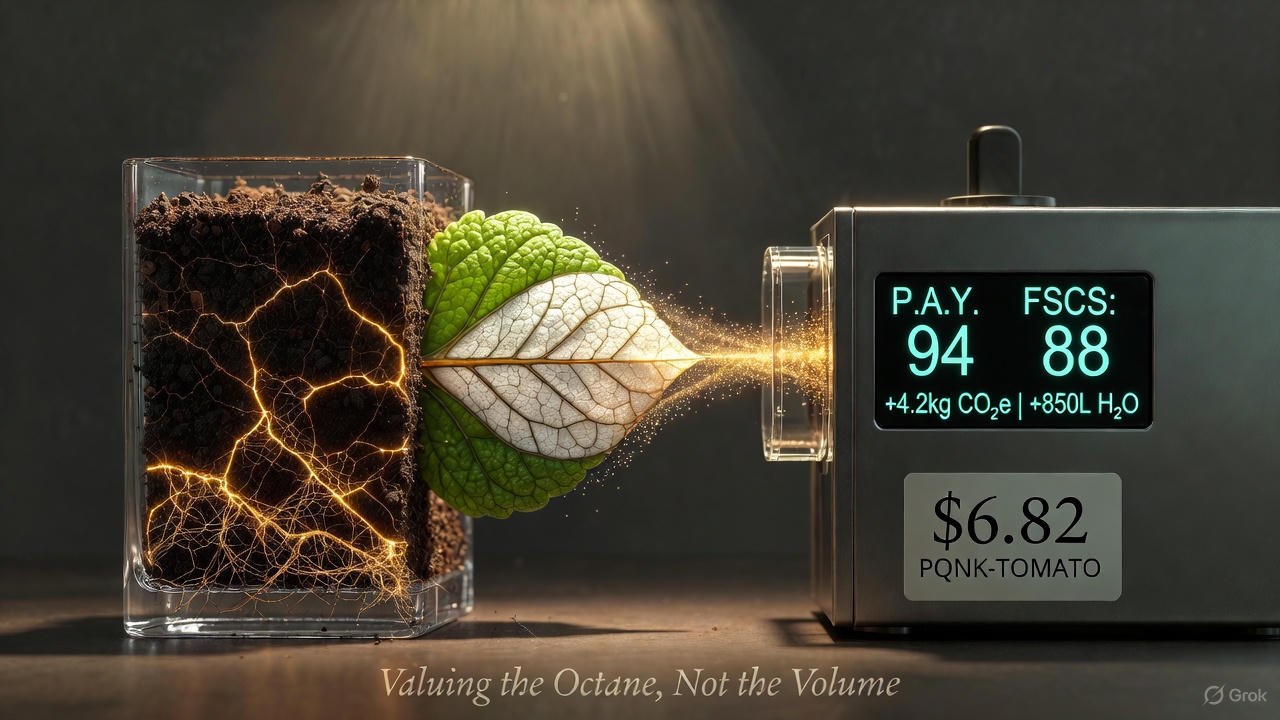
P.A.Y. FSCS
94 88
+4.2 kg CO₂e | +850 L H₂O
Preamble: The prevailing economic model for agriculture is a thermodynamic absurdity. It values food by the inert metric of mass (kilograms, bushels), incentivizing the production of volumetric bulk at the expense of biological intelligence and nutritional utility. This paper establishes the second pillar of Paedar Qudratti Nizam Kashatqari: a price mechanism derived from first principles of biology and physics. In PQNK, food is valued not as a commodity, but as a packaged energy and information output of a coherent biological field. We propose paying for the usable metabolic energy in food—its “biological octane”—and the verified ecosystem coherence that generated it.
I. The Thermodynamic Failure of Current Valuation
The industrial food system operates on a broken feedback loop. It rewards maximum biomass production per unit area/time, which inevitably leads to systemic degradation. This is because:
• Mass ≠ Nutrition: The Dilution Effect is well-documented: increasing yield through synthetic nitrogen and irrigation dilutes mineral and phytonutrient concentration.
• Mass ≠ Health: Caloric density (energy for storage as fat) is prioritized over mitochondrial utility (energy for cellular function and repair).
• Mass ≠ Sustainability: The economic drive for mass externalizes the true costs: soil depletion, water pollution, biodiversity loss, and human metabolic disease.
PQNK Axiom: The economic signal must reward the farmer for enhancing the quality of energy flow through the farm-human continuum, not for maximizing the stockpile of biomass.
II. The Two Pillars of Bio-Energetic Valuation
Valuation must shift from external, simple metrics to internal, complex ones that reflect the farm’s health as outlined in Topic 1. Pillar 1: The Potential Adenosine Triphosphate Yield (P.A.Y.) – The “Octane Rating” Adenosine Triphosphate (ATP) is the universal cellular energy currency. Food’s true value lies in its capacity to generate ATP in the human mitochondrion efficiently and without metabolic cost.
• The P.A.Y. Assay: A standardized laboratory biochemical protocol to estimate the net ATP-generating potential of a food sample. It factors in:
• Macronutrient Matrix Quality: Not just grams of fat, but the omega-3:6 ratio; not just grams of carbohydrate, but the presence of resistant starches and fiber modulating absorption.
• Micro-Cofactor Sufficiency: Concentration and bioavailability of magnesium (required for ATP synthesis), B vitamins (coenzymes in the Krebs cycle), and antioxidants (protecting mitochondrial membranes).
• Toxic Load Discount: Quantifiable presence of pesticide residues, heavy metals, or advanced glycation end-products (AGES) that create an “energy tax” by forcing detoxification pathways and causing oxidative damage.
• Implementation: A P.A.Y. score of 50–100. Industrially produced, nutrient-dilute, chemically-laden food would score 50–60. PQNK food from a coherent field would score 85–100. For example: “PQNK Kale – P.A.Y. 94”.
Pillar 2: The Farm System Coherence Score (FSCS) – The “Provenance of Coherence” The P.A.Y. of a food is a snapshot of its potential. The FSCS certifies the provenance of that potential—the health of the biological field that created it. It is a real-time, data-driven derivative of the five expressions from Topic 1.
• Calculation: An algorithm processes continuous sensor data:
• Photonic Expression Index: Spectral reflectance data.
• Myco-Electrical Conductivity: Soil sensor data on microbial/fungal activity.
• VOC Profile Complexity: Atmospheric sampling of canopy volatiles.
• Trophic Response Ratio: Insect camera trap data analyzing predator-prey arrival lags.
• Water Structure Penetration Rate: Infiltrometer and soil moisture tension data.
• Output: A dynamic score from 0–100. A score below 60 indicates a fragmented, mechanistic field. A score above 85 indicates a highly coherent, self-regulating field. This score is immutably logged for each harvest batch.
III. The Valuation Formula: Internalizing the Whole-System Dividend
The price of PQNK produce is not arbitrary. It is the sum of its measurable contributions to individual and planetary health.
Proposed Formula:
Price = (Base Production Cost × Livelihood Index) + (P.A.Y. Premium × kWh Equivalent) + (FSCS × Ecosystem Service Credit)
1. Base Production Cost × Livelihood Index:
• Covers the true cost of skilled human stewardship, not minimum wage. The Livelihood Index ensures the farmer’s income provides dignity, security, and the ability to invest in further coherence.
2. P.A.Y. Premium × kWh Equivalent:
• The Energy Transaction. The P.A.Y. score is converted to a “biological kilowatt-hour” equivalent. Research establishes that 1 unit of P.A.Y. correlates to X kJ of net usable human energy.
• Example: A food with P.A.Y. 90 provides more net usable energy per gram than a food with P.A.Y. 60. The consumer pays for this efficiency. They purchase energy yield, not mass.
3. FSCS × Ecosystem Service Credit:
• The Systems Health Dividend. The FSCS unlocks a monetization of verified ecosystem services. Each point on the FSCS scale corresponds to a quantifiable value:
• Carbon Sequestration: Verified tons of CO₂e stored in soil and perennial biomass.
• Water Cycle Enhancement: Gallons of water recharged and purified.
• Biodiversity Habitat Unit: A measure of supported species richness and complexity.
• This credit is purchased by consumers, corporations (for ESG compliance/offsets), or governments. It directly pays the farmer for being a steward of the commons.
IV. Implementation: The PQNK Market Interface & Visual Language
This valuation formula is operationalized through a transparent digital and physical market interface.
The Digital-Provenance Ledger:
Each batch of produce receives a digital twin on a transparent ledger. This twin contains the farm’s real-time FSCS data, third-party P.A.Y. certificate, and a breakdown of Ecosystem Service Credits.
The Consumer Interface – A Mandate for Clarity:
The visual representation of this framework is not mere decoration; it is a functional interface that must communicate scientific authority and conceptual clarity.
Consumer Facing Label (Digital & Physical):
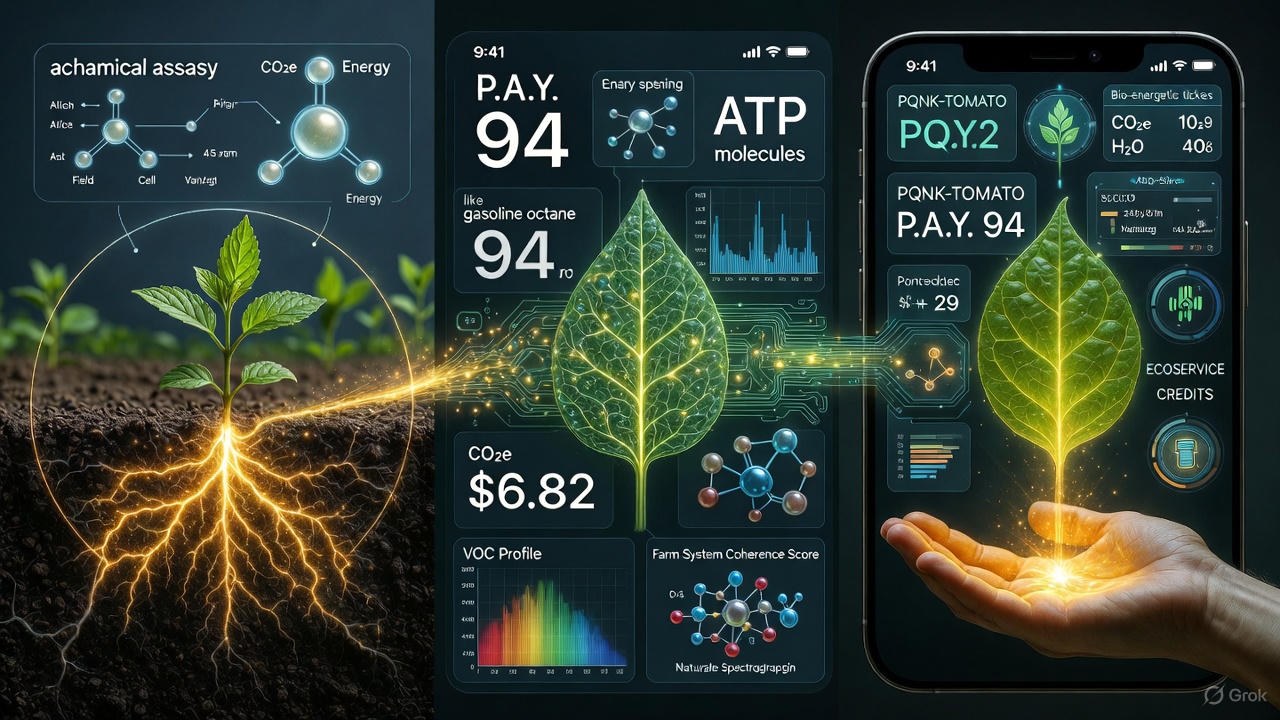
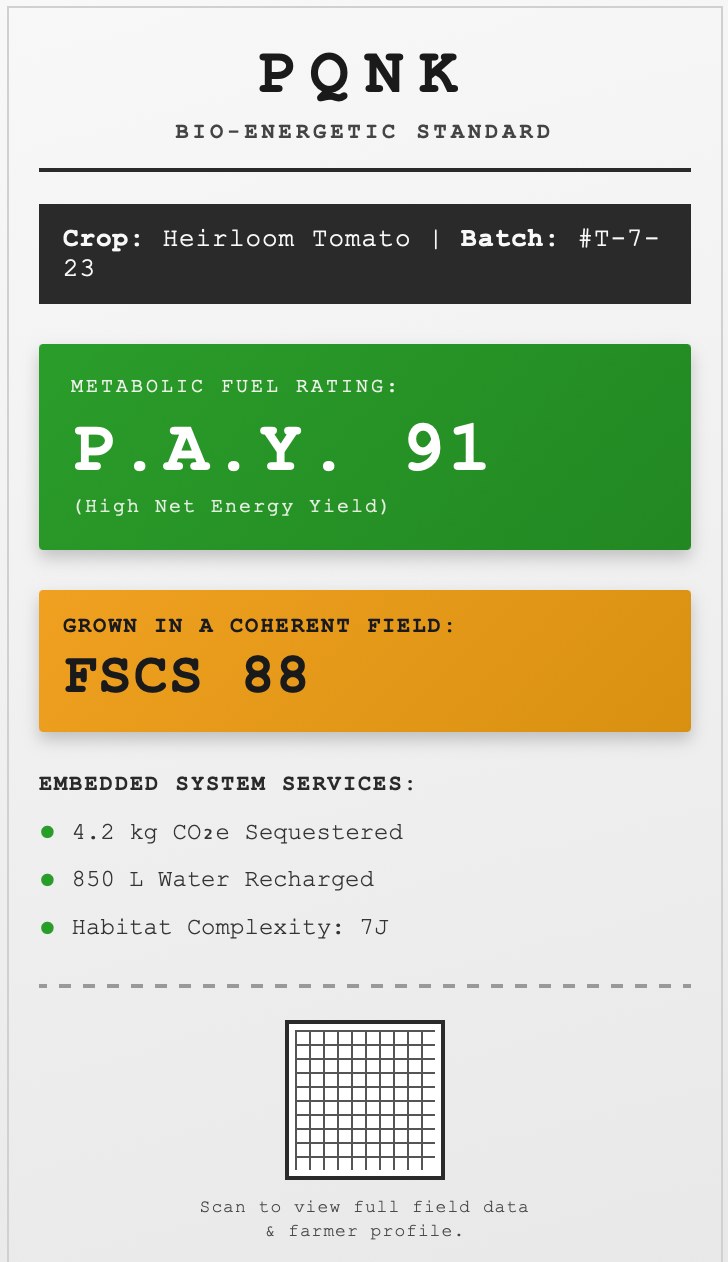
PQNK BIO-ENERGETIC STANDARD
Crop: Heirloom Tomato | Batch: #T-7-23 Metabolic Fuel Rating: P.A.Y. 91 (High Net Energy Yield) Grown in a Coherent Field: FSCS 88 Embedded System Services:
• 4.2 kg CO₂e Sequestered
• 850 L Water Recharged
• Habitat Complexity: 7J
Scan to view full field data & farmer profile.
Market Transformation:
• Hospitals: Procure for patients based on minimum P.A.Y. scores to accelerate healing.
• Athletic Programs: Specify P.A.Y. 90+ for optimal performance and recovery.
• Schools: Source FSCS 80+ food, using the lunch program to educate children on how their food choices support ecosystem and climate stability.
• Consumers: Shift from “Is this cheap?” to “What is the energy and ecosystem return on my food expenditure?”
V. Conclusion: Economics as an Expression of Ecology
The PQNK Bio-Energetic Valuation Framework completes the scientific paradigm. Topic 1 defined the farm as a coherent organism. Topic 2 creates the economic language that allows that organism to thrive in the human marketplace. This is not a “premium price.” It is the first honest price in the history of agriculture—one that accounts for the total flow of energy and value from a healthy biosphere to a healthy human cell. By valuing the octane over the volume, we align human economics with natural law. We create a market that pays farmers to generate health, not just harvests, and empowers consumers to invest in planetary vitality with every meal. This is the non-negotiable economic foundation for a sustainable future.
Next Steps for the Farmer
Begin documenting not just yield, but energy quality proxies: Brix levels, seed viability, post-harvest shelf life without refrigeration. These are early indicators of your farm’s P.A.Y. potential. Simultaneously, start recording simple coherence markers (earthworm counts, dawn bird diversity) to build your FSCS narrative. Your ledger begins now.
Footnote: Any Production Process That Inundates Soil With Water, Disturbs Soil Through Tillage, Or Leaves Soil Bare Without Organic Mulch Cover Does Not Qualify As Natural Ecosystem Science For Production Agriculture.
PQNK, to be pronounced as 'picnic', which stands for Paedar Qudratti Nizam Kashatqari, and means: the regenerative & sustainable Pristine Organic Farming System.
About This Paper
- Problem
- Price Volatility / Market Glut
- Science
- Nutrition · Food Quality · Economics
- Evidence
- Economic Model/Projection
- Authority
- Current / Approved PQNK Knowledge
Related PQNK Science
Key Takeaways
- Proposes replacing mass-based food pricing (kg, bushels) with a two-part scoring system, arguing mass-based pricing structurally rewards volumetric bulk over nutrition, citing the documented 'dilution effect' as evidence.
- Defines the P.A.Y. (Potential ATP Yield) score, a proposed lab assay estimating a food's net usable cellular energy, factoring in macronutrient quality, micro-cofactor sufficiency, and a 'toxic load discount' for residues.
- Defines the FSCS (Farm System Coherence Score), a sensor-derived 0-100 field-health score built from the five coherence indicators established in the companion Topic 1 paper.
- Proposes a pricing formula combining a livelihood-weighted base cost, a P.A.Y.-based energy premium, and an FSCS-linked ecosystem service credit for carbon, water, and biodiversity.
- Sketches a sample consumer-facing label (P.A.Y. 91, FSCS 88, specific CO2e and water figures) as the intended point-of-sale interface for the framework.
- Proposes institutional applications including hospital procurement on minimum P.A.Y. thresholds and school lunch sourcing on minimum FSCS scores.
Related Knowledge
same problem
Comprehensive Guide: High-Anthocyanin Black Carrot Under the PQNK Closed-Loop System
Written for a farmer under contract to supply anthocyanin for nutraceutical extraction, this guide explains the cold-stress biochemistry behind pigment concentration in black carrot and how PQNK's stable 13-26°C root zone lets a farmer trigger that stress deliberately, through timed irrigation intervals, cool nights, and a low-dose ethanol spray, without ever starving the plant.
same problem
How PQNK Delivers the Highest Nutrition at the Lowest Cost — and Why This Paradox Is Your Real Power
Answering a farmer's question about whether PQNK should adopt lab testing and certification, this advisory explains why nutrition and low cost rise together under PQNK rather than trading off, and proposes an outcome-based validation label and lab scorecard as the alternative to paperwork-heavy organic certification.
same problem
What Science Delivered: The Documented Balance Sheet of a Century of Input-Funded Agricultural Research
Prompted by an online dismissal of scientific consensus, this paper turns the same skepticism on a century of input-industry-funded agricultural research and totals its documented balance sheet across soil, water, climate, cost, yield, food quality, and smallholder viability, using named published sources throughout and flagging PQNK's own field data separately wherever it appears.
same problem
Commercial Advantages of PQNK Production: Why Biological Correctness Outperforms Industrial Efficiency
A supplementary business case arguing PQNK's commercial edge comes not from yield or scale but from structurally low cost of production, quality-driven demand, and continuous harvest cash flow, walking through eleven distinct commercial mechanisms from certification-free trust to appreciating soil as a farm asset.