

KP-096 · Nutrition & Food Quality
Scientific Parameters Behind Shelf Life, Pest Attraction & Deterioration — A Pristine PQNK Perspective
A rapid-fire Q&A that argues certified organic and conventional chemical farming are functionally the same input-dependent system wearing different labels, both producing produce that spoils faster and attracts more pests than PQNK, and works through eight specific farmer questions on the measurable biology behind shelf life, pest attraction, and seed lineage.
Read or listen to the full paper ↓Abstract
The paper opens with a deliberately sharp framing: Ancient Conventional Industrial (ACI) production and certified organic production are described as fundamentally similar systems, both input-dependent and human-managed in ways that disrupt the soil-plant-microbial continuum, differing only in whether the inputs are synthetic or 'organic' substitutes. PQNK is positioned as categorically different, a self-regulating, input-less system in which even irrigation is treated as an interruption to natural equilibrium.
On shelf life specifically, the paper attributes PQNK produce's storage advantage to four measurable factors: pristine cell architecture from unstressed lignification and balanced dry matter, a protective native microbiome coating derived from undisturbed soil, natural Brix and antioxidant sufficiency from demand-driven microbial nutrient release rather than forced feeding, and a lower post-harvest respiration rate from growth without stress or excess nitrogen, concluding that PQNK produce has the longest shelf life because it is closest to wild, evolutionary design.
On pest attraction, the paper argues both ACI and certified organic produce draw more pests because their fertilizers, organic or synthetic, elevate free amino acids and sugars in plant sap, while an incomplete soil food web leaves plants without induced systemic resistance or protective leaf-surface microflora; in PQNK, by contrast, pests are described as part of an ecological check-and-balance, with plants producing exactly the phytochemicals needed to deter excess pest activity while beneficial predators are preserved rather than eliminated.
Further answers address measurable internal plant immunity (terpene and phenol diversity, chitinase and glucanase activity, rhizosphere microbial diversity, and a stable, slightly acidic leaf surface pH, described as constitutive rather than input-induced in PQNK), a stated shelf-life hierarchy of PQNK-grown produce outperforming wild-adapted produce, which in turn outperforms certified organic and ACI roughly equally, and a contrast between desi seed saved from prior PQNK crops (co-evolved with local soil microbiome, generational adaptation improving storability) versus hybrid seed bred primarily for input-response and yield at the cost of defense compounds.
The paper closes by generalizing its answers into a broader claim: longer shelf life and lower pest pressure are emergent, non-engineered properties of minimal human interference rather than something achieved through any specific added treatment, and explicitly proposes reframing the usual 'organic vs. chemical' debate as 'PQNK vs. everything else.'
Full Paper
If you use “Listen”, the text of the page may be sent to your browser or operating system’s speech provider, such as Apple, Google or Microsoft, depending on the voice your device uses. Pedaver does not process, transmit or store any audio.
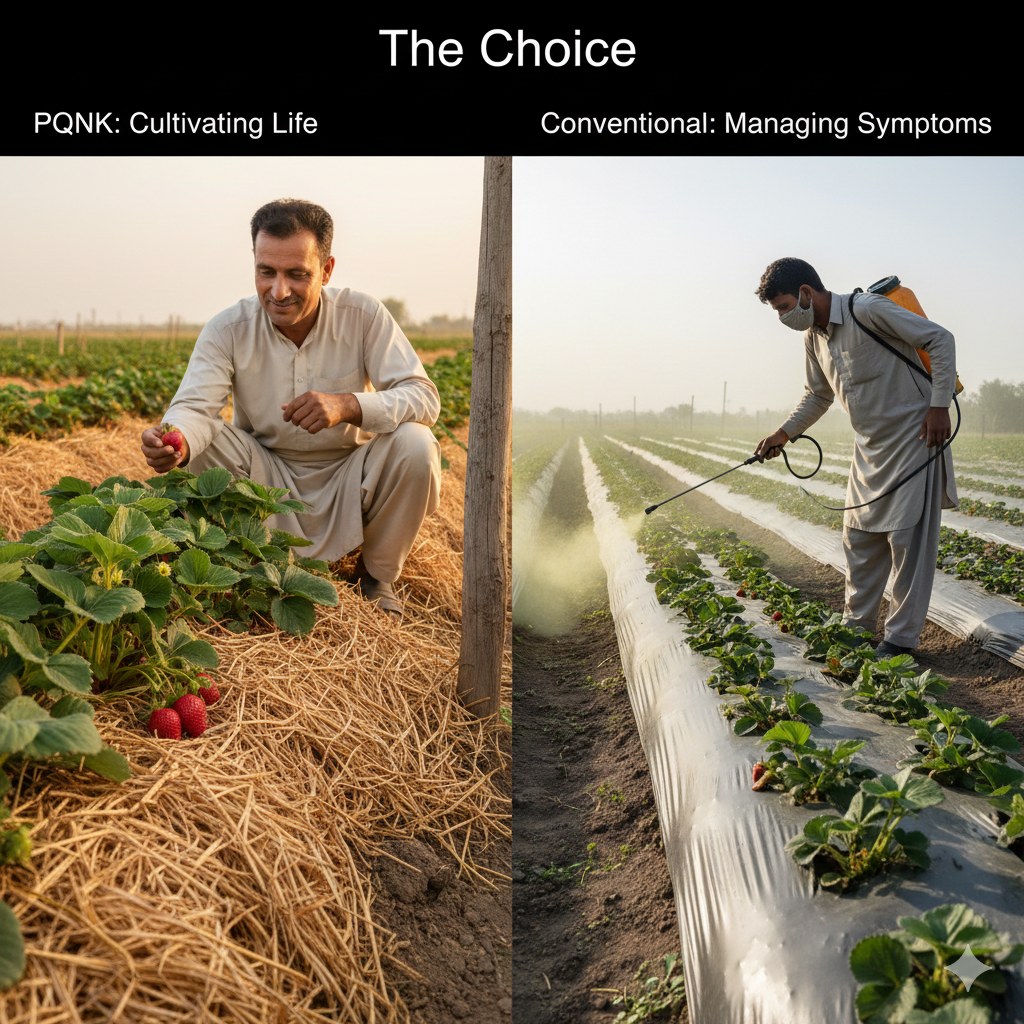
It is the process that matters most. PQNK is a pristine production system designed not merely for yield, but for optimal, balanced output—where quality, sustainability, and ecological harmony emerge from a self-regulated, zero-external-input methodology.
In light of our PQNK Knowledge Papers, the distinction becomes unequivocal. Ancient Conventional Industrial (ACI) and so-called "Certified Organic" production are fundamentally similar systems — both are input-dependent, human-managed interventions that disrupt the soil-plant-microbial continuum. The only difference is the source of inputs (synthetic vs. "organic" substitutes).
PQNK (Paedar Qudratti Nizam Kashatqari), however, is a self-regulating, input-less, pristine system where crops are grown strictly by leveraging in-situ ecological intelligence — no external inputs, not even irrigation, which is viewed as an interruption to natural equilibrium.
Below are the answers to the farmer’s questions, strictly through the PQNK lens:
1⃣ Key Scientific Parameters Deciding Shelf Life in PQNK
In PQNK, shelf life is determined by:
• Pristine Cell Architecture: Developed under no external nutrient or water shock, leading to optimal lignification, balanced dry matter, and intrinsic strength.
• Native Microbiome Symbiosis: Plants coated with a protective layer of endemic microbes from untouched soil, acting as a living shield.
• Natural Brix & Antioxidant Sufficiency: Achieved through microbe-mediated nutrient release at plant’s demand, not forced feeding.
• Low Respiration Quotient: PQNK plants grow without stress or excess nitrogen, leading to lower post-harvest metabolic rates.
PQNK Verdict: Shelf life is longest in PQNK produce because it is the closest to wild, evolutionary design.
2⃣ Faster Deterioration: Naturalness or Weakness?
Faster deterioration in ACI or certified organic produce is a sign of systemic weakness — caused by:
• Input-induced cellular dilution (excess water/nitrogen).
• Absence of a coherent surface microbiome due to sterile/imported inputs.
• Poor plant immunity from disrupted soil ecology.
In PQNK, deterioration is slow because the plant’s self-defense mechanisms are fully expressed — no forced growth, no imbalance.
3⃣ Why Pests Attack "Organic" Produce Faster
Pests attack ACI and certified organic produce because:
• These systems still use fertilizers (even if "organic") that elevate free amino acids and sugars in plant sap, attracting pests.
• Plants lack induced systemic resistance (ISR) because soil food web is incomplete.
• No microbial deterrence on leaf surfaces — inputs disrupt native microflora.
In PQNK, pests are part of the ecological check-and-balance; plants produce exact phytochemicals needed to deter excessive pest activity, and benicial predators are preserved.
4⃣ How Chemical/Organic Inputs Affect Physiology
Both chemical and "organic" inputs:
• Weaken cell walls by forcing uptake of soluble nutrients.
• Increase water content, dilute minerals.
• Reduce secondary metabolites (antioxidants, phenols).
• Alter respiration by causing growth spurts.
PQNK plants have denser cells, higher mineral density, and balanced water content because nutrients are released in sync with plant rhythm by soil microbes.
5⃣ Internal Plant Immunity in PQNK
In PQNK, immunity is innate and fully activated:
• Measurable via:
• Terpene and phenol diversity in leaf/fruit volatiles.
• Chitinase and glucanase activity in response to fungal presence.
• Rhizosphere microbial diversity index (RMDI) — higher in PQNK.
• Leaf surface pH — stable and slightly acidic, inhibiting pathogens.
• Immunity is not "induced" by inputs — it is continuous and constitutive in an undisturbed system.
6⃣ Shelf Life: Growing Method Over Label
Yes. PQNK-grown > Wild-adapted > Certified Organic ≈ ACI in shelf life.
• PQNK method ensures the plant’s genomic potential for storage is fully expressed.
• Certified organic often uses irrigation, tillage, and organic fertilizers that still dilute cellular integrity.
7⃣ Variation in Organic Shelf Life
In certified organic, variation arises from:
• Type of inputs used (compost, manure, JADAM inputs etc.).
• Irrigation schedule causing uptake fluctuations.
• Soil not being a self-sufficient ecosystem — thus plant health varies.
In PQNK, there is minimal variation because the system is closed, self-regulating, and location-adapted. If variation appears, it is due to climatic factors, not management.
8⃣ Desi Seeds in PQNK vs. Hybrids in ACI
• Desi seeds in PQNK are co-evolved with the local soil microbiome; they express natural storage traits because they are grown in the environment of their selection.
• Hybrids in ACI/Organic are bred for input-response and yield, often at the cost of defense compounds and storability.
• In PQNK, seed is saved from previous PQNK crops, enhancing generational adaptation and shelf life.
✅ PQNK Conclusion
• Longer shelf life is a non-human-designed emergent property of the PQNK system.
• Pest attraction is higher in input-based systems (even organic) because plants are in a state of physiological imbalance.
• True naturalness means no external inputs — not even water — allowing plants to develop pristine structure and chemistry.
• Shelf life is therefore a direct measure of how much we have interfered — in PQNK, interference is near zero, so shelf life is maximized.
Let’s move beyond "organic vs. chemical" to "PQNK vs. everything else."
Respectfully,
PQNK Research Wing
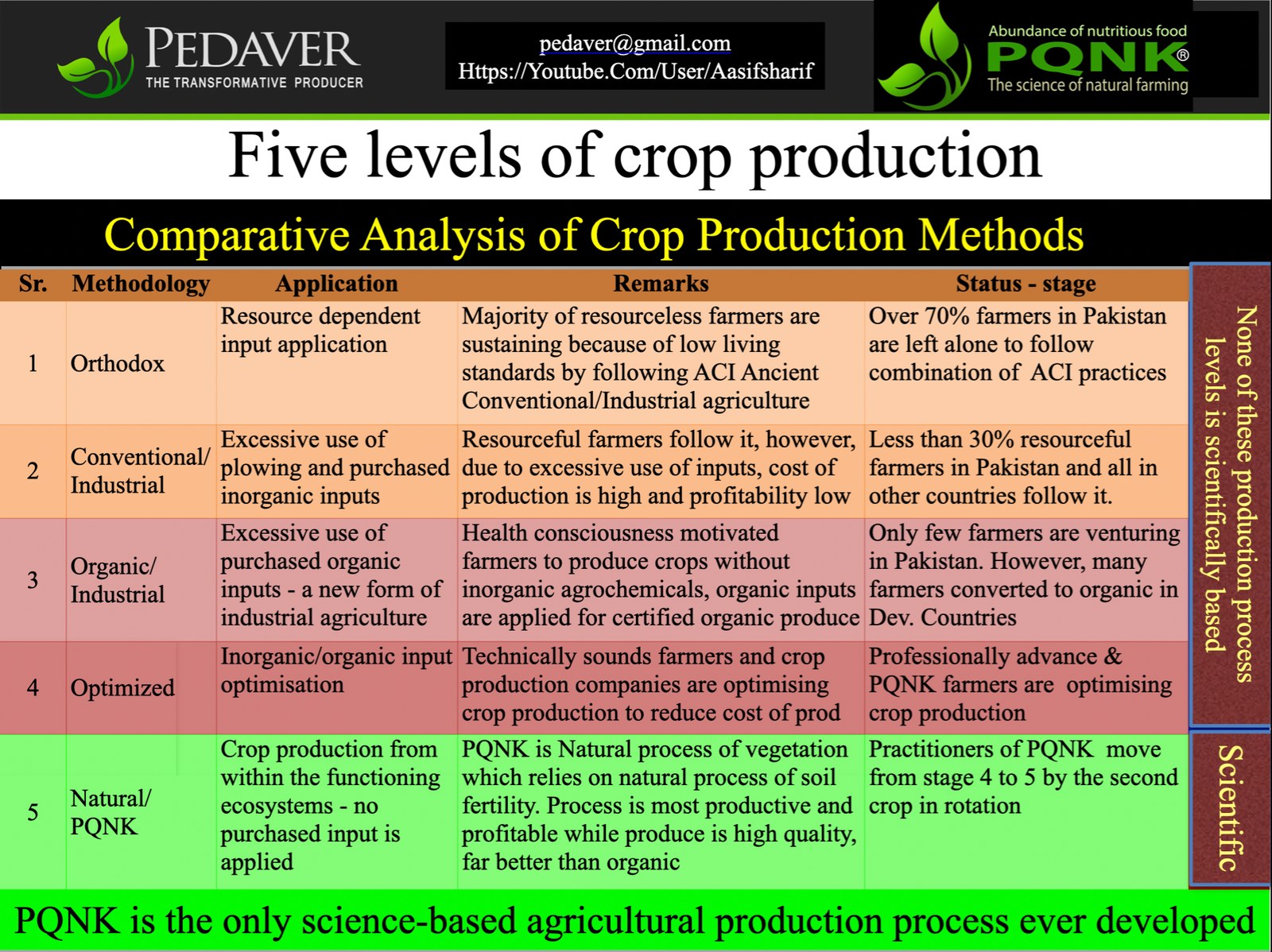
| Sr. | Methodology | Application | Remarks | Status - stage |
|---|---|---|---|---|
| 1 | Orthodox | Resource dependent input application | Majority of resourceless farmers are sustaining because of low living standards by following ACI Ancient Conventional/Industrial agriculture | Over 70% farmers in Pakistan are left alone to follow combination of ACI practices |
| 2 | Conventional/ Industrial | Excessive use of plowing and purchased inorganic inputs | Resourceful farmers follow it, however, due to excessive use of inputs, cost of production is high and profitability low | Less than 30% resourceful farmers in Pakistan and all in other countries follow it. |
| 3 | Organic/ Industrial | Excessive use of purchased organic inputs - a new form of industrial agriculture | Health consciousness motivated farmers to produce crops without inorganic agrochemicals, organic inputs are applied for certified organic produce | Only few farmers are venturing in Pakistan. However, many farmers converted to organic in Dev. Countries |
| 4 | Optimized | Inorganic/organic input optimisation | Technically sounds farmers and crop production companies are optimising crop production to reduce cost of prod | Professionally advance & PQNK farmers are optimising crop production |
| 5 | Natural/ PQNK | Crop production from within the functioning ecosystems - no purchased input is applied | PQNK is Natural process of vegetation which relies on natural process of soil fertility. Process is most productive and profitable while produce is high quality, far better than organic | Practitioners of PQNK move from stage 4 to 5 by the second crop in rotation |
| Side labels: levels 1 to 4, "None of these production process levels is scientifically based"; level 5, "Scientific". Footer: PQNK is the only science-based agricultural production process ever developed. |
Footnote: PQNK (pronounced 'picnic')—the regenerative & sustainable Pristine Organic Farming System—is grounded in Natural Ecosystem Science. This science employs perennial biodiversity, protects soil with organic mulch, and avoids practices like water inundation, tillage disturbance, and leaving soil bare.
PDF Knowledge papers: https://drive.google.com/drive/folders/ 1iadwV6mdUPyrUIpB3oRfNv6DLiackaUL?usp=sharing
About This Paper
- Problem
- General Pest Pressure · Short Shelf Life · Seed Sourcing / Genetic Vulnerability
- Science
- Nutrition · Food Quality · Crop Protection · Biodiversity
- Evidence
- Philosophical/Framework Argument
- Authority
- Current / Approved PQNK Knowledge
Related PQNK Science
Key Takeaways
- Argues certified organic and conventional (ACI) farming are functionally similar, both input-dependent systems disrupting the soil-plant-microbial continuum, differing only in whether inputs are synthetic or 'organic.'
- Attributes PQNK produce's shelf-life advantage to four factors: pristine cell architecture, a protective native microbiome coating, demand-driven Brix/antioxidant levels, and a lower post-harvest respiration rate.
- Argues both organic and synthetic fertilizers elevate free amino acids and sugars in plant sap, making both ACI and certified organic produce more pest-attractive than PQNK produce.
- States a shelf-life hierarchy: PQNK-grown produce outperforms wild-adapted produce, which outperforms certified organic and ACI produce (roughly equal to each other).
- Contrasts desi seed saved across generations of PQNK cultivation (co-evolved with local soil microbiome, naturally storable) against hybrid seed bred for input-response and yield at the expense of defense compounds.
- Proposes reframing the produce-quality conversation from 'organic versus chemical' to 'PQNK versus everything else.'
Related Knowledge
same problem
The PQNK Strawberry Production System: Achieving Commercial Abundance Through Ecosystem Logic
A full production system for open-field commercial strawberries under PQNK, covering ultra-high-density planting (19,600 plants/acre, nearly double the conventional standard), a mulch-hydration system that eliminates irrigation, a three-layer pest defense, and a post-harvest cold-chain protocol, plus a winter-crop rotation that keeps the same permanent bed productive year-round.
same problem
PQNK Foundational Document, Topic 14: The Expression of Genetic Blueprint — How PQNK's Restored Covenant Maximizes Phytochemical Density in Produce
This paper argues that a crop's flavor, aroma, and phytochemical richness are not additives but the automatic output of a fully expressed genetic blueprint, achievable only when an intact 'soil-plant covenant' lets the plant's microbial partners deliver nutrients on demand, and sets out three specific PQNK practices, light architecture, managed growth regulation, and cyclical harvest timing, that support that expression.
same problem
Knowledge Paper: PQNK — The Natural Ecosystem Science for Production Agriculture (Reviving the Self-Regulating Agroecosystem through Regenerative Principles)
This paper reframes pests and diseases as 'scavengers of the weak' rather than enemies, and sets out a four-tier plant protection system, repellent biochemistry, antixenosis, induced systemic resistance, and predator recruitment, that it argues emerges automatically once the same four-step PQNK soil process used across the knowledge library is correctly executed.
same problem
Watermelon Cultivation Under the Paedar Qudratti Nizam Kashatqari (PQNK): A Guideline Based on Practical Field Observations
PQNK watermelon takes 90-100 days to mature instead of 70 under chemical systems, not a delay but evidence of the plant building a real root-microbiome partnership first. This guideline works through frost protection, vine training, tip-cutting after fruit set, shade-based shrinkage prevention, and a cold-water field-heat removal protocol that holds fruit quality for 10-14 days.