

KP-091 · Nutrition & Food Quality
PQNK Foundational Document, Topic 14: The Expression of Genetic Blueprint — How PQNK's Restored Covenant Maximizes Phytochemical Density in Produce
This paper argues that a crop's flavor, aroma, and phytochemical richness are not additives but the automatic output of a fully expressed genetic blueprint, achievable only when an intact 'soil-plant covenant' lets the plant's microbial partners deliver nutrients on demand, and sets out three specific PQNK practices, light architecture, managed growth regulation, and cyclical harvest timing, that support that expression.
Read or listen to the full paper ↓Abstract
The paper's premise is that a plant's DNA is a complete blueprint specifying not just size and shape but the precise antioxidants, carotenoids, and flavonoids that define its quality, and that executing this blueprint requires a precise, on-demand nutrient supply delivered by soil life acting as the plant's 'professional chefs,' hired through root exudates. It reframes conventional agriculture's yield metric, tonnes per acre, as a measure of bulk biomass produced through survival stress, against a proposed PQNK metric of 'nutritional intelligence per gram,' arguing phytochemical density is not something added to food but something allowed to occur.
It describes what happens on either side of an intact 'soil-plant covenant': in a broken system, tillage, flooding, bare soil, and chemical inputs demolish the microbial workforce, forcing the plant into a survival state that produces bulk tissue and simple sugars while its complex phytochemical synthesis pathways run at a fraction of capacity; in a restored PQNK system, the microbial kitchen is fully staffed and the plant's genetic demand is met precisely, letting it invest solar energy into terpenes, polyphenols, alkaloids, and vitamins, the compounds that define flavor, aroma, and medicinal value.
Three specific PQNK practices are set out to support this expression. Light architecture governs planting geometry through two rules, a 'same-height guild' of dense east-west rows for companion crops of matched height and harvest timing (e.g., carrots and onions), and a 'staggered-height, north-south guild' for companions of differing height (e.g., maize over mung bean), ensuring shorter plants still receive adequate direct sunlight to fund their genetic programs. Managed growth regulation uses strategic, mechanical pruning or topping (such as pinching an okra's apical bud) as a physical signal telling a well-nourished plant to redirect energy from vegetative expansion into quality-focused fruit, seed, or essential-oil production, a practice the paper stresses only works within an already-intact covenant.
Cyclical harvest timing is treated as an act of respect for the plant's circadian and seasonal biochemical rhythm: leafy greens and aromatic herbs are recommended for mid-morning harvest, after dew evaporates but before midday sun volatilizes essential oils; fruits are recommended for harvest only at full ripeness, once final sugar-acid balancing and pigment synthesis are complete; and roots and seeds are recommended for post-senescence harvest, once all valuable compounds have translocated to the storage organ, with the paper stating that harvesting early yields an unfinished product and harvesting late yields a product in decline.
The paper closes with three explicit prohibitions protecting this system: no intentional stress-for-quality methods (deliberate injury, competitive companions, or trap crops to induce defense compounds), no direct fertilization to manipulate Brix or size (with the standard 4 kg/acre Nitrophos permitted only as a transitional deficiency correction), and no preventive pest or disease spraying, even organic, since pest pressure above a 2% threshold is treated as a symptom of a broken covenant, typically overwatering, to be corrected systemically rather than sprayed away.
Full Paper
If you use “Listen”, the text of the page may be sent to your browser or operating system’s speech provider, such as Apple, Google or Microsoft, depending on the voice your device uses. Pedaver does not process, transmit or store any audio.
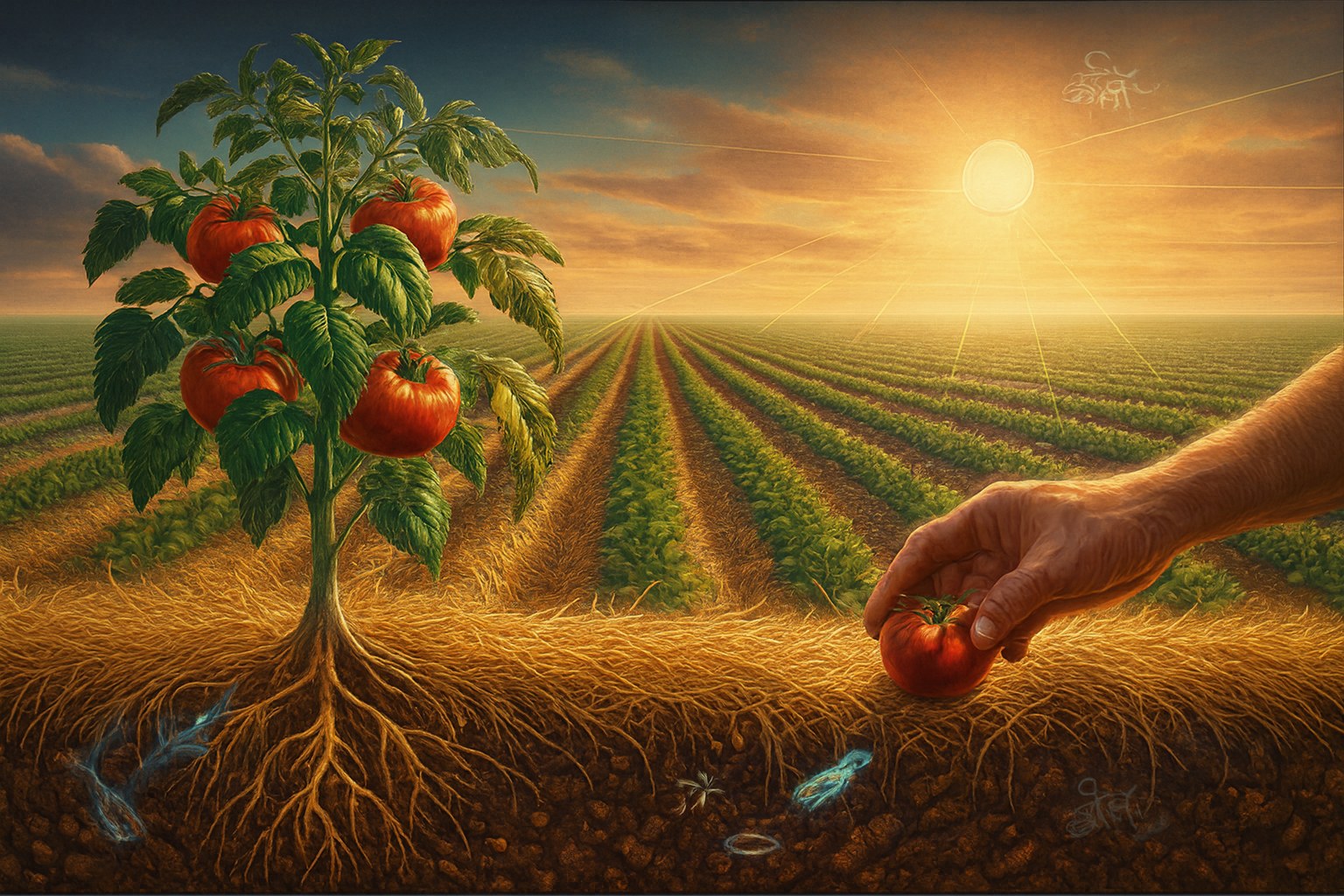
Core Principle: The concentration of vitamins, antioxidants, and essential oils in a crop is the direct, harvestable result of a fully expressed genetic blueprint. This expression is only possible when the Soil-Plant Covenant—the 400-million-year-old contract between plant intelligence and soil life—is intact and uninterrupted.
PQNK Integration: This topic is the living proof and tangible yield of the PQNK Axiom of the Soil-Plant Covenant. It moves the measure of success from weight to intelligence, from yield to wholeness.
1.0 The PQNK Premise: Quality As A System Diagnostic
Conventional agriculture measures success in tonnes per acre—a metric of bulk biomass produced through force and intervention. This biomass is often nutritionally hollow, the product of a broken system where the plant struggles to survive. PQNK measures success in nutritional intelligence per gram—a metric of vitality. This intelligence—manifested as vibrant color, complex aroma, profound flavor, and dense concentrations of phytochemicals—is the signature of a plant whose genetic destiny is being fulfilled. It is the product of a restored system where the plant thrives in seamless partnership with its soil. Therefore, phytochemical density is not something we add; it is something we allow. It is the ultimate field diagnostic for the health of the covenant.
2.0 The Science Of The Covenant: From DNA To Dish
A plant's DNA is a complete blueprint. It specifies not just the shape of a leaf, but its precise blend of antioxidants. It dictates not just the color of a fruit, but the specific carotenoids and flavonoids that create it. To execute this blueprint, the plant requires a precise, on-demand supply of nutrients in exact proportions. This is the role of the soil life—the professional chefs. Through root exudates, the plant "hires" a specific microbial workforce to unlock and prepare the required nutrients from the soil's mineral bank. This is a back-to-back, demand-driven system.
• In a Broken System: Tillage, flooding, bare soil, and chemical inputs demolish this workforce. The plant, starved of intelligent service, defaults to a survival state. It produces simple sugars and bulk tissue to stay alive, its genetic programs for complex phytochemicals switched off or running at a fraction of their potential. The result is food that fills the stomach but does not nourish the cell.
• In the Restored PQNK System: The covenant is honored. The microbial kitchen is intact and fully staffed. The plant’s genetic demand is met with precision. Consequently, its advanced metabolic pathways operate unimpeded. The plant invests its solar energy not into desperate growth, but into the sophisticated synthesis of terpenes, polyphenols, alkaloids, and vitamins—the very compounds that define its quality, flavor, and medicinal value.
PQNK Conclusion: A nutrient-dense carrot is not a stressed carrot. It is a complete carrot. It is a plant that has successfully realized its "carrot-ness."
3.0 PQNK Practice 1: Light Architecture—Fueling The Genetic Furnace
Light is the energy source that powers all biosynthesis. Our planting architecture has one goal: to deliver the full, necessary light ration to each plant so it can fund its genetic programs without energy shortage.
The Two Rules Of PQNK Light Management:
1. The Same-Height Guild: For crops of identical mature height and coinciding harvest (e.g., Carrots (Gajar) and Onions (Piyaz)), plant in dense, East-West rows. This maximizes photosynthetic capture per square meter, providing abundant energy for both crops to synthesize their unique phytochemical profiles (e.g., beta-carotene in carrots, quercetin in onions).
2. The Staggered-Height, North-South Guild: For companions of different heights (e.g., Maize (Makki) with a understory of Mung Bean), planting rows must run precisely North-South. This allows the sun to travel along the row, granting the shorter plant its critical hours of direct sunlight. This prevents shade-induced suppression of its genetic expression.
Violation of these rules creates energy poverty, forcing the plant to abandon "quality" programs to fund basic survival.
4.0 PQNK Practice 2: Managed Growth Regulation—The Signal To Consolidate
In nature, plants experience grazing and browsing. In our protected fields, they may grow excessively vegetative—a diversion of energy away from the genetic blueprint for fruits, seeds, and essential oils.
• The Practice: Strategic, mechanical pruning or topping. At a defined growth stage, we provide a transient, physical signal (e.g., pinching the apical bud of Okra (Bhindi) or cutting back Mint (Pudina)).
• The Covenant Logic: This signal tells the plant to stop investing in expansion and start consolidating energy into quality production. It redirects the flow of resources— now perfectly supplied by the microbial workforce—towards enhancing flavor, aroma, and phytochemical concentration in the remaining structures.
• Crucial Note: This practice is only effective within an intact covenant. A malnourished plant will be weakened by pruning. A PQNK plant, supported by its full workforce, responds with vigorous, quality-focused regrowth.
5.0 PQNK Practice 3: Cyclical Harvest—Receiving The Gift At Its Peak
The plant’s biochemical production follows a circadian and seasonal rhythm set by its genetics. Harvest is an act of respect: receiving the offering at the moment of its greatest perfection.
PQNK Harvest Schedule:
• For Leafy Greens & Aromatic Herbs (e.g., Fenugreek (Methi), Coriander (Dhania)): Harvest mid-morning. Dew has evaporated, minimizing rot, but the midday sun has not yet volatilized the delicate essential oils and compounds synthesized overnight.
• For Fruits (e.g., Tomato, Pepper (Shimla Mirch), Berries (Phalsa)): Harvest only at full ripeness on the plant. The complex final biochemical transformations—sugar balancing, acid development, pigment synthesis—are complete. This is the final, executed command of the genetic blueprint.
• For Roots & Seeds: Harvest post-senescence, when the plant's life cycle is complete and all valuable compounds have been translocated to the storage organ as programmed.
Harvesting early is receiving an unfinished product. Harvesting late is receiving a product in decline.
6.0 The PQNK Prohibitions: Protecting The Covenant
To preserve the system that makes quality possible, PQNK explicitly forbids practices that undermine the soil-plant partnership:
1. No "Stress-for-Quality" Methods: We do not intentionally injure plants, use competitive allelopathic companions, or employ trap crops to induce "defense" compounds. This is an adversarial approach that disrupts the plant's balanced management of its resources and workforce.
2. No Direct Fertilization for Quality: We never apply soluble NPK or supplements to directly manipulate brix or size. This bypasses and destroys the microbial workforce, replacing the plant's intelligent ordering system with a crude, force-fed slurry. The permitted 4 kg/Nitrophos per acre is a transitional supplement only, used only to correct visible deficiency while the microbial workforce re-establishes.
3. No Preventive Pest/Disease Intervention: Any spray—even organic—disrupts the phyllosphere and soil biology. In a functioning covenant, pest populations are regulated below a 2% damage threshold by natural balance. Exceeding this threshold is not a pest problem; it is a symptom of a broken covenant (typically from overwatering) and must be corrected systemically, not attacked directly.
7.0 Conclusion: The Taste Of Wholeness
When you consume a PQNK harvest, you are participating in a successful ancient contract. The burst of flavor in a strawberry, the pungent warmth of turmeric, the rich green vitality of spinach—these are not accidents of agriculture. They are biological achievements. They are proof that the plant, as employer, has successfully recruited and directed its microbial workforce. They are proof that the soil, as kitchen, has delivered precisely what was ordered. They are proof that we, as stewards, have removed ourselves as obstacles and allowed nature's flawless production system to operate. Therefore, the pursuit of phytochemical density in PQNK is the highest form of cultivation. It is the cultivation of completeness. It is the practice of enabling life to express its fullest, most intelligent, and most nourishing potential.
This document completes the core agronomic cycle of PQNK, linking the soil-life covenant to its ultimate expression: food that truly feeds.
Footnote: PQNK (pronounced 'picnic')—the regenerative & sustainable Pristine Organic Farming System—is grounded in Natural Ecosystem Science. This science employs perennial biodiversity, protects soil with organic mulch, and avoids practices like water inundation, tillage disturbance, and leaving soil bare.
About This Paper
- Problem
- Weak Flavor / Aroma / Quality Sensory Markers · General Pest Pressure · Macro / Policy-Level Externalities
- Science
- Plants · Nutrition · Food Quality · Biodiversity
- Evidence
- Philosophical/Framework Argument
- Authority
- Current / Approved PQNK Knowledge
Related PQNK Science
Key Takeaways
- Argues phytochemical density (flavor, aroma, antioxidant content) is the automatic output of a fully expressed genetic blueprint, not an input to be added, and proposes 'nutritional intelligence per gram' as an alternative yield metric to tonnes per acre.
- Frames soil microbes as the plant's demand-driven 'professional chefs,' hired through root exudates to deliver precise nutrients that unlock complex biosynthesis pathways otherwise run at a fraction of capacity.
- Sets two specific light-architecture planting rules: a 'same-height guild' (dense east-west rows for matched-height companions) and a 'staggered-height, north-south guild' (for companions of differing height, like maize over mung bean).
- Prescribes managed pruning/topping as a physical 'stop expanding, start consolidating' signal to redirect a well-nourished plant's energy toward fruit and phytochemical quality, valid only in an already-intact soil-plant covenant.
- Recommends specific harvest timing by crop type: mid-morning for leafy greens/herbs (post-dew, pre-volatilization), full ripeness only for fruit, and post-senescence for roots and seeds.
- Sets three explicit prohibitions: no deliberate stress-induction for quality, no direct fertilization to manipulate Brix/size, and no preventive spraying, treating pest pressure above 2% as a systemic symptom, not an isolated problem.
Related Knowledge
same problem
Nutrition-Dense Food and the Recovery of Ecological Quality
Industrial agriculture measures food primarily by yield and appearance, leaving taste, aroma, shelf stability, and mineral density as afterthoughts. This paper argues those qualities are not separate from ecology, they are the biological expression of a stable soil system, and walks through the specific mechanisms, deep rooting, fungal continuity, secondary metabolites, that connect soil health directly to what a crop tastes, smells, and how long it keeps.
same problem
The PQNK Strawberry Production System: Achieving Commercial Abundance Through Ecosystem Logic
A full production system for open-field commercial strawberries under PQNK, covering ultra-high-density planting (19,600 plants/acre, nearly double the conventional standard), a mulch-hydration system that eliminates irrigation, a three-layer pest defense, and a post-harvest cold-chain protocol, plus a winter-crop rotation that keeps the same permanent bed productive year-round.
same problem
Watermelon Cultivation: Pruning, Irrigation, and Trellis Q&A
A farmer's detailed field questions on watermelon pruning ratios, shading with corn, trellis design, plant spacing, and irrigation timing, answered against PQNK's water-mineral and moisture-gradient principles.
same problem
Scientific Parameters Behind Shelf Life, Pest Attraction & Deterioration — A Pristine PQNK Perspective
A rapid-fire Q&A that argues certified organic and conventional chemical farming are functionally the same input-dependent system wearing different labels, both producing produce that spoils faster and attracts more pests than PQNK, and works through eight specific farmer questions on the measurable biology behind shelf life, pest attraction, and seed lineage.