

KP-083 · PQNK Philosophy, Framework & Economics
Knowledge Paper: PQNK — The Natural Ecosystem Science for Production Agriculture (Reviving the Self-Regulating Agroecosystem through Regenerative Principles)
This paper reframes pests and diseases as 'scavengers of the weak' rather than enemies, and sets out a four-tier plant protection system, repellent biochemistry, antixenosis, induced systemic resistance, and predator recruitment, that it argues emerges automatically once the same four-step PQNK soil process used across the knowledge library is correctly executed.
Read or listen to the full paper ↓Abstract
The paper's philosophical opening reframes the conventional pest/disease relationship: rather than external enemies requiring chemical elimination, pests and diseases are cast as scavengers of the weak, natural recyclers of unhealthy or senescent plant matter. In a fully restored soil ecosystem, the paper argues, plants become inherently resistant, and it cites a claimed infestation ceiling below a 2% threshold in mature PQNK systems as evidence the defense emerges spontaneously rather than being applied.
That defense is organized into a four-tier system: repellent biochemistry, in which healthy plants emit volatile organic compounds that repel insects; antixenosis, in which balanced mineral and secondary-metabolite accumulation makes plant tissue unpalatable or indigestible to pests; induced systemic resistance, in which a diverse rhizosphere and phyllosphere microbiome, including native Bacillus thuringiensis strains, primes the plant's own immune defenses; and predator recruitment, in which a stable, complex habitat is said to sustain over 1,700 species of natural predators that provide biological control.
The paper then walks through the same four-step PQNK soil process documented across the knowledge library, breaking the hardpan, correcting soil chemistry with deep leaching and diluted sulfuric acid, building permanent raised beds and planting Jantar as a biological subsoiler, and retaining/mulching/no-till planting, framing each step's specific contribution to the emergent pest-defense cascade rather than treating it purely as a soil-structure or fertility intervention.
A direct contrast table sets the industrial/GMO model (single-crop yield maximization, chemical or single-gene Bt pest control, soil as an inert medium, biodiversity treated as a threat, high resistance risk from single-mode selection pressure, and a degenerative trajectory) against the PQNK ecosystem model (whole-agroecosystem health, emergent multi-layered pest defense, soil as a living foundation, biodiversity actively encouraged, negligible resistance risk from complex multi-layered defense, and a regenerative trajectory), citing the documented failure of single-gene Bt cotton against pink bollworm as a direct consequence of the industrial model's simplistic approach.
The paper closes by describing PQNK as a knowledge system for reuniting agriculture with ecology, in which pest resistance is not a trait to be inserted into a crop but a potential to be unleashed by restoring the soil-plant-microbe-animal continuum, positioning the resulting farm as simultaneously more productive, more self-protective, more profitable, and more regenerative than either conventional or GMO-based alternatives.
Full Paper
If you use “Listen”, the text of the page may be sent to your browser or operating system’s speech provider, such as Apple, Google or Microsoft, depending on the voice your device uses. Pedaver does not process, transmit or store any audio.
Executive Summary
PQNK (Paedar Qudratti Nizam Kashatqari), pronounced “picnic,” represents a paradigm shift in agriculture—from an intervention-based, input-heavy industrial model to a regenerative and sustainable pristine organic farming system. Rooted in the science of natural ecosystems, PQNK restores the innate ability of plants to protect themselves, produce abundantly, and sustain ecological balance. This paper outlines the philosophy, scientific principles, and practical methodology of PQNK, demonstrating how it reintegrates production agriculture with nature’s provision and protection mechanisms.
1. Philosophy & Core Principle: The Self-Protected Plant
Conventional agriculture views pests and diseases as enemies to be eliminated with external inputs—chemical pesticides, fungicides, and GMO traits. PQNK reframes this understanding:
“Pests and diseases are not attackers; they are scavengers of the weak.”
In a natural ecosystem, pests and diseases serve as recyclers, removing unhealthy or senescent organic matter. When plants are truly healthy—grown in a revived soil ecosystem—they become inherently resistant. Infestation in a PQNK system is observed to remain below a 2% threshold, a level manageable by natural predators and considered ecologically benign.
The Four-Tier Plant Protection System in PQNK:
Repellent Biochemistry: Healthy plants emit volatile organic compounds (smells) that repel phytophagous insects.
Antixenosis (Bad Taste): Robust plant tissues accumulate balanced minerals and secondary metabolites (e.g., phenolics, alkaloids), making them unpalatable or indigestible to sucking and chewing insects.
Induced Systemic Resistance: A vibrant soil microbiome, including diverse strains of Bacillus thuringiensis (Bt) and other beneficials, colonizes the rhizosphere and phyllosphere, priming the plant’s own immune defenses.
Predator Recruitment: A stable, complex habitat attracts and sustains over 1,700 species of natural predators (e.g., ladybugs, spiders, parasitic wasps) that provide ultimate biological control.
This layered defense emerges spontaneously when the soil ecosystem is functionally restored. PQNK, therefore, does not “inject” or “add” protection but enables the conditions for it to arise naturally.
2. The Scientific Pillars of PQNK Methodology
PQNK’s methodology is a sequential, non-negotiable framework designed to repair the foundational layers of the agroecosystem.
Step 1: Break the Hardpan – Liberate the Subsoil
Problem: Decades of tillage and heavy machinery create a compacted layer (hardpan) 8–17 inches below the surface. Consequence: It restricts root penetration, water infiltration, and gas exchange, leading to shallow-rooted, drought-stressed, and vulnerable plants. PQNK Action: Use a subsoiler or chisel plow to shatter the hardpan without inverting the soil profile. This action:
Enables deep root exploration for water and nutrients.
Improves infiltration and reduces anaerobic conditions.
Creates physical pathways for soil macrofauna (e.g., earthworms).
Result: Plants develop taproots, become more resilient to stress, and are less attractive to root-feeding parasites.
Step 2: Correct Soil Chemistry with Water and Acid – Reset the Mineral Base
Problem: Industrial agriculture leads to saline, sodic, or high-pH soils (pH >8), where essential minerals are chemically “locked up” and unavailable to plants. PQNK Action: A one-time corrective intervention within a closed-loop system:
Deep Leaching Irrigation: Apply ample water to wash soluble salts and chemical residues below the root zone.
Targeted Acidification: Apply diluted sulfuric acid (≈8 kg/acre with irrigation). The acid (H₂SO₄) neutralizes bicarbonate ions, lowers pH, and dissolves calcium carbonate, freeing bound phosphorus, micronutrients, and cations. Scientific Rationale: This step does not aim to make soil acidic but to neutralize extreme alkalinity, moving the pH toward a neutral 6.5–7.5 range where microbial life thrives and nutrient availability is optimal.
Step 3: Build Permanent Raised Beds and Plant Jantar – Engineer Structure and Biology
Problem: Flat fields with random traffic lead to re-compaction, poor aeration, and waterlogging. PQNK Action:
Construct Permanent Raised Beds: Shape beds with dedicated furrows for tractor tires. This confines compaction to traffic lanes, preserving the soft, aerated bed structure for roots indefinitely.
Plant a Deep-Taprooted Cover Crop (Jantar - Sesbania sesban): Immediately sow Jantar on the beds. Its aggressive taproot:
Acts as a “biological subsoiler,” further fracturing the subsoil.
Mines nutrients from deep layers and fixes atmospheric nitrogen.
Creates bio-pores for water movement and subsequent root growth.
Step 4: Retain, Mulch, and Plant with No-Till – Activate the Life Cycle
This is the core regenerative engine of PQNK.
Retain: Do not uproot Jantar. Let its root mass decay in situ, feeding soil fungi and bacteria—a massive injection of organic matter into the subsoil.
Mulch: Chop the above-ground Jantar biomass and lay it back on the bed as a thick, uniform mulch layer.
Functions: Suppresses weeds, moderates soil temperature, conserves soil moisture, prevents erosion, and feeds soil life from the top down.
No-Till Plant: Using a no-till planter, sow the cash crop seeds directly into the mulched bed.
Critical Principle: Zero soil disturbance. Tillage destroys soil structure, fungal networks, and habitat. No-till preserves the built-up soil ecosystem, allowing mycorrhizal fungi and other organisms to establish stable, symbiotic relationships with plant roots.
3. The Emergent Ecosystem: How Protection and Provision Are Restored
The four-step process catalyzes a positive ecological cascade:
Soil Physics → Improved structure allows free movement of air, water, and roots.
Soil Chemistry → Balanced pH and unlocked minerals provide optimal nutrition.
Soil Biology → The mulch and root residues fuel an explosion of microbial life: bacteria, fungi, protozoa, nematodes. This includes a diverse, native population of Bt bacteria.
Plant Health → With accessible nutrients and symbiotic microbes, plants achieve “optimum health.” They photosynthesize efficiently, producing complete proteins and robust cell walls.
Pest Resistance → The four-tier defense system activates. Insects find the plants repellent and unpalatable. The diverse, soil-borne Bt population provides a variable, non-selectable background defense.
Predator Sanctuary → The permanent mulch and diverse habitat provide shelter and alternative prey for a vast array of beneficial insects, birds, and spiders, which keep any potential pest influx below the 2% damage threshold.
4. Contrast with Industrial and GMO-Based Agriculture
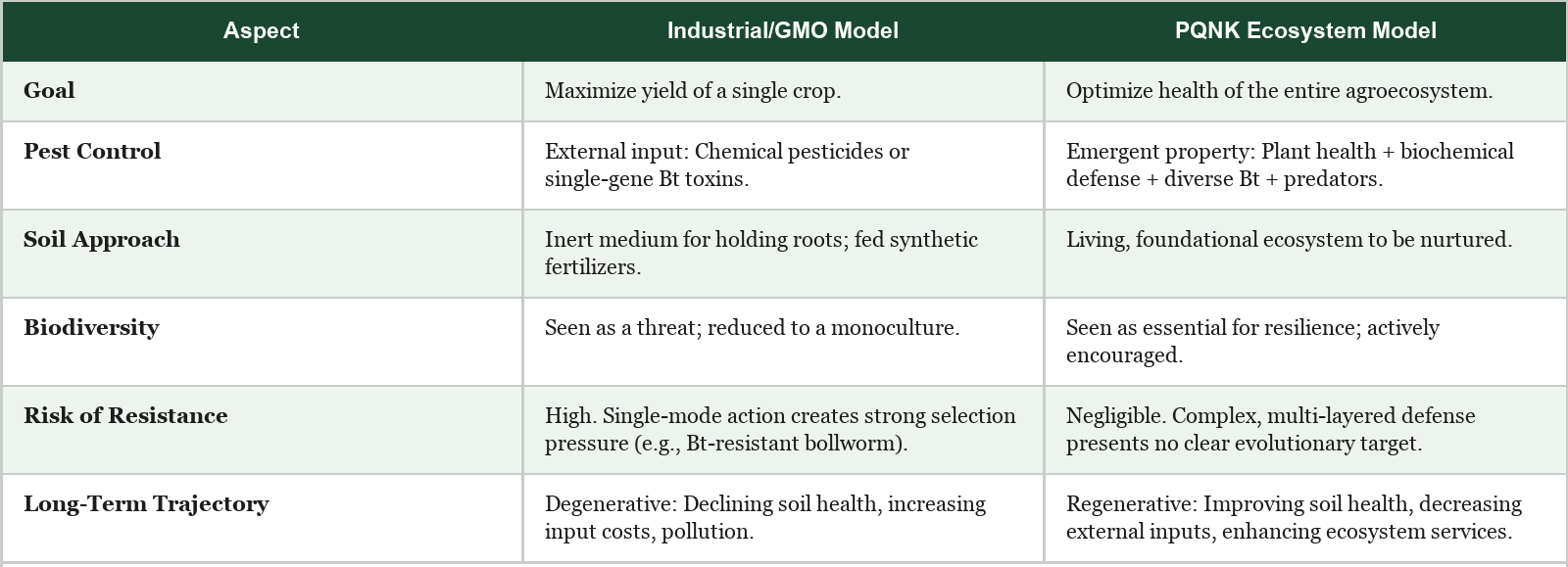
| Aspect | Industrial/GMO Model | PQNK Ecosystem Model |
|---|---|---|
| Goal | Maximize yield of a single crop. | Optimize health of the entire agroecosystem. |
| Pest Control | External input: Chemical pesticides or single-gene Bt toxins. | Emergent property: Plant health + biochemical defense + diverse Bt + predators. |
| Soil Approach | Inert medium for holding roots; fed synthetic fertilizers. | Living, foundational ecosystem to be nurtured. |
| Biodiversity | Seen as a threat; reduced to a monoculture. | Seen as essential for resilience; actively encouraged. |
| Risk of Resistance | High. Single-mode action creates strong selection pressure (e.g., Bt-resistant bollworm). | Negligible. Complex, multi-layered defense presents no clear evolutionary target. |
| Long-Term Trajectory | Degenerative: Declining soil health, increasing input costs, pollution. | Regenerative: Improving soil health, decreasing external inputs, enhancing ecosystem services. |
The documented failure of single-gene Bt cotton against pink bollworm is a direct consequence of the industrial model’s simplistic approach. PQNK avoids this by leveraging complexity and diversity—the very forces that govern stable natural ecosystems.
5. Conclusion: PQNK as a Knowledge System
PQNK is more than a set of techniques; it is a science-based knowledge system for reuniting agriculture with ecology. It recognizes that a plant’s ability to resist pests is not a “trait” to be inserted but a potential to be unleashed by restoring the soil-plant-microbe-animal continuum.
By following the sequential steps—breaking the hardpan, correcting chemistry, engineering beds with deep-rooted covers, and adopting permanent no-till mulching—farmers do not merely grow a crop. They reboot the natural ecosystem for production agriculture. The outcome is a farming system that is:
Productive (abundant, nutritious food),
Protective (self-regulating against pests),
Profitable (low external input costs),
Progressive (regenerates land over time), and
Pristine (free of synthetic chemical residues).
PQNK offers a proven, pragmatic pathway out of the pesticide-resistance treadmill, pointing toward a future where farms are not factories, but functional, resilient ecosystems that provide true food security.
Document Prepared For: The Transformative Producer Core Philosophy: Abundance through Ecosystem Revival. Threshold Promise: Infestation never over 2%.
—————————
Footnote: Any Production Process That Inundates Soil With Water, Disturbs Soil Through Tillage, Or Leaves Soil Bare Without Organic Mulch Cover Does Not Qualify As Natural Ecosystem Science For Production Agriculture.
PQNK, to be pronounced as 'picnic', which stands for Paedar Qudratti Nizam Kashatqari, and means: the regenerative & sustainable Pristine Organic Farming System.
www.Facebook.Com/Pedaver
https://www.youtube.com/@pedaverpqnk3167/videos
pedaver@gmail.com
WhatsApp +92 320 677 6666
About This Paper
- Crop
- Cotton
- Problem
- General Pest Pressure · Pesticide Resistance
- Science
- Crop Protection · Soil · Biodiversity
- Evidence
- Scientific Mechanism
- Authority
- Current / Approved PQNK Knowledge
Related PQNK Science
Key Takeaways
- Reframes pests and diseases as 'scavengers of the weak' rather than enemies, arguing a fully restored soil ecosystem produces plants that are inherently resistant, with claimed infestation held below a 2% threshold.
- Defines a four-tier natural plant protection system: repellent biochemistry, antixenosis (unpalatable tissue), induced systemic resistance via rhizosphere/phyllosphere microbiome, and predator recruitment (1,700+ predator species).
- Ties the four-step PQNK soil protocol (hardpan removal, chemistry correction, permanent beds with Jantar, no-till mulching) directly to the emergence of this pest-defense cascade, not just to soil fertility.
- Cites the documented failure of single-gene Bt cotton against pink bollworm as evidence that industrial agriculture's simplistic, single-mode pest control creates high resistance risk.
- Contrasts the industrial/GMO model (soil as inert medium, biodiversity as threat) against the PQNK model (soil as living foundation, biodiversity actively encouraged) across five dimensions.
- Frames pest resistance as a potential to be unleashed through ecosystem restoration, not a trait to be genetically inserted or chemically imposed.
Related Crops
Related Knowledge
same problem
Chilli Production Under PQNK (PICNIC)
Chilli is biologically perennial and can remain productive for over a decade, but conventional short-cycle, urea-dependent management collapses that potential into a pest-prone annual grind. This paper shows how PQNK's soil-conversion framework and a single apical-pinching intervention restore chilli to a low-cost, high-density perennial crop, validated on a Hafizabad farm.
same problem
The Qudratti Nizam as a Holistic Organism: The Principle of Closed-Loop Perception
This foundational document asks farmers to stop seeing their fields as a collection of managed parts and instead see a self-executing, closed-loop organism, then works through what that lens means diagnostically when poor germination, insect presence, or start-up nutrient deficiency shows up in a converted PQNK field.
same problem
The PQNK Strawberry Production System: Achieving Commercial Abundance Through Ecosystem Logic
A full production system for open-field commercial strawberries under PQNK, covering ultra-high-density planting (19,600 plants/acre, nearly double the conventional standard), a mulch-hydration system that eliminates irrigation, a three-layer pest defense, and a post-harvest cold-chain protocol, plus a winter-crop rotation that keeps the same permanent bed productive year-round.
same problem
The Pest-Free Revolution: Eliminating Agrochemicals by Unleashing Soil Biology with the PQNK System
A knowledge paper arguing that a properly implemented PQNK system leaves crops 98-99% free of pest and disease pressure through native Bt bacteria and a conserved predator population, and that the system's single greatest failure point is not input scarcity but over-irrigation.