

KP-171 · Water & Climate
The Hidden Crisis: How Industrial Agriculture Has Broken Earth's Water Cycle
A quantified case that industrial agriculture has driven global groundwater tables from 20-30 feet to over 300 feet deep, creating a roughly $200 billion annual crisis addressable through a costed $15 billion, 24-month PQNK rollout plan.
Read or listen to the full paper ↓Abstract
The paper opens with a single headline figure: groundwater that stood 20-30 feet below the surface for generations has fallen to over 300 feet in many agricultural regions today, a loss of roughly 280 feet of water storage displaced from the ground into atmospheric instability. It attributes this to three compounding industrial practices: bare soil exposed to direct sun regularly reaches 70°C (158°F), driving explosive upward air movement that displaces moisture far from where it fell; heavy machinery compacts soil into hardpan layers that block infiltration entirely, turning rainfall into fast runoff; and the combination displaces trillions of tonnes of water from stable underground storage into unpredictable atmospheric circulation.
The stated annual cost of this disruption is over $200 billion: more than $50 billion in flood damage to infrastructure and crops, over $30 billion in drought-related agricultural losses, over $20 billion in progressively deeper well-drilling and expanded water treatment, and over $100 billion in emergency response and disaster recovery, framed as an accelerating, compounding cost rather than a stable baseline.
The remedy is the four-step PQNK sequence scaled to national policy: subsoilers cutting 18-24 inches deep break the hardpan; one deep irrigation washes salts and residues out of the root zone; permanent raised beds prevent future inundation and compaction; and roots are retained, mulch is kept and crops are planted without tillage: a fast-growing Jantar cover crop is grown to about six feet and mulched in place with its roots intact, then crop after crop is planted into the same beds with SIPP or VIPP precision planters. A complete machine set (subsoiler, raised-bed maker, mulcher, and SIPP/VIPP planter) is costed at approximately $10,000 per 200-acre unit.
The paper's economic argument rests on a stated 13-to-1 return: a one-time $15 billion investment, broken into roughly $3 billion for hardpan-breaking, $4 billion for raised-bed construction, $2 billion for initial cover-crop establishment, $5 billion for machine-set distribution, and $1 billion for farmer training and field support, against $200 billion in current annual losses. It lays out a 24-month, four-phase emergency rollout: crisis declaration and mapping (months 1-6), machinery and cover-crop distribution (months 7-12), completion of hardpan-breaking and bed construction with cash-crop planting beginning (months 13-18), and the remaining machinery, farmer training and permanent policy (months 19-24).
Full Paper
If you use “Listen”, the text of the page may be sent to your browser or operating system’s speech provider, such as Apple, Google or Microsoft, depending on the voice your device uses. Pedaver does not process, transmit or store any audio.
The Numbers That Tell the Devastating Story
Imagine if someone told you that trillions of tons of water that once provided climate stability are now floating chaotically in our atmosphere, driving the weather chaos we see around us. You might think this sounds like science fiction. But the evidence is buried beneath our feet, telling an undeniable story of unprecedented environmental destruction.
For generations, groundwater stood just 20 to 30 feet below the soil surface, maintaining Earth’s delicate water balance. Today, that same water table has plummeted to over 300 feet deep—and continues falling. This represents 280 feet of water storage lost to the atmosphere, fundamentally disrupting the water cycle that sustained life on Earth for millennia.
The Perfect System We Destroyed
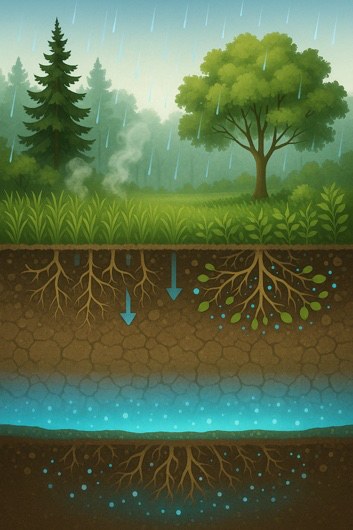
Before industrial agriculture, Earth operated as a perfectly balanced water machine. Soil wasn’t just dirt—it was a living, breathing sponge, rich with organic matter and teeming with biological activity. When rain fell, this soil embraced every drop, storing it in vast underground reservoirs. Plants and trees created protective canopies that kept temperatures cool and stable, while water moved gently through layers of earth, feeding rivers and springs with crystal-clear flow.
The atmosphere held precisely the right amount of moisture for predictable seasons. Farmers could count on nature’s rhythm because this system had been perfected over millions of years. This wasn’t environmental luck—this was engineering by evolution.
How We Broke the Water Cycle
Industrial agriculture shattered this ancient system through three devastating practices that continue today:
1. Creating Massive Heat Islands. When we stripped away nature’s protective plant cover, we exposed naked soil to blazing solar radiation. Agricultural soil now regularly reaches temperatures of 70°C (158°F) and beyond—hot enough to burn human skin. When air touches this superheated earth, it doesn’t just warm up; it explodes upward like a rocket, carrying precious water vapor far from where it’s needed.
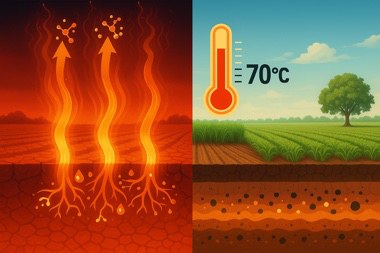
What should be gentle, local precipitation becomes violent storms hundreds of miles away. We’ve essentially turned millions of acres of farmland into massive heat islands that violently displace atmospheric moisture.
2. Creating Impermeable Hardpan Layers. As if burning away soil’s protective cover wasn’t destructive enough, we then crushed what remained. Massive tractors weighing tens of thousands of pounds compress earth into concrete-hard layers called hardpan. When rain falls on these compacted surfaces, it cannot penetrate. Instead, water races across the land like it’s hitting pavement, gathering speed and destructive power as it rushes toward low-lying areas.
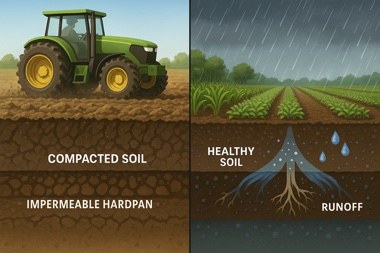
What should gently nourish crops becomes a destructive force, washing away the very topsoil our agricultural future depends on.
3. Forcing Massive Water Displacement. The combination of extreme soil heating and hardpan formation has displaced an almost incomprehensible volume of water from soil storage into atmospheric chaos. That 280-foot drop in groundwater levels represents trillions of tons of water that once provided natural climate stability now floating unpredictably in our skies.
When this displaced water finally condenses and falls, it doesn’t arrive as the gentle, predictable precipitation that sustained agriculture for thousands of years. Instead, it crashes down in devastating torrents that overwhelm rivers, streams and channels, destroy infrastructure, and flood communities, while the areas that lost this water suffer under intensifying droughts.
The Evidence of Catastrophic Disruption
The proof of this water cycle disruption surrounds us:
Groundwater Crisis: Wells that previous generations dug at 30 feet now require drilling to 300 feet or more—and many still come up dry. This isn’t isolated to particular regions; it’s happening everywhere industrial agriculture has been practiced.
Weather Chaos: Flash floods that turn streets into rivers within minutes. Droughts that persist for years in historically well-watered regions. Heat waves that shatter century-old temperature records, followed by unseasonable cold snaps that devastate crops.
Agricultural Instability: Farmers face unprecedented volatility, with crop yields swinging wildly between flood damage and drought stress. Traditional growing seasons have become unreliable, making long-term agricultural planning nearly impossible.
The Accelerating Crisis
Every year we continue current agricultural practices, the crisis compounds exponentially. Hardpan layers grow thicker and more impermeable. The soil biology that once created natural water storage systems is suppressed further. Remaining topsoil gets washed or blown away at alarming rates.
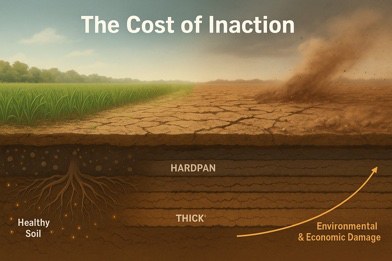
We’re not just damaging agricultural land—every season of delay makes the recovery longer and costlier. Living soil can always be restored, but the bill for the damage grows each year. The question isn’t whether we can afford to act; it’s whether we can afford to wait another day.
The Economic Emergency
This environmental crisis is simultaneously bankrupting us. Current agricultural practices create over $200 billion in annual costs:
• $50+ billion in flood damage to infrastructure and crops
• $30+ billion in drought-related agricultural losses
• $20+ billion for increasingly deep wells and expanded water treatment
• $100+ billion in emergency response and disaster recovery
We’re literally spending ourselves into poverty trying to manage the chaos created by destroying soil’s natural water storage capacity.
The Solution: The PQNK Four-Step Natural Ecosystem Restoration
The remarkable truth is that we know exactly how to restore Earth’s water cycle. The solution follows the proven PQNK (pronounced “picnic”) methodology—Paedar Qudratti Nizam Kashatqari—which means the regenerative and sustainable Pristine Organic Farming System. This comprehensive approach requires four essential, coordinated actions:
1. Break the Hardpan Immediately. Subsoilers—specialized equipment with steel shanks that cut 18 to 24 inches deep—can shatter the impermeable layers choking our soil. As these tools slice through compacted earth, they restore pathways for water to flow back where nature intended. This isn’t just farming equipment; it’s climate repair technology that recreates the soil’s natural porosity for water infiltration.
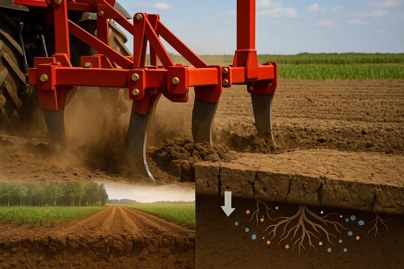
2. Wash the Soil Once. With the hardpan broken, one deep irrigation washes accumulated salts and agrochemical residues down out of the root zone and wets the soil profile to depth. It is applied once, at conversion; after that the field is never flooded again.
3. Create Permanent Raised Beds. After the water wash, the next critical step is constructing permanent raised beds that prevent soil inundation and waterlogging. These raised beds serve multiple functions: heavy rain soaks rapidly into the opened soil instead of standing on the surface, the beds keep their structure, equipment traffic stays in the furrows so the beds are never compacted, and the beds create optimal growing conditions by managing both water infiltration and retention.
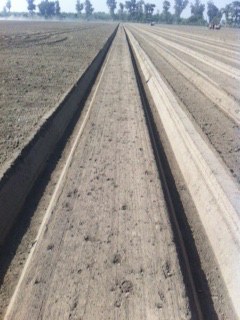
The raised bed system mimics nature’s own topography, where plants naturally grow on elevated, well-aerated ground. This prevents the destructive cycle of soil saturation and subsequent hardpan formation that occurs when fields are left flat and exposed to flooding.
4. Retain Roots, Mulch, and Plant Without Tillage. After constructing the permanent raised beds, the first crop planted is a fast-growing cover crop with large root systems, such as Jantar. This initial cover crop is allowed to grow to its full height of approximately six feet, developing an extensive root network that naturally restores soil pores essential for water seepage, aeration, and microbial activity.
When the Jantar crop reaches maturity, it is mulched directly on the raised beds using a specialized mulcher designed for crop residue management. This critical technique preserves the entire root system intact within the soil, maintaining the natural channels and biological networks the roots created. The mulcher cuts and distributes the above-ground portion of the plant evenly across the bed surface, creating a protective mulch layer that covers the soil, keeping temperatures within moderate limits and dramatically reducing water evaporation.
The intact root system continues to decompose slowly underground, feeding soil biology and maintaining the pore structure necessary for water infiltration and storage. Meanwhile, the surface mulch created by the mulcher provides nature’s protective armor, shielding the soil from temperature extremes while maintaining optimal moisture levels.
After the first cover crop is mulched, cash crops are planted one after another directly into the same permanent raised beds without ever disturbing the soil structure. This is accomplished using specialized equipment designed specifically for the PQNK system:
Slit Insertion Precision Planter (SIPP): Creates minimal soil disturbance through precise slitting action
Vertical Insertion Precision Planter (VIPP): Inserts seeds vertically with zero tillage disruption
Both planters work effectively through the mulched surface, allowing farmers to plant successive crops while preserving the soil’s natural architecture—the intricate networks of channels, fungal threads, and biological pathways created by the initial cover crop roots and maintained by the ongoing soil biology.
Each subsequent crop is planted into this living, breathing soil ecosystem, building upon the foundation created by the mulched cover crop system while preserving the water infiltration pathways and continuously enhancing organic matter and soil biology with every growing season.
When implemented together, this PQNK (picnic) system transforms agricultural land from a water-rejecting, heat-generating surface into a water-welcoming, climate-stabilizing ecosystem that functions like the natural systems that sustained Earth’s water cycle for billions of years.
The Economic Opportunity
Here’s the stunning economic reality: completely fixing this crisis through the PQNK (picnic) Pristine Organic Farming System would cost approximately $15 billion over two years, thanks to the remarkably affordable and efficient PQNK machinery system:
PQNK Machine Categories:
• One-time use machines: Subsoiler and Raised-bed maker (serve thousands of acres)
• Regular use machines: Mulcher for crop residue management and either SIPP or VIPP planter (designed for 200-acre operations)
• Complete PQNK machine set: Approximately $10,000 USD per 200-acre unit
Investment Breakdown:
• $3 billion for comprehensive hardpan breaking operations (Paedar)
• $4 billion for permanent raised bed construction nationwide (Qudratti)
• $2 billion for initial Jantar cover crop establishment (Nizam)
• $5 billion for PQNK machine sets (Mulcher + SIPP/VIPP) distribution to farmers (Kashatqari)
• $1 billion for farmer training and field support
This represents a remarkable 13-to-1 return on investment—spending just $15 billion once to save $200 billion annually forever. The affordability of the PQNK machinery makes this solution accessible to farmers worldwide while providing the greatest economic bargain in agricultural history.
The 24-Month Emergency Response Plan
We cannot afford to study this problem for another decade. We need emergency action with a clear timeline:
Months 1-6: Declare soil hardpan a national crisis. Begin comprehensive mapping of compacted agricultural land. Deploy subsoiling equipment to the most critical watersheds. Begin permanent raised bed construction in priority watersheds. Implement immediate moratorium on unnecessary plowing.
Months 7-12: Distribute subsoiling technology and raised bed construction equipment to agricultural regions nationwide. Begin large-scale Jantar cover crop planting on completed raised bed systems. Provide financial support and PQNK machine sets ($10,000 per 200-acre unit) to farmers transitioning to the system. Carry out the one-time deep water wash on every field as its hardpan is broken.
Months 13-18: Complete hardpan breaking and raised bed construction operations on all compacted agricultural land. Use specialized mulchers to process mature Jantar crops (at 6-foot height) without uprooting to create protective soil cover. Begin cash crop planting using SIPP or VIPP precision planters. Enforce prohibition on destructive tillage practices.
Months 19-24: Expand mulcher and planter distribution to the remaining farms. Train farmers to keep the beds permanently mulched and to give water only when the soil-ball test shows a need, never above a 4-inch head. Establish permanent policies for maintaining the four-step regenerative system.
The Global Leadership Opportunity
Successfully implementing soil health restoration would position any nation as a global environmental leader. Other countries would witness that it’s possible to restore water cycles, stabilize climate patterns, and create agricultural abundance instead of scarcity.
When we prove that soil health equals climate health, we become the example that can help save not just our own agricultural systems, but the planet’s food security. This represents our generation’s opportunity to choose between being remembered as those who broke Earth’s water cycle, or those who healed it.
The Transformation Vision
Imagine standing on agricultural land three years after implementing the complete PQNK (picnic) Pristine Organic Farming System. The hardpan is broken through Paedar, and soil breathes again through permanent raised beds (Qudratti) that manage water perfectly. When rain falls, you can hear it being welcomed by earth instead of rejected, flowing through the pore systems created by the initial Jantar cover crop roots, with excess water soaking down into the subsoil while optimal moisture is retained in the root zone.
Ground stays cool under the protective mulch layer from the six-foot-tall Jantar crop that was processed by the specialized mulcher, never uprooted, leaving its extensive root system to maintain soil pores and feed soil biology. The mulched surface provides perfect growing conditions while the underground root channels continue functioning as nature’s irrigation system. Springs that went dry decades ago begin flowing again as the raised bed system captures and stores water efficiently.
Farmers plant crop after crop on the same permanent beds using their affordable PQNK machine sets—either SIPP or VIPP precision planters working seamlessly through the mulched surface—with confidence instead of fear, knowing their soil structure will never be destroyed again. Each cash crop grows in this living soil ecosystem where the decomposing Jantar roots continuously feed beneficial microorganisms while the surface mulch maintains perfect growing conditions.
Weather patterns stabilize as local water cycling is restored through this engineered ecosystem that perfectly mimics nature’s own design. The beauty of the system lies not just in its effectiveness, but in its accessibility—at just $10,000 per 200-acre operation, every farmer can afford to be part of healing the planet’s water cycle.
This isn’t fantasy—this is what happens when we implement the complete PQNK (picnic) methodology to fix the water cycle. This is what we can have if we choose to act.
The Choice Before Us

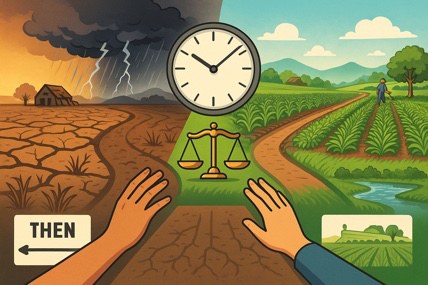
We stand at the most critical decision point in agricultural history. Down one path lies accelerating disaster: deeper droughts, more violent floods, higher costs, and ultimately the collapse of stable food production. Down the other path lies restoration: healed soils, stable weather, abundant water, and a legacy of environmental stewardship our children can be proud of.
The science is clear. The solutions are proven. The economics are overwhelming. All that remains is the political will to act.
What Must Happen Now
Policymakers must take five immediate actions to implement the PQNK (picnic) Pristine Organic Farming System:
1. Declare emergency status for soil health and water cycle restoration using the four-step PQNK methodology
2. Allocate emergency funding for the complete Paedar Qudratti Nizam Kashatqari system implementation, including affordable $10,000 machine sets for farmers
3. Implement immediate moratorium on destructive flat-field tillage practices
4. Establish mandatory permanent raised bed, mulching, and precision planting requirements for all agricultural land
5. Give every farmer access to PQNK machinery and training in the four-step conversion, from breaking the hardpan to planting without tillage
Our Legacy Decision
History will remember this moment. Future generations will judge whether we chose to be the people who broke Earth’s water cycle, or those who healed it. Whether we left our children a world of climate chaos and scarcity, or stable weather and abundance.
The water cycle can be restored. The climate can be stabilized. The future can be saved. It all starts with the soil beneath our feet, and the choice we make today.
The nation that destroys its soil destroys itself. The nation that restores its soil secures its future.
Today, we must choose to secure the future.
Mr. Asif Sharif, a visionary agricultural pioneer, innovator, philanthropist, and global citizen, upholds his SirGroh family’s legacy in education, agriculture, and community service. His expertise includes marketing, agricultural project development, production process development and mechanization, forward engineering, alternate energies, value addition, and responsible citizenship. He developed the first crop production process based on Natural Ecosystem Science, named PQNK, which means “the regenerative & sustainable Pristine Organic Farming System”.
This analysis is based on more than fifty years of PQNK field work and observation. For more information on soil health restoration techniques, contact pedaver@gmail.com
Call to Action: Contact your representatives today to demand emergency action on soil health restoration. Share this article to spread awareness of the hidden crisis threatening our planet’s water cycle. The time for incremental change has passed—the time for emergency action is now.
YouTube: https://www.youtube.com/@pedaverpqnk3167/videos | Facebook: FB.com/pedaver | WhatsApp +92 320 677 6666
About This Paper
- Problem
- Groundwater / Aquifer Depletion · Flooding · Drought / Water Scarcity · Hardpan · Runoff
- Science
- Water · Climate · Economics · Production Architecture
- Evidence
- Economic Model/Projection
- Authority
- Current / Approved PQNK Knowledge
Related PQNK Science
Key Takeaways
- Groundwater depth in heavily farmed regions has fallen from a historical 20-30 feet to over 300 feet, a loss of roughly 280 feet of underground water storage displaced into atmospheric instability.
- Current industrial-agriculture water-cycle disruption is costed at over $200 billion annually: $50B+ flood damage, $30B+ drought losses, $20B+ deepening wells/water treatment, $100B+ emergency response.
- Bare agricultural soil regularly reaches 70°C (158°F) under direct sun, hot enough to burn skin, driving explosive upward air movement that displaces water vapour far from where it fell.
- The fix is the four-step PQNK sequence (subsoiling 18-24 inches deep, one deep water wash, permanent raised beds, roots and mulch kept with continuous no-till SIPP/VIPP planting after a six-foot Jantar cover crop), costed at about $10,000 per 200-acre machine set.
- The paper proposes a one-time $15 billion national investment against $200 billion in current annual losses, a stated 13-to-1 return, deployed over a costed 24-month, four-phase rollout plan.
Related Knowledge
same problem
Rain Where It Falls: Restoring the Soil Before Building More Water Storage
Rajendra Singh’s Rajasthan story shows that slowing runoff lets water enter the ground and restore wells and rivers. PQNK moves that principle upstream into the field itself: correct the hardpan, stop disturbing the soil, keep the surface covered, and let every acre receive and hold the rain where it falls, so that agricultural water demand stays within what the landscape renews.
same problem
PQNK: The Wholesale Four-Step System to Reconnect the Water Cycle and End Water Scarcity
Iran's collapsing rivers, sinking cities, and vanishing aquifers are presented as a preview of what awaits any nation that keeps farming on hardpan-sealed, bare soil. This paper argues the crisis is not a rainfall shortage but a blocked water cycle, and lays out PQNK's four-step protocol for reopening it.
same problem
When 13 Inches of Rain Falls in Eight Hours
After 13 inches of rain in eight hours, the PQNK orchard beds of Jaskaran Singh in Fazilka district, Indian Punjab, had taken the water into the soil and could be walked on in slippers, while neighbouring conventional orchards and fields stood under water, and so did a strip of his own orchard where the hardpan had not been broken. The paper explains why hardpan is a water barrier as well as a root barrier, and why the soil is the first reservoir.
same problem
The Hydrological Transformation of Agricultural Landscapes Through the Paedar Qudratti Nizam Kashatqari (PQNK) System
PQNK-prepared fields are documented absorbing rainfall events of 600mm in a day without runoff, a figure the paper says farmers initially found impossible to believe. It explains the soil physics behind that claim, from macroporosity gains to deep-rooted 'biological drills,' and positions PQNK farms as recharge basins rather than flood risks.