

KP-182 · PQNK Philosophy, Framework & Economics
Recalibrating Pakistan's Textile Value Chain: From Farm to Fabric and Beyond
Deconstructs the cotton-to-garment value chain stage by stage to argue that Pakistani policy misattributes value creation to industrial processing while sidelining the farm as the base of all value, and traces three historical cotton epochs, Deltapine-15, Bt cotton, and PQNK, to argue PQNK is the next necessary revolution.
Read or listen to the full paper ↓Abstract
The paper's core argument is that Pakistan's textile policy misattributes value creation, crediting the industry's processing stages for the total value of the exported product while sidelining the farm-level production that establishes the entire chain's quality potential and carries its highest inherent risk. It sets out a stage-by-stage value attribution: farm production as the 100 percent base value, ginning adding roughly 15 to 20 percent, spinning 25 to 35 percent, weaving or knitting 15 to 20 percent, wet processing (calendaring, coloring, printing) 20 to 30 percent, and garment making 40 to 60 percent, the largest single marginal addition, credited to design, branding, and tailoring.
It situates this within a historical retrospective of three epochs of cotton revolution in Pakistan, each credited to the author's own organization. Epoch 1 (1974) introduced the Deltapine-15 variety, tripling yields from 600 kg to 1,800 kg per acre while improving lint-to-seed ratio, fiber length, and softness, with its flower-at-each-leaf-axil trait later indigenized into NIAB-78. Epoch 2 (1990s) introduced Bt cotton in response to bollworm infestation, based on a soil bacterium producing an insect-toxic protein, which saved the crop but eventually produced resistance in pests like the pink bollworm, exposing the vulnerability of single-technology reliance.
Epoch 3 (2008 to present) is framed as the Sustainable Quality Revolution through PQNK, offering lowest cost of production by eliminating chemical inputs, certified organic 'plus' quality, and a price premium commanding up to double the price in international markets, positioning Pakistan to lead global sustainable textile production.
The paper argues the current policy framework, built on the industry's mischaracterization of value creation, grants undue subsidies, incentives, and rebates that often favor imported raw materials such as cotton and man-made fiber over domestic production, disincentivizing investment in Pakistani cotton and undermining fiber security.
Its recommended policy shift has three parts: phase out subsidies tied to general industrial activity or input imports and redirect funds to farm-level support; mandate contract farming that ties the textile industry to local sourcing, ensuring assured supply, contracted quality parameters such as PQNK organic standards, and lower sourcing cost by eliminating middlemen and import tariffs; and invest directly in the PQNK ecosystem through farmer training, access to PQNK-specified machinery, and certification support for premium international market access.
Full Paper
If you use “Listen”, the text of the page may be sent to your browser or operating system’s speech provider, such as Apple, Google or Microsoft, depending on the voice your device uses. Pedaver does not process, transmit or store any audio.
Abstract: Pakistan's economy is heavily reliant on its textile sector, which contributes significantly to its export earnings and employment. However, the prevailing narrative and policy framework disproportionately credit the industrial processing stages for the sector's value, overlooking the foundational role of agriculture and raw material production. This paper deconstructs the cotton value chain to accurately attribute value addition at each stage. It traces the historical evolution of cotton production in Pakistan through three pivotal interventions—the introduction of high-yield varieties in 1974, the adoption of Bt cotton in the 1990s, and the recent development of the Pristine Organic (PQNK) system in 2008. The paper argues that current subsidy structures are misaligned, incentivizing input imports over domestic farm-level resilience. It concludes with policy recommendations for a contract farming model centered on PQNK, positioning Pakistan to leverage its unique organic advantage for global leadership in sustainable textiles.
1. Introduction: The Value Addition Fallacy in Pakistani Textiles
Pakistan's industrial landscape is characterized by low-to-medium technology sectors that add value to domestically mined and, more importantly, agriculturally produced raw materials. The textile industry stands as the cornerstone of this setup, dominating the nation's export profile. A critical flaw in the sector's economics, however, lies in the misrepresentation of value addition. The industry often claims credit for the final exported product's total value, a calculation that erroneously sidelines the primary production at the farm level.
Production occurs on the farm; value-addition through processing occurs in the industry. A fair economic assessment must dissect the chain and attribute credit where it is due. This is not merely an academic exercise but a crucial step for designing equitable and effective government policies regarding subsidies, incentives, and long-term strategic development.
2. Deconstructing the Cotton Value Chain: A Step-by-Step Value Attribution
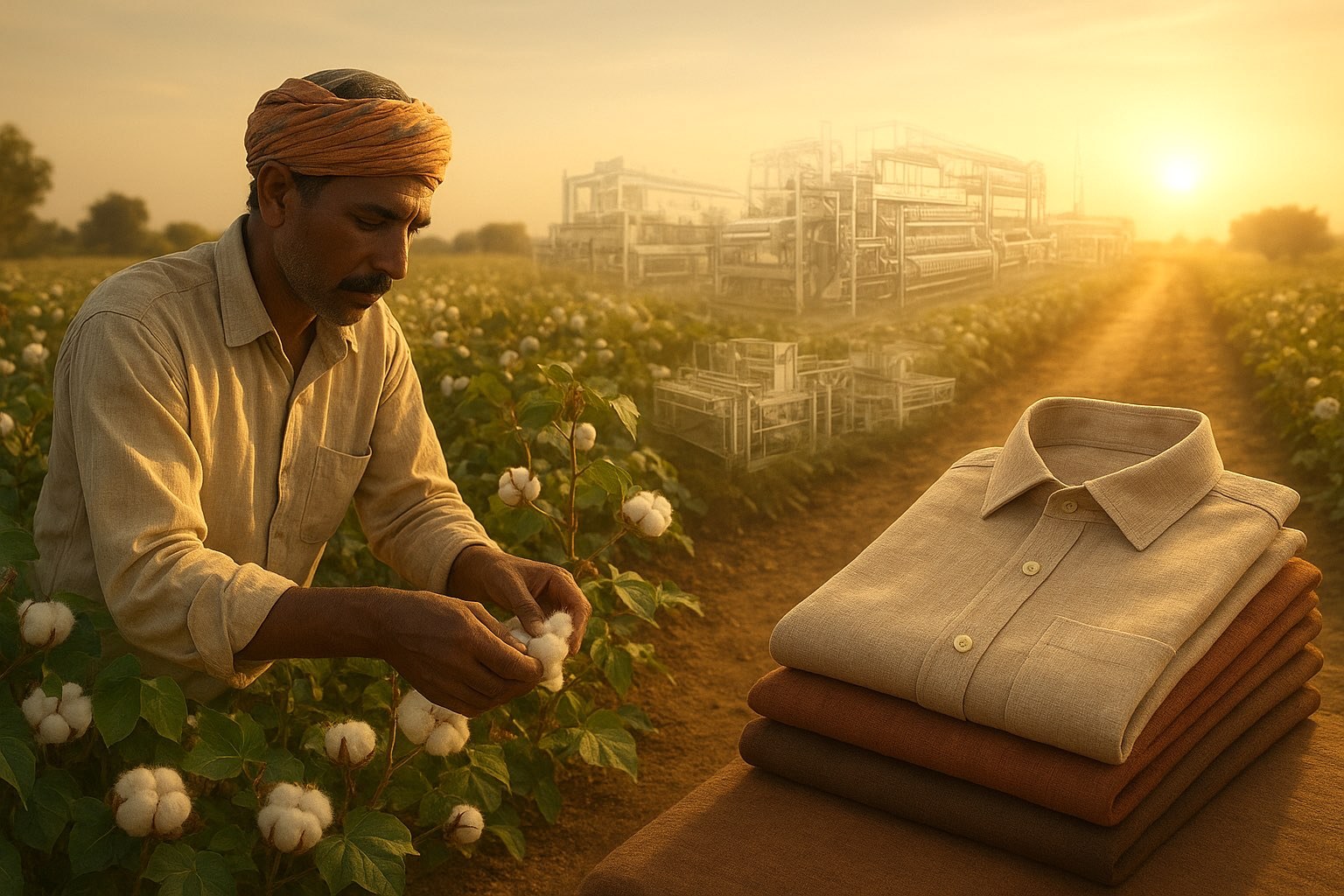
The journey of cotton from field to garment involves multiple stages, each contributing a marginal increase to the final product's value. While precise percentages can fluctuate with market dynamics, a representative breakdown illustrates the distribution:
Farm Production (Base Value - 100%): This is the genesis of all value. The farmer invests in land, water, seeds, fertilizers, and labor to produce seed cotton (kapas). This step carries the highest inherent risk (weather, pests, market prices) and establishes the entire chain's quality potential. Credit: Farmer.
Ginning (~15-20% Value Addition): Ginning separates the valuable lint (fibre) from the cotton seed. This is the first processing step, converting a raw agricultural commodity into a tradable textile fibre. Credit: Ginning Industry.
Spinning (~25-35% Value Addition): Spinning converts loose lint into continuous yarn. This stage requires significant capital investment in machinery and adds substantial value by creating a versatile intermediate product. Credit: Spinning Industry.
Weaving/Knitting (~15-20% Value Addition): Yarn is transformed into woven fabric (grey cloth) or knitted fabric. This step creates the substrate for all downstream finishing and manufacturing. Credit: Weaving/Knitting Industry.
Processing (Calendaring, Coloring, Printing) (~20-30% Value Addition): This stage gives fabric its functional and aesthetic properties—softness, durability, color, and design. It is a high-skill, chemical-intensive process that significantly enhances the product's market appeal. Credit: Processing Industry.
Garment Making (~40-60% Value Addition): The final transformation of fabric into finished apparel or home textiles (made-ups). This step captures the highest marginal value addition, incorporating design, branding, and tailoring. Credit: Garment Manufacturing Industry.
Cumulative Insight: The industrial processing stages (Ginning to Garment Making) collectively add the majority of the final value, and rightly so. However, their ability to do so is entirely contingent upon the quality and quantity of the raw material produced at the farm level, which constitutes the foundational 100% base value. The textile industry's claim of creating the "whole value" is a misrepresentation that undermines the agricultural sector's critical role.
3. A Historical Retrospective: Three Epochs of Cotton Revolution in Pakistan
The success of Pakistan's textile industry is built upon a series of agricultural breakthroughs that rescued and boosted cotton production. It is critical to note that each of these three pivotal interventions was pioneered and driven by our organization, demonstrating a five-decade commitment to securing Pakistan's cotton value chain at its root.
Epoch 1 (1974): The Yield Revolution with Deltapine-15
The introduction of the Deltapine-15 variety was a paradigm shift. It tripled yields from 600 kg to 1,800 kg per acre. More than just yield, it improved key quality parameters: the lint-to-seed ratio, fibre length, and softness. Its unique trait of producing a flower at each leaf axil was later indigenized into the NIAB-78 variety. This visionary initiative ensured self-sufficiency, boosted farmer incomes, laid the groundwork for a robust textile export industry, and established Pakistan as a global cotton producer.
Epoch 2 (1990s): The Pest Resistance Revolution with Bt Cotton By the mid-1990s, the cotton crop was facing existential threats from bollworm infestations. A proactive effort to source and test early Bt cotton seeds in the Pakpattan area demonstrated remarkable success. The technology, based on a soil bacterium (Bacillus thuringiensis) producing a protein toxic to pests, was rapidly adopted by farmers. This second monumental contribution saved the cotton crop, secured the textile economy, and empowered farmers to produce profitably. However, over-reliance on this single technology led to resistance in pests like the pink bollworm, revealing the system's vulnerability.
Epoch 3 (2008-Present): The Sustainable Quality Revolution with PQNK In response to the limitations of conventional and GM farming, the Pristine Organic (PQNK) system emerged. PQNK offers a holistic organic farming solution that eschews synthetic chemicals. It provides an undeniable competitive edge:
Lowest Cost of Production: By eliminating expensive chemical inputs.
Highest Value Produce: Certified organic "plus" quality.
Price Premium: Commands up to double the price in international markets. PQNK represents the future, positioning Pakistan to lead the world in sustainable, high-value textile production.
4. Policy Critique and a Strategic Way Forward
The current policy framework is flawed. Based on the industry's misrepresentation of value creation, it grants undue subsidies, incentives, and rebates—often on the import of raw materials like cotton and man-made fibers. This disincentivizes investment in domestic cotton production and creates a dependency on imports, undermining national food and fiber security.
Recommended Policy Shift:
Phase Out Misguided Subsidies: Gradually withdraw rebates and subsidies tied to general industrial activity or input imports. Redirect these funds towards a targeted farm-level support system.
Mandate Contract Farming for Local Sourcing: The government should implement policies that encourage, and eventually require, the textile industry to engage in contract production with local farmers. This ensures:
Assured Supply: The industry gets the required quantity at a desired time.
Quality Control: Specific quality parameters (e.g., PQNK organic standards) can be contracted.
Lower Sourcing Cost: Eliminates middlemen and import tariffs, reducing the final cost of raw material.
Invest in the PQNK Ecosystem: The government, in partnership with industry, should support farmers with:
Training in PQNK methodologies.
Access to specified PQNK farm machinery.
Certification support to access premium international markets.
5. Conclusion
The story of cotton and textiles in Pakistan is one of symbiotic potential, currently hampered by an imbalanced narrative. The farm and the factory are two halves of a whole. By accurately recognizing value addition, learning from the historical successes of agricultural innovation, and decisively pivoting policy to support the next revolution—the PQNK organic model—Pakistan can transform its textile sector. The goal is not just to export more, but to build a more resilient, equitable, and sustainable value chain that truly leads the world, from the ground up.
—————————
Footnote: Any Production Process That Inundates Soil With Water, Disturbs Soil Through Tillage, Or Leaves Soil Bare Without Organic Mulch Cover Does Not Qualify As Natural Ecosystem Science For Production Agriculture.
PQNK, to be pronounced as 'picnic', which stands for Paedar Qudratti Nizam Kashatqari, and means: the regenerative & sustainable Pristine Organic Farming System.
www.Facebook.Com/Pedaver
https://www.youtube.com/@pedaverpqnk3167/videos
pedaver@gmail.com
WhatsApp +92 320 677 6666
About This Paper
- Crop
- Cotton
- Problem
- Named Pest Infestation (Bollworm, Fruit Fly, Nematode, etc.) · Macro / Policy-Level Externalities
- Science
- Economics · Production Architecture
- Evidence
- Economic Model/Projection
- Authority
- Current / Approved PQNK Knowledge
Related PQNK Science
Key Takeaways
- Assigns specific value-addition ranges across the cotton-to-garment chain: farm production as the 100% base, ginning 15-20%, spinning 25-35%, weaving/knitting 15-20%, wet processing 20-30%, and garment making 40-60%.
- Documents three historical cotton epochs in Pakistan: Deltapine-15 in 1974 (tripling yields from 600 kg to 1,800 kg per acre), Bt cotton in the 1990s (later undermined by pink bollworm resistance), and PQNK from 2008 onward.
- Claims PQNK cotton commands up to double the price premium in international markets while carrying the lowest production cost of the three epochs, due to eliminating purchased chemical inputs.
- Argues current Pakistani textile subsidies and rebates disproportionately favor imported raw materials over domestic cotton production, undermining fiber security.
- Recommends a three-part policy shift: phase out input-import subsidies, mandate contract farming tied to PQNK quality standards, and directly fund PQNK farmer training, machinery access, and certification support.
Related Crops
Related Knowledge
same problem
Five Decades of Agricultural Innovation: Interventions and Achievements in Chronological Order, 1973–2023
Asif Sharif's own year-by-year record of fifty years of hands-on agricultural intervention in Pakistan, from early machinery and seed distribution through the 2008 development of PQNK and its crop-by-crop expansion since, presented as the primary evidentiary record behind PQNK: a ground-up, farmer-verified track record rather than a journal citation.
same problem
Addressing the Critical Gap of Untrained Farm Workforce for Sustainable Agricultural Advancement in Pakistan
This policy note argues Pakistani agriculture is bottlenecked not by strategy but by execution, citing 10-20% grain losses from untrained combine harvester operators and a complete absence of formal training for two critical roles, Farm Production Managers and Machinery Operators, and calls for their formal certification within national agricultural policy.
same problem
Pakistan's Agricultural Biotechnology Policy 2025: The Right Intention, The Wrong Diagnosis
A formal PQNK response to Pakistan's Federal Cabinet-approved National Agricultural Biotechnology Policy 2025, arguing the BT cotton experiment already proved that engineering the plant to compensate for a damaged environment fails within years, and that the real intervention point is restoring the soil biology and water systems the policy leaves untouched.
same problem
Every Seed Is a Promise to the Next Generation: Why PQNK Selects Open-Pollinated Genetics Over GMO, Hybrid, and Seedless Seed
PQNK's seed philosophy separates three routinely conflated categories, GMO, F1 hybrid, and induced seedlessness, and argues open-pollinated seed was never agriculture's weak link; degraded, tillage-hollowed soil was. This knowledge paper works from the biology of pollination through the Green Revolution's real achievement to a full crop-by-crop protocol for saving, isolating, and hand-pollinating open genetics on a PQNK farm.