

KP-097 · Workforce & Practice Advisories
Addressing the Critical Gap of Untrained Farm Workforce for Sustainable Agricultural Advancement in Pakistan
This policy note argues Pakistani agriculture is bottlenecked not by strategy but by execution, citing 10-20% grain losses from untrained combine harvester operators and a complete absence of formal training for two critical roles, Farm Production Managers and Machinery Operators, and calls for their formal certification within national agricultural policy.
Read or listen to the full paper ↓Abstract
The paper's opening claim is that Pakistani agriculture's productivity, sustainability, and profitability are undermined less by decisions made in offices than by a pervasive skills deficit in their field execution, identifying two specific, chronically untrained operational cadres as the primary bottleneck: Farm Production Managers, described as the 'brain' of the operation, and Machinery Operators, described as its 'hands.'
Production Managers are diagnosed as currently relying on outdated, manual practices and ad-hoc advice, often shaped by input suppliers rather than farm-specific need, and the paper's required competency profile is extensive: understanding PQNK and other production systems, economic thresholds, integrated pest and nutrient management, financial controls, human resource management, and land use planning, spanning the full cycle from soil testing through market selling. Machinery Operators are diagnosed as frequently being mere drivers lacking technical knowledge of machine calibration and maintenance, a gap the paper illustrates concretely through combine harvester operation, where crop moisture, forward speed, reel speed, drum RPM, sieve settings, and fan speed all require precise, trained adjustment, and where their absence currently produces documented grain losses of roughly 10-20% at harvest.
A dedicated section filters both training curricula through PQNK, arguing land preparation and seedbed operations must prioritize soil structure and microbial life, that precision and minimization of waste (input, soil disturbance, harvest loss) is the explicit training goal, and that practices like companion cropping, roller crimping, and mulch-based weed management require operator understanding well beyond simple machine handling. It further separates farm operational work into two distinct sectors: infrastructure creation (topography survey and scientific land leveling that shifts the minimum soil volume, itself framed as a core PQNK erosion-prevention principle) and crop production work (precision planting via calibrated seed drills and efficient, low-loss harvesting).
Consequences of continued inaction are listed directly: continued high post-harvest losses to farmers and national food security, repeated failure to adopt new technology (citing Pakistan's stalled cotton-harvest mechanization since 1988 and current struggles introducing SIPP planters), resource degradation from inefficient water, fuel, and agrochemical use, and stagnated competitiveness that locks farmers into low-margin commodity production.
The paper closes with five recommendations: formal policy recognition of 'Certified Farm Production Manager' and 'Certified Agricultural Machinery Operator' as national vocational categories, standardized curricula taught through a PQNK and sustainability lens, public-private training centers funded by government extension services, agricultural banks, and machinery dealers, tying credit and export certification access to employment of trained personnel, and continuous skill-upgrade mechanisms, closing with the analogy that an army cannot win with untrained soldiers no matter how brilliant its generals.
Full Paper
If you use “Listen”, the text of the page may be sent to your browser or operating system’s speech provider, such as Apple, Google or Microsoft, depending on the voice your device uses. Pedaver does not process, transmit or store any audio.
To: Farmers, Agricultural Policy Makers, and Decision-Makers From: PQNK collective Date: 2 January 2026
Imperative for Systemic Training of Farm Production Managers and Machinery Operators through the PQNK (Pristine Organic Farming System) Lens
1. Executive Summary
The future productivity, sustainability, and profitability of Pakistani agriculture are being significantly undermined by a pervasive skills deficit at the operational level. This note highlights the urgent, systemic need to train two critical cadres of farm personnel: Production Managers and Machinery Operators. Their current lack of formal, science-based training leads to substantial economic losses (e.g., 10-20% grain loss during harvesting), inefficient resource use, environmental degradation, and hinders the adoption of modern technologies. Success in agriculture hinges not just on decisions made in offices, but on their precise and knowledgeable execution in the field.
2. The Core Challenge: Two Critical Untrained Cadres
As evidenced in the attached conversation and detailed training outlines, the agricultural system rests on two operational pillars. The failure to professionally train these pillars is the primary bottleneck to progress.
A. The Farm Production Manager: The "Brain" of the operation.
Current State: Often relies on outdated, manual practices and ad-hoc advice, frequently influenced by input suppliers rather than farm-specific needs.
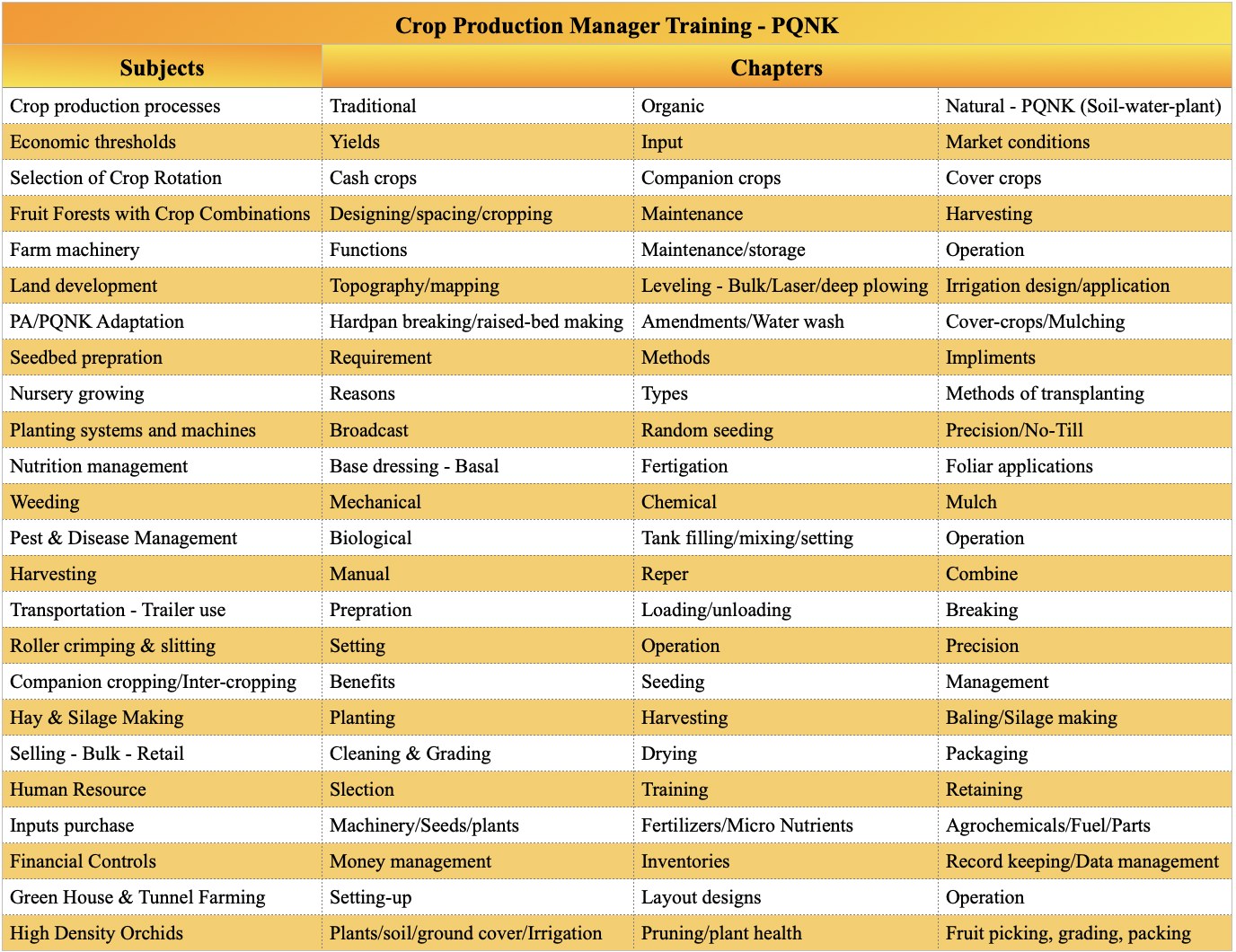
Required Competency (as per Farm Manager Training Outline): Must be a holistic decision-maker. This includes understanding PQNK (Paedar Qudratti Nizam Kashatqari) and other production systems, economic thresholds, integrated pest/nutrient management, financial controls, human resource management, and sophisticated land use planning (crop rotation, intercropping, greenhouse management). They are responsible for the entire cycle from soil testing to market selling.
B. The Machinery Operator: The "Hands" of the operation.
Current State: Often merely a driver, lacking technical knowledge of machine functions, fine adjustments, and maintenance. This results in poor field execution, high machinery wear-and-tear, and massive post-harvest losses, as vividly described in the case of combine harvester operation.
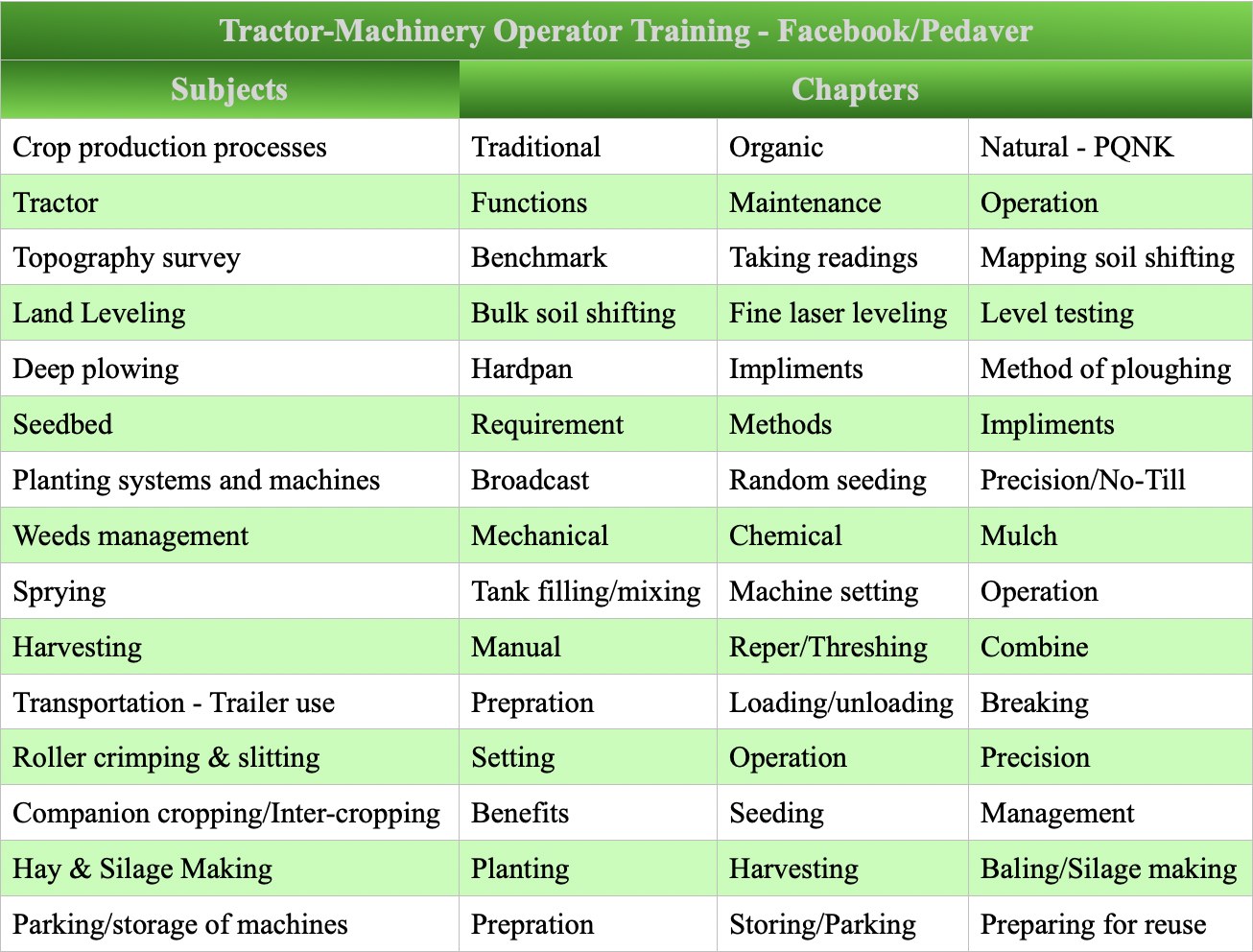
Required Competency (as per Machinery Operator Training Outline): Must be a precision technician. Skills range from topography survey and land development to the precise operation and calibration of complex machinery for planting, spraying, and harvesting to minimize losses.
3. The PQNK Lens: Integrating Sustainability into Operational Training
The Pristine Organic Farming System (PQNK) is not merely a set of practices but a philosophy of regenerative and sustainable agriculture. Training for both managers and operators must be filtered through this lens, emphasizing:
Soil as a Living System: Operations (especially deep plowing, leveling, seedbed prep) must prioritize soil health, structure, and microbiological life.
Precision and Minimization: The goal is to achieve desired outcomes (level fields, established crops, harvested grain) with minimum input waste, minimum soil disturbance, and minimum harvest loss. This requires skilled operators.
Systemic Harmony: Practices like companion cropping, roller crimping, and mulch-based weed management (outlined in both training slides) require deep understanding for effective implementation, moving beyond chemical-dependent monocultures.
4. Two Sectors of Farm Operational Work: A Clarification
Training must distinctly address two foundational work sectors, both critical for PQNK-aligned outcomes:
Farm Development Work: This is the infrastructure creation phase. It involves:
Topography Survey & Strategic Design: Planning based on land contours.
Scientific Land Leveling: The objective is to create optimally long fields for efficient machinery operation by shifting the minimum amount of soil. This reduces fuel use, preserves topsoil structure, and prevents erosion—a core PQNK principle.
Crop Production Work: This is the execution and harvesting phase. It demands precision at both ends of the cycle:
Precision Planting & Establishment: Using calibrated machines (seed drills, planters) for accurate seed placement, optimizing plant population and resource use.
Efficient Harvesting with Minimum Losses: As highlighted, this is where untrained operators cause catastrophic waste. Proper training in machine calibration (drum speed, sieve setting, fan speed) relative to crop condition is non-negotiable for economic and food security.
5. Consequences of Inaction
Continued High Post-Harvest Losses: Direct financial loss to farmers and national food security.
Failed Technology Adoption: Repeat of past failures (e.g., cotton harvesting mechanization) due to untrained personnel unable to adapt farm processes or operate new machinery.
Resource Degradation: Inefficient use of water, fuel, and agrochemicals, leading to higher costs and pollution.
Stagnated Competitiveness: Inability to adopt high-value, sustainable practices (like those in the training outlines) locks farmers into low-margin, commodity-based production.
6. Recommendations for Action
Policy Recognition: Formalize the roles of "Certified Farm Production Manager" and "Certified Agricultural Machinery Operator" within national agricultural policy and vocational frameworks.
Curriculum Standardization: Adopt and expand upon the comprehensive subjects outlined in the attached training slides, ensuring they are taught through the PQNK and sustainability lens.
Public-Private Training Initiatives: Establish dedicated, practical training centers. Mobilize resources from government extensions, agricultural banks, machinery importers/dealers, and private sector agri-services companies.
Linkage to Support Systems: Tie access to credit, subsidies, or certification schemes (e.g., for organic export) to the employment of trained personnel.
Continuous Learning: Establish mechanisms for continuous skill upgrades as new technologies and practices emerge.
7. Conclusion
The analogy from the attached conversation is precise: an army cannot win with untrained soldiers, no matter how brilliant the generals. Similarly, Pakistani agriculture cannot achieve its potential for sustainability, resilience, and high productivity without a professionally trained corps of Farm Production Managers (the strategists) and Machinery Operators (the frontline technicians). Investing in their systematic, science-based training is the most critical step towards realizing a prosperous and regenerative (PQNK) agricultural future.
Attachments:
Training Curriculum Outline for Farm Production Managers.
Training Curriculum Outline for Farm Machinery Operators.
| Subjects | Chapter 1 | Chapter 2 | Chapter 3 |
|---|---|---|---|
| Crop production processes | Traditional | Organic | Natural - PQNK (Soil-water-plant) |
| Economic thresholds | Yields | Input | Market conditions |
| Selection of Crop Rotation | Cash crops | Companion crops | Cover crops |
| Fruit Forests with Crop Combinations | Designing/spacing/cropping | Maintenance | Harvesting |
| Farm machinery | Functions | Maintenance/storage | Operation |
| Land development | Topography/mapping | Leveling - Bulk/Laser/deep plowing | Irrigation design/application |
| PA/PQNK Adaptation | Hardpan breaking/raised-bed making | Amendments/Water wash | Cover-crops/Mulching |
| Seedbed prepration | Requirement | Methods | Impliments |
| Nursery growing | Reasons | Types | Methods of transplanting |
| Planting systems and machines | Broadcast | Random seeding | Precision/No-Till |
| Nutrition management | Base dressing - Basal | Fertigation | Foliar applications |
| Weeding | Mechanical | Chemical | Mulch |
| Pest & Disease Management | Biological | Tank filling/mixing/setting | Operation |
| Harvesting | Manual | Reper | Combine |
| Transportation - Trailer use | Prepration | Loading/unloading | Breaking |
| Roller crimping & slitting | Setting | Operation | Precision |
| Companion cropping/Inter-cropping | Benefits | Seeding | Management |
| Hay & Silage Making | Planting | Harvesting | Baling/Silage making |
| Selling - Bulk - Retail | Cleaning & Grading | Drying | Packaging |
| Human Resource | Slection | Training | Retaining |
| Inputs purchase | Machinery/Seeds/plants | Fertilizers/Micro Nutrients | Agrochemicals/Fuel/Parts |
| Financial Controls | Money management | Inventories | Record keeping/Data management |
| Green House & Tunnel Farming | Setting-up | Layout designs | Operation |
| High Density Orchids | Plants/soil/ground cover/Irrigation | Pruning/plant health | Fruit picking, grading, packing |
Summary of Expert Conversation on Mechanization and Training Gaps.
Summary of Expert Conversation on Mechanization and Training Gaps
| Subjects | Chapter 1 | Chapter 2 | Chapter 3 |
|---|---|---|---|
| Crop production processes | Traditional | Organic | Natural - PQNK |
| Tractor | Functions | Maintenance | Operation |
| Topography survey | Benchmark | Taking readings | Mapping soil shifting |
| Land Leveling | Bulk soil shifting | Fine laser leveling | Level testing |
| Deep plowing | Hardpan | Impliments | Method of ploughing |
| Seedbed | Requirement | Methods | Impliments |
| Planting systems and machines | Broadcast | Random seeding | Precision/No-Till |
| Weeds management | Mechanical | Chemical | Mulch |
| Sprying | Tank filling/mixing | Machine setting | Operation |
| Harvesting | Manual | Reper/Threshing | Combine |
| Transportation - Trailer use | Prepration | Loading/unloading | Breaking |
| Roller crimping & slitting | Setting | Operation | Precision |
| Companion cropping/Inter-cropping | Benefits | Seeding | Management |
| Hay & Silage Making | Planting | Harvesting | Baling/Silage making |
| Parking/storage of machines | Prepration | Storing/Parking | Preparing for reuse |
Thank you for your message. Harvesting technology is still evolving. At present, on large acreages, cereal crops and oilseeds are harvested using combine harvesters. However, challenges remain. Internationally, cotton harvesting has been mechanized, but in Pakistan this has not yet been successfully adopted. An initiative was taken in 1988, but it failed because changes were required in the cotton production process itself. Row-to-row spacing needed to be increased, plant height had to be controlled (it should not exceed about four feet), and single picking had to be adopted. At that time, farmers were not ready to accept these changes. The time is now approaching when such harvesting technologies will have to be introduced.
Regarding fruits and orchards, harvesting is mechanized only in a few cases—for example, grapes and some other very dense crops. Otherwise, most fruits are still hand-picked. Some fruits are harvested by shaking the trees so that the fruit falls and is then collected.
Sugarcane harvesting, on the other hand, has been quite successful. It was introduced in 1987, and today many sugarcane harvesters are operating successfully, particularly in areas like Rahim Yar Khan.
As for vegetables, except for carrots and crops that mature all at once and are grown directly from seed—such as peas, radish, and potatoes—mechanized harvesting is limited. These crops are being harvested mechanically to some extent. However, vegetables that are harvested gradually, such as muskmelon, watermelon, all types of gourds, and many other vegetables, are still entirely hand-picked.
In Pakistan, combine harvesters were introduced around 1983 through institutions such as the Zarai Taraqiati Bank. At the initial stage, a significant number of operators were trained, but this training was not continued. Over time, skills were passed informally from one person to another. Today, many of those operating harvesters are essentially drivers, not trained operators. As a result, there are substantial grain losses.
Combine harvesters require very fine and precise adjustments. First, the crop moisture content must be at the correct level. Then the forward speed of the harvester, reel speed, drum speed (RPM), sieve settings to separate broken grain, weed seeds, and impurities, as well as fan speeds, all must be properly managed. Currently, grain losses of approximately 10–20% are occurring because operators are not properly trained.
The biggest problem we face is that unless we train two key categories of people, we cannot successfully move agriculture forward.
First, we need trained production managers who can manage production at the farm level. Such professionals are largely unavailable. The current system is mostly manual, outdated, and orthodox. Many are incentivized by input supply companies to apply fertilizers and other inputs forcefully, often without proper reasoning or actual need.
Second, we need well-trained tractor and farm machinery operators. The role of a tractor operator in agriculture is similar to that of a gunman in an army—he is the one who actually implements decisions in the field. If a gunman does not know how to handle or fire a weapon, what results can be expected? Similarly, if a tractor or machinery operator is not properly trained, the outcomes will be poor.
Proper training in these two areas is essential. I have been highlighting this issue to the government and at various forums for a long time, but unfortunately, no one seems willing to engage seriously with it.
—————————
Footnote: PQNK (pronounced 'picnic')—the regenerative & sustainable Pristine Organic Farming System—is grounded in Natural Ecosystem Science. This science employs perennial biodiversity, protects soil with organic mulch, and avoids practices like water inundation, tillage disturbance, and leaving soil bare.
www.Facebook.Com/Pedaver
https://www.youtube.com/@pedaverpqnk3167/videos
pedaver@gmail.com
WhatsApp +92 320 677 6666
About This Paper
- Crop
- Cotton
- Problem
- Post-Harvest Loss / Spoilage · Untrained Labor / Management · Macro / Policy-Level Externalities
- Science
- Production Architecture · Economics · Transition
- Evidence
- Economic Model/Projection
- Authority
- Current / Approved PQNK Knowledge
Related PQNK Science
Key Takeaways
- Identifies two chronically untrained operational cadres as agriculture's primary bottleneck: Farm Production Managers (the 'brain') and Machinery Operators (the 'hands').
- Cites documented grain losses of roughly 10-20% at harvest directly attributable to untrained combine harvester operators unable to correctly calibrate moisture thresholds, drum RPM, sieve settings, and fan speed.
- Notes Pakistan's cotton-harvest mechanization has stalled since a failed 1988 initiative, and that SIPP precision planter adoption faces similar operator-training obstacles today.
- Argues training curricula for both roles must be filtered through PQNK principles, emphasizing soil-health preservation and precision minimization of input, disturbance, and harvest loss.
- Separates farm operational work into two distinct training sectors: infrastructure creation (topography survey, scientific land leveling) and crop production work (precision planting, low-loss harvesting).
- Recommends formal national certification for 'Farm Production Manager' and 'Agricultural Machinery Operator' roles, with credit and export-certification access tied to employing trained personnel.
Related Crops
Related Knowledge
same problem
Beyond the Traditional Cooperative
Argues that smallholders need a third structure between the traditional cooperative and the corporation: individual land ownership and accountability combined with professional production management, machinery services, risk protection, processing and collective market power. Draws on cooperative, machinery-service, land-reform and price-reform experience in Yugoslavia, Pakistan, India and Scandinavia to propose the farmer-owned Crop Production Management Company (CPMC) as the institutional vehicle for PQNK.
same problem
Five Decades of Agricultural Innovation: Interventions and Achievements in Chronological Order, 1973–2023
Asif Sharif's own year-by-year record of fifty years of hands-on agricultural intervention in Pakistan, from early machinery and seed distribution through the 2008 development of PQNK and its crop-by-crop expansion since, presented as the primary evidentiary record behind PQNK: a ground-up, farmer-verified track record rather than a journal citation.
same problem
The Farm You Only Have to Build Once: How PQNK Converts a Conventional Field into a Permanent, No-Till System
Most fields across Pakistan and northern India's irrigated plains are still laid out for nineteenth-century bullock-and-plough flood irrigation. This paper walks through the one-time engineering project, topography survey, field redesign, hardpan fracture, laser levelling, and permanent bed shaping, that converts such a field into a permanent PQNK system, citing published water-savings and yield data specific to Pakistani Punjab.
same problem
Recalibrating Pakistan's Textile Value Chain: From Farm to Fabric and Beyond
Deconstructs the cotton-to-garment value chain stage by stage to argue that Pakistani policy misattributes value creation to industrial processing while sidelining the farm as the base of all value, and traces three historical cotton epochs, Deltapine-15, Bt cotton, and PQNK, to argue PQNK is the next necessary revolution.