

KP-215 · Crop-Specific Guides
Rapeseed, Frost and the Sowing Window
Rapeseed survives winter cold; the danger is frost on its flowers and young pods. For central Punjab, PQNK sows between 1 and 15 October with a suitable variety so that the crop flowers after the main frost period, tops the leader shoot at about 12 inches for a shorter, branchier crop, and sprays a 2% solution of food-grade ethanol when flowering meets frost. Mulched living soil keeps roots active through winter; irrigation is never increased to fight frost.
Read or listen to the full paper ↓Abstract
The central question is not whether rapeseed can survive winter. It is whether the crop will be flowering, setting pods or filling seed when damaging frost occurs. Rapeseed is naturally cold-tolerant in vegetative growth, but its flowers, pollen and young pods are vulnerable to freezing.
Sowing date, together with the variety, decides when the crop meets the frost. For central Punjab, including Faisalabad and Toba Tek Singh, PQNK sows between 1 and 15 October with a variety suited to the area, so that the crop flowers after the local period of damaging frost and still fills its seed before spring heat. Cooler northern and hotter southern districts adjust the variety and date.
PQNK adds a vigorous, deep-rooted crop on mulched, living soil that stays at about 10 to 20 °C in winter. Irrigation is never increased to fight frost. The leader shoot is chopped off when plants reach about 12 inches, breaking apical dominance for a shorter, sturdier crop with more flowering branches.
If flowering coincides with frost, a 2% solution of food-grade ethanol sprayed on the crop helps protect flowers and young pods for four to five days; when frost is forecast it is applied beforehand as a preventive measure.
Full Paper
If you use “Listen”, the text of the page may be sent to your browser or operating system’s speech provider, such as Apple, Google or Microsoft, depending on the voice your device uses. Pedaver does not process, transmit or store any audio.
The central question is not whether rapeseed can survive winter. It is whether the crop will be flowering, setting pods or filling seed when damaging frost occurs.
1. The Distinction That Matters
Rapeseed and canola are cool-season oilseed crops. Rapeseed is a naturally cold-tolerant crop: in vegetative growth, sugars and antifreeze proteins in its tissues protect it from ordinary winter cold. Reproductive tissues are more vulnerable. Freezing conditions during flowering may injure flowers and pollen, impair fertilisation and reduce pod set. During early pod development, frost can abort young pods or developing seeds. At later filling stages, sufficiently severe cold can reduce seed weight and oil yield. The extent of injury depends on minimum temperature, exposure duration, crop stage, cultivar and conditions before and after the event. A light frost does not necessarily cause a measurable yield loss.
2. Sowing Date Is the Tool for Frost Avoidance
The practical objective is to arrange the crop calendar so that the principal winter frost period coincides, as far as possible, with the more tolerant vegetative stage, while major flowering and early pod set occur after the local period of greatest frost risk. Sowing date works together with the variety: an early-flowering cultivar sown in early October may flower in December or January. A later-flowering cultivar may fit the desired window more closely, provided it can finish seed filling before damaging spring heat.
3. The PQNK Sowing Window for Punjab
For central Punjab, including Faisalabad and Toba Tek Singh, sow between 1 and 15 October, using a rapeseed or canola variety suited to the area. Northern, cooler districts may require a different variety and sowing date; southern districts must also account for rising late-season heat. The right date is the one that brings the selected variety into flower after the local period of damaging frost.
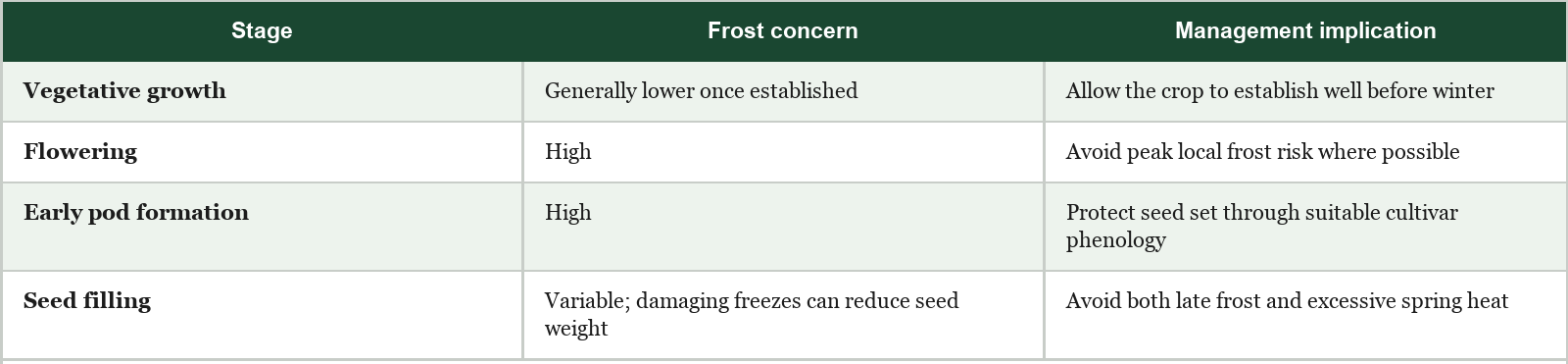
| Stage | Frost concern | Management implication |
|---|---|---|
| Vegetative growth | Generally lower once established | Allow the crop to establish well before winter |
| Flowering | High | Avoid peak local frost risk where possible |
| Early pod formation | High | Protect seed set through suitable cultivar phenology |
| Seed filling | Variable; damaging freezes can reduce seed weight | Avoid both late frost and excessive spring heat |
4. A Working Crop Calendar, Not a Fixed Biological Timetable
In a suitable central Punjab variety, October sowing may place establishment and vegetative development in autumn and winter, with main flowering and early pod formation targeted for the period when severe frost becomes less likely. Seed filling and maturity then follow according to the cultivar’s actual duration. Some short-duration canola cultivars mature too early for a March–April harvest; they cannot be assigned the same flowering calendar as longer-duration rapeseed.
5. What PQNK Adds
PQNK provides a more favourable root-zone environment through permanent organic cover, no soil disturbance, correction of the hardpan where present, Soil Moisture Management and biological diversity. Deep rooting and steady access to water and nutrients give a vigorous crop that recovers quickly from weather stress. The mulch moderates soil temperature: in winter the protected root zone stays at about 10 to 20 °C while air temperatures swing much more widely, so roots and soil life stay active. Flowers and pods, however, stand above the mulch in the open air, and a damaging frost at flowering can still injure them. That is why sowing time matters even on a PQNK field. Irrigation is never increased to fight a frost: added water cannot protect leaves and flowers from cold air and only displaces air from the soil (KP-155).
Accordingly, frost avoidance through cultivar choice and sowing time complements PQNK rather than replacing its four governing principles: no soil disturbance, no inundation, permanent biological cover and maximum biodiversity.
6. Topping the Leader Shoot
To manage crop height and bring out more branches, chop off the leader shoot when the plants reach about 12 inches in height. Removing the leader breaks its apical dominance: the plant stays shorter and sturdier and puts out additional side branches, each of which carries its own flowers and pods.
7. If Flowering Meets Frost
If the crop comes into flower while frost is still likely, spray it with a 2% solution of food-grade ethanol. The spray helps protect the flowers and young pods for four to five days. When frost is forecast, apply it beforehand as a preventive measure, and repeat while the frost risk lasts.
8. A Field-Based Decision Rule
First, identify the district’s usual last damaging frost period using local weather records, recognising that individual years vary. Second, obtain the cultivar’s expected days from sowing to first flowering, peak flowering, pod set and maturity under local conditions. Third, work backward from the desired flowering window to select the sowing date. Finally, check that seed filling will not be pushed into damaging late-season heat.
Conclusion
The best frost strategy is to keep rapeseed in its comparatively tolerant growth stages during the main winter frost period and shift sensitive reproduction toward safer weather, without sacrificing seed filling to spring heat. For central Punjab, sowing between 1 and 15 October with a suitable variety is the PQNK sowing window. PQNK improves the conditions in which the crop grows; phenological timing reduces the chance that exposed reproductive tissues encounter damaging frost.
PQNK Principle: Protect the soil biologically. Protect flowering and pod formation by matching the variety and sowing date to the local climate.
Related PQNK Sources
1. PQNK Knowledge Paper KP-155: PQNK Advisory Note: Frost, Cold Weather & Irrigation Management. https://pedaver.com/papers/pqnk-advisory-frost-cold-weather-irrigation/
2. PQNK Knowledge Paper KP-156: Temperature-Induced Vascular Failure in Plants. https://pedaver.com/papers/cold-and-heat-induced-vascular-stress-in-plants/
3. PQNK Book, Chapter 26: Soil Moisture Management. https://pedaver.com/books/natural-ecosystem-science/soil-moisture-management/
About This Paper
- Crop
- Rapeseed
- Problem
- Cold / Frost Damage · Poor Flowering / Fruit Set · Lodging / Weak Stem Structure
- Science
- Climate · Plants
- Evidence
- Field Observation
- Authority
- Current / Approved PQNK Knowledge
Related PQNK Science
Key Takeaways
- Rapeseed survives ordinary winter cold; frost damages its flowers, pollen and young pods.
- Central Punjab: sow between 1 and 15 October with a suitable variety so that flowering follows the main frost period.
- Chop off the leader shoot at about 12 inches to keep the crop shorter and bring out more flowering branches.
- If flowering meets frost, spray a 2% solution of food-grade ethanol; it protects for four to five days, and is applied ahead of forecast frost.
- Never increase irrigation to fight frost; mulched, living soil keeps the root zone at about 10 to 20 °C in winter.
Related Knowledge
same problem
PQNK Advisory Note: Frost, Cold Weather & Irrigation Management
Directly answers a farmer's question about whether irrigation should be increased during frost and cold spells, explaining why added water cannot protect plants from cold stress and can actively harm soil biology, with a supplementary protocol for mild-weather transitional-season crops.
same problem
Banana Cultivation on PQNK (PICNIC)
Documenting a tissue-culture banana plantation in the frost-prone, heat-extreme foothills of Nainital, this paper argues that banana is not climate-limited but soil-limited, and that a permanent grass and mulch cover, not soil cleanliness, is what lets it survive both winter frost and summer heat without chemical inputs.
same problem
Watermelon Cultivation Under the Paedar Qudratti Nizam Kashatqari (PQNK): A Guideline Based on Practical Field Observations
PQNK watermelon takes 90-100 days to mature instead of 70 under chemical systems, not a delay but evidence of the plant building a real root-microbiome partnership first. This guideline works through frost protection, vine training, tip-cutting after fruit set, shade-based shrinkage prevention, and a cold-water field-heat removal protocol that holds fruit quality for 10-14 days.
same problem
PQNK Advisory Paper: Tomato (Solanum lycopersicum)
Tomato is naturally perennial in its tropical highland origin, and this advisory shows how PQNK's stable microclimate, mulch, living companion canopy, and a low-dose ethanol spray, can restore that perennial behavior in open-field cultivation, alongside a full sucker-pruning and harvest protocol.